
Industrial Pipe Insulation Types: A Practical Guide
Pipe insulation comes down to temperature, medium, and form. Here is the material map by service range, plus the common forms and a quick selection rule.
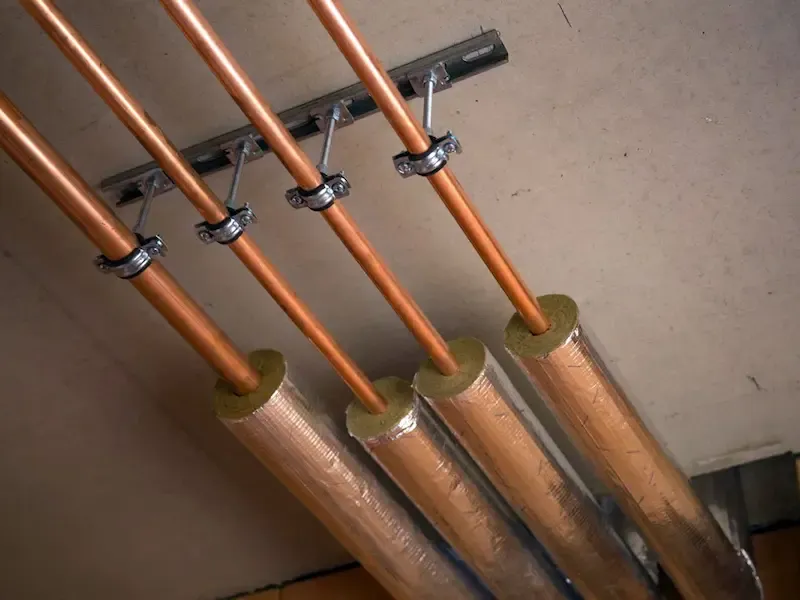
Three Variables Decide the Type
Pipe insulation types are usually listed by material first. That ordering is why so many specifications end up with the right material in the wrong form.
Picking pipe insulation comes down to three things: temperature, medium, and form. Get those right and the material almost selects itself.
That is true, but it is not the whole job — and the missing part is where most specifications go wrong. Temperature narrows the material. Pipe diameter then decides whether that material can be supplied in the form you assumed, and maintenance access decides whether the form you chose survives its first shutdown. A header that will never be opened again and a valve that gets stripped twice a year do not want the same construction, even at the same temperature.
Temperature sets the material family, and it is the one variable nobody forgets. The other two are the ones that get missed.
Diameter sets the form. Preformed pipe sections are produced against fixed tooling in standard bores; outside that range the realistic options are wrapped blanket, cut board, or a made-to-order shell, and both price and lead time move once you leave the standard range.
Access sets the construction at fittings. Anything that will be opened is a different engineering problem from anything that will not, and it should be specified separately rather than left to site practice.
This guide works through all three variables, then covers the four decisions that remain once the material is settled: preformed sections or wrapped blanket, single layer or double, what to do at fittings, and when a removable cover pays for itself.
Selecting by Service: Temperature and Medium
Material selection for pipe insulation starts with temperature, because it eliminates most of the field immediately.
| Band | Range | First choice | Usual form | Note |
|---|---|---|---|---|
| Cryogenic | −200 °C to −50 °C | Cellular glass, aerogel, multilayer | Preformed section with a sealed vapour barrier | Outer surface must stay above dew point |
| Low | −50 °C to +250 °C | Glass wool | Pipe section or blanket | Chilled water, HVAC, condensate return |
| Medium | +250 °C to +650 °C | Rock wool | Pipe section | Steam, thermal oil, most process lines |
| High | +650 °C to +1000 °C | Calcium silicate | Preformed section or board | Rigid; needs expansion allowance |
| Ultra-high | +1000 °C to +1400 °C | Ceramic fiber | Wrapped blanket or vacuum-formed shape | Furnace, reformer and kiln services |
In practice rock wool pipe insulation covers the largest share of industrial metreage, because most process lines sit in the medium band. Two rules override the table. First, specify against the peak, not the normal operating point — a 600 °C line that sees 800 °C upsets belongs in the ceramic fiber row, not the rock wool row. Second, thermal cycling matters as much as absolute temperature: a line that swings several hundred degrees twice a day will fatigue a rigid system long before it reaches its temperature limit, and a wrapped blanket tolerates that movement better.
The medium sets the failure mode more than the material does. Steam drives water through any gap in the barrier, and wet insulation has lost most of its value. Thermal oil wicks and, above roughly 250 °C, begins to burn the organic binder out of a wool product — which is one reason the medium band starts where it does. Cryogenic service almost never fails inside the insulation; it fails at the vapour barrier, and it fails at the supports and valve bodies first.
The Four Construction Types at a Glance
Four constructions carry nearly all industrial pipe insulation, and they are not interchangeable. Pipe insulation types are easier to shortlist once diameter and access are settled, which is what this section is about.
| Construction | Built from | Where it wins | Where it loses |
|---|---|---|---|
| Preformed pipe section | Rigid or semi-rigid, split into two half shells | Straight runs on standard bore; fastest install, uniform density | Non-standard outside diameter, very large bore, short runs where tooling cost dominates |
| Wrapped blanket or roll | Flexible, wired or banded on | Large bore, irregular geometry, field-fitted work | Exposed weather without a jacket; low compressive strength |
| Board or slab | Rigid | Flat equipment, vessels, large-diameter duct | Anything curved below roughly 600 mm diameter |
| Removable cover | Textile-encased mattress, strapped or laced | Valves, flanges, instruments — anything opened on a schedule | Permanent straight runs: costs more per metre and insulates slightly worse |
Choosing between pipe insulation types is mostly a diameter and access question rather than a thermal one, which is why the next three sections matter more than the table above. For the full material comparison behind these four, including the jointing and weatherproofing detail, see our industrial pipe insulation materials guide. For a system-level view of how the same materials are specified across a plant, see our pipe insulation applications guide.
Preformed Pipe Sections: The Default for Standard Bore
Preformed pipe sections are the default pipe insulation on standard bore, and for good reason.
A preformed pipe section is a half shell moulded to a specific inside diameter and wall thickness, supplied in pairs, banded over the pipe, and finished with the jacket. Where the bore is standard, it is the best answer available: the density is uniform, the inner face sits tight against the pipe with no compression loss, and installation is quick because there is nothing to cut or size on site.
That tight fit is the whole argument for preformed pipe insulation. Heat loss through a pipe insulation system is governed by the insulation only when the fit is right; a gap at the inner face sets up a convection loop that bypasses the material altogether. Sections also hold their thickness under banding, which a compressible blanket does not.
The catch is that sections are produced against tooling — one mould per combination of nominal bore and wall thickness. That is simultaneously their advantage and their limit.
Where Preformed Sections Stop: Diameter, Tooling and Non-Standard Sizes
Three situations push a pipe insulation specification off preformed pipe sections, and none of them have anything to do with temperature.
Very large bore. Above roughly DN 600 to DN 900, depending on the mill, half shells get heavy and fragile to handle, and the tooling cost per metre is hard to justify for a single run. Most large-diameter specifications switch to wired blanket, or to board segments cut and banded on site.
Non-standard outside diameter. Older pipe schedules, non-metric sizes, thick-walled process pipe, and jacketed or traced lines all have outside diameters that fall between standard tooling sets. A section whose inside diameter is larger than the pipe leaves a circumferential gap, and the convection loop is back — on hot service that shows up as a hot jacket, and on cold service as sweating and corrosion under insulation.
Short runs and one-off sizes. If a project needs twelve metres of one size, the tooling charge may cost more than the insulation.
The working rule is simple: a circumferential fit gap of up to about 5 mm is acceptable; anything larger should not be packed with offcuts. Change the form instead and wrap with blanket, which conforms to whatever diameter is actually there. And confirm the mill can produce the inside diameter and wall thickness you need rather than assuming the standard range covers it.
Wrapped Blanket and Roll for Large Bore and Irregular Geometry
Blanket is often treated as the fallback when it is the better pipe insulation answer from the start. It conforms to any diameter, cuts with a knife, needs no tooling, and absorbs thermal movement that would crack a stiff shell — which makes it the default for large bore, elbows, tees and anything field-fitted.
Two things have to be specified or the installed result will not match the calculation. First, state the thickness at a stated compression. Blanket is compressible; an enquiry that only says "50 mm" will be supplied at nominal thickness and installed at something less, and the heat loss will run higher than designed. Second, blanket has almost no compressive strength and no weather resistance of its own — it needs banding at regular centres and a metal or polymeric jacket outdoors, with sealed laps.
Where the duty is hot and the geometry is awkward, ceramic fiber blanket covers the ultra-high band and rock wool blanket covers the medium band in exactly this form.
Single Layer or Double Layer
Pipe insulation thicker than about 75 mm is almost always built in two layers. Thickness is set by the heat-loss or surface-temperature limit, and the number of layers follows from the thickness.
- Up to about 50 mm — a single layer is normal and cheaper.
- 50–75 mm — either works; single layer if the mill stocks that thickness, two if not.
- Above about 75 mm, or any service above roughly 400 °C — specify a double layer.
There are three reasons to go double even when a single thick section exists. Joints get staggered, so no joint runs straight through the insulation to the pipe wall. A double layer also lets the two layers be different materials, which is the economic argument: put the expensive high-temperature material on the hot face at reduced thickness, and a cheaper, lower-conductivity material outside it where the temperature is already lower. And thick rigid shells in one layer crack more readily under thermal movement.
The field rule for multi-layer pipe insulation that actually matters: stagger longitudinal joints by at least 200 mm between layers, and stagger the circumferential joints as well. A straight-through joint is a heat-loss path on hot service and a condensation path on cold service.
Worth saying explicitly: adding layers is not adding thickness for its own sake. The thickness should come out of an economic-thickness calculation — the point where the marginal cost of another millimetre exceeds the value of the heat it saves over the life of the line. Layer count is then simply the practical way of delivering that thickness.
Fittings, Valves and Flanges
Fittings are where pipe insulation most often stops, and where the heat loss concentrates. An uninsulated valve body loses several times more heat than an equivalent length of bare pipe, simply because of its surface area and its mass of metal, and it stays hot enough to be a contact hazard.
- Elbows take either mitred blanket cuts or preformed elbow shells. Mitring is faster on site and cheaper on short runs; shells hold their thickness at the outside of the bend and look better on visible lines.
- Tees and reducers are usually built up from blanket and banded, or boxed out with board and jacketed.
- Valves and flanges have to stay accessible. Either fit a removable cover, or box the item in a sealed, banded enclosure that is understood to be cut away and replaced at each opening.
- Supports, shoes and hangers are the classic thermal bridge. Insulation should be interrupted at the support rather than compressed through it, and cold service needs a load-bearing insert that carries the load without carrying the heat.
The failure pattern is consistent enough to be worth designing against: the straight run is well insulated and the fittings are not. Walk any plant and the bare spots are elbows, valve bodies and support shoes.
Two practical notes. Mitred blanket work is the usual source of thin spots, because an offcut that is slightly short still looks acceptable once the jacket is on — specify the finished thickness at the outside of the bend, not only on the straight. And on cold service, every penetration of the vapour barrier at a support or an instrument connection has to be sealed as carefully as the barrier itself, because that is where the water gets in.
Removable Insulation Covers as a Designed System
Removable pipe insulation exists for one reason: some points have to be opened again. A removable cover is not a bag tied around a valve. It is a small engineered assembly with four parts, and all four belong in the specification:
- Inner liner — a textile rated above the service temperature, because it sits against the hot face.
- Insulation mattress — sized and quilted so it holds its thickness instead of slumping to the bottom of the jacket after two heat cycles.
- Outer textile — rated for weather, ultraviolet exposure and any chemical contact on site.
- Closure — lacing hooks, straps or buckles rated for the number of removal cycles expected, not merely for the first fit.
Four more items separate a cover that stays in service from one that is left off after the first shutdown: handling weight per piece (keep it under about 15 kg so one person can manage it), labelling so each part returns to the same location, drainage on outdoor vertical runs, and spares — order roughly one spare per ten covers.
The economics of removable pipe insulation are straightforward. Where a valve or strainer is opened twice a year, the labour saved stripping and rebuilding a fixed box pays for the cover within the first or second outage. The same logic is why covers are increasingly supplied with an inspection port or an embedded temperature sensor, turning an insulation check into something that can be done without a shutdown.
Rock Wool Pipe Section: Spec Ranges by Temperature
Rock wool pipe insulation carries the medium band, and these are the ranges a rock wool pipe section specification normally works within. Rock wool pipe also has a practical advantage on site: it is A1 non-combustible and naturally water-repellent, so it tolerates a wet trade sequence better than most alternatives.
| Parameter | Typical range | Why it matters |
|---|---|---|
| Density | 80–180 kg/m³, most often 100–150 | Higher density for load, vibration and ovalisation resistance |
| Wall thickness | 25–200 mm, standard stock 30–100 mm | Built up in layers above about 75 mm |
| Inside diameter | 18–1500 mm | Non-standard sizes are made, but lead time follows |
| Continuous service | to about 650 °C | Above that, move to calcium silicate or ceramic fiber |
| Fibre diameter | 4–6 µm | Finer fibre gives lower conductivity and more dust |
| Shot content | ≤ 12 %, premium grades ≤ 7 % | Non-fibrous particle; affects handling and conductivity |
| Hydrophobicity | ≥ 95 %, ≥ 98 % for hot-humid service | Water repellency retained after exposure |
| Chloride content | < 0.05 % | Required over austenitic stainless steel |
Density is the lever most pipe insulation specifications under-use. Specifying the right density and compressive grade costs almost nothing, and it prevents the most common field failure on large-diameter lines: sections ovalising under their own weight between supports.
For how these numbers are produced — melt temperature, fibre formation, binder dosing and curing — see rock wool pipe insulation: specs, production and selection. Product ranges: rock wool pipe insulation for the medium band, calcium silicate pipe above it, and glass wool blanket for chilled and HVAC duty.
What to Put on a Pipe Insulation Enquiry
Most pipe insulation quotes are inaccurate for the same reason. Most of them come from an enquiry that specified the material and nothing else. These fields close the gap:
- Actual outside diameter and nominal bore — not the DN alone
- Operating temperature, peak temperature, and the cycling profile
- Medium, plus whether the line runs indoors, outdoors or buried
- Required thickness, or the heat-loss / surface-temperature limit to design against
- Jacketing material and finish
- Fittings schedule — count of elbows, tees, valves and flanges, not just total metres
- Access points — what has to be opened, and how often
- Vapour barrier requirement on any chilled or cryogenic service
- Quantity per size, broken out rather than given as one total
Every one of these fields changes which pipe insulation types can actually be quoted. The last two are the ones most often missing, and they are the two that move the price the most.
For a full-site view spanning distillation, cracking, storage and heat-traced services, see our petrochemical plant insulation guide. And once the unit duty is known, the construction-level choices behind it are covered in our unit-by-unit refinery and reformer insulation guide companion.
Related Reading
- Is glass wool fireproof? A1 non-combustible rating explained
- Power plant insulation: materials & thickness by system
- Rock wool for marine & offshore engineering: applications & benefits
- Best heat-resistant materials for furnace (2026 guide)
- Marine fire insulation: materials & standards (SOLAS)
- Rock wool slabs for building, industrial & HVAC insulation
- Industrial pipe insulation materials: the full comparison
- Cryogenic pipe insulation: vapour barriers and cold service detail
- Aerogel vs mineral wool for pipe insulation
Explore flexible aerogel and microporous insulation options in our aerogel insulation guide.
Frequently asked
What are the types of industrial pipe insulation? +
By material: glass wool, rock wool, calcium silicate, ceramic fiber, and dedicated cryogenic systems. By construction: preformed pipe sections, wrapped blanket or roll, board or slab, and removable covers. Which construction applies depends less on temperature than on pipe diameter and on how often the line has to be opened.
What insulation for 600 °C steam pipes? +
Rock wool (continuous to about 650 °C) or, for margin and rigidity, calcium silicate or ceramic fiber above that.
Glass wool or rock wool for pipes? +
Both are A1 non-combustible. Rock wool holds the medium band to about 650 °C and is naturally water-repellent, which is why it dominates steam and thermal-oil lines. Glass wool is lighter and cheaper for the low band to roughly 250 °C — chilled water, HVAC and condensate return — with high-temperature grades running above that.
What insulation for cryogenic pipes? +
Dedicated low-temperature systems — cellular glass, aerogel, multilayer constructions — covering roughly −200 °C to −50 °C, always with a sealed vapour barrier. Not the high-temperature wools. The cold end fails at the barrier, the supports and the valve bodies long before it fails in the insulation itself.
Is rock wool the most common industrial pipe insulation? +
Yes, for most industrial lines. Rock wool pipe sections are A1 non-combustible, rated to about 650–700 °C, naturally water-repellent, and the lowest-cost option in their temperature band — which is why they dominate steam, thermal-oil, and process lines. Ceramic fiber takes over above ~650 °C, and calcium silicate where rigid load-bearing insulation is needed.
When should I use blanket instead of preformed pipe sections? +
Use preformed sections on standard-bore straight runs — they install faster and hold their thickness. Switch to blanket above roughly DN 600, on any non-standard outside diameter where the fit gap would exceed about 5 mm, and on short runs where tooling cost dominates the price. Blanket also handles thermal cycling better, because the fibre mat absorbs movement that cracks a rigid shell.
How should valves and flanges be insulated? +
Either with a removable cover or with a sealed, banded box intended to be cut away at each opening. A removable cover pays back wherever the item is opened more than once a year. Specify the liner temperature rating, a quilted mattress that will not slump, an outer textile rated for weather and ultraviolet exposure, a closure rated for the number of removal cycles, and handling weight under about 15 kg per piece.
Request a quote
Interested in our insulation solutions? Send us your requirements and our team responds within one business day.