
Petrochemical Plant Insulation: Materials, Selection and Standards by Process Unit
A unit-by-unit guide to petrochemical plant insulation — distillation, cracking, storage and heat-traced lines — with the temperature bands and corrosion regimes that decide material selection.
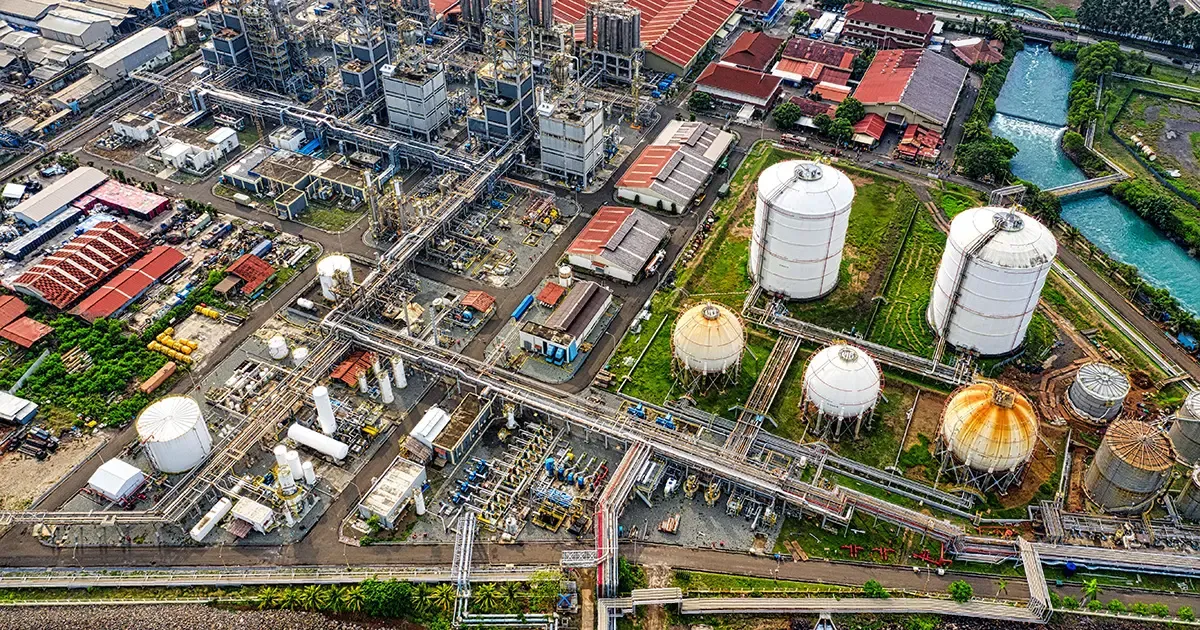
Insulating a refinery or petrochemical complex is not one specification repeated across the site, and refinery insulation rarely transfers from one unit to the next. A crude distillation column, an ethylene cracking furnace, a process reactor, an LNG storage tank and a heat-traced instrument line impose almost nothing in common beyond a fire rating, and the material that is correct on one of them is frequently wrong on the next.
This guide is written for engineers and buyers who have to specify petrochemical plant insulation across all four. It works unit by unit, gives the temperature band and the corrosion regime that actually governs each one, and ends with the thickness and structure rules that current standards require. For the material landscape as a whole, see our top 10 high-temperature insulation materials guide.
What Petrochemical Plant Insulation Has to Do
Four requirements separate petrochemical insulation from general industrial work.
Fire performance is not negotiable. Hydrocarbon service means the insulation on hot lines and vessels is expected to be non-combustible. A1 or A-grade material is the default across virtually every high-temperature and flammable-media application on site, and combustible organic foam is confined to cold service where its low conductivity is worth the fire-engineering cost.
Corrosion under insulation (CUI) is usually the dominant lifecycle risk. Water that reaches a warm steel surface under a jacket stays there. The result is a failure mode that is invisible until the insulation is stripped. Material selection, vapour retarders and jacketing detail matter more here than a few points of conductivity.
Temperature range is extreme and discontinuous. One site spans about -165 °C on cryogenic storage to 1 300 °C in a cracking furnace radiant section, with almost nothing in between on many units. No single material covers that span.
Access is expensive. Scaffolding, stripping and reinstatement routinely cost several times the material. That is what makes service life and inspectability a first-order economic input rather than an afterthought.
The Four Material Families at a Glance
Petrochemical specifications draw on four families. The table below gives the working ranges used across the industry.
| Family | Service range | Fire class | Conductivity | Where it is used |
|---|---|---|---|---|
| Rock wool | -200 to 650 °C | A1 / A | 0.032–0.060 W/(m·K) | Hot pipework, vessels, columns, general refinery duty |
| Ceramic fibre (aluminium silicate) | -200 to 1 400 °C | A1 / A | 0.030–0.035 W/(m·K) | Cracking furnaces, reformers, reactors, high-temperature piping |
| Glass wool | -120 to 400 °C | A1 / A | 0.032–0.040 W/(m·K) | Low-temperature lines, acoustic and HVAC duty |
| Calcium silicate | -200 to 650 °C | A1 / A | 0.040–0.050 W/(m·K) | Load-bearing hot equipment, pipe supports, fire-rated panels |
| Aerogel composite | -200 to 650 °C | A | 0.015–0.025 W/(m·K) | Space-constrained hot lines, valves, flanges, irregular geometry |
| Foam glass | -196 to 100 °C | A1 | 0.040–0.060 W/(m·K) | Cryogenic storage, buried and fully immersed service |
| Closed-cell elastomeric | -40 to 105 °C | B1 | 0.032–0.040 W/(m·K) | Cold and chilled water, low-temperature traced lines |
The inorganic families — rock wool, ceramic fibre, glass wool and calcium silicate — carry the bulk of petrochemical plant insulation because they are non-combustible, chemically stable against process fluids and dimensionally stable through thermal cycling. Organic foams and elastomerics appear where they must: low-temperature and cold service. Aerogel composite has moved from a specialist item to a routine choice where clearance is the binding constraint.
For a material-by-material walkthrough of the family that carries most refinery hot pipework, see our rock wool for petrochemical and refining insulation guide.
Distillation Units: 150 to 420 °C with Two Corrosion Regimes
A crude or vacuum column is the clearest example of one piece of equipment needing two insulation approaches.
Temperature distribution. Atmospheric distillation runs roughly 150–200 °C at the column overhead and 360–370 °C at the column bottom. Vacuum distillation, operated under reduced pressure specifically to suppress thermal cracking of heavy fractions, runs about 300–420 °C.
Two distinct corrosion mechanisms. The overhead condensing system carries an HCl–H₂S–H₂O environment with a condensate pH that can reach 1.0–1.3 — strongly acidic, and aggressive to both carbon steel and austenitic stainless. The column bottom carries a completely different problem: sulphidic corrosion when running high-sulphur crudes and naphthenic acid corrosion when running high-acid crudes. Naphthenic acid attack does not begin below about 220 °C, peaks at roughly 270–280 °C, and effectively ceases above 400 °C.
What that means for insulation. The overhead circuit is where CUI starts, because it is cool enough to condense water and acidic enough to attack steel quickly. Insulation here has to be paired with a vapour retarder and a coating system specified for wet service, not simply chosen on conductivity. The bottom circuit is hot enough that water does not persist, so the driver becomes thermal performance and mechanical stability at 360–420 °C.
Material selection. Glass wool and composite silicate suit overhead duty in the 150–200 °C band. Rock wool, ceramic fibre and calcium silicate carry the 360–420 °C bottom circuit. Phase-change zones — the initial condensation region where the vapour first liquefies — are the most aggressive locations on the column and deserve the most attention in both coating and insulation detail.
Typical economic thickness runs 30–100 mm on the low-temperature circuit and 50–150 mm on the hot circuit. Both are calculated, not assumed, and both need a dew-point check on the cold side.
Cracking and Reformer Furnaces: 600 to 1 300 °C and Thermal Shock
Ethylene cracking and catalytic reforming are the two most demanding furnace insulation duties on a typical petrochemical site.
Temperature distribution. Cracking furnace radiant sections operate at 600–1 300 °C, and decoking pushes tube metal to around 1 400 °C. Ultra-high-pressure steam lines leaving the transfer line exchanger are designed for roughly 520 °C at about 11 MPa.
Thermal shock is the governing problem in furnace and reactor insulation. The cracking and decoking cycle swings tube temperature substantially and quickly — shutdown can drop tube temperature by 50–80 °C per hour. That cycling produces thermal fatigue in both the refractory and the tube supports, and it is the reason thermal shock resistance, not just temperature rating, selects the material for furnace insulation.
Coke deposition creates a second mechanical problem. Coke and the underlying alloy expand at different rates, generating stress at the interface and spalling refractory if the lining is not designed for it.
Material selection. Ceramic fibre — aluminium silicate — is the standard answer in the 1 000–1 400 °C band: low thermal mass, good thermal stability and low linear shrinkage, which is what makes it survive cycling. Alumina fibre extends to 1 600–2 000 °C for genuinely extreme positions. On the ultra-high-pressure steam lines at 520 °C and 11 MPa, rock wool, ceramic fibre and aerogel composite all appear; aerogel is chosen where clearance or weight is constrained, and the others where first cost governs.
Thickness on furnace walls usually lands at 80–120 mm by heat-loss calculation, more in the hottest zones. On steam piping above 80 mm, the standards require the insulation to be built up in layers rather than as a single thickness — a rule that exists because a single thick layer compacts and slumps. What each unit actually demands of those numbers is set out in our unit-by-unit guide to refinery and reformer insulation, from CDU columns to SRU dew points.
For the pipe-side detail, including pre-formed sections and density selection, see our rock wool pipe insulation specification and selection guide.
Storage Tanks: LNG Cryogenic Through Ambient Crude
Storage spans the widest temperature range of any unit on site, and the two ends need completely different systems.
LNG and cryogenic storage, about -165 °C. The insulation has to hold boil-off to a very low rate — published operating data for large cryogenic tanks puts this in the region of 0.025 % per day — and it has to do so while the tank shell contracts. Two properties govern: the material must not shrink more than about 0.5 % at service temperature, and its bond strength to the substrate must stay above roughly 0.05 MPa. Foam glass, nanoporous aerogel composite and high-density polyisocyanurate are the standard answers. Cold-insulation thickness typically lands at 150–200 mm, and the outer surface must be held at or above ambient dew point — usually taken as dew point plus 1–3 °C — or the system will sweat, ice and fail.
Crude and product tanks, ambient to moderate temperature. Here the governing requirement is fire performance, not thermal: A-grade non-combustible material, compatible with the tank's explosion-protection and earthing design. Rock wool, glass wool and composite silicate all serve. Thickness responds mostly to climate — roughly 70–100 mm in cold regions and 50–70 mm in temperate ones.
Vapour control is common to both. Water absorption is normally held to 1.0 % or below, and the oxygen index of any organic component is normally specified at 30 or above. Where the tank shell is austenitic stainless, the insulation and any cement or mastic touching it have to meet the chloride, fluoride, silicate and sodium limits set out for austenitic stainless surfaces.
For cryogenic pipework connecting into tankage, see our cryogenic pipe insulation guide.
Heat-Trace and Traced Lines: -40 to +400 °C
Traced lines are where most of the insulation volume on a site actually sits, and where the specification is most often generic.
Temperature split. Low-temperature trace runs about -40 to 105 °C on instrument air, cooling water and similar services. High-temperature trace extends to roughly 400 °C where the line has to maintain process temperature.
Three requirements dominate. Flexibility, because traced lines move, vibrate and are repeatedly stripped for maintenance. Water resistance, because cold traced lines condense and a wet insulation system is a CUI site as much as a hot one. And conformability, because the difficult parts of a traced system are not the straight runs — they are valves, elbows and flanges.
Material selection. Closed-cell elastomeric insulation is the low-temperature default: it stays flexible at -40 °C with elastic recovery above 90 %, and its closed-cell structure is inherently water-resistant. Above about 100 °C, ceramic fibre and composite silicate take over. On irregular components — valve bodies, flanges, orifice plates — aerogel-based coating or ceramic fibre needled blanket is the practical answer, because a brushed or sprayed coating covers a flange with no joints and no leak paths, while a blanket can be cut and pinned to shape.
Thickness is usually 30–100 mm by heat-loss calculation on low-temperature trace and 80–120 mm on hot trace, with the trace power and the ambient design condition both entering the calculation.
Getting the Thickness and the Structure Right
Three standards shape the calculation, and recent revisions have materially tightened what is acceptable.
Thickness is calculated, not tabulated. Three methods are in normal use. The economic thickness method balances the cost of heat loss against the cost of insulation and is the usual basis for hot service. The surface temperature method is used where the constraint is personnel protection or condensation control. The heat balance method is used where the requirement is to delay freezing or to hold a defined rate of temperature drop.
The limits have tightened. The 2024 revision of the general national standard for equipment and pipe insulation cut allowable heat loss by roughly 30 % across the range — at a 150 °C surface under continuous operation, the allowable figure fell from about 104 W/m² to about 71 W/m². The petrochemical design code aligns with this. In practice, thicknesses that were compliant five years ago now need to be recalculated, and many do not pass.
Surface temperature limits are explicit. For personnel protection the outer surface is normally held at 60 °C or below. For cold insulation the outer surface is held at or above ambient dew point plus 1–3 °C.
Structure has its own rules. Insulation above 80 mm is built in layers, and where two different materials are layered, the interface temperature between them has to sit within about 0.9 of the outer layer's service limit — otherwise the inner layer cooks the outer one. A hot system is insulation plus weather jacket; a cold system is insulation plus vapour retarder plus jacket, and the retarder is not optional. On austenitic stainless surfaces, ion limits apply to everything in contact with the steel. Jacket design life should match or exceed the insulation service life, because a jacket that fails early destroys the system behind it.
CUI has its own qualification standard. Insulation systems for service in the CUI temperature band — roughly -200 °C to 204 °C — are qualified against a dedicated international standard for corrosion under insulation, and coating systems are qualified by test rather than by description. Asking for that test report is the single most useful question in a petrochemical insulation enquiry.
For glossary terms used across these material families, see our insulation glossary.
Specification Checklist for a Petrochemical Enquiry
Eight items will get you a firm answer rather than a range:
- Continuous and peak operating temperature, per line or per zone. Not "high temperature" — the number.
- Process fluid and any corrosion mechanism. Sulphidic, naphthenic acid, chlorides, amine — each changes the material and the coating.
- Substrate metallurgy. Austenitic stainless triggers ion limits on everything touching it.
- Geometry and clearance. Pipe diameter, vessel outside diameter, and the millimetres actually available.
- Mechanical duty. Protected inside a casing, or clamped, walked on, vibrating or repeatedly stripped?
- Water exposure. Outdoor, buried, washdown, or deluge system. This decides vapour retarder and jacketing.
- Applicable standard and heat-loss limit. The design code and the revision year, because the limits moved recently.
- Form and annual volume. Board, blanket, pre-formed pipe section, cut shape or coating, plus quantity.
Ask for the conductivity curve across your operating range rather than a single value at ambient, and ask for lot-level test certificates rather than typical values. Petrochemical insulation is specified against service conditions, not datasheet headlines — on refinery duty the difference between grades is not visible on a datasheet.
Closing
Petrochemical insulation is four specifications, not one. Distillation needs two corrosion strategies on the same column. Cracking needs thermal shock resistance at 1 300 °C and layered construction at 11 MPa. Storage needs cryogenic dimensional stability at one end and fire performance at the other. Traced lines need flexibility and water resistance, and they are where most of the site's insulation volume and most of its CUI risk actually sit.
Across all four, non-combustible inorganic material is the default, water management decides service life more often than conductivity does, and the recent tightening of allowable heat loss means most existing thickness schedules need recalculating.
Send us the unit, the operating temperature, the substrate metallurgy, the clearance and the applicable standard, and our engineers will return a thickness calculation, a material schedule and a quotation within two weeks.
Two follow-ups round out this petrochemical insulation guide. For a comparison of the two fibre families that carry most refinery hot duty, see our glass wool versus rock wool comparison. For the rigid board family used on load-bearing hot equipment, see our calcium silicate insulation guide.
Explore our petrochemical plant insulation applications for reformers, crackers, and pipe racks in refining and petrochemicals.
Explore flexible aerogel and microporous insulation options in our aerogel insulation guide.
For more detail, see our guide on industrial pipe insulation types.
Frequently asked
What insulation is used in a petrochemical plant? +
Rock wool and ceramic fibre carry the majority of hot duty. Rock wool covers hot pipework, columns and vessels up to about 650 °C; ceramic fibre serves cracking furnaces and reformers at 1 000–1 400 °C. Calcium silicate is used where the insulation has to carry load, glass wool on low-temperature and acoustic duty, foam glass and polyisocyanurate on cryogenic storage, and aerogel composite where clearance is constricted.
Why is A-grade non-combustible material required? +
Hydrocarbon service means any insulation on hot lines or vessels is a fire load if it burns. A1 or A-grade non-combustible material does not contribute to flame spread, which is why it is the default across high-temperature and flammable-media applications. Combustible organic foam is used only on cold service, where its low conductivity justifies the fire-engineering cost.
What is corrosion under insulation and how do you prevent it? +
CUI is corrosion of the steel surface beneath insulation, driven by water that enters the system and is held against warm metal. It is invisible until the insulation is stripped, which is why it is a leading cause of unplanned petrochemical maintenance. Prevention is water management — vapour retarders on cold systems, correct jacketing and sealing on hot ones — plus coating systems qualified by test rather than by description, and ion limits on austenitic stainless surfaces.
How thick should petrochemical pipe insulation be? +
It is calculated, not tabulated. Economic thickness method is usual for hot service, surface temperature method for personnel protection and condensation control, and heat balance method where freezing delay or a defined temperature drop rate governs. Typical results are 30–100 mm on low-temperature circuits and 50–150 mm on hot ones, and anything above 80 mm is built in layers.
What temperature does a cracking furnace insulation need to handle? +
Radiant sections operate at 600–1 300 °C and decoking pushes tube metal to about 1 400 °C. Ceramic fibre is the standard answer at 1 000–1 400 °C, with alumina fibre for 1 600–2 000 °C positions. Thermal shock resistance matters as much as the temperature rating, because the cracking and decoking cycle swings tube temperature by 50–80 °C per hour on shutdown.
Can rock wool be used on petrochemical pipework? +
Yes — it is the most widely used material for refinery hot pipework. Rock wool covers -200 to 650 °C, is A1 non-combustible, and is supplied as pre-formed pipe sections as well as blanket and board. Above roughly 650 °C ceramic fibre or calcium silicate takes over, and the choice between them depends on whether the duty is thermal or mechanical.
What is different about LNG tank insulation? +
Cryogenic service is governed by dimensional stability rather than conductivity alone. At about -165 °C the insulation must not shrink more than roughly 0.5 % and must retain bond strength above about 0.05 MPa, or it will crack away from the shell. Boil-off rate is the performance measure, and cold insulation is typically 150–200 mm thick with the outer surface held at or above ambient dew point plus 1–3 °C.
Do insulation thickness requirements change with the new standard? +
Yes, materially. The 2024 revision of the general equipment and pipe insulation standard cut allowable heat loss by roughly 30 % across the range — at a 150 °C continuous-duty surface the limit fell from about 104 W/m² to about 71 W/m². Thickness schedules calculated against the previous edition should be recalculated, and many will not pass without additional thickness or a lower-conductivity material.
What should I ask a supplier for in a petrochemical quotation? +
The conductivity curve across your operating range rather than a single ambient value, lot-level test certificates rather than typical values, the standard and revision year the design is calculated against, the coating and vapour retarder system with its qualification test report, and confirmation of ion limits if the substrate is austenitic stainless.
How often should petrochemical insulation be inspected? +
Inspection intervals are set by the CUI risk ranking of each circuit rather than by a single site-wide rule. Circuits that cycle through the CUI temperature band, run wet, or have a history of jacket damage are inspected most frequently. The practical point is that insulation is not fit-and-forget: jacket condition and seal integrity are what determine whether the system reaches its design life.
Request a quote
Interested in our insulation solutions? Send us your requirements and our team responds within one business day.