
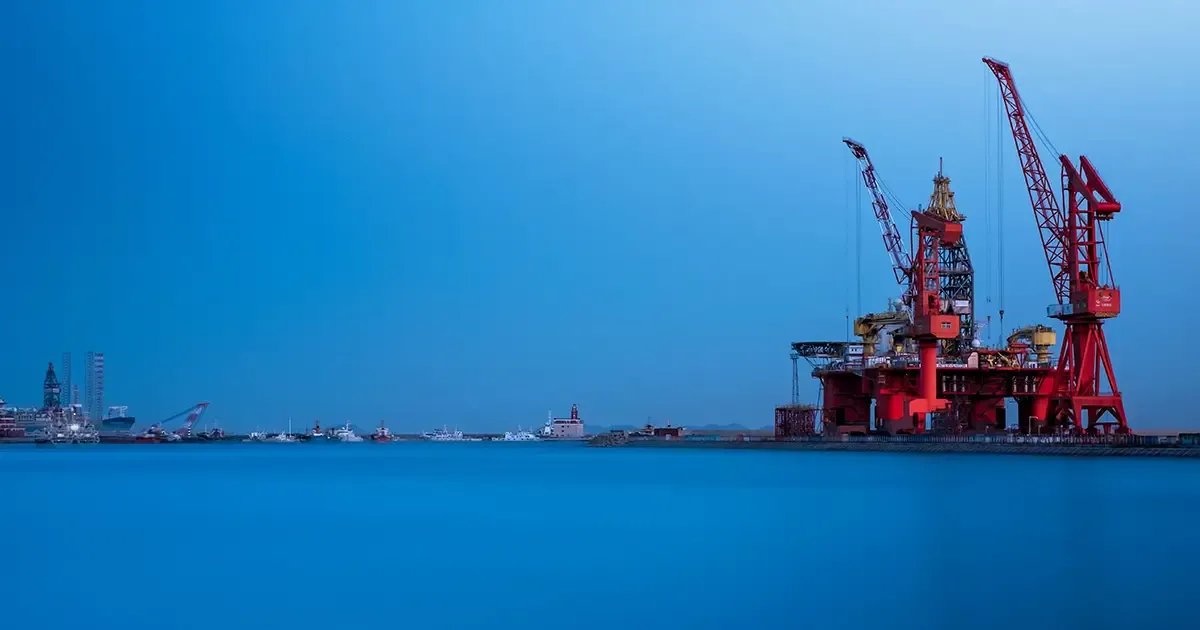
Marine & Offshore
Moisture- and corrosion-resistant thermal and fire insulation for ships and offshore structures — deck fire barriers, engine-room piping, LPG tank fire layers and 100% asbestos-free bulkheads.
Marine and offshore engineering faces high humidity, salt-spray corrosion and tight space — so insulation must resist moisture, corrosion and be lightweight. Fire divisions must hold under rolling and pitching, and pipe systems must stay serviceable in a corrosive atmosphere. Asbestos-free calcium silicate and ceramic fiber dominate the safety-critical zones.
Material Comparison
| Material | Best fit | Service temp | Key advantage |
|---|---|---|---|
| Rock wool | Decks, cabin walls, cable trenches | up to 650 °C | Fire barrier, structural, salt-resistant |
| Glass wool | Cabins, HVAC, cable insulation | up to 400 °C | Lightweight, acoustic |
| Ceramic fiber | Exhaust & boiler piping | 1100–1430 °C | High-temp, thin shield |
| Calcium silicate | Fire bulkheads, LPG tanks | up to 1000 °C | 100% asbestos-free, salt-spray proof |
Application Scenarios
Marine & Offshore Application Scenarios
- Ship deck fire barriers — rock wool layers prevent fire spread across decks.
- Cabin wall insulation — rock wool and glass wool keep living quarters comfortable.
- Cable-trench fire barriers — rock wool stops cable fires from propagating.
- Ventilation duct lining — glass wool reduces heat loss and noise in ship HVAC.
- Exhaust-pipe heat shields — ceramic fiber jackets rated to 1430 °C cut radiation near personnel.
- Marine boiler & engine piping — ceramic fiber on high-temperature lines withstands long service.
- Fire bulkheads — 100% asbestos-free calcium silicate, salt-spray resistant with high fire rating.
- LPG tank fire layers & power-system insulation — calcium silicate on storage and propulsion systems.
Related Articles
Standards & Compliance
Marine & Offshore Insulation Standards
Marine and offshore insulation is governed as much by certification as by physical performance. A material that passes a factory test means little without the documentary evidence a classification society requires. The framework that governs most new-build and retrofit work is the International Maritime Organization (IMO) regime, reinforced by regional fire classifications.
- SOLAS and the IMO FTP Code — the International Convention for the Safety of Life at Sea sets structural fire-protection requirements, while the IMO Fire Test Procedures Code defines how materials are tested for non-combustibility, smoke and toxicity, and surface flammability.
- A-60 and H-60 fire divisions — A-class divisions are tested on the cellulosic fire curve; H-class divisions use the faster hydrocarbon curve required for oil, gas and offshore areas. A material that passes A-60 is not automatically accepted for H-60.
- EN 13501-1, Class A1 — mineral wool that meets non-combustibility (EN ISO 1182) and gross heat of combustion (EN ISO 1716) is classed A1 non-combustible, the same concept used onshore and accepted for marine fire divisions.
- ASTM E84 and ASTM E119 — widely referenced surface-burning and fire-resistance tests for materials entering North American and dual-certification projects.
We document every marine-duty specification against these tests and recommend confirming class-society type-approval for the specific division and vessel before a bill of materials is finalized.
Material Selection Guide
How to Select Marine Insulation
- Fix the fire division first. A-60, A-30, H-60 or H-120 is set by the vessel’s fire plan and is a hard constraint, not a preference.
- Match the service temperature. Rock wool serves reliably to about 650 °C; ceramic fiber carries exhaust and boiler lines up to 1430 °C; calcium silicate and glass wool cover mid-range and accommodation zones.
- Weigh the environment. Salt spray, condensation and vibration decide whether a hydrophobic blanket, a rigid board or a faced system is the right call.
- Confirm approvals. Ask for IMO FTP Code evidence and, where required, class-society type-approval or equivalent test reports.
- Plan the facing and sealing. A non-combustible core still fails if water reaches the cold face; specify metal jacketing and sealed penetrations.
See our rock wool blanket, ceramic fiber blanket and calcium silicate board for the forms most specified into marine and offshore projects.
Related Applications
Offshore and marine systems combine fire safety, cryogenic duty, and corrosion challenges. See how our insulation performs across related sectors:
- Cryogenic insulation for LNG carriers and low-temperature marine lines
- Fire protection for vessels and offshore platform safety
- Pipe insulation for shipboard process and utility piping networks
- Nuclear-grade insulation for marine reactor and defense applications
Why Rosetexwool
Key Benefits
Why Marine & Offshore operations choose Rosetexwool insulation solutions.
Fire & Partition Safety
100% asbestos-free calcium silicate bulkheads and rock wool decks provide high fire ratings in confined marine spaces.
Corrosion Resistance
Salt-spray-resistant boards and jackets perform reliably in high-humidity offshore environments.
Operational Efficiency
Exhaust and machinery insulation cuts radiant heat, improving crew safety and reducing energy loss.
Long Service Life
Durable, moisture-stable materials extend maintenance intervals on vessels and platforms.
Support
Frequently asked questions
Are your marine insulation products asbestos-free? +
Yes. Our calcium silicate bulkhead fillings are 100% asbestos-free and salt-spray resistant, with high fire ratings for ship partitions.
What material insulates ship exhausts? +
Ceramic fiber insulation jackets rated for continuous service up to 1430 °C for exhausts, boilers and propulsion piping.
Can you protect LPG tanks? +
Yes. Calcium silicate jackets provide fire and thermal protection for LPG storage tanks and high-temperature marine piping.
What fire rating do marine bulkheads and decks require? +
Most machinery and accommodation boundaries are specified to A-60 (60 minutes on the cellulosic curve) or, in oil, gas and offshore areas, H-60 or H-120 on the faster hydrocarbon curve. The insulation system must hold the unexposed-side temperature limits for the full rating.
Is rock wool A1 non-combustible and accepted for ships? +
Yes. Mineral wool that meets EN ISO 1182 and EN ISO 1716 is classed A1 non-combustible under EN 13501-1 and is accepted for marine fire divisions when supported by IMO FTP Code evidence. Our rock wool is hydrophobic and salt-resistant for the marine environment.
Ready to start? Tell us your specs — we'll quote within 24 hours.
Get pricing
Request a quote for Marine & Offshore solutions
Tell us about your marine & offshore project requirements — our team responds within one business day.