
Calcium Silicate Pipe Insulation: Selection, Thickness and Standards
Calcium silicate pipe insulation explained: xonotlite vs tobermorite grades, conductivity at real mean temperatures, thickness design, and the ASTM C533/C795 compliance checklist.
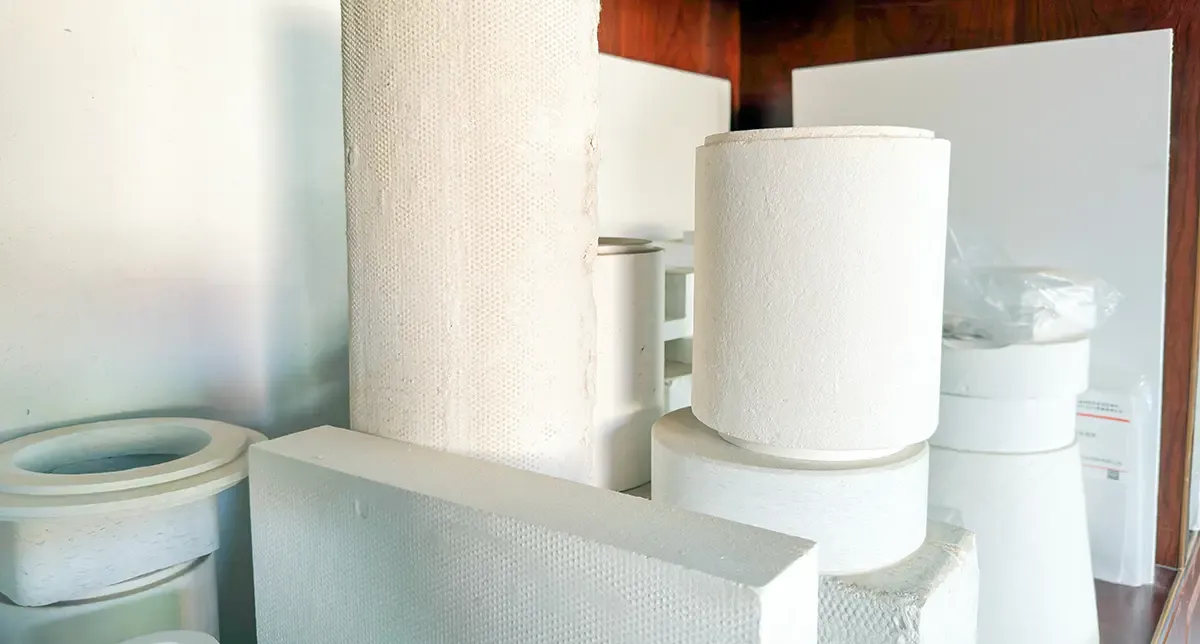
When process lines carry steam, hot oil or heat-transfer fluids at 300–650 °C, the insulation around them has to do three jobs at once: hold its shape under its own weight, keep surface temperatures safe for personnel, and stay non-combustible for the life of the plant. Pre-formed calcium silicate pipe insulation — often shortened to "calsil" in procurement documents — is still the default rigid answer for that band. This guide covers what the material actually is, how the two mineral grades differ, how to size thickness, where it beats (and loses to) competing materials, and what to specify so batches arrive fit for austenitic stainless pipework.
What Exactly Is Calcium Silicate Pipe Insulation?
Calcium silicate pipe insulation is supplied as rigid, pre-formed half-shells (two-piece sections) that fit around the pipe outer diameter, plus curved segments and custom shapes for elbows, tees and vessels. Unlike flexible blankets, a calsil section is self-supporting: it can bridge between supports, keep a smooth outer profile for metal cladding, and resist denting in plant traffic.
The chemistry matters more than the catalogue name. Industrial calsil exists in two mineral phases:
- Type I (tobermorite-based) — classified around 650 °C, the standard grade for steam distribution, hot oil and most process piping.
- Type II (xonotlite-based) — classified up to about 1000 °C, the high-temperature grade for superheated lines and fired equipment.
A "calcium silicate" label alone does not tell you which phase you are buying — and the phase, not the label, decides how the material behaves after years at temperature. Our calcium silicate pipe section is an asbestos-free xonotlite-reinforced product, and our material hub explains the full product family. For board-form selection, see the dedicated calcium silicate buyers guide.
How It Is Made: Hydrothermal Chemistry, Not Sintering
Calsil is not fired like a brick. Reactive lime and fine silica are dispersed in water, and the slurry is cured in autoclaves under saturated steam, where needle-like calcium silicate hydrate crystals (xonotlite in high-temperature grades) grow into a three-dimensional interlocking network. Reinforcing fibres are added to the slurry to hold the wet body together and toughen the finished section.
After hydrothermal curing, the body is pressed or moulded into half-shells, then dried under controlled conditions to fix the pore structure. Two consequences matter for buyers:
- Density is a design choice, not an accident. Lower density lowers conductivity but also lowers surface hardness and handling strength; higher density improves durability and compressive strength at a small conductivity penalty.
- The crystal phase sets the service ceiling. Tobermorite grades dehydrate and shrink if pushed far past 650 °C, while xonotlite grades hold their structure towards 1000 °C. That is why the phase — verifiable by X-ray diffraction — should appear in your specification, not just the marketing temperature.
Key Technical Properties
| Property | Typical value (Type I half-shells) |
|---|---|
| Maximum service temperature | 650 °C classification; high-temperature (xonotlite) grades to ~1000 °C |
| Density | 170–250 kg/m³ |
| Thermal conductivity | ≤0.065 W/(m·K) at 100 °C mean; ≤0.095 W/(m·K) at 400 °C mean |
| Standard thickness | 25–100 mm per layer |
| Pipe coverage | pre-formed half-shells for pipe OD from ~15 mm up to 1000 mm and above |
| Fire classification | A1 non-combustible (EN 13501-1) |
| Product standards | ASTM C533; EN 14306 |
| Chloride content | specified to low-ion limits for stainless-steel service (see below) |
The A1 rating is intrinsic: the material is already fully oxidised, so there is nothing left to burn — no smoke, no dripping, no flame spread. That is why calsil keeps its place on life-safety-critical lines even where a cheaper product could meet the thermal duty.
Thermal Conductivity: Why the Mean Temperature Matters
Conductivity values are only comparable at the same mean temperature — the average of hot-face and cold-face. A typical Type I product curve reads roughly:
| Mean temperature | Typical thermal conductivity |
|---|---|
| ~40 °C | 0.053 W/(m·K) |
| ~200 °C | 0.071 W/(m·K) |
| ~320 °C | 0.087 W/(m·K) |
Two practical rules follow. First, always collect the full conductivity equation (or curve) for the density grade you are buying — a single catalogue point is not enough to size thickness. Second, never compare a 25 °C value from one material (for example, an ambient-temperature aerogel figure) against a 300 °C value from calsil; at equal mean temperatures the ranking can change completely. Our comparison of calcium silicate and ceramic fiber board shows how this plays out at high temperature.
Thickness Design: A Worked Example for Main Steam Piping
Thickness is normally set by the economic-thickness method (see ISO 12241 for the general framework), then verified against surface-temperature and heat-loss limits. For personnel protection, a surface temperature of about 60 °C is the usual touch-safe target.
Take a representative case using the standard cylinder surface-temperature method:
- Hot face (main steam): 540 °C
- Ambient: 25 °C
- Target outer surface: 60 °C
- Outer-surface heat-transfer coefficient: ≈8 W/(m²·K)
- Assumed conductivity: 0.09 W/(m·K) at operating mean temperature
Solving the cylinder equation gives approximately 110 mm of calsil on a DN200 line and 130 mm on a DN600 line. The sensitivity matters as much as the answer: raising the assumed conductivity by just 0.01 W/(m·K) adds roughly 12–18 mm of required thickness across those diameters. In other words, at main-steam temperatures the conductivity equation you specify is worth more than the last negotiation on price per cubic metre.
For a wider view of how pipe insulation systems are selected and sized across materials, see industrial pipe insulation types, the companion piece on industrial pipe insulation materials, and the piping application overview at piping insulation applications.
Where Calsil Pipe Sections Win — and Where to Switch
Calsil wins when rigidity earns its keep. Straight runs of steam and process piping, district-heating spine lines, and anywhere the insulation must bridge between supports or present a hard, cladding-ready surface. It is also the preferred base layer in dual-layer systems where the inner section carries the mechanical duty.
Switch away from calsil when:
- The hot face exceeds the product's verified long-term rating. For 900–1200 °C duty, ceramic fiber — modules, blankets or boards — takes over. (High-temperature xonotlite grades cover a middle band, but always against verified shrinkage data.)
- Complex geometry and vibration dominate. Valves, flanges, turbines and pulsating lines are better served by flexible blankets or removable jackets; forcing rigid sections onto those surfaces invites cracking at every joint.
- Cost rules in the mid-temperature band. For lines at or below about 500 °C where rigidity is not required, rock wool pipe sections deliver the duty at lower cost — the trade-off is lower compressive strength and less dimensional stability.
- Space is the binding constraint. Where a pipe run is boxed into a duct or trench, thin aerogel or microporous layers can cut built thickness dramatically at higher material cost.
A pragmatic pattern on real plants: calsil on straight hot runs, ceramic fiber or aerogel at hot spots and odd geometry, rock wool on the cooler periphery, and one cladding and weatherproofing system over everything outdoors.
Installation Details That Decide Performance
Good material installed badly loses to average material installed well. The details that matter most:
- Fit, then stagger. Dry-fit each half-shell, then stagger longitudinal and circumferential joints between layers the way masonry courses are staggered. Through-joints are heat leaks.
- Do not let insulation carry the pipe. Supports, guides and shoes must carry loads through insulated pipe shoes or load-bearing blocks — crushing calsil at a support creates both a thermal bridge and a crack initiation point.
- Cut clean, cut cool. Use fine-tooth saws with dust extraction; hammer-fitting oversized sections onto small-bore lines is the most common source of edge damage.
- Movement joints at every direction change. Elbows, tees and expansion loops need calculated expansion gaps filled with a compatible high-temperature flexible material, not packed with rigid offcuts.
- Removable jackets at flanges and valves. Rigid sections glued around items that get maintenance access weekly will be destroyed within months. Specify removable insulated jackets with adequate overlap (typically ≥50 mm at closures).
- Water is a system problem. Outdoors, continuous metal cladding with weather-lapped joints and drainage at low points is part of the insulation system, not an accessory. See our piping application guide for system-level layout, and the calcium silicate insulation board product page for flat-surface companions to the pipe sections.
If calsil does get wet — construction rain, flange leaks, cladding damage — the correct response is to remove the wet sections and replace them, or dry them under controlled conditions and verify conductivity and dimensions. Baking water out in place and re-covering without checking the result traps the problem.
Stainless-Steel Compatibility and the Procurement Checklist
The classic failure mode on austenitic stainless lines is external chloride stress-corrosion cracking (SCC): water carrying soluble ions through wet insulation, evaporating at the hot pipe wall and concentrating chlorides at metal surfaces under tensile stress. The specification defence is standardised:
- Require compliance with ASTM C795 (thermal insulation for use over austenitic stainless steel), with ion limits verified per ASTM C871 and stress-corrosion behaviour per ASTM C692. In Europe the corresponding requirements sit within EN 14306 and related product rules.
- Keep the "asbestos-free" claim auditable: modern calsil contains no asbestos by design, but batch documentation (safety data sheets and third-party test reports) should be part of the purchase order, particularly for mixed-supplier projects.
- Water management is part of the same package — the best low-ion product still needs drainage, sealed penetrations and intact cladding to stay dry.
A one-page checklist to attach to your next enquiry:
- Grade and phase (Type I tobermorite / high-temperature xonotlite), density class
- Full thermal conductivity equation versus mean temperature for that density
- Classification temperature and verified long-term hot-face rating
- Linear shrinkage after heat soak at the project hot face
- Compressive and flexural strength (handling and support design)
- Ion limits for stainless service (ASTM C795 / C871 package, or EN 14306 declaration)
- Asbestos-free certification, batch traceability, third-party test reports
- Dimensions and tolerances: half-shells matched to actual pipe OD, thickness per layer, custom shapes for fittings
- Packaging with moisture protection for ocean freight and site storage
Send that list to three suppliers and you will learn more from the responses than from any brochure — including ours. If the pipe form is what you need, start from our calcium silicate pipe insulation product page and the what is calsil explainer for the fundamentals behind the checklist.
Frequently asked
What temperatures can calcium silicate pipe insulation handle? +
Standard Type I (tobermorite) pipe sections are classified to 650 °C and suit steam, hot-oil and most process lines. High-temperature Type II (xonotlite) grades are classified up to about 1000 °C for superheated and fired-equipment duty. Always design against the verified long-term hot-face rating, which sits below the classification temperature, and request shrinkage and strength-retention data at your actual operating temperature.
How thick should calcium silicate insulation be on a 540 °C steam line? +
It depends on line size, conductivity and the surface-temperature target. Using the standard cylinder surface-temperature method with a 540 °C hot face, 25 °C ambient, a 60 °C touch-safe target and a conductivity of 0.09 W/(m·K), the result is roughly 110 mm on a DN200 line and 130 mm on a DN600 line. Because required thickness grows by about 12–18 mm for every 0.01 W/(m·K) of conductivity at these temperatures, sizing should always use the supplier's full conductivity equation, not a single catalogue value.
Is calcium silicate pipe insulation safe for austenitic stainless steel pipes? +
Yes, provided the product is specified and tested for that service. Require compliance with ASTM C795, with soluble ion limits verified per ASTM C871 and stress-corrosion performance per ASTM C692 (in Europe, declarations under EN 14306). Keeping the insulation dry through sound cladding and drainage matters as much as the chemistry, because chloride concentration at the hot wall needs water to migrate there.
Calcium silicate or rock wool pipe sections — which should I choose? +
For rigid, self-supporting sections on hot lines — typically 350–650 °C — calcium silicate wins on compressive strength, dimensional stability and a hard cladding-ready surface. Rock wool pipe sections are the economical choice in the mid-temperature band, roughly up to 500–650 °C depending on grade, where rigidity is not required. Many plants use both: calsil on critical hot straight runs, rock wool on cooler or cost-sensitive circuits.
What happens if calcium silicate pipe insulation gets wet? +
Water in the pore structure raises conductivity sharply and can drive corrosion under the insulation. Replace or properly dry and re-verify wet sections rather than simply re-covering them. Prevention is systemic: continuous weather-lapped cladding, drainage at low points, sealed penetrations at supports, and prompt repair of cladding damage — especially on outdoor and wash-down areas.
What sizes are calcium silicate pipe sections available in? +
Half-shells are pre-formed for pipe outer diameters from about 15 mm up to 1000 mm and above, in thickness steps from 25 mm to 100 mm per layer, with larger thicknesses built up in staggered multiple layers. Curved segments, elbows, tees and custom shapes are produced for fittings and vessel nozzles. Confirm exact dimensional tolerances and matching to your actual pipe OD in the purchase order, not just the nominal pipe size.
Request a quote
Interested in our insulation solutions? Send us your requirements and our team responds within one business day.