
Glass Wool vs Rock Wool: 7 Differences That Decide the Spec
Glass wool or rock wool? Compare the six forms of each, then temperature, density, fire rating, acoustics, water resistance, conductivity, cost and installation speed.
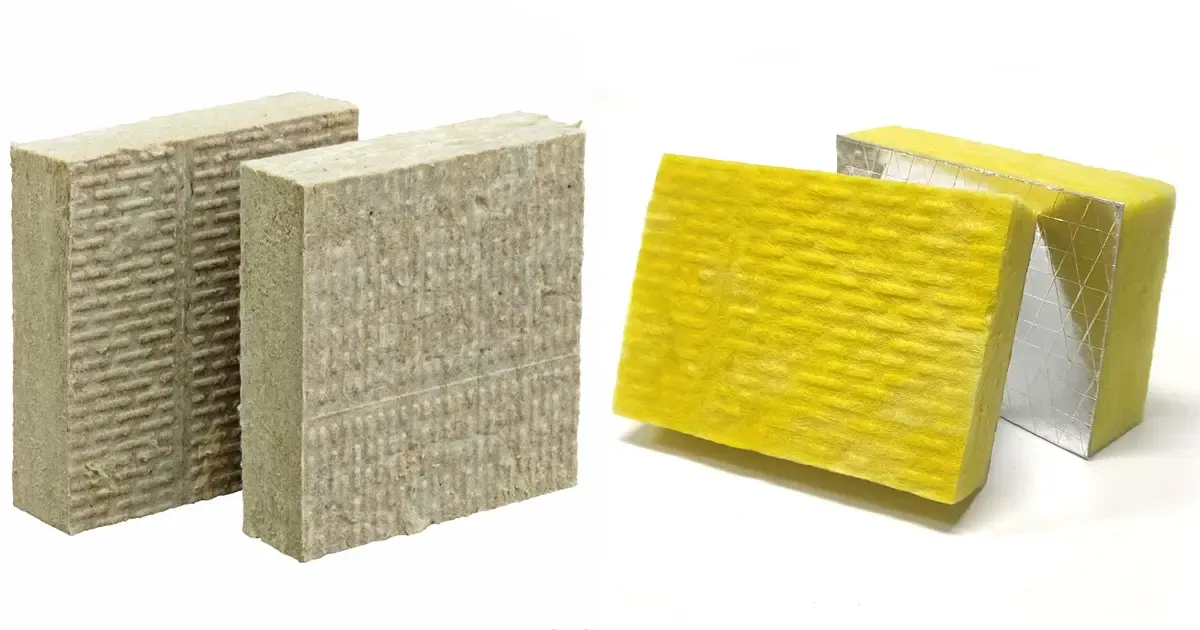
Glass wool and rock wool are both mineral-fiber insulants, both A1 non-combustible, and both widely used in industrial and building applications. But they are not interchangeable. The wrong choice can mean melted insulation, sagging blankets, or money spent on performance you do not need.
This guide compares the two materials across the seven differences that actually matter when you write a spec — and, before that, sets out the types of glass wool and the types of rock wool you are really choosing between. Both are family names, not products, and most specification errors start with picking the right material in the wrong form. If you are deciding between a glass wool blanket and a rock wool blanket, start here. Most glass wool vs rock wool comparisons stop at a property table; the form you specify usually decides the outcome first.
Quick Decision Table
| If your project needs... | Choose | Why |
|---|---|---|
| Continuous service above 400 °C | Rock wool | Glass wool softens and degrades above ~350–400 °C |
| Maximum sound absorption (NRC) | Glass wool | Finer fibers absorb mid-to-high frequencies better |
| Lightest weight on steel roof decks | Glass wool | Density roughly 24–64 kg/m³ vs 80–150 kg/m³ |
| Fire barrier / fire isolation zone | Rock wool | Higher density and melting point give longer fire resistance |
| Fast, large-area roll-out | Glass wool | Supplied in long rolls; covers more area per man-hour |
| Damp or freeze-thaw exposure | Either, with treatment | Both reach ≥ 98 % water repellency when treated |
| Lowest material cost | Glass wool | Lower raw-material and processing cost |
| Large-diameter vessel or drum | Rock wool | Supplied as lamella mat that bends without compressing the fibre |
| Standard stud or joist cavity | Either, as batts | Friction fit at standard centres; form, not fibre, decides |
Types of Glass Wool: Six Forms and Where Each Fits
"Types of glass wool" is one of the most common queries in this subject area, and the honest answer is that the material barely changes between them. What changes is the form it is delivered in — and that choice is driven by geometry, load and handling, not by chemistry.
Every form of glass wool insulation starts from the same base: molten glass spun into fibres of roughly 4–9 µm, bonded with a thermosetting resin, and cured into a stable mat. Our walkthrough of how centrifugal glass wool is made covers the production line step by step. What matters here is what happens after the curing oven.
1. Blanket and roll. The default form, and the one most people mean when they say glass wool. Supplied compressed in long rolls at roughly 10–48 kg/m³, it is unrolled across roof decks, laid over ductwork and draped over irregular plant. It is the fastest form to install per square metre and generally the cheapest per unit of thermal resistance. It carries no load and needs support or cladding. Specification detail sits in our glass wool blanket buying guide.
2. Batt. Pre-cut lengths, friction-fitted between studs, joists or purlins. Same material as blanket, but the dimension is fixed to a standard frame spacing, which removes cutting waste on repetitive work. Where the cavity is regular — partition walls, ceiling grids — batts beat rolls on labour even at identical material cost.
3. Rigid board. The same fibre pressed to a higher density, typically 24–100 kg/m³, with enough rigidity to hold an edge, accept a bonded facing and resist fixing pressure without slumping. This is the form to specify whenever the insulation has to be dimensionally stable or has to carry a finish. The density classes and what each one buys you are set out in our rigid board selection and spec guide, and the application split in where glass wool board earns its place.
4. Pipe section. Pre-formed half-shells or full-round sections sized to a nominal pipe diameter. Density runs higher than roll form, because a curved segment has to hold its geometry against banding pressure and thermal movement without opening at the seam. For hot and cold process pipework this is usually the only sensible form — a blanket wrapped around a pipe compresses on the inside of the curve and loses most of its thickness where it matters most.
5. Loose-fill and blowing wool. Unbonded fibre blown or poured into irregular cavities, lofts and voids where no cut product can be fitted. It has the lowest installed density of the six and no shape of its own, so it is entirely dependent on containment and will settle in an open cavity.
6. Faced and composite variants. Any of the above with a factory-applied facing — foil, Kraft paper, glass tissue, or a reinforced foil scrim. The facing is not decoration. It controls vapour drive, protects the fibre from mechanical damage and air erosion, and on ductwork it doubles as the air-stream surface. Choosing the wrong facing causes more field failures than choosing the wrong density.
Two points are worth stating plainly, because they shorten most specification arguments.
First, the form does not change the temperature ceiling. A rigid board and a roll from the same line share the same binder and the same upper limit. If the duty is 500 °C, no glass wool form will survive it.
Second, the conductivity differences between forms are second-order compared with getting thickness and installed density right. Form is a geometry and handling decision; performance lives in the spec.
Types of Rock Wool: The Parallel Family
Rock wool is made from basalt and dolomite rather than recycled glass, melted at a higher temperature and spun into coarser, denser fibre. The family runs parallel to glass wool, with two forms that glass wool does not normally offer.
Blanket and roll — denser and heavier than the glass wool equivalent, typically 80–150 kg/m³, chosen where temperature and fire rating govern rather than weight.
Board — the workhorse form for fire-rated walls, facades and industrial equipment, and the one to specify when the insulation has to survive handling on site.
Pipe section — pre-formed for process pipework, and the standard answer above the glass wool temperature ceiling.
Loose fill — for cavity and void filling where settlement is acceptable.
Wired mat — fibre stitched to a galvanised wire mesh. This is a rock wool form with no common glass wool equivalent: it exists because high-temperature pipework and vessels need a product that can be sewn around a curve and pinned without tearing.
Lamella mat — narrow slabs of fibre oriented perpendicular to the facing and bonded to a foil or mesh backing, so the product bends around large-diameter pipe and vessel shells without compressing the fibre on the inside of the curve.
That last pair is why rock wool dominates above 400 °C in a way no property table captures. It is not only the melting point — it is that rock wool is supplied in forms designed for hot, curved, mechanically pinned service.
Form-by-Form: Which Type Wins Where
Read a glass wool vs rock wool comparison form by form rather than property by property, and the answer usually appears faster — most jobs carry a geometry constraint that already rules out half the options.
| Job | Glass wool form | Rock wool form | Why |
|---|---|---|---|
| Long roof deck runs, light load | Blanket / roll, 16–24 kg/m³ | Blanket, 80–100 kg/m³ | Glass wool covers faster and loads the structure less |
| Partition or ceiling cavity on standard centres | Batt | Batt | Friction fit either way; form, not fibre, decides |
| Dimensionally stable, faced, mechanically fixed | Rigid board, 48–100 kg/m³ | Board | Both work; rock wool carries more load |
| Process pipe below 350 °C | Pipe section | Pipe section | Glass wool is cheaper; rock wool has headroom |
| Process pipe above 350 °C | — | Pipe section or wired mat | Glass wool binder is out of range |
| Large-diameter vessel or drum | — | Lamella mat | Bends without compressing the fibre |
| Fire-rated wall or penetration seal | — | Board | Density and melting point |
| Irregular void or loft | Loose fill | Loose fill | Containment decides, not the fibre |
1. Service Temperature
Temperature is the single most important difference, and it is the one that eliminates a material outright rather than ranking it.
- Glass wool: typically rated for –50 °C to 350 °C, with some industrial grades reaching ~400 °C for short periods. Above this the binder begins to degrade and the fibres lose their spring, which is why a glass wool layer that has been overheated looks intact but has lost most of its thickness.
- Rock wool: typically rated for –50 °C to 650 °C, The basalt-based fibres have a higher melting point and hold their structure at temperatures where glass wool would slump.
The failure mode is worth understanding. It is rarely a dramatic melt — it is binder burn-out followed by gradual compaction. Glass wool insulation that has been overheated stays in place, the cladding still looks fine, and the surface temperature creeps up over months. By the time anyone notices, the layer has lost a third of its design thickness.
If your process runs above 350 °C continuously, rock wool is the safer spec. For the exact rock-wool ceiling, see our guide on what temperature rock wool can withstand.
2. Fire Performance
Both materials are classified A1 non-combustible under EN 13501-1. Neither will propagate flame or produce significant smoke. The difference shows up under prolonged direct flame or when the material is asked to act as a fire barrier rather than simply not burn.
Rock wool's higher density and melting point make it the preferred material for fire-rated walls, fire-stop collars, penetration seals and fire isolation zones. Glass wool provides excellent fire safety for ducts, partitions and ceilings where the temperature stays within its service range, but it is not normally chosen as a primary fire barrier.
The practical distinction is integrity time — how long the layer stays in place and continues to insulate the protected side. A non-combustible material that softens and falls out at 500 °C is not a barrier, however good its classification looks on paper.
For a deeper look at glass-wool fire behaviour, read is glass wool fireproof.
3. Density & Compressive Strength
Density follows directly from the fibre diameter and production process.
| Material | Typical density | Compressive behaviour |
|---|---|---|
| Glass wool blanket | 24–64 kg/m³ | Soft, conformable, low compressive strength |
| Glass wool board | 24–100 kg/m³ | Rigid, holds an edge, takes fixing pressure |
| Rock wool blanket | 80–150 kg/m³ | Firmer, higher compressive strength, less sag under load |
| Rock wool board | 100–200 kg/m³ | Dimensionally stable, used where load or impact matters |
The higher density of rock wool makes it better for applications where the insulation must support its own weight over long spans, such as large steel-framed roofs or vertical wall cavities. Glass wool's lower density reduces structural load and makes it easier to cut and fit around services. On long roof runs that is usually decisive: glass wool roof insulation in blanket form adds a fraction of the dead load of a rock wool layer at the same thermal resistance, which is why it is the default on lightweight steel decks.
A useful rule: specify the lowest density that survives installation. Insulation is compressed by banding, by cladding fixings and by foot traffic during maintenance, and every kilogram per cubic metre above what the job needs is spent on a property nobody asked for.
4. Thermal Conductivity
At room and moderate temperatures, glass wool usually has a slight edge. Both materials follow the same pattern — conductivity rises with mean temperature as radiation across the pore structure becomes a larger share of total heat transfer.
| Mean temperature | Glass wool | Rock wool |
|---|---|---|
| 25 °C | 0.032–0.040 W/(m·K) | 0.035–0.045 W/(m·K) |
| 100 °C | 0.040–0.050 W/(m·K) | 0.044–0.055 W/(m·K) |
| 200 °C | 0.055–0.070 W/(m·K) | 0.058–0.072 W/(m·K) |
The gap narrows as temperature rises. More importantly, rock wool keeps its conductivity stable at temperatures where glass wool would be degrading. Specifying insulation by a single low-temperature conductivity value is a common mistake: always check the mean-temperature curve across the actual service range, and check it at the hot-face condition rather than at ambient.
5. Acoustic Performance
Glass wool's fibres are finer and more uniform, giving it excellent sound absorption across mid and high frequencies. It is the usual choice for acoustic ceilings, duct liners, plant rooms and building partitions where speech and machine noise dominate.
Rock wool absorbs sound well, especially at lower frequencies, and its higher mass improves airborne sound insulation. It is often used in cinemas, studios and industrial enclosures where low-frequency energy is the problem.
On the numbers that actually decide an acoustic bid — noise reduction coefficient and weighted absorption coefficient — the two sit close together at equal thickness, and rock wool's advantage comes mostly from mass rather than from the absorption mechanism itself. Our glass wool acoustic insulation guide sets out the NRC and αw data, the partition and ceiling constructions that reach them, and the cases where glass wool is the wrong answer.
For rigid board applications, compare glass wool board and rock wool board against the project's acoustic target rather than its thermal target — the density that optimises one is rarely the density that optimises the other.
6. Water Resistance & Moisture Behavior
Both materials can be supplied with water-repellent treatment, typically reaching ≥ 98 % water repellency. Untreated, the behaviour differs:
- Glass wool drains water relatively well after short-term wetting and dries faster because of its open, fine-fibre structure. However, prolonged soaking collapses the blanket and destroys thermal performance.
- Rock wool absorbs less water by mass but can hold moisture in its denser fiber matrix. Once saturated, it takes longer to dry.
In practice, both materials should be protected with a vapor barrier or cladding in wet locations. The choice between them should be driven by temperature and mechanical loads, not by small differences in water absorption.
The real risk is not the water itself but what it does to the thermal calculation. A wet insulation layer conducts several times better than a dry one, and the loss is invisible until the surface temperature or the energy bill moves. Our guide on whether glass wool blanket is waterproof covers where the treated grades genuinely hold and where they do not.
7. Cost & Installation Speed
Glass wool is generally the lower-cost option, both in material and labour for large areas. Long rolls can be unrolled quickly across roof decks and ductwork. Rock wool is more expensive per square metre and is often supplied in boards or shorter rolls that require more cutting. The trade-off is durability and temperature headroom.
| Factor | Glass wool | Rock wool |
|---|---|---|
| Material cost | Lower | Higher |
| Roll length / coverage | Longer rolls, faster coverage | Shorter rolls or boards, more cuts |
| Cutting | Easy with knife | Denser; requires saw or insulation knife |
| Labour speed on large areas | Faster | Slower |
| Lifetime in harsh service | Good | Better at high temperature and load |
Application Decision Matrix: Where Each Wins
The seven differences above explain why the two fibres diverge. This matrix flips the question and starts from the job — find the row that matches your application and read the recommendation.
| Application | Recommended | Why |
|---|---|---|
| HVAC ducts, roof decks and general building (≤250 °C) | Glass wool | Lowest material cost, fastest roll coverage, good sound absorption |
| Cavity and partition walls (acoustic + thermal) | Glass wool | Lightweight, high NRC, easy to cut and friction-fit |
| Acoustic ceilings, studios, plant rooms | Glass wool | Best absorption per dollar; rock wool is over-specified here |
| Industrial process pipe ≤350 °C | Either — glass wool where acoustics matter, rock wool for mechanical duty | Both rated to 350 °C; glass wool cheaper, rock wool more robust |
| Equipment, flues, stacks and exhaust >500 °C | Rock wool | Only fibre rated for sustained high temperature (continuous ≤650 °C) |
| Fire-rated barriers, fire-stop collars, penetration seals | Rock wool | Non-combustible and holds integrity as a barrier, not merely "does not burn" |
| Weather-exposed external walls | Rock wool | Better dimensional stability and water behaviour under load |
| Cryogenic or sub-ambient service | Glass wool | Stable at low temperature with no embrittlement |
The pattern is consistent: below about 350 °C, glass wool is the default unless acoustics are irrelevant and mechanical load is high. Above 500 °C, rock wool is the only fibre option in this comparison. Between 350 °C and 500 °C, the choice comes down to fire-barrier duty and load — exactly the dimensions compared above.
Application Decision Matrix: Where Each Wins
The seven differences above explain why the two fibres diverge. This matrix flips the question and starts from the job — find the row that matches your application and read the recommendation.
| Application | Recommended | Why |
|---|---|---|
| HVAC ducts, roof decks and general building (≤250 °C) | Glass wool | Lowest material cost, fastest roll coverage, good sound absorption |
| Cavity and partition walls (acoustic + thermal) | Glass wool | Lightweight, high NRC, easy to cut and friction-fit |
| Acoustic ceilings, studios, plant rooms | Glass wool | Best absorption per dollar; rock wool is over-specified here |
| Industrial process pipe ≤350 °C | Either — glass wool where acoustics matter, rock wool for mechanical duty | Both rated to 350 °C; glass wool cheaper, rock wool more robust |
| Equipment, flues, stacks and exhaust >500 °C | Rock wool | Only fibre rated for sustained high temperature (continuous ≤650 °C) |
| Fire-rated barriers, fire-stop collars, penetration seals | Rock wool | Non-combustible and holds integrity as a barrier, not merely "does not burn" |
| Weather-exposed external walls | Rock wool | Better dimensional stability and water behaviour under load |
| Cryogenic or sub-ambient service | Glass wool | Stable at low temperature with no embrittlement |
The pattern is consistent: below about 350 °C, glass wool is the default unless acoustics are irrelevant and mechanical load is high. Above 500 °C, rock wool is the only fibre option in this comparison. Between 350 °C and 500 °C, the choice comes down to fire-barrier duty and load — exactly the dimensions compared above.
How to Choose: A 5-Step Framework
Use this sequence when writing the spec — the order matters, because each step eliminates options rather than ranking them.
- Check the temperature. If continuous service is above 350 °C, eliminate glass wool unless the hot face is protected by a higher-temperature material.
- Check the load and span. If the insulation must carry its own weight over a wide cavity or roof span, favour rock wool's higher density — or move from blanket to rigid board.
- Pick the form, not just the fibre. Blanket, batt, board, pipe section, loose fill or faced composite. On a pipe, a wrapped blanket loses thickness on the inside of the curve; a pre-formed section does not.
- Check acoustic and budget priorities. For maximum sound absorption at the lowest cost, glass wool wins. For fire barriers and high-temperature duty, rock wool wins.
- Check the facing and the weather. Facing, vapour control and cladding decide service life more often than the fibre does.
Common Mistakes
- Specifying glass wool on a 500 °C steam pipe — the binder burns out and the blanket compacts.
- Using rock wool for light acoustic ceiling tiles — heavier, harder to handle, and more expensive than necessary.
- Wrapping blanket around small-bore pipe instead of using a pre-formed section — the insulation compresses exactly where the geometry works against it.
- Ignoring facing and cladding — both materials need protection from weather and liquid water, regardless of water-repellent treatment.
- Comparing only material price — installation labour, longevity and reline frequency often outweigh the per-metre cost difference.
- Assuming the form changes the rating — a board and a roll from the same line share the same temperature ceiling.
Once the material choice is made, the buying decisions take over. For supplier audit, density selection and the enquiry checklist that settle a purchase, see our glass wool supplier selection guide.
Bottom Line
Glass wool and rock wool solve different problems. Glass wool is the lighter, more acoustically absorbent, lower-cost choice for temperatures up to about 350 °C. Rock wool is the higher-temperature, higher-density, fire-barrier choice for service up to 650 °C.
Within each family, the form does most of the work. Getting the types of glass wool straight — blanket, batt, board, pipe section, loose fill and faced composite — usually settles the specification faster than any property comparison, and the same logic runs through the rock wool family on the other side of the temperature line. Glass wool insulation is the right answer up to roughly 350 °C; above that the question stops being about properties at all.
A glass wool vs rock wool decision that never gets past the property table tends to produce the right material in an unbuildable form.
At Rosewool we manufacture both glass wool blankets and boards and rock wool blankets, boards, and pipes since 1982, with ISO 9001, CE, and SGS certification. Contact our team for a spec matched to your temperature, acoustic, and fire requirements.
Explore the full Rosetexwool product range — ceramic fiber, rock wool, calcium silicate, microporous aerogel and glass wool — with specification tables and application notes for each family.
Explore flexible aerogel and microporous insulation options in our aerogel insulation guide.
Frequently asked
What are the main types of glass wool? +
Six forms cover practically every job: blanket and roll for large-area coverage, batts for standard stud and joist cavities, rigid board where dimensional stability or a bonded facing is needed, pipe sections for process pipework, loose fill for irregular voids, and faced or composite variants where vapour control or an air-stream surface matters. The fibre is the same in all six — the form decides how it is installed and what it can carry.
Which type of glass wool is best for pipe insulation? +
A pre-formed pipe section. Wrapping blanket around a pipe compresses the fibre on the inside of the curve, so the layer loses thickness exactly where the thermal path is shortest. Pipe sections are supplied denser than roll form and sized to nominal pipe diameter, which also makes banding and cladding straightforward.
What is the difference between glass wool blanket and glass wool board? +
Blanket is a flexible roll at roughly 10–48 kg/m³ that drapes over irregular shapes and covers large areas quickly. Board is the same fibre pressed to 24–100 kg/m³ so it holds an edge, accepts a facing and resists fixing pressure. Choose blanket for coverage speed and board whenever the insulation has to stay flat, carry a finish or keep its thickness under load.
Is glass wool or rock wool better for sound absorption? +
Glass wool absorbs more at mid and high frequencies because its fibres are finer and more uniform, which is why it dominates acoustic ceilings and duct liners. Rock wool's advantage comes from mass: at equal thickness the absorption coefficients are close, but the heavier product insulates better against airborne low-frequency energy. For speech and machine noise, glass wool. For studios and heavy plant enclosures, rock wool.
Can glass wool be used at 400 °C? +
Only briefly. Standard glass wool is rated for continuous service to about 350 °C, and while some industrial grades tolerate short excursions up to about 400 °C, sustained operation at 400 °C burns out the binder and the layer compacts. Above 350 °C continuous, rock wool is the correct specification.
Are both glass wool and rock wool non-combustible? +
Yes. Both are classified A1 non-combustible under EN 13501-1 and neither propagates flame or generates significant smoke. The distinction is integrity under fire rather than combustibility: rock wool's higher melting point and density keep it in place far longer, which is why it is the material specified for fire barriers, penetration seals and fire isolation zones.
Which is cheaper, glass wool or rock wool? +
Glass wool, on both material and installed cost for large areas. It is lighter to handle, supplied in longer rolls and cuts with a knife. Rock wool costs more per square metre and needs more cutting time, but it lasts longer in high-temperature and high-load service, so the lifecycle comparison narrows considerably on hot plant.
Does the form change the temperature rating of glass wool? +
No. A rigid board and a roll from the same production line share the same binder and the same upper limit, roughly 350 °C continuous for glass wool. Changing the form changes handling, dimensional stability and load capacity — not the temperature ceiling.
Can I use glass wool instead of rock wool? +
Only if the service temperature stays within the glass wool limit and the application does not require high compressive strength or fire-barrier performance. For continuous temperatures above 350 °C, rock wool is the safer choice.
Which is more water resistant, glass wool or rock wool? +
Both can be treated to reach ≥ 98 % water repellency. Untreated glass wool drains and dries faster but is easily damaged by prolonged soaking. Untreated rock wool absorbs less water by mass but dries more slowly. Both should be protected with cladding or a vapor barrier in wet locations.
Why is glass wool sometimes preferred over rock wool? +
For most building and HVAC applications below about 350 °C, glass wool is the practical default. It costs less per square metre, ships in longer rolls that cover ductwork and roof decks faster, absorbs more sound per dollar, and is easier to cut and friction-fit into cavities. Rock wool's advantages — a higher temperature ceiling (continuous to 650 °C), higher density and stronger fire-barrier performance — are simply not needed in those jobs, so specifying it adds cost and weight without a measurable benefit. The two fibres are not 'better' or 'worse' in general; they are matched to different service conditions.
What is the flash point of glass wool and rock wool? +
Neither material has a flash point in the usual sense. Flash point describes the temperature at which a flammable liquid or gas releases enough vapour to ignite, and both glass wool and rock wool are non-combustible mineral fibres classified A1 under EN 13501-1 — they do not burn and do not release flammable vapour. Instead of a flash point they have a softening or melting range: glass wool softens around 700 °C and rock wool around 1,000 °C, while their continuous service temperatures are far lower (about 350 °C for glass wool, up to 650 °C for rock wool). Long before melting, the binder in glass wool degrades above its service limit and the layer compacts.
When is rock wool the only viable choice? +
Rock wool becomes the only option whenever the service condition leaves glass wool's 350 °C ceiling behind. That includes continuous process temperatures above 350–500 °C (equipment, flues, stacks, exhaust), any application that must perform as a fire barrier or penetration seal rather than merely 'not burn', and weather-exposed external walls where higher density and better water behaviour matter. Below 350 °C, glass wool is usually sufficient; above 500 °C, rock wool is the sole fibre-based choice in this comparison.
Why is glass wool sometimes preferred over rock wool? +
For most building and HVAC applications below about 350 °C, glass wool is the practical default. It costs less per square metre, ships in longer rolls that cover ductwork and roof decks faster, absorbs more sound per dollar, and is easier to cut and friction-fit into cavities. Rock wool's advantages — a higher temperature ceiling (continuous to 650 °C), higher density and stronger fire-barrier performance — are simply not needed in those jobs, so specifying it adds cost and weight without a measurable benefit. The two fibres are not 'better' or 'worse' in general; they are matched to different service conditions.
What is the flash point of glass wool and rock wool? +
Neither material has a flash point in the usual sense. Flash point describes the temperature at which a flammable liquid or gas releases enough vapour to ignite, and both glass wool and rock wool are non-combustible mineral fibres classified A1 under EN 13501-1 — they do not burn and do not release flammable vapour. Instead of a flash point they have a softening or melting range: glass wool softens around 700 °C and rock wool around 1,000 °C, while their continuous service temperatures are far lower (about 350 °C for glass wool, up to 650 °C for rock wool). Long before melting, the binder in glass wool degrades above its service limit and the layer compacts.
When is rock wool the only viable choice? +
Rock wool becomes the only option whenever the service condition leaves glass wool's 350 °C ceiling behind. That includes continuous process temperatures above 350–500 °C (equipment, flues, stacks, exhaust), any application that must perform as a fire barrier or penetration seal rather than merely 'not burn', and weather-exposed external walls where higher density and better water behaviour matter. Below 350 °C, glass wool is usually sufficient; above 500 °C, rock wool is the sole fibre-based choice in this comparison.
Request a quote
Interested in our insulation solutions? Send us your requirements and our team responds within one business day.