
Glass Wool Insulation Board: Rigid Board Selection & Spec
Spec-side guide to glass wool rigid insulation board: density classes 24–100 kg/m³, lambda, compressive, A1 fire, facings, tolerances, and side-by-side comparison with rock wool board.
Where Rigid Board Comes From — and Why Spec Matters
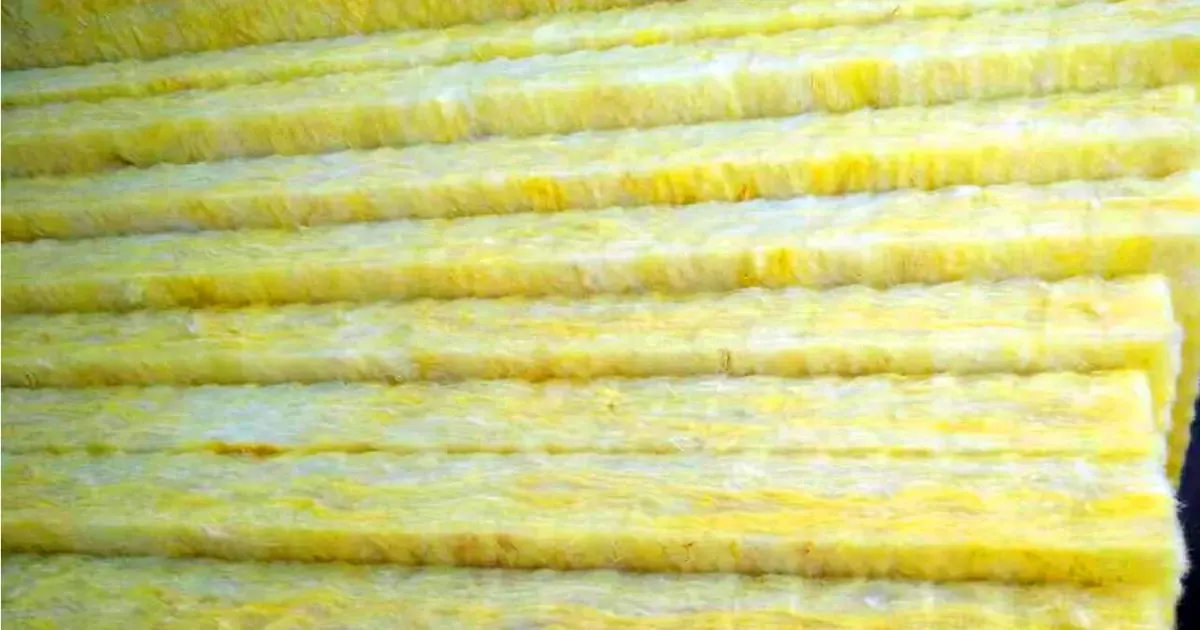
Glass wool rigid board is the same melt-spun glass fibre used to make blanket and roll, but bonded into a flat, self-supporting panel. The form factor is what changes the specification logic. A blanket drapes and conforms; a board holds its shape inside a framed cavity, takes fixing pressure without slumping, and gives a clean surface for a bonded facing. Every spec on a data sheet — density, lambda, compressive strength, water repellency, acoustic — has to be read against that single fact: the panel is rigid and the joint is fixed.
A spec sheet for glass wool board is not the same as a spec sheet for blanket, and it is definitely not interchangeable with rock wool board at the same density. Two boards of the same nominal density can perform very differently depending on how the fibre is formed, how the binder is cured, and which facing is bonded to the surface. Choosing by density alone is the most common error we see in purchasing documents; this guide explains which parameter to read for which decision. The full material grade range is listed on our glass wool board product page.
For applications where board sits in a frame to deliver thermal and acoustic performance together, see our glass wool board applications guide, which covers the application side in detail. The present guide is the spec and selection counterpart — density, lambda, strength, fire, facing and tolerances.
Density Classes and What Each One Buys You
Density is the master variable on a glass wool board data sheet, because almost every other spec flows from it. The practical bands used by manufacturers worldwide are 24, 32, 48, 64, 80 and 100 kg/m³, occasionally extending to 120 kg/m³ for acoustic grades. Going up in density raises compressive strength, improves acoustic absorption above 500 Hz, and gives the board the body needed to carry a foil or tissue facing without bowing. Going down in density drops weight, lowers material cost, and improves thermal performance at 25 °C within a useful window. Beyond roughly 80 kg/m³, however, lambda at 25 °C starts to drift upward again because the fibre packing squeezes the air cavities that drive the insulation, which is why the most efficient building densities sit in the 24–48 kg/m³ band rather than at the high end.
The density band itself is not the spec — what matters is the spec values inside the band. A 48 kg/m³ board from one supplier and a 48 kg/m³ board from another can differ in lambda by 0.005 W/(m·K) and in compressive strength by 20 kPa. Density is a sorting parameter; lambda and compressive strength are the spec.
| Density band | Typical role | Where it tends to be specified |
|---|---|---|
| 24–32 kg/m³ | Light fills, friction-fit cavities, partition infill | Internal walls, light ducts |
| 32–48 kg/m³ | General wall insulation, steel-structure envelope | Curtain-wall spandrels, sandwich panels |
| 48–64 kg/m³ | Structural envelope, mixed thermal/acoustic | Metal deck roofs, facade cassettes |
| 64–96 kg/m³ | High-temperature equipment, hot-face service | Industrial casings, ducts carrying warm air |
| 80–110 kg/m³ | Acoustic ceilings, studio treatments | Studios, auditoria, plant rooms |
| ≥ 100 kg/m³ | Special-duty acoustic, load-bearing boards | Plant-room ceilings, trafficable decks |
Four Spec Parameters That Decide Suitability
Thermal conductivity. At 25 °C, glass wool board lambda typically lands between 0.032 and 0.045 W/(m·K) depending on density. The lowest lambda values sit in the 24–48 kg/m³ window; above that, lambda at 25 °C rises slightly. At 70 °C — the temperature at which hot-side service behaviour starts to deviate from cold-side behaviour — lambda lands at 0.039 to 0.042 W/(m·K) for the same products. Ask for the lambda curve in the data sheet, not just a single number; the same board is rarely as efficient at 200 °C as it is at 25 °C.
Compressive strength. This is the spec that determines whether a board can be walked on, fitted between studs without slumping, or carry a bonded facing without bowing. The standard test is 10 % deformation in the through-thickness direction. Practical bands: 24 kg/m³ grades typically reach 10–30 kPa, 48 kg/m³ grades 50–80 kPa, 64 kg/m³ grades 80–120 kPa, 96 kg/m³ grades 120–200 kPa, and ≥ 100 kg/m³ grades exceed 200 kPa. Below 24 kg/m³ the board is not a board in any meaningful sense and should be treated as a soft product.
Acoustic absorption. Glass wool absorbs through its open fibre structure, and absorption rises as density increases up to a peak around 80–100 kg/m³ at low frequencies and around 48–64 kg/m³ at mid-to-high frequencies. The metric specifiers should track is NRC — the Noise Reduction Coefficient, an arithmetic average of absorption at 250, 500, 1,000 and 2,000 Hz, rounded to the nearest 0.05. A 50 mm board at 48 kg/m³ reaches NRC 0.85–0.95. A 50 mm board at 80 kg/m³ reaches NRC 0.95–1.00. Above 100 mm thickness, NRC gains are marginal; below 25 mm, NRC drops sharply.
Water repellency and acoustic-facing behaviour. Two parameters that are easy to miss but matter in service. Hydrophobic treatment to ≥ 98 % water repellency is required for any board exposed to condensation, rain ingress, or outdoor service. Open or tissue facings preserve acoustic absorption; sealed foil facings block it. A board that meets both A1 non-combustibility and ≥ 98 % water repellency is the baseline specification for most external building applications.
Glass Wool vs Rock Wool Board — Selection Matrix
Glass wool and rock wool board overlap on most building applications but diverge sharply where temperature and structural load rise. The reading is straightforward: glass wool wins on weight, lambda at 25 °C, acoustic absorption and cost; rock wool wins on temperature limit, compressive strength and fire behaviour under load.
| Spec | Glass wool board | Rock wool board |
|---|---|---|
| Lambda at 25 °C | 0.032–0.045 W/(m·K) | 0.040–0.048 W/(m·K) |
| Compressive strength (10 % deformation) | Up to ~200 kPa at 100 kg/m³ | Up to ~300 kPa or more at 100 kg/m³ |
| Maximum service temperature | 250 °C standard; 538 °C high-temperature grades | 600–1,100 °C depending on grade |
| Acoustic absorption (NRC, 50 mm) | Up to 0.95–1.00 (peak at 80–110 kg/m³) | Up to 0.70 typical |
| Fire classification (unfaced) | A1 non-combustible | A1 non-combustible |
| Density range | 24–120 kg/m³ | 60–200 kg/m³ |
| Weight advantage at same thickness | Lighter (lower density bands cover more cases) | Heavier for the same lambda |
| Cost | Generally lower | Generally higher |
Three rules follow. First, rock wool stops at 800 °C service and runs higher than glass wool in the 800–1,100 °C band; once that band is reached, glass wool is no longer an option. Second, in the 250–600 °C band, high-temperature glass wool and rock wool compete on a cost/spec basis — read the bid documents carefully because both materials appear in the spec. Third, in any acoustic specification, glass wool outperforms rock wool at the same thickness, which is why studios and concert halls use glass wool behind perforated panels. For a complete comparison of the two material families across applications, see our industrial pipe insulation materials overview, which puts both side by side in real installations. On fire performance specifically — what A1 means in practice and how unfaced and faced products differ — see our dedicated note is glass wool fireproof.
Where the decision reaches beyond board — temperature ceiling, fire barrier duty or acoustic target — our full glass wool vs rock wool form-by-form comparison covers all seven differences. If the question is vocabulary rather than material — what separates board from panel, tile and sheet across all five insulation families — our insulation board and panel forms guide fixes each term before you send the enquiry.
Temperature Limits, Service vs Peak
The temperature spec on a glass wool board data sheet has two readings, and conflating them is the second most common spec error. Maximum continuous service temperature is the temperature at which the board can sit indefinitely without fibre degradation, binder breakdown or excessive linear shrinkage. Peak or excursion temperature is a short-duration ceiling — minutes rather than hours. Most glass wool boards run 250 °C continuous on the standard grade and 538 °C continuous on the high-temperature grade, with peak temperatures 100–200 °C above those figures for short exposures. Where the bid documents ask for "538 °C glass wool", clarify whether that is continuous or peak before comparing prices.
Above roughly 538 °C, glass wool is no longer the right answer; polycrystalline wool fibre modules and similar high-temperature modules cover the 1,260–1,700 °C band, typically in combination with a refractory back-up. A practical procurement rule: if the equipment can be touched for maintenance without thermal protection beyond gloves, glass wool board at 250 °C continuous is the wrong choice and high-temperature glass wool or a layered lining is needed. The selection between the two depends on operating hours, temperature cycling and the binder chemistry on the data sheet — read the data sheet, do not infer it from a product brochure.
Facings — What Each One Does
A facing on a glass wool board is not decorative; it changes how the board behaves in service. The common facings and what they do are:
- Unfaced. Standard product. Suitable for indoor dry service, partition cavities, duct internal lining, anywhere the board stays dry and acoustic absorption is needed.
- Foil-scrim-kraft (FSK). Aluminium foil bonded to kraft with a fibreglass scrim. Acts as a vapour barrier and a reflective radiant barrier. Standard for duct external insulation on rectangular ductwork, especially on chilled-water and cold supply-air systems where condensation is the failure mode to design against.
- Aluminium foil (ALU). Heavier vapour barrier than FSK, less mechanically durable at joints. Used where reflective performance matters more than handling.
- Black glass tissue. Open facing that preserves acoustic absorption. Standard on duct liner boards and acoustic ceilings.
- White glass tissue / PVC. Decorative and cleanable facing for plant-room ceilings and food-processing areas.
- Bitumen / roofing felt. Used on metal deck roofs in built-up roofing systems where the board sits under a waterproof membrane.
A spec error we see often: specifying FSK on an acoustic ceiling where black tissue was the correct choice. The foil reflects sound back into the room instead of absorbing it, and the specifier re-issues the panel order the next month. Pick the facing by the function it must perform — vapour barrier, acoustic, decorative, weather — not by colour.
Standard Sizing, Tolerances and What Is Actually Stocked
Standard board sizes in metric projects are 1,200 × 600 mm and 1,200 × 2,400 mm; imperial projects use 24 × 48 in (610 × 1,219 mm). Thickness runs 20–150 mm in standard grades, 25–100 mm in the most commonly stocked window, and 100–150 mm in higher-density acoustic grades. Dimensional tolerance is typically ± 2 % on length and width and ± 2 mm on thickness; tighter tolerances cost more and are not usually justified for general building insulation. Boards are supplied in shrink-wrap pallets, typically 4–12 boards per pack depending on thickness. Custom sizes can be cut to order but carry a cutting surcharge and a longer lead time.
A practical note on procurement: thickness is not the same as thermal performance. A 50 mm board at 32 kg/m³ and a 50 mm board at 64 kg/m³ have different lambda values and therefore different R-values per unit thickness. Read the thermal resistance from the data sheet for the specific product, not from a generic thickness table. For U-value targets on building elements, run the calculation against lambda at mean service temperature — usually 10 °C for walls, 25 °C for roofs, 40 °C for cold-store envelopes.
Procurement Checklist — Six Items to Verify Before Placing an Order
The questions below separate a data sheet worth reading from a brochure worth discarding. They are the same six items a quality engineer should be able to answer on every glass wool board quotation.
- Density and lambda at the actual operating temperature, not at 25 °C if the application runs warmer or colder.
- Compressive strength at 10 % deformation, with the test method referenced on the data sheet, not just a generic "high compressive strength" claim.
- Maximum continuous service temperature and peak temperature, written separately on the data sheet.
- Facing type and pressure-sensitive adhesive behaviour if the board is to be bonded rather than mechanically fixed.
- Water repellency percentage for any external or condensation-exposed application, with the test method cited.
- Documentation package: country-of-origin certificate, ISO 9001 quality-management certificate, and compliance with REACH in EU jurisdictions or equivalent national regulations elsewhere.
Items 1 to 4 govern whether the panel does its job; items 5 and 6 govern whether the panel survives service and gets through customs. A quotation that does not answer all six in writing is a quotation that will be re-opened during installation.
Conclusion — Reading the Spec Sheet Like a Specification, Not a Brochure
Glass wool rigid board specification comes down to four reading skills: recognise the density band as a sorting parameter rather than a single answer, read lambda at the actual operating temperature, match compressive strength to the fixing method rather than the nominal density, and choose the facing by the function it must perform — vapour barrier, acoustic, decorative, weather — not by colour. When the application climbs past 250 °C continuous, high-temperature glass wool grades take over until rock wool or PCW modules become the right answer. When the application is acoustic, glass wool dominates rock wool at the same thickness. When the application is structural load-bearing at high temperature, rock wool dominates glass wool.
The companion to this guide is our glass wool board applications guide, which steps through the application side of the same material family across building envelope, HVAC and industrial equipment. Read the two together for a complete specification and procurement picture.
For a deeper dive into forms, temperature ratings, and application guides, see our ceramic fiber insulation hub.
Frequently asked
What is the standard density range for glass wool rigid insulation board? +
Standard glass wool rigid boards run from 24 kg/m³ at the lightweight end to roughly 120 kg/m³ at the heavy acoustic and high-temperature end. The most commonly stocked grades are 32, 48, 64 and 80 kg/m³. Density is a sorting parameter rather than an answer to a single spec question; the actual spec that decides suitability is lambda at operating temperature or compressive strength at 10 % deformation.
Is glass wool board the same as glass wool blanket? +
No. Both are made from melt-spun glass fibre, but glass wool blanket is a flexible product that drapes over irregular geometry, while glass wool rigid board is bonded into a flat self-supporting panel that holds its shape inside framed cavities. The two products are not interchangeable: blanket wins on speed and conformance, board wins on dimensional stability, bonded facings, and handling under mechanical load.
What density of glass wool board should I use? +
Pick density by the application, not by maximum insulation value. 24–32 kg/m³ for friction-fit cavities and partition infill; 32–48 kg/m³ for general wall insulation and steel-structure envelopes; 48–64 kg/m³ for curtain-wall spandrels and metal deck roofs; 64–96 kg/m³ for high-temperature equipment; 80–110 kg/m³ for acoustic ceilings; and ≥ 100 kg/m³ only where load-bearing acoustic or hot-face service is required.
What is the temperature limit of glass wool board? +
Standard glass wool board runs 250 °C continuous service with peak excursions 100–200 °C higher. High-temperature grades reach 538 °C continuous. Above 538 °C, glass wool is no longer suitable; high-temperature modules, rock wool board, or PCW modules cover that band. Always read maximum continuous service temperature and peak temperature as separate figures on the data sheet.
Is glass wool board fireproof? +
Unfaced glass wool board is classified A1 non-combustible. Faced products can drop classification depending on the facing; a foil or FSK facing is typically A2-s1, d0 in European classifications. For a full breakdown of what A1 means in practice and how facing affects classification, see our dedicated guide on whether glass wool is fireproof.
How does glass wool board compare to rock wool board for the same thickness? +
Glass wool board is generally lighter, lower-cost, and has lower lambda at 25 °C, with stronger acoustic absorption at the same thickness. Rock wool board runs higher in compressive strength, supports higher continuous service temperatures (typically 600–1,100 °C), and is the right choice where the application runs above roughly 538 °C. In the 250–538 °C band, both materials are options and the choice is driven by cost, weight and acoustic requirements rather than temperature alone.
Which facing should I use on glass wool board? +
Match the facing to the function it has to perform. FSK or aluminium foil for vapour barrier and radiant reflection on rectangular ductwork and external walls. Black glass tissue for acoustic ceilings and duct liner. White tissue or PVC for cleanable decorative surfaces in plant rooms. Unfaced for dry indoor partitions and duct internal lining where acoustic absorption is required. Bitumen or roofing felt for built-up roof assemblies under a waterproof membrane.
Is glass wool insulation board waterproof? +
Hydrophobic-treated glass wool board achieves ≥ 98 % water repellency and resists short-term wetting without losing insulation value, but it is not fully waterproof in the sense of being submersible. Long-term water ingress degrades performance and can compromise binders. For any external or condensation-exposed application, specify ≥ 98 % water repellency on the data sheet and pair the board with a continuous facing or vapour barrier.
What is the standard size of glass wool board? +
Standard sizes are 1,200 × 600 mm and 1,200 × 2,400 mm in metric projects and 24 × 48 in (610 × 1,219 mm) in imperial projects. Standard thickness runs 20–150 mm, with 25–100 mm as the most commonly stocked window. Dimensional tolerances are typically ± 2 % on length and width and ± 2 mm on thickness. Custom sizes can be cut to order but carry surcharges and longer lead times.
What documents should I request with a glass wool board quotation? +
Ask for the country-of-origin certificate, ISO 9001 quality-management certificate, compliance with REACH in EU jurisdictions or equivalent national regulations elsewhere, and a data sheet covering density, lambda at operating temperature, compressive strength at 10 % deformation, maximum continuous and peak temperature, facing type and water repellency percentage with test methods cited. A quotation that does not provide these in writing will be re-opened during installation.
Request a quote
Interested in our insulation solutions? Send us your requirements and our team responds within one business day.