
What Temperature Can Rock Wool Withstand? (≤650°C Continuous, ~1000°C Melting)
What temperature can rock wool withstand? Continuous service ≤ 650°C, sintering limit ~1000°C. A1 fire rating and rock wool vs glass wool & ceramic fiber.
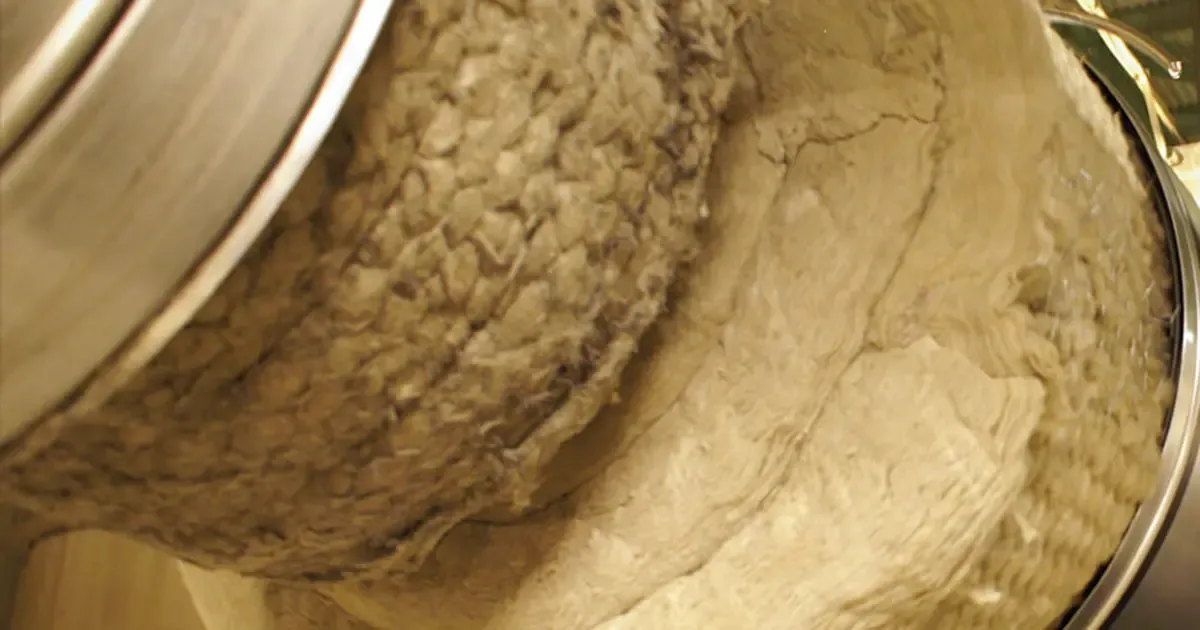
Rock wool (also called mineral wool or stone wool) is one of the most widely used inorganic insulation materials in construction and industry. If you are specifying it for a project, the two numbers that matter most are its continuous service temperature and its melting (sintering) point — and they are not the same. This guide explains both, with the real figures behind rock wool's temperature limit, A1 non-combustibility, and how it compares with glass wool and ceramic fiber.
Rock Wool Temperature Rating & Melting Point
Rock wool's long-term safe service temperature runs from cryogenic temperatures up to ≤ 650 °C, depending on product type, density, and binder.
- Standard rock wool: continuous-use ceiling of ≤ 650 °C. As an inorganic fiber it stays mechanically stable far below freezing, so the practical lower limit is set by moisture management rather than the fiber itself (see the cold-end section below).
- High-density basalt rock wool (≥ 120 kg/m³): engineered to hold ≤ 650 °C reliably for long duty cycles on industrial piping and thermal equipment.
- Short-term / sintering limit ≈ 1000 °C: at roughly this temperature the fibers begin to sinter — they lose elasticity and structural stability, and properties such as thermal conductivity and compressive strength degrade. The material can briefly see ~1000 °C, but it must not be specified for sustained service there.
Rule of thumb: treat ≤ 650 °C as the working ceiling and ~1000 °C as the structural / sintering limit. Anything above 650 °C for sustained duty calls for ceramic fiber.
Rock Wool Insulation Blanket (Rock Wool Blanket) is the typical flexible form for wrapping pipes, ducts, and equipment within this temperature band.
Melting Point vs Continuous Service Temperature
This is the distinction most specifiers miss. "Melting point" and "continuous service temperature" describe two completely different limits:
| Term | What it means | Rock wool figure |
|---|---|---|
| Continuous service temperature | The temperature the material can run at indefinitely for insulation duty without losing performance | ≤ 650 °C |
| Sintering / structural limit | The temperature at which fibers begin to soften, shrink, and lose structure | ≈ 1000 °C |
| Melting point (true melt) | The temperature at which the mineral fully liquefies | well above 1000 °C (not a usable limit) |
Why it matters: a material's melting point is not its operating temperature. Insulation is never run at its melting point — doing so would mean the fibers have already begun to sinter and fail. The number that belongs in a specification is the continuous service temperature (≤ 650 °C for rock wool), with the sintering point (~1000 °C) treated only as an absolute upper boundary for transient excursions.
The same logic applies to fire ratings. The A1 non-combustibility test (EN ISO 1182) exposes a rock wool sample to a 750 °C furnace — a test condition, not a service temperature. Rock wool passes because it neither burns nor contributes to fire growth, even under that test heat. Don't read the 750 °C test furnace as a working limit; the working limit stays at ≤ 650 °C.
What Does A1 Fire Rating Mean?
The A1 fire rating is the highest classification in the EN 13501-1 European standard for the reaction to fire of building products — it denotes a completely non-combustible material that contributes nothing to a fire. (An equivalent non-combustibility grade exists under other regional standards; EN 13501-1 is the most widely referenced in international projects.)
To earn A1, rock wool must pass the EN ISO 1182 non-combustibility test with:
- Furnace temperature rise ≤ 30 °C
- Mass loss ≤ 50%
- Sustained burning time t = 0 (no combustion)
- Gross heat of combustion PCS ≤ 2.0 MJ/kg (rock wool is usually far below this)
- No smoke toxicity (t0 class)
- No burning droplets (d0 class)
Rock wool achieves A1 because it is composed entirely of inorganic mineral fibers. Basalt rock wool with an acid coefficient (MK) ≥ 1.7 retains its structural integrity through the 750 °C test furnace. The continuous service temperature of ≤ 650 °C sits well inside this fire-test envelope — which is exactly why rock wool is trusted as a fire barrier.
For load-bearing and fire-rated assemblies, Rock Wool Board — Stone Wool Slabs provides the rigidity and dimensional stability needed.
Rock Wool vs Glass Wool vs Ceramic Fiber (Temperature)
Rock wool sits between glass wool and ceramic fiber on the temperature scale — making it the right choice for mid-to-high-temperature duty.
| Material | Long-term service temp | Short-term limit | Fire rating | Typical applications |
|---|---|---|---|---|
| Rock wool | ≤ 650 °C | ~1000 °C (sintering) | A1 | Building exterior walls, fire barriers, industrial pipe insulation, marine |
| Glass wool | −120 °C to ~400 °C | ~500–700 °C | A1 | Interior walls, steel-roof decks, HVAC ducts, acoustic |
| Ceramic fiber | 1100–1430 °C | 1600–1900 °C | A class | Industrial kilns, high-temp piping, power boilers, refining equipment |
Versus glass wool: glass wool's long-term limit is about −120 to 400 °C. Above 400 °C its thermal conductivity climbs sharply and its binder carbonizes between 300–500 °C, destroying structural strength. Glass wool is lighter, but it cannot match rock wool in sustained high-temperature service.
For a full breakdown of whether glass wool burns and its A1 non-combustible rating, see our dedicated guide.
Versus ceramic fiber: ceramic fiber serves 1100–1430 °C continuously with almost no shrinkage, but it is brittle. Rock wool's temperature ceiling is lower, yet its mechanical strength is higher — better for load-bearing structures — and its natural hydrophobicity keeps performance stable in humid environments. Above 650 °C for sustained duty, step up to ceramic fiber. For steam and process lines, Rock Wool Pipe Insulation is engineered for the ≤ 650 °C band.
What Affects Rock Wool's Temperature Resistance
Four factors decide how close to the limit you can safely run:
- Raw material — basalt vs slag: Basalt rock wool (SiO₂ 45.8–55.7 wt%, Al₂O₃ 13.2–19.1 wt%) sustains up to 650 °C. Slag-based wool, higher in CaO/MgO, typically caps lower and tends to powder and disintegrate at high temperature. The difference traces to the acid coefficient (MK): basalt MK ≥ 1.8 versus slag MK ≤ 1.5.
- Acid coefficient (MK = (SiO₂+Al₂O₃)/(CaO+MgO)): MK ≥ 1.8 gives better heat and chemical stability (up to 650 °C); MK ≥ 2.0 improves water and corrosion resistance for humid, high-temperature duty.
- Density and fiber structure: density normally spans 40–200 kg/m³; higher density means better heat resistance and lower shrinkage. High-density grades (100–140 kg/m³) hold dimension better, and fibers averaging ≤ 7 µm give higher compressive strength and heat-load temperature.
- Binder type: conventional phenolic binders tolerate only ≤ 250 °C; switching to an inorganic binder (e.g., aluminum silicate) lifts the product ceiling above 600 °C. Binder content should stay ≤ 3.0% — too much undermines heat performance.
Relevant product and test standards to ask for: EN 13162 (manufactured mineral wool products for buildings), EN 14303 (industrial insulation), EN ISO 1182 (non-combustibility), and EN 12667 / EN 12939 (thermal resistance).
Cold End: How Low Can Rock Wool Go?
Mechanically, rock wool is an inorganic fiber and remains stable at very low temperatures — there is no "cold melting point." The real limit at the cold end is moisture, not temperature.
Rock wool is open-cell and hygroscopic. Below about −50 °C, and especially at LNG temperatures around −160 °C, any water vapor that reaches the insulation will condense and then freeze, destroying the insulation value and adding enormous thermal mass. So the practical cold-service rule is: a hydrophobic grade with a continuous vapour barrier and metal jacketing is the standard specification down to about −50 °C. Below that, rock wool moves to a secondary or insulated-jacket role and closed-cell materials take the primary duty — see the cryogenic insulation applications guide.
Choosing the Right Rock Wool for Your Temperature
- Building exterior walls: specify basalt rock wool with MK ≥ 1.8 and density ≥ 120 kg/m³ for long-term heat and fire performance.
- Power-industry duty (boilers, turbines, duct linings): for system-level material selection and thickness, see our guide to rock wool in the power industry.
- Industrial high-temperature piping: match density to the operating temperature; above 650 °C for sustained duty, step up to ceramic fiber.
- Humid or wet environments: choose products with water-repellent rate ≥ 98% to prevent water uptake that raises thermal conductivity and lowers heat resistance.
- Above 650 °C equipment: use high-density or basalt rock wool plus metal jacketing for structural stability; in sulfurous or alkaline atmospheres, validate performance with project-specific testing.
- Cold service: a hydrophobic grade with continuous vapour barrier and metal jacketing is standard to about −50 °C; below that, see the cryogenic insulation applications guide.
- Always request third-party test reports — acid coefficient, density, thermal conductivity, and fire-resistance rating — before purchase.
Related Reading
- Ceramic Fiber vs Rock Wool for Furnace Linings: Which to Choose
- Best Heat-Resistant Materials for Furnace (2026 Guide)
- Rock Wool Insulation Hub — stone wool boards for thermal & fire protection
For a deeper dive into forms, temperature ratings, and application guides, see our ceramic fiber insulation hub.
Frequently asked
What temperature can rock wool withstand continuously? +
Standard and high-density basalt rock wool is rated for continuous use up to ≤ 650 °C. Short excursions toward ~1000 °C cause sintering (loss of structure), so 650 °C is the safe working ceiling for sustained service.
What is rock wool's melting point? +
Rock wool fibers begin to sinter (soften and lose structure) at about 1000 °C, so that is the practical structural limit rather than a true melt. The mineral itself melts at a much higher temperature, but above ~1000 °C the material should not be used for structural or insulating duty.
Is rock wool fireproof? What does A1 mean? +
Rock wool is A1 classified under EN 13501-1 — the highest non-combustibility grade. It does not burn, does not melt, and releases no toxic smoke or burning droplets (t0/d0). It contributes nothing to fire growth. The A1 test (EN ISO 1182) subjects it to a 750 °C furnace as a test condition, not a service temperature.
Rock wool vs glass wool — which withstands higher temperature? +
Rock wool by a wide margin. Rock wool serves ≤ 650 °C continuously (sintering ~1000 °C), while glass wool is limited to about −120 to 400 °C and its binder fails above 400–500 °C.
Rock wool vs ceramic fiber — which is better for high heat? +
Ceramic fiber wins on pure temperature (1100–1430 °C continuous) and shrinkage, but it is brittle. Rock wool's ceiling is ≤ 650 °C yet it has higher mechanical strength and natural water resistance, better for load-bearing and humid environments. Above 650 °C sustained, choose ceramic fiber.
What's the difference between rock wool's melting point and its continuous use temperature? +
They are different limits. The continuous service temperature (≤ 650 °C) is what you specify for ongoing duty; the sintering / melting point (~1000 °C) is where fibers begin to fail. Insulation is never run at its melting point, so the continuous-use figure — not the melting point — belongs in your specification.
Request a quote
Interested in our insulation solutions? Send us your requirements and our team responds within one business day.