
Glass Wool Acoustic Insulation: NRC & Application Guide
Glass wool acoustic insulation: NRC and αw by density and thickness, mass-spring-mass wall and ceiling constructions, machine-room enclosures, and rock wool acoustic panels compared.
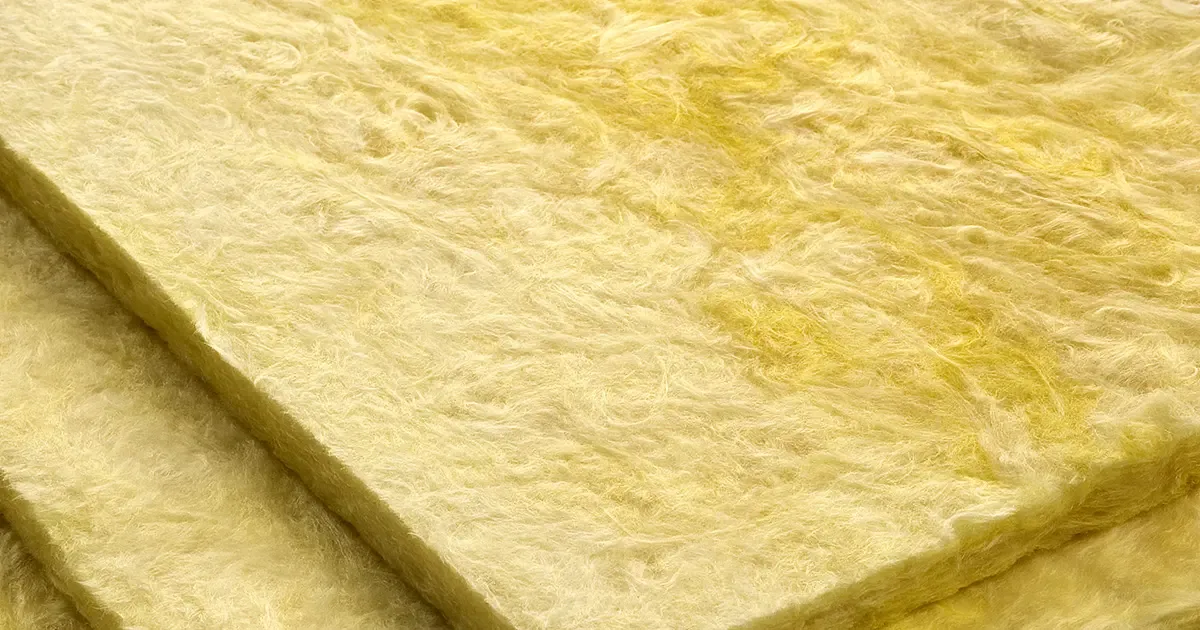
Glass wool acoustic insulation is one of the few building materials that simultaneously does two opposite jobs — it absorbs sound and it muffles heat loss — and most of the specification work is getting those two jobs to talk to each other rather than fight. This guide collects the noise-reduction coefficient (NRC) and weighted absorption coefficient (αw) data that actually controls an acoustic bid, the four application constructions that show up in 90% of projects (partition wall, ceiling lining, machine-room enclosure, duct lagging), the points where glass wool gives up and rock wool acoustic panels take over, and the parameter list every acoustic report needs before a project clears review.
For the material's thermal properties outside the acoustic context, see our industrial pipe insulation materials hub and the glass wool board applications page — this article stays strictly inside the acoustic frame.
What NRC and αw actually tell you
Most procurement teams reach for NRC first because it is the only number on the data sheet that combines the four speech-band frequencies (250, 500, 1000 and 2000 Hz) into a single figure. The arithmetic mean is rounded to the nearest 0.05. The range you will see on a glass wool line card is roughly 0.70 to 1.00, but the practical values cluster as follows:
| Configuration | NRC | αw | Test standard |
|---|---|---|---|
| 50 mm, 24 kg/m³ | 0.85 | 0.75 | ASTM C423 / ISO 354 |
| 50 mm, 48 kg/m³ | 0.95 | 0.90 | ASTM C423 / ISO 354 |
| 100 mm, 48 kg/m³ + 100 mm cavity | 1.00 | 0.95 | ASTM C423 / ISO 354 |
| 25 mm, 32 kg/m³ (direct-mount) | 0.60 | 0.55 | ASTM C423 / ISO 354 |
The numbers hide three traps. First, NRC is speech-band only — it says nothing about low-frequency rumble (50–125 Hz), which is exactly where HVAC noise and traffic noise live. Second, αw is the figure you use for international certification (ISO 11654 / EN ISO 11654) because it weights the absorption curve by human-ear sensitivity; a 0.05 difference in αw can swing a project onto the design-corrective-action list. Third, what the suppliers print on a brochure and what a third-party reverberation-room test shows can differ by 0.10 — always ask for the test report, not the brochure.
How glass wool absorbs and isolates sound
The absorption mechanism is the part that surprises people coming from thermal insulation: it has nothing to do with density per se and everything to do with air friction in micro-channels. Glass fibres typically 5–8 µm in diameter pack into a felt that is 95% air by volume. When a sound wave enters the felt, the air molecules next to each fibre vibrate against the fibre wall, and viscous drag converts that motion into heat. The absorption coefficient therefore rises steeply with thickness (more air column to friction against) and only mildly with density (more fibres per cm³ to friction against), until density crosses about 120 kg/m³ — beyond which the felt becomes acoustically reflective and absorption drops.
The isolation mechanism (Rw, sound transmission loss) is a different story. A glass wool batt alone is a terrible sound barrier — at 50 mm and 48 kg/m³ it reaches maybe 18 dB Rw, which is irrelevant next to a 9 dB drop from a single electrical outlet. Real isolation comes from composite systems built on the mass–spring–mass principle:
- Mass layer 1 — high surface density (12 mm gypsum ≈ 10 kg/m² ≈ 30 dB by mass law)
- Spring layer — air cavity 50–100 mm deep, sometimes with damping material
- Mass layer 2 — second gypsum or steel sheet
- Absorption cavity fill — glass wool, packed to about 45 kg/m³ to break the cavity resonance without choking the air spring
Two 12 mm gypsum boards bracketing a 50 mm glass wool cavity at 48 kg/m³ reach a laboratory STC in the 50–58 dB range. Add a 3 mm butyl-rubber damping sheet between one gypsum face and the studs and the same build can climb to 58–63 dB — a noticeable step change for the marginal cost of one damping sheet.
For the broader composite-wall story including the dual-layer layouts that pair glass wool with rock wool acoustic panels, see our rock wool acoustic panels page, which covers the higher-density half of the product range.
Partition wall construction
The reference partition for residential and office work looks like this, from one face to the other:
Face A  — 12 mm gypsum board
Studs   — light-gauge steel C 50 × 30 × 0.6 mm, 400 mm centres,
          on 5 mm EPDM isolators (decoupled from structure)
Cavity  — 50 mm glass wool, 48 kg/m³, friction-fit between studs
Damping — 3 mm butyl-rubber mass-loaded vinyl (optional)
Face B  — 12 mm gypsum board
Total wall thickness: 130–150 mm. Rw 50–58 dB in lab test (35–45 dB in the field, after electrical outlets and services). The four installation points that decide whether the wall hits the rated value or underperforms by 8–10 dB are:
- Stud isolation — studs must NOT touch the surrounding structure. An EPDM strip under the bottom track and a continuous bead of sealant at the head is non-negotiable.
- Batt continuity — joints staggered at least 50 mm. Any gap wider than about 5 mm at a panel joint drops the field rating by roughly 10 dB.
- Service penetrations — switch boxes back-to-back on the same stud bay are the single most common failure. Offset them by at least one stud cavity.
- Damping sheet continuity — if used, the sheet must wrap the perimeter of the partition, not stop short at the corners.
The batt at 48 kg/m³ is an acoustic choice, not a thermal one — at lower densities you get the same Rw with thicker material, which trades stud depth for dollars. The glass wool batt for these partitions is supplied in rolls cut to fit a 600 mm stud bay; for the material range see our glass wool blanket product page.
For heavyweight venues (recording studios, dubbing rooms, music practice rooms) the same system steps up to 15 mm gypsum both faces, 0.8 mm steel studs at 300 mm centres, 100 mm glass wool at 60 kg/m³, 5 mm damping sheet, and pulls Rw 58–65 dB.
Ceiling lining construction
Ceiling acoustics usually work against thermal insulation rather than with it: the question is how much sound absorption you can stack over a roof slab without losing the thermal R-value. The reference layering for office and conference-room builds:
- 12 mm gypsum board (the finished face)
- 50 mm glass wool at 32 kg/m³, with a 50 mm air gap above it
- 100 mm thermal glass wool at 24 kg/m³, adhered to the slab soffit
The split is intentional: the lower-density felt absorbs (mid–high speech band), the higher-density layer above adds the thermal break. Combined absorption rating sits around NRC 0.85 and αw 0.75 at 100 mm total build.
For cinema and auditorium work the layering gets a damping sheet and the construction rises to 100 mm glass wool at 48 kg/m³ in a 100 mm cavity, with NRC above 0.95 and αw 0.90. The construction should be hung on decoupled hangers (spring or rubber-in-shear type, 60–80 cm grid), and any lighting or sprinkler penetrations through the lining must be sealed with non-setting acoustic sealant — a single unsealed down-light can leak 4–6 dB.
Machine-room acoustic enclosures
Acoustic enclosures around pumps, compressors, gensets and chillers are the place where glass wool earns its keep most decisively, because the noise source has a defined spectrum and a defined surface area. The reference enclosure, for a unit operating at 85–95 dB(A) free-field:
Outer skin — 2–3 mm galvanised steel sheet
Damping    — 2 mm bitumen-based damping mat (loss factor ≥ 0.3)
Cavity     — 60–100 mm air gap
Inner fill — 50 mm glass wool, 48 kg/m³, behind 0.8 mm perforated
             galvanised steel (perforation 20–30%, hole Φ3 mm)
Inner face — perforated steel skin (sound enters, is absorbed, cannot
             reflect back into the cavity)
Insertion loss target — 35–45 dB(A)
Three rules determine whether the enclosure meets the rated insertion loss (IL) or merely looks like it does. The leakage area (gaps around doors, pipe penetrations, cable glands) must stay below 10% of the total enclosure surface area; for every doubling of leakage area the IL drops by roughly 3 dB. Every duct into the enclosure needs a flexible connector and an acoustic splitter silencer rated at 25 dB(A) or better. The door should be a double-seal acoustic door with cam-lift hinges — a standard industrial door is the second-largest leak after the ventilation path.
For high-temperature enclosures (boiler rooms, exhaust manifolds, furnace plenums) the glass wool has to be the foil-faced high-density variant (80 kg/m³, 80 mm) and the damping mat upgraded to a high-temperature grade rated to at least 500 °C. Rated IL drops to 30 dB(A) but the working life inside the rated temperature window rises to the same 40-year envelope as the industrial insulation stack.
Where glass wool's 400 °C ceiling is the binding limit, the enclosure can either step up to a rock wool acoustic panel inner skin or carry a separate thermal barrier outside the acoustic layer.
Glass wool vs rock wool acoustic panels
When the question moves from "what absorbs" to "what survives", glass wool and rock wool acoustic panels start to diverge:
| Property | Glass wool | Rock wool acoustic panel |
|---|---|---|
| Thermal conductivity (W/(m·K)) | 0.035–0.040 | 0.040–0.045 |
| Continuous service temperature | ≤ 400 °C | ≤ 700 °C |
| Fire classification (EN 13501-1) | A1 non-combustible | A1 non-combustible |
| Mid–high frequency α (500–2000 Hz) | 0.80–0.95 | 0.70–0.85 |
| Low-frequency α (125 Hz, 50 mm) | 0.20–0.40 | 0.30–0.45 |
| Hydrophobicity | ≥ 98 % | ≤ 80 % |
| Chemical stability | pH 7–8, neutral | Slightly alkaline; can corrode unprotected steel |
| Density range for acoustic use | 24–100 kg/m³ | 40–200 kg/m³ |
| Cost per acoustic-Rw unit | Lower | 30–60 % higher |
The rule of thumb that holds across most projects: glass wool for indoor conditioned space where mid–high frequency absorption is the goal; rock wool where continuous surface temperature exceeds 250 °C, where hydrocarbon or solvent exposure is a possibility, or where mechanical robustness is critical (industrial walls, mechanical-room soffits, plant rooms). The two materials can be combined in a single build — a thin low-density glass wool layer for absorption plus a higher-density rock wool facing for impact and fire — but every combined layer adds labour and the design must show why the combination is worth doing.
Acoustics is one of seven decision axes; temperature, fire, density and cost are the others, set out in our glass wool vs rock wool comparison across all six forms.
Acoustic-report parameter checklist
An acoustic report that gets accepted by a reviewer on the first pass covers five blocks. Skip one and the report goes back for revision:
- Material identity — type (glass wool), form (board / blanket / loose fill), density (kg/m³), thickness (mm), fibre diameter (µm), facing (none / foil / glass cloth / VIP), fire classification (EN 13501-1 letter and year), hydrophobicity rating if in service.
- Acoustic data — six-band α values at 125, 250, 500, 1000, 2000, 4000 Hz; NRC rounded to 0.05; αw with shape indicator; Rw for any composite system tested as a unit (not for the glass wool alone).
- Installation conditions — stud or joist depth and spacing, cavity depth, presence of damping sheet, mounting method (direct / spaced / suspended), any deviation from the tested configuration.
- Test provenance — reverberation-room volume (≥ 200 m³ per ISO 354), third-party lab accreditation, date of test, test report number that can be cross-referenced.
- Scope of validity — frequency band over which the data is reliable, conditions under which the rating is invalidated (humidity above 70 %, surface temperature outside the rated window, mechanical loading beyond design), and the limit of applicability to similar but not identical builds.
For moisture-exposed service, the hydrophobicity rating needs to be > 98 %; the glass wool blanket waterproofing page sets out the testing protocol. For purely thermal context where acoustic is secondary, the glass wool board applications page covers the construction-trade reading.
Where glass wool acoustic insulation is the wrong answer
Three situations trip up the unwary. Low-frequency-only sources (transformer hum, large compressor pulsation) need a thick cavity and tuned damping — glass wool alone at 50 mm cannot bring a 63 Hz tone below the design threshold. Outdoor service without a vapour-tight facing is a maintenance trap; even at 98 % hydrophobicity, the long-term water-vapour transmission rate will degrade αw by 0.10 over a five-year cycle. Plenum return air in HVAC systems has strict surface-speed limits (around 3–5 m/s for glass wool faced with a glass cloth, lower for unprotected felt) — above those limits fibres shed and the supply stream becomes the indoor air-quality problem.
In each of those cases, the engineering fix is not "more glass wool" but a different acoustic strategy: tuned-mass dampers for low frequency, foil-faced hydrophobic batts for outdoor service, and high-density rigid boards for plenum return. The right move is to identify these at specification stage rather than discover them in the post-installation acoustic test.
Glass wool acoustic insulation stays the right answer in roughly 80% of indoor commercial builds; the work is choosing the density and thickness that actually reaches the rated NRC and verifying with a third-party test report rather than a brochure number.
Quick specification summary
A starting configuration that resolves most indoor commercial acoustic bids without further iteration:
- Partition wall: 50 mm glass wool at 48 kg/m³ between 50 mm light-gauge steel studs on EPDM isolators, finished both faces with 12 mm gypsum → Rw 50–58 dB.
- Ceiling lining: 50 mm glass wool at 32 kg/m³ in a 50 mm air cavity, under 12 mm gypsum → NRC 0.85, αw 0.75.
- Machine-room enclosure: 50 mm glass wool at 48 kg/m³ inside a 60–100 mm cavity, behind 0.8 mm perforated steel with 20–30 % open area, plus 2 mm damping mat and 2–3 mm outer steel skin → IL 35–45 dB(A).
- Step up to rock wool acoustic panels: surface temperature > 250 °C, hydrocarbon exposure, or mechanical impact is foreseeable.
- Always request from supplier: third-party ASTM C423 / ISO 354 test report with six-band α data, NRC rounded to 0.05, and αw with shape indicator.
Anything outside that envelope — large low-frequency tones, outdoor service, plenum return air, or a project-specific fire classification — needs its own design pass before the bid locks in.
Frequently asked
What NRC should I specify for a glass wool acoustic ceiling? +
For office and conference work the target is NRC ≥ 0.85 with αw ≥ 0.75; for cinemas, auditoria and recording studios it rises to NRC ≥ 0.95 with αw ≥ 0.90. Both are reached at 50 mm and 48 kg/m³, or at 100 mm with a 50 mm cavity behind a perforated facing.
Can glass wool replace rock wool acoustic panels in a partition wall? +
Yes, when the surface temperature stays below 250 °C and there is no hydrocarbon exposure; in those conditions glass wool at 48 kg/m³ matches or slightly exceeds rock wool for mid–high frequency absorption. At higher temperatures or where mechanical robustness matters, rock wool remains the better choice.
Does 100 mm glass wool beat 50 mm glass wool for soundproofing? +
Doubling thickness from 50 mm to 100 mm typically gains 4–6 dB of Rw in a composite system and shifts the low-frequency absorption edge down by roughly an octave. The exact gain depends on whether the cavity is still air-filled or damped; in a tuned build the difference can be larger.
What does αw mean and how is it different from NRC? +
NRC is the arithmetic mean of four speech-band absorption coefficients, reported to 0.05. αw is the weighted sound-absorption coefficient that follows ISO 11654 / EN ISO 11654 and reflects human-ear sensitivity across the spectrum. A material with NRC 0.90 can have αw anywhere from 0.70 to 0.95 depending on the absorption curve shape.
How does humidity affect glass wool acoustic performance? +
Above 70 % relative humidity, NRC typically falls by 8 to 12 % because water vapour displaces the air in the felt and changes the viscous damping. For high-humidity service, specify glass wool with a hydrophobicity rating of at least 98 % and a facing that breaks the moisture path.
What density of glass wool is best for a partition wall? +
48 kg/m³ is the working density for most partition walls. Below 32 kg/m³ the cavity resonance grows and Rw drops; above 80 kg/m³ the felt becomes acoustically reflective and mid-frequency absorption falls off. The 48 kg/m³ value is a balance point between cavity filling and acoustic mass.
Is glass wool safe to use in a machine-room enclosure? +
Yes, when the surface temperature stays under 400 °C. For pumps and compressors at 85–95 dB(A) free-field, a 50 mm glass wool inner layer at 48 kg/m³ inside a damped steel enclosure reaches 35–45 dB(A) insertion loss and stays within the material's rated temperature window.
What fire rating do glass wool acoustic panels need? +
For commercial interior use in most jurisdictions the requirement is EN 13501-1 A1 or A2-s1, d0 (non-combustible or limited combustibility, no smoke, no flaming droplets). Glass wool at 24 kg/m³ and above meets A1 by composition; verify the test report cites a third-party lab and a current standard version.
Can I install glass wool acoustic insulation myself? +
For partitions and ceiling linings, yes — batts are lightweight and cut with a long knife. For machine-room enclosures and any composite system that needs to meet a rated IL figure, the installation should be carried out by an acoustic contractor because a 5 mm gap at a stud joint can drop the field rating by 10 dB.
Where should I go first when I have a number to hit and a budget to keep? +
Start with the dominant constraint — temperature, frequency band, or Rw value — and pick the configuration from the partition/ceiling/enclosure tables in this guide that meets it. Then verify the supplier test report is current and third-party, and have the installer confirm that gaps, penetrations and damping-sheet continuity are within tolerance.
Request a quote
Interested in our insulation solutions? Send us your requirements and our team responds within one business day.