
Ceramic Fiber vs Rock Wool for Furnace Linings: Which to Choose
A data-backed comparison of ceramic fiber and rock wool for industrial furnace linings — temperature limits, conductivity curves, thermal cycling, form factors, and life-cycle cost.
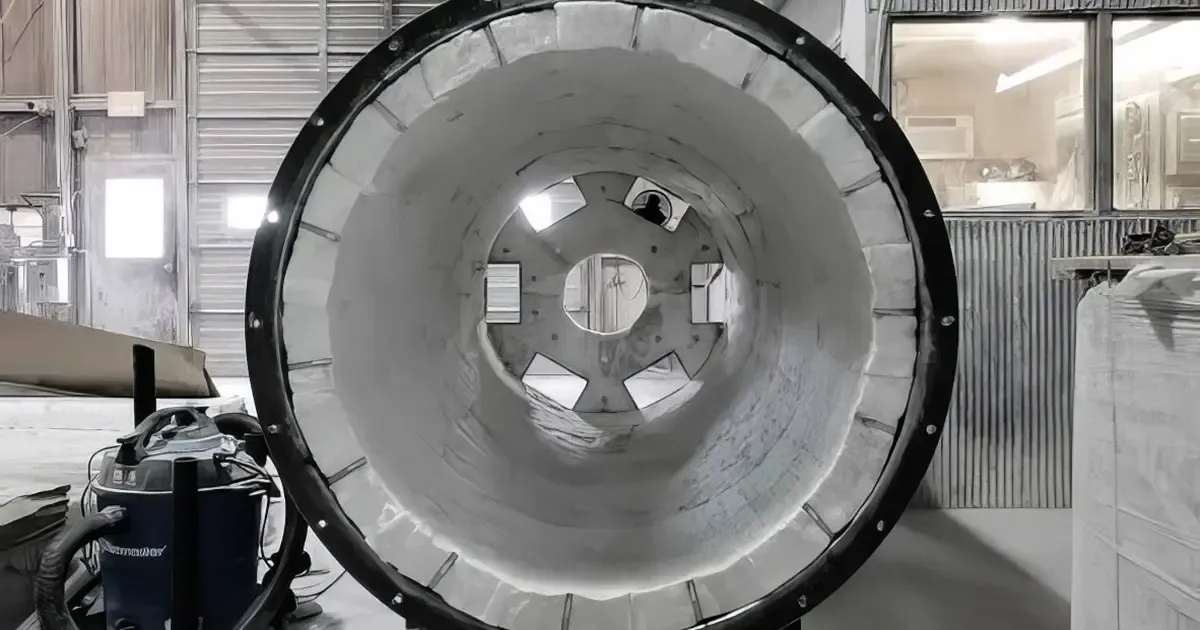
Ceramic Fiber vs Rock Wool for Furnace Linings: Which to Choose
Choosing between ceramic fiber and rock wool for a furnace lining is rarely a toss-up — it is a temperature-and-duty decision. Below ~650°C the two materials overlap and rock wool wins on cost; above that threshold they diverge completely, and ceramic fiber becomes the only viable hot-face option. This guide is a single-point, head-to-head comparison for furnace duty. For the full multi-material selection matrix (castables, microporous, calcium silicate, and more), see our https://www.rosetexwool.net/news/best-heat-resistant-materials-furnace-2026/[heat-resistant materials for furnaces guide], and for the mechanics of anchoring ceramic fiber modules, see our https://www.rosetexwool.net/news/ceramic-fiber-module-installation-anchoring-guide/[ceramic fiber module installation guide].
Material Basics: Composition & Structure
Ceramic fiber (also called refractory ceramic fiber, RCF) is an alumina-silica melt spun or blown into fine inorganic filaments. Standard grades are 45–55% Al₂O₃; high-purity and zirconia grades push the temperature ceiling higher. Rock wool (stone wool) is made by melting basalt and blast-furnace slag at ~1,400–1,500°C and centrifuging the melt into mineral fibers, then bonding them with a phenolic or formaldehydefree organic binder.
The structural consequence matters: ceramic fiber has no organic binder and almost no crystalline water, so it does not chemically degrade when heated. Rock wool's mechanical integrity depends on its binder, which burns off early in any furnace duty. That single difference explains most of the failure modes below.
Temperature Limits: The Decisive Difference
| Material | Continuous service | Upper practical limit | What happens beyond |
|---|---|---|---|
| Ceramic fiber (standard) | 1,000–1,260°C | 1,260–1,430°C (high-purity) | Zirconia grades to 1,600°C+ |
| Rock wool | ≤ 650°C | ~750–800°C short term | Binder burns off; fibers sinter and soften toward ~1,000°C melt |
The rule is simple: if the hot-face temperature exceeds about 650°C, rock wool is out. Above that line, ceramic fiber is not "better" — it is the only material that still functions. Rock wool's rated 1,000°C figure is a melt point, not a service temperature; continuous operation past 650°C causes rapid binder burnout and shrinkage.
Thermal Conductivity: Why Ceramic Fiber Wins Above 600°C
Thermal conductivity is where the two materials look similar when cold but diverge sharply when hot. Representative published ranges (W/m·K at mean temperature):
| Mean temp | Rock wool | Ceramic fiber |
|---|---|---|
| 200°C | 0.055–0.065 | 0.050–0.058 |
| 400°C | 0.110–0.130 | 0.085–0.095 |
| 600°C | 0.190–0.220 (near limit) | 0.125–0.140 |
| 800°C | N/A (exceeded) | 0.175–0.195 |
| 1,000°C | N/A (exceeded) | 0.230–0.260 |
Below 300°C rock wool and ceramic fiber are close. But rock wool's conductivity climbs steeply past 300°C and hits its practical ceiling at 600°C, while ceramic fiber stays comparatively low even at 1,000°C. In practice this means a ceramic fiber lining can hold the same shell temperature with a thinner wall — or a cooler shell with the same thickness — at any furnace-relevant temperature.
Thermal Mass & Energy Efficiency: Faster Cycles, Lower Fuel
Ceramic fiber's heat-storage capacity is roughly one-tenth that of dense refractory brick and substantially lower than dense rock wool batts. For batch furnaces that cycle between ambient and operating temperature, that low thermal mass is decisive:
- The lining absorbs far less energy on heat-up, so the furnace reaches temperature faster.
- Cool-down is quicker, shortening cycle time and raising throughput.
- Compared with traditional brick construction, a ceramic fiber lining can cut total heat loss by up to 30%, directly reducing fuel consumption.
Rock wool's higher density works against it here: more energy is parked in the lining itself rather than delivered to the product.
Thermal Cycling & Dimensional Stability
This is the failure mode most often missed in spec sheets. Rock wool relies on organic binder for rigidity. Above roughly 250°C the binder burns off; in a vertical wall this causes slumping — the insulation droops and leaves uninsulated voids at the top of the casing. Near its 650°C limit, rock wool fibers sinter and undergo linear shrinkage of about 4%, opening cracks and shell hot-spots.
Ceramic fiber has no binder to lose. Its needle-locked fibers keep their structure through rapid heating and cooling, and standardized linear shrinkage stays below 2–3.5% even after 24 hours at 1,260°C. In module form it is installed pre-compressed 15–25%, so it expands laterally to fill joints and compensates for that small residual shrinkage over the lining's life. See our https://www.rosetexwool.net/news/ceramic-fiber-module-installation-anchoring-guide/[module anchoring guide] for the pre-compression and anchor-alloy logic.
Density, Water Resistance & Acoustics
Rock wool is denser, dimensionally rigid, and an excellent sound absorber. It is also moisture-resistant and contains no respirable crystalline silica, which makes it the default for HVAC, building envelopes, and acoustic panels. Ceramic fiber is light (typically 96–128 kg/m³ for blanket) with only moderate acoustic performance, though hydrophobic-treated grades resist water pickup.
For furnace duty these differences are secondary — but they explain why rock wool still wins in the low-temperature, weight-insensitive, noise-sensitive parts of a plant that a furnace serves.
Form Factors: Blanket, Module, Board, Castable
| Form | Ceramic fiber | Rock wool |
|---|---|---|
| Flexible blanket | Yes — needle felt | Yes — batts |
| Module (anchored) | Yes — folded/stacked, hot-face | No — cannot survive furnace temp |
| Rigid board | Yes — up to ~1,260°C | Yes — but ≤ 650°C |
| Castable / monolithic | Yes — via bonding | No |
For furnace hot-face work, the ceramic fiber module is the workhorse: it delivers full-thickness low-mass lining in pre-compressed units anchored to the casing. Rock wool's board and blanket only apply to low-temperature sections (ducts, cold-face backup, building envelopes). Product pages: https://www.rosetexwool.net/products/ceramic-fiber-blanket/[ceramic fiber blanket] and https://www.rosetexwool.net/products/rock-wool-blanket/[rock wool blanket].
Installation & Maintenance
Ceramic fiber blanket and modules are light, cut easily, and can be handled by one or two workers even on complex geometries. Modules use a stainless or high-alloy anchor system chosen by tip temperature — the selection logic is detailed in our https://www.rosetexwool.net/news/ceramic-fiber-module-installation-anchoring-guide/[installation guide]. Maintenance is modular: a damaged module is replaced as a unit.
Rock wool arrives as heavier rigid slabs better suited to straight runs and flat surfaces; it is harder to fit to curved furnace shells. More importantly, in furnace duty it is not really maintainable — once it reaches temperature it degrades, so "repair" means replacement with the correct high-temperature material.
Life-Cycle Cost: Why Ceramic Fiber Often Wins
Ceramic fiber costs more per cubic meter — often several times the price of rock wool. But total cost of ownership tells a different story for furnace service:
- A thinner ceramic fiber lining means a smaller furnace shell and less steel.
- 15–20% lower fuel use and up to 30% less heat loss cut operating cost every hour the furnace runs.
- Faster cycles raise throughput; longer high-temperature life cuts relining frequency.
In continuous or frequently-cycled furnaces the payback on the ceramic fiber premium is often well under two years. Rock wool's low price is real only where its temperature limit is never approached.
Environmental & Health Considerations
Ceramic fiber contains inhalable fibers and requires PPE during cutting and handling; modern low-bio-persistence (LBP) and alkaline-earth silicate (AES) fibers, covered in our https://www.rosetexwool.net/news/alumina-aes-furnace-lining-applications/[AES furnace lining guide], are markedly safer. Rock wool is non-toxic, A1 non-combustible, and free of crystalline silica. Both demand controlled installation; neither should be loose-fiber handled without protection.
Furnace Type Fit: Batch, Continuous, Reformer
- Batch furnaces (heat-treat, forge, periodic kilns): ceramic fiber's low thermal mass delivers the biggest gain — faster turnaround and lower fuel per cycle.
- Continuous / tunnel kilns: ceramic fiber modules with pre-compression keep shrinkage compensated and the lining stable over years of operation.
- Reformers, crackers, and >1,000°C process heaters: standard ceramic fiber or polycrystalline mullite modules (see our https://www.rosetexwool.net/news/polycrystalline-fiber-modules-spec-installation-applications/[polycrystalline module guide]) are required; rock wool is limited to low-temperature headers and ductwork.
- Cement rotary kilns and similar: our https://www.rosetexwool.net/news/cement-kiln-thermal-protection-insulation-engineering/[cement kiln insulation guide] shows the layered refractory-ceramic fiber approach.
- Steel and metals processing: see our https://www.rosetexwool.net/applications/iron-steel/[iron and steel applications].
Rock wool's legitimate furnace-adjacent role is limited to doors, low-temperature ducting, and cold-face backup below 650°C.
Which Should You Choose? (Decision Checklist)
Choose ceramic fiber when:
- Hot-face temperature exceeds ~650°C.
- The furnace cycles frequently (thermal shock and fast turnaround matter).
- Weight or shell size is constrained.
- Fuel cost and throughput dominate the economics.
Choose rock wool when:
- Temperature stays below 600°C.
- Rigidity, acoustic control, or moisture resistance lead.
- Budget is the primary constraint and duty is non-critical.
For most furnace hot-face applications the answer is ceramic fiber; rock wool and ceramic fiber are complementary across the plant, not head-to-head rivals. For the complete material shortlist, consult our https://www.rosetexwool.net/news/best-heat-resistant-materials-furnace-2026/[furnace material selection guide]. Need a specific lining design? https://www.rosetexwool.net/contact/[Contact our engineers] for a quote.
Related Reading
- https://www.rosetexwool.net/news/ceramic-fiber-module-installation-anchoring-guide/[Ceramic Fiber Module Installation & Anchoring Guide]
- https://www.rosetexwool.net/news/best-heat-resistant-materials-furnace-2026/[Heat-Resistant Materials for Furnaces: 2026 Selection]
- https://www.rosetexwool.net/news/polycrystalline-fiber-modules-spec-installation-applications/[Polycrystalline Fiber Modules: Spec & Installation]
- https://www.rosetexwool.net/news/refractory-board-selection-calsil-ceramic-fiber/[Refractory Board Selection: Calsil vs Ceramic Fiber]
- https://www.rosetexwool.net/news/cement-kiln-thermal-protection-insulation-engineering/[Cement Kiln Thermal Protection & Insulation]
Explore the full Rosetexwool product range — ceramic fiber, rock wool, calcium silicate, microporous aerogel and glass wool — with specification tables and application notes for each family.
For board-format calcium silicate insulation rated up to 1100 °C and classified A1 non-combustible, see our calcium silicate insulation board product page.
Explore flexible aerogel and microporous insulation options in our aerogel insulation guide.
Frequently asked
Can rock wool be used inside a furnace? +
Only if the continuous operating temperature stays below about 650°C. Above that, rock wool loses its binder, slumps, and eventually sinters toward its ~1,000°C melt point. For any hot-face furnace lining, ceramic fiber is required.
Is ceramic fiber better than rock wool? +
Not in every case. Ceramic fiber wins above roughly 650–750°C and wherever thermal shock, low weight, or fast cycling matter. Rock wool wins on cost, rigidity, and low-temperature performance below 600°C, plus acoustic control. They are complementary, not strictly competing.
What temperature can ceramic fiber withstand? +
Standard grades serve 1,000–1,260°C continuously; high-purity grades reach 1,350°C and zirconia grades 1,250–1,350°C, with special products rated to 1,600°C and beyond. Its low thermal mass also improves furnace energy efficiency by 15–20%.
Can ceramic fiber fully replace rock wool? +
For high-temperature furnaces, yes — ceramic fiber is the correct substitute. For buildings, HVAC, and acoustic or moisture-sensitive low-temperature service, rock wool remains the better and cheaper choice. The two cover different zones of the same plant.
Why does rock wool degrade above 600°C while ceramic fiber holds? +
Rock wool depends on an organic binder for rigidity. That binder burns off above ~250°C, causing slumping in vertical walls, and near 650°C the fibers sinter with ~4% linear shrinkage, opening cracks. Ceramic fiber is binder-free and only shrinks 2–3.5% even at 1,260°C, with modules pre-compressed to compensate.
Is the higher cost of ceramic fiber justified for furnaces? +
In furnace duty, usually yes. The premium per cubic meter is offset by a thinner lining (less steel), 15–20% lower fuel use, up to 30% less heat loss, faster cycles, and longer life. Payback on continuous or cycled furnaces is often under two years; rock wool's low price only pays off where its temperature limit is never approached.
Request a quote
Interested in our insulation solutions? Send us your requirements and our team responds within one business day.