
Refractory Board Selection: Calcium Silicate vs Ceramic Fiber Board for Furnace Linings
How to choose refractory board for a furnace lining: hot face or back-up duty, batch or continuous cycling, gas velocity, slag and alkali exposure.
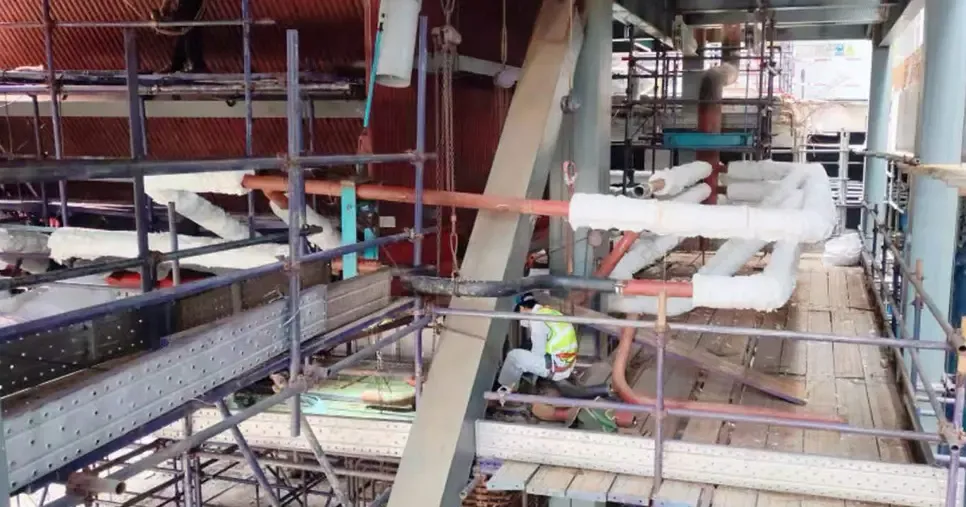
Quick answer: For refractory duty, pick the board by position in the lining first, then by cycling, then by chemistry — not by thermal conductivity. A refractory board in the back-up position behind brick or castable, running continuously below about 1,000 °C, is best served by calcium silicate board: it carries load, spans supports and costs less per cubic metre. A board on the hot face of a batch furnace — door, roof, ladle cover, kiln car, burner block — should be ceramic fiber board, because low heat storage and thermal shock resistance matter more there than compressive strength. Above roughly 1,050 °C, ceramic fiber board is the only option of the two.
Almost every industrial furnace ends up using both refractory board types, in a composite furnace lining. The boards are not competing for the same job; they are doing different jobs in the same wall.
Most selection guides stop at two numbers: maximum temperature and thermal conductivity. Both of those matter, and neither decides a refractory lining. What decides it is where the board sits in the furnace lining, how often the temperature swings, and what the gas and melt are doing to the surface. This guide works through all three, then turns them into a five-step procedure that ends with a refractory lining specification you can hand to a supplier.
Why a General Material Comparison Is Not Enough
A side-by-side comparison of calcium silicate board and ceramic fiber board is a useful starting point, and we have published one. It is also, on its own, not enough to specify refractory board.
The reason is that a furnace lining is a system, and each position in that system imposes a different set of demands. The board behind the working lining is asked to insulate, carry load and stay put for a campaign. The board facing the flame is asked to survive thermal shock, resist gas velocity and not store so much heat that every cycle wastes fuel. Different jobs, different failure modes, and often different materials in the same wall.
Three axes decide it:
- Duty position — hot face or back-up.
- Operating cycle — continuous and steady, or batch and cycling.
- Environment — gas velocity, dust, slag, molten metal, alkali and acid.
Get these three wrong and no data-sheet value will save the refractory lining. Get them right and the material choice usually becomes obvious. It is also worth saying what is not on the list: thermal conductivity. It appears later in this guide because it matters, but it belongs at the end of the reasoning rather than the start.
Calcium Silicate and Ceramic Fiber Board: The Material Baseline
Before the duty assessment, it helps to know what the two boards are. One clarification matters up front: the refractory board discussed here is the lightweight insulation grade of calcium silicate board, around 170–270 kg/m³. That is not the same product as the dense building board used for fire-rated partitions, which runs several times heavier. Data for the building board cannot be used for refractory lining design.
| Property | Calcium silicate board (insulation grade) | Ceramic fiber board (vacuum formed) |
|---|---|---|
| Temperature class | Tobermorite-based ≈650 °C; xonotlite-based 1,000–1,050 °C; ASTM C533 Type II continuous ≈927 °C | Classification 1,260 / 1,360 / 1,430 °C (zirconia); continuous use = classification minus roughly 100–150 °C; polycrystalline alumina fibre to 1,600 °C |
| Density | 170–270 kg/m³ (light 170–200, standard 200–240, high density 240–270) | 250–350 kg/m³, special orders to about 400 kg/m³ |
| Thermal conductivity | 0.05–0.06 W/(m·K) at 70 °C; 0.08 at 200 °C; 0.10 at 400 °C; 0.10–0.12 at 600 °C; 0.13–0.15 at 1,000 °C | 0.06 W/(m·K) at 200 °C; 0.085 at 400 °C; 0.11–0.16 at 600 °C; 0.132 at 800 °C; 0.18–0.19 at 1,000 °C |
| Mechanical strength | Flexural 0.3–0.55 MPa, high density grades above 1.0 MPa; compressive 0.35–2.0 MPa | Compressive 0.2–0.8 MPa; edges are brittle and the board must be anchored and supported |
| Permanent linear change | ≤2 % after 3 h at rated temperature; 1.3–1.8 % on high-purity grades | ≤3.0 % after 24 h at 1,000 °C; ≤3.5 % after 24 h at 1,350 °C |
| Thermal shock | Moderate to poor; rapid heating and cooling cracks it, and site breakage rates are high | Excellent; the first choice for batch plant, furnace doors and covers |
| Gas velocity and abrasion | Hard and dense, tolerates light abrasion better | Stiffer than blanket, but hot faces above about 5 m/s need surface hardening |
| Chemical resistance | Silicate based; not resistant to HF or strong alkali; must not contact molten steel or slag | Resists weak acid and weak alkali; not wetted by molten aluminium; not for direct contact with molten steel or aggressive slag |
| Water and fabrication | High water absorption, becomes fragile when wet, higher cutting loss | Can be made water repellent, absorbs almost nothing, suited to precision machining of shaped parts |
| Heat storage | High heat capacity | Low heat capacity; fast heat-up and real fuel savings on batch plant |
| Cost position | Mid to low price; high value as a back-up layer | Higher cost per cubic metre; justified at high temperature or where shapes must be machined |
| Typical standards | ASTM C533; EN 14306 | ASTM C892; EN 1094-1 |
Two entries in that table deserve emphasis, because they cause the most argument on site. The density figures put calcium silicate board and ceramic fiber board in the same broad band, so weight is rarely the deciding factor. And the conductivity figures overlap across most of the working range, which we return to below.
Axis 1 — Duty Position: Hot Face or Back-Up
The first question is simply where in the refractory lining the board goes.
Back-up and outer layers — behind refractory brick or castable, in flues, in vessel insulation layers, and as external fire barriers on furnace shells. Here calcium silicate board is usually the right refractory board. It is rigid, it carries load, it can span between supports without sagging, it tolerates light abrasion, and it is the more economical back-up insulation. High density grades are specified where the back-up layer has to carry mechanical load, and the difference in load-bearing capacity between a 240 kg/m³ board and a 170 kg/m³ board is large enough to matter in the design. A high density calcium silicate board will also take the incidental knocks of plant life — a ladder against the shell, a foot on a ledge, the vibration of a fan downstream — that would break the edge of a light board in the same position.
Hot face — in direct contact with flame or hot combustion gas. Ceramic fiber board can serve as a hot face within its classification temperature. Calcium silicate board above about 600 °C is generally a back-up material rather than a hot-face one, and is not recommended where it would face high-velocity hot gas directly.
The 600 °C figure is not a hard limit on the material; it is where the risk profile changes. Below it, calcium silicate board behaves predictably on a hot face. Above it, the combination of shrinkage, thermal shock and gas erosion shortens service life sharply.
Axis 2 — Operating Cycle: Continuous or Batch
The second question is how the temperature behaves over time, and it is the one most often skipped.
Batch and intermittent plant — furnace doors, furnace roofs, ladle covers, kiln cars, batch heat-treatment furnaces. Thermal shock and heat storage are the dominant problems. Ceramic fiber board has low heat capacity and excellent thermal shock resistance, so it heats and cools with the cycle instead of fighting it, and the fuel saved over a campaign of short cycles is substantial. Calcium silicate board under repeated heating and cooling carries a high cracking risk, and there are many documented field failures to that effect.
Continuous, steady-state plant — long campaigns with stable temperature and no violent swings. Where the temperature sits below about 1,000 °C and the gas is slow and lightly loaded, a calcium silicate board back-up is the value choice. Thermal shock is not the governing failure mode, so the board's weakness in that respect costs nothing.
This is usually the moment when the specification becomes clear. A ladle cover that cycles twice a shift is a ceramic fiber board application whatever the conductivity table says. A continuous annealing furnace backing wall at 800 °C is a calcium silicate board application whatever the shock resistance table says.
Where a furnace lining sees both — a continuous campaign punctuated by weekend shutdowns, for instance — treat it as cycling plant. Weekend cooling is enough to initiate the cracking that eventually ends the campaign, and the material that survives it is the one specified for cycling duty.
Axis 3 — Environment: Gas Velocity, Slag, Molten Metal and Alkali
The third axis is a set of vetoes. These override everything else, because none of them can be engineered around by choosing a different thickness.
- High-velocity dust-laden gas above about 5 m/s. A ceramic fiber board hot face needs surface hardening — a silica-sol or similar treatment — or the hot-face material should change to castable or brick. Calcium silicate board belongs on the low-velocity side.
- Direct contact with molten steel or aggressive slag. Neither board is acceptable. The working lining has to be refractory brick or castable. This is not a preference; both boards will fail.
- Aluminium and non-ferrous melting. Ceramic fiber board is not wetted by molten aluminium and is suitable. Neither board is suitable in strong alkali or HF environments.
Note that these are genuine vetoes, not gradations, and no refractory board in either family is exempt from them. Once one applies, the fibre-versus-silicate question is already settled, and the remaining decision is about the working face of the furnace lining rather than the insulation layer.
Thermal Conductivity Is Not the Tie-Breaker
There is a persistent belief that ceramic fiber board always insulates better than calcium silicate board. Across the range where both are viable, that is not borne out by the data, and specifying on it will sometimes lead you to the wrong board.
Between roughly 400 °C and 800 °C the two conductivity curves run close together — 0.10 W/(m·K) against 0.085 W/(m·K) at 400 °C, and comparable values through to 800 °C. The gap is small enough that it is not, on its own, a reason to choose one board over the other. Above about 800 °C the curves separate, with calcium silicate board reaching 0.13–0.15 W/(m·K) at 1,000 °C and ceramic fiber board 0.18–0.19 W/(m·K) at the same temperature — and that reversal surprises a lot of people who assumed fibre always wins.
Two further points follow from the numbers rather than from marketing. First, 1,000 °C is the practical ceiling of calcium silicate board, so at that temperature the safety margin is minimal and the risk of shrinkage cracking is rising. A 1,260 °C class ceramic fiber board at a 1,000 °C duty still has generous reserve. That reserve, not the conductivity, is the reason to move to fibre at the top of the range.
The practical rule: choose on temperature margin plus duty, and treat conductivity as a tie-breaker only when both boards are otherwise equally suitable.
There is a second reason conductivity is a poor primary filter: it is quoted at a mean temperature, and the mean temperature in a furnace lining is not the flame temperature. A back-up board sitting behind 200 mm of brick may run at 400 °C while the hot face runs at 1,200 °C. Specifying on the hot-face figure will systematically overestimate the heat flow through the back-up layer and push the design towards thickness it does not need.
A Five-Step Selection Procedure
Running the three axes in order gives a procedure that works for most furnace lining work, and it can be walked through in a specification meeting without a single calculation.
- Fix the position. Hot face, or back-up and outer layer.
- If back-up, specify xonotlite-based calcium silicate board at 1,000 °C class — or the tobermorite-based ≈650 °C grade where the temperature allows it. Constraints: continuous temperature within the grade limit, no rapid quenching, and a dry environment.
- If hot face, go to the temperature and cycling test. Batch or rapid-cycling duty — furnace doors, ladle covers, kiln cars — calls for 1,260 °C class ceramic fiber board, using its thermal shock resistance and low heat storage. Continuous duty above 1,000 °C — burner zones, cracking furnaces, high-temperature heat treatment — calls for high-alumina or zirconia fibre board at 1,360–1,430 °C. Continuous duty at or below 1,000 °C with slow gas and light abrasion can stay with calcium silicate board.
- Run the environment vetoes. Gas velocity above about 5 m/s means hardening the fibre hot face or changing the hot-face material. Molten steel or aggressive slag rules out both boards. Aluminium and non-ferrous duty favours ceramic fiber board. Strong alkali or HF rules out both.
- Confirm thickness and density together. Thickness sets the heat flow; density sets whether the board survives handling, fixing and load. Specifying one without the other is the most common way to get a lining that performs well in the calculation and poorly on site.
Composite Linings: How the Two Boards Get Used Together
The industry convention, and the arrangement most furnace designers arrive at, is a composite furnace lining. The boards are complementary rather than alternatives:
Refractory brick or castable (hot-face working lining) + calcium silicate board (back-up load-bearing insulation) + ceramic fiber board (roof, door, burner blocks and machined shapes).
This structure uses each material where its properties pay: the working lining takes the flame and the slag, calcium silicate board carries load and insulates cheaply behind it, and ceramic fiber board handles the positions that cycle, and the shapes that have to be cut or machined.
Specifying a single board for an entire refractory lining is usually a false economy. The places where one board is wrong cost more in early failure than the mixing ever costs in procurement complexity.
Thickness, Density and Fixing Details
Three practical details decide whether the selected refractory board performs as calculated once it is on the wall rather than on a data sheet.
Density with a tolerance. Calcium silicate board is offered in light, standard and high density grades across 170–270 kg/m³, and the grade has to be named on the drawing. High density calcium silicate board is the one to specify where the back-up layer carries load or where the surface takes mechanical contact, and it is also the grade to ask for when the board will be cut into narrow strips, because a light board cut to a 100 mm width tends to break before it is fixed. Where the duty is simply to fill a cavity behind a working lining at low temperature, a light grade does the same job for less money.
Fixing and anchoring. Ceramic fiber board edges are brittle and the board has little flexural strength compared with its compressive figure, so anchoring and support are design items, not site improvisation. Calcium silicate board is more forgiving in handling but has high water absorption, and a board that has been stored wet and then dried will often crack before it ever sees service.
Water management. Because calcium silicate board absorbs water readily and becomes fragile when saturated, dry storage matters more with this material than with any other board in the family. Ceramic fiber board can be supplied water repellent, which also makes it the better choice where condensation during heat-up is expected.
None of these three details is difficult, and all of them are cheaper to settle on the drawing than on the scaffold. A refractory board that is right on paper and installed into a wet, unsupported, under-specified position will still fail early — and the failure will be blamed on the material.
What This Data Does Not Tell You
Honesty about the limits of the numbers is part of specifying them:
- Cost conclusions vary and can reverse. Different suppliers reach opposite conclusions on the installed cost of the two boards, depending on density, grade and cutting waste. No market survey sits behind the cost positions stated here.
- High-temperature conductivity figures come from technical literature, not from independent measurement of production samples, and they are typical values rather than guaranteed ones.
- Shrinkage and thermal shock behaviour are standard test results, which is to say laboratory conditions. A laboratory thermal shock test is not a furnace door cycling twice a shift.
The practical consequence is simple for anyone specifying a furnace lining: treat the table as a way to shortlist, and the duty assessment as the way to choose. Where the stakes justify it, ask the supplier for test certificates against the specific order rather than a generic data sheet.
Related Reading
- Calcium silicate vs ceramic fiber board: the general material comparison
- Refractory insulation materials: types, temperature ratings and applications
- High-density calcium silicate board: properties and uses
- Calcium silicate board density, thickness and thermal conductivity: spec guide
- Ceramic fiber blanket, board, paper and cloth compared
- High-temperature insulation wool: temperature ratings explained
Frequently asked
Can calcium silicate board be used as a hot-face lining? +
Below about 600 °C, yes, calcium silicate board can serve on the hot face. Above that temperature it is normally a back-up material rather than a hot-face one, and it is not recommended where it would face high-velocity hot gas directly. The combination of shrinkage, thermal shock susceptibility and gas erosion shortens service life sharply once the temperature climbs. For hot-face duty in the 1,000–1,400 °C range, ceramic fiber board is the material to specify.
At what temperature do I have to switch to ceramic fiber board? +
Above roughly 1,050 °C, ceramic fiber board is the only option of the two. Calcium silicate board reaches the top of its range around 1,000–1,050 °C for xonotlite-based grades, and tobermorite-based board is limited to about 650 °C. Even where calcium silicate board is technically within its limit, running at the ceiling leaves almost no safety margin and raises the risk of shrinkage cracking, so many designers move to ceramic fiber board earlier than the limit strictly requires.
Which refractory board suits a batch furnace door or kiln car? +
Ceramic fiber board, almost without exception. Batch plant — furnace doors, roofs, ladle covers, kiln cars — cycles repeatedly, so thermal shock and heat storage are the governing problems. Ceramic fiber board has low heat capacity and excellent thermal shock resistance, which means it heats and cools with the cycle and saves fuel on every run. Calcium silicate board under repeated heating and cooling has a high cracking risk, and there are many recorded field failures from exactly that application.
Can either board be used in contact with molten steel or slag? +
No. Neither calcium silicate board nor ceramic fiber board may be used in direct contact with molten steel or aggressive slag. The working lining in those positions has to be refractory brick or castable. This is a veto rather than a preference — both insulation boards will fail. Ceramic fiber board is suitable around aluminium and other non-ferrous melts because it is not wetted by molten aluminium, but strong alkali and HF environments rule out both materials.
Is ceramic fiber board always lower in thermal conductivity? +
No, and this is one of the most persistent misconceptions in refractory board selection. Between roughly 400 °C and 800 °C the two conductivity curves run close together — around 0.085–0.10 W/(m·K) at 400 °C — so the difference is too small to justify a choice on its own. Above about 800 °C the order actually reverses, with calcium silicate board around 0.13–0.15 W/(m·K) at 1,000 °C against 0.18–0.19 W/(m·K) for ceramic fiber board. Select on temperature margin and duty first, and use conductivity only as a tie-breaker.
What gas velocity requires a hardened ceramic fiber board hot face? +
Once hot-face gas velocity exceeds about 5 m/s, particularly when the gas carries dust, a ceramic fiber board hot face needs surface hardening — a silica-sol treatment or equivalent — or the hot-face material should change to castable or brick. Below that threshold an untreated board is normally acceptable. Calcium silicate board, being hard and dense, tolerates light abrasion better and is the usual choice on the low-velocity side of a lining.
Why do most furnaces use both boards rather than one? +
Because the boards do different jobs in different positions. The conventional composite lining is refractory brick or castable as the hot-face working lining, calcium silicate board as the load-bearing back-up insulation, and ceramic fiber board at the roof, doors, burner blocks and machined shapes. Calcium silicate board is cheaper per cubic metre and carries load; ceramic fiber board handles cycling and complex shapes. Specifying one board for an entire furnace tends to cost more in early failures than mixing ever costs in procurement.
Request a quote
Interested in our insulation solutions? Send us your requirements and our team responds within one business day.