
Cement Kiln Thermal Protection: Insulation Engineering
Engineering guide to cement kiln thermal protection: zone-by-zone insulation material selection, shell temperature reduction, and energy-saving case data for cement plants.
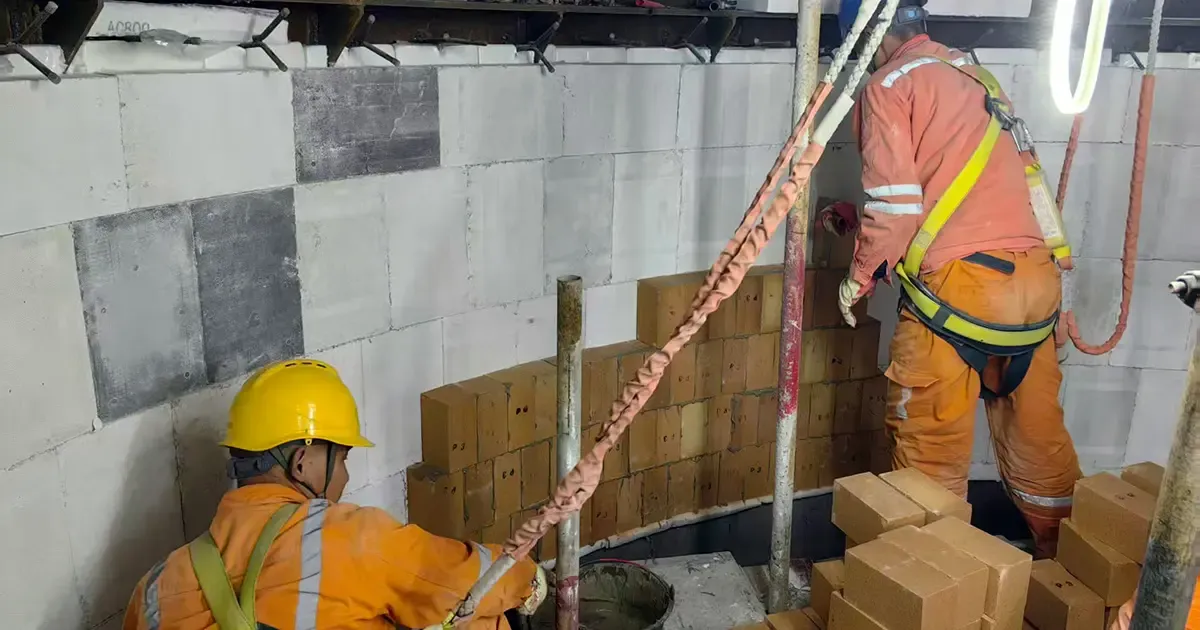
Why Cement Kiln Thermal Protection Matters
The rotary kiln is the single largest energy consumer in a cement plant. Heat loss from the kiln shell and preheater system typically accounts for 40–60% of total thermal energy input, and most of that loss passes straight through the lining and insulation. For a 5,000 t/d clinker line, every 10°C of unnecessary shell temperature can mean tens of thousands of dollars in extra fuel per year.
Effective cement kiln thermal protection is therefore not a maintenance afterthought — it is a production and profitability decision. The right insulation system lowers shell temperature, reduces fuel consumption, protects the steel shell, and extends refractory life.
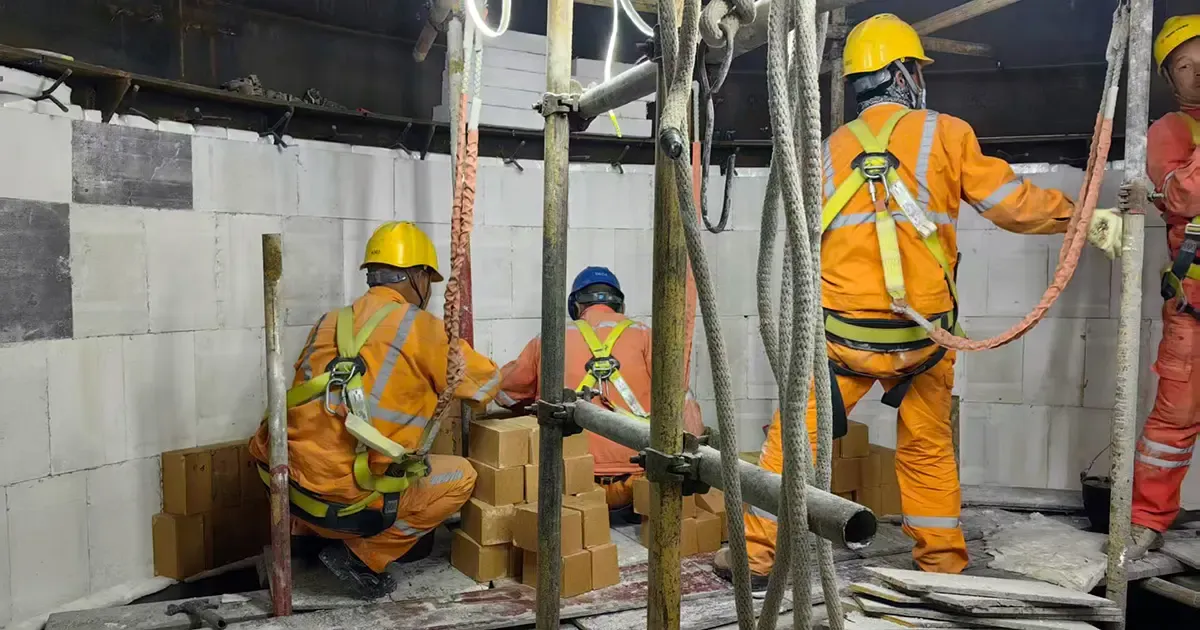
The Cement Kiln Environment
A cement kiln is not one uniform furnace. Along the length of the rotary kiln and its preheater tower, temperatures, chemistry, and mechanical loads change continuously. A sound insulation engineering strategy must match each zone to the material that performs best there.
Temperature Zones
| Zone | Typical temperature | Key process role |
|---|---|---|
| Preheater top | 700–900°C | Raw meal preheating |
| Preheater lower / calciner | 900–1,150°C | Calcination |
| Transition zone | 1,200–1,400°C | Clinker formation begins |
| Burning zone | 1,450–1,500°C (gas to 2,000°C) | Sintering |
| Cooling zone | 200–1,300°C | Clinker cooling |
| Tertiary air duct | 900–1,100°C | Combustion air return |
| Kiln hood | 900–1,100°C | Burner / discharge area |
Chemical and Mechanical Loads
Beyond temperature, kiln linings face:
- Alkali attack. K₂O and Na₂O vapors react with calcium-bearing materials above 650°C, forming compounds such as K₂CaSi₂O₇ that break down insulation structure. The reaction accelerates sharply near 1,100°C.
- Sulfur and chloride corrosion. Fuel and raw-material variations introduce acidic gases that attack certain fiber materials.
- Thermal cycling. The transition and cooling zones see rapid temperature swings. Materials must resist thermal shock and maintain low shrinkage.
- Mechanical abrasion. Falling coating, moving load, and dust streams wear exposed hot-face surfaces.
These factors make zone-specific material selection the foundation of cement kiln insulation engineering.
Key Performance Requirements
Any insulation product used in a cement kiln should be evaluated against the following criteria:
| Property | Requirement | Why it matters |
|---|---|---|
| Maximum service temperature | 600–1,500°C depending on zone | Prevents melting, shrinkage, and structural collapse |
| Thermal conductivity | 0.03–0.20 W/(m·K) depending on grade | Lower λ = lower heat loss and shell temperature |
| Compressive strength | 0.5–3.5 MPa | Resists handling, vibration, and thermal stress |
| Linear shrinkage | ≤3.5% at service temperature | Maintains lining integrity over years |
| Alkali resistance | ≤5% mass loss after 96 h alkali exposure | Survives the cement kiln vapor chemistry |
| Workability | Easy to cut, fit, and anchor | Controls installation cost and downtime |
Material Selection by Kiln Zone
The most efficient insulation systems do not rely on a single product. They layer materials so each layer handles the load it is best suited for.
Preheater Top and Cooler Rear (≤900°C)
At the cooler end of the process, rock wool board or calcium silicate board provides cost-effective thermal insulation. These zones are not exposed to heavy alkali load, so standard hydrophobic rock wool or medium-density calcium silicate performs well.
Preheater Lower, Calciner, and Tertiary Air Duct (900–1,150°C)
This is where alkali vapor concentration rises. Standard-grade ceramic fiber blanket or ceramic fiber modules are the conventional choice because they are lightweight and reduce shell temperature quickly. For severe alkali conditions, high-alumina or zirconia-containing ceramic fiber grades give better chemical resistance.
Transition Zone (1,200–1,400°C)
The transition zone demands both thermal insulation and mechanical toughness. High-alumina ceramic fiber blankets backed by a rigid backup layer are common. Where falling coating or mechanical impact is severe, a denser castable or brick hot-face may be required, with insulation behind it.
Burning Zone (1,450–1,500°C)
The burning zone is dominated by refractory wear, not lightweight insulation. The design is usually a high-grade magnesia-spinel or dolomite brick hot-face, followed by a thin but thermally efficient backup layer. Zirconia-reinforced ceramic fiber or high-density microporous boards can be used in selected cooler-gas pathways and hood areas adjacent to the burning zone.
Cooling Zone and Kiln Hood (900–1,300°C)
These areas see thermal shock as clinker temperature drops. A layered system — rigid hot-face or castable, plus calcium silicate insulation board and ceramic fiber backup — gives a good balance of strength, insulation, and shock resistance.
Traditional Insulation Materials in Cement Kilns
Calcium Silicate Insulation Board
Calcium silicate board is widely used as a backup and mid-temperature insulation layer. Standard boards are rated to 650°C; high-density hard calcium silicate grades reach 1,000–1,050°C.
Strengths:
- Rigid, dimensionally stable
- Good compressive strength (~0.55 MPa)
- Non-combustible, A1 fire rating
- Asbestos-free and low emission
Limits:
- Alkali resistance drops sharply above 650°C
- Thermal conductivity increases at high temperature
- Not suitable for the burning zone hot-face
Best applications: preheater shells, cooler sections, tertiary air ducts, and as a rigid backup behind castables.
Rock Wool Board
Industrial rock wool board is an economical choice for lower-temperature areas (up to ~650°C continuous, depending on binder grade). It offers good thermal performance, fire safety, and sound absorption.
Strengths:
- Low cost per unit of thermal resistance
- A1 non-combustible
- Good acoustic damping
- Chemically neutral, low chloride content
Limits:
- Maximum continuous service temperature lower than ceramic fiber
- Higher density than some fiber alternatives
- Needs protection from direct alkali vapor above rated temperature
Best applications: preheater top, cooler rear, duct casing, and general building-services insulation around the kiln system.
Ceramic Fiber Blanket and Modules
ceramic fiber blanket and folded modules dominate the 900–1,300°C range. Grades range from standard (1,050–1,150°C) through high-alumina (1,260–1,300°C) to zirconia-containing (up to ~1,430°C).
Strengths:
- Low thermal conductivity, especially at high temperature
- Light weight reduces steel-shell load
- Excellent thermal shock resistance
- Fast installation on curved shells
Limits:
- Standard grades are vulnerable to alkali vapor above 1,000°C
- Long-term exposure above 1,200°C can cause embrittlement and dusting
- Requires proper anchoring and compression
Best applications: preheater lower sections, calciner, kiln hood, and as backup insulation behind refractory brick.
Glass Wool
Glass wool is useful only for the lowest-temperature parts of the cement plant — ductwork, electrical rooms, and personnel protection around equipment operating below ~250–300°C continuous. It is not suitable for kiln shell or preheater hot zones, despite excellent room-temperature thermal conductivity.
Advanced Insulation for Modern Cement Plants
Nano Microporous Insulation Boards
Calcium-silicate-based nano microporous boards combine ultra-low thermal conductivity (roughly 40% lower than conventional materials in the 400–1,100°C range) with useful mechanical strength. Their pore structure is engineered into the nanometer scale, which suppresses gas-phase heat transfer.
Engineering advantages:
- Thermal conductivity as low as 0.018–0.025 W/(m·K) at mid-high temperature
- High surface hardness and compressive strength
- Stable to 1,100°C continuous; tolerates short thermal spikes above 2,000°C
- Good alkali and corrosion resistance
- Can be cut and installed without special encapsulation
These boards are particularly effective in the calciner, preheater lower sections, and kiln hood, where they replace thicker conventional layers without increasing shell temperature.
Zirconia-Reinforced Ceramic Fiber
For the hottest zones that still need fiber flexibility, zirconia-stabilized ceramic fiber blankets offer service temperatures up to ~1,400–1,500°C. Their zirconia content improves both refractoriness and alkali resistance compared with standard alumino-silicate fiber.
Engineering advantages:
- Low thermal conductivity at 1,200°C (~0.05 W/(m·K))
- Excellent thermal shock resistance
- Lightweight, reducing shell stress
- Better alkali durability than standard ceramic fiber
They are used in transition-zone backup, kiln hood, and specialized high-temperature duct linings.
Modular Kiln Lining Systems
Modern projects increasingly use modular lining systems: factory-engineered blocks that combine a hot-face refractory layer, an intermediate microporous or ceramic-fiber insulation layer, and an outer protective shell. The modules are lifted into place and anchored, cutting installation time and improving joint quality.
For a major 5,000 t/d line upgrade in Central China, a modular lining system delivered:
- Total lining weight reduced by 122 tonnes (18.7%)
- Kiln shell temperature reduced by 90–130°C
- Main drive motor current reduced by 250–300 A
- Clinker power consumption reduced by 1.5 kWh/t
- Coal consumption reduced by 3 kg/t clinker
- Payback period: approximately 11 months
Shell Temperature Reduction and Energy Savings
The relationship between shell temperature and fuel cost is direct. Lower shell temperature means less heat radiated to atmosphere, which means less fuel is needed to maintain process temperature. Practical targets vary by zone, but typical improvements include:
| Zone | Typical uninsulated shell temp | Target with engineered lining | Estimated fuel saving |
|---|---|---|---|
| Calciner | 180–220°C | 120–150°C | 3–5% |
| Preheater lower | 160–200°C | 110–140°C | 2–4% |
| Kiln hood | 220–280°C | 140–180°C | 4–6% |
| Tertiary air duct | 150–190°C | 100–130°C | 2–3% |
For a 5,000 t/d line, a 3% reduction in specific fuel consumption often translates to fuel savings well into six figures USD annually. The insulation upgrade pays for itself through lower fuel, lower electrical load on the kiln drive, and longer refractory campaigns.
Multi-Layer Design Principle
High-performance kiln insulation is almost always a multi-layer composite:
- Hot-face working layer. Directly exposed to process temperature, abrasion, and chemical attack. Usually refractory brick or castable selected for the zone.
- Intermediate insulation layer. Reduces heat flux toward the shell. Ceramic fiber modules, nano microporous boards, or high-temperature calcium silicate board depending on temperature and load.
- Backup insulation layer. Further lowers shell temperature and smooths temperature gradients. Rock wool board or lower-density ceramic fiber.
- Outer protection. Metal cladding, stainless-steel shields, or weatherproof coatings protect the insulation from rain, mechanical damage, and dust ingress.
Each layer is selected so the material just inside its safe operating limit. Over-specifying one layer and under-specifying another is a common source of premature failure.
Installation and Maintenance Notes
Even the best materials fail if they are not installed correctly. Key points for cement kiln insulation projects:
- Use modular, interlocking sections where possible to reduce cold joints and thermal bridges.
- Stagger joints between layers. Never align the seams of the hot-face and backup layers.
- Anchor carefully. Anchors must withstand thermal cycling without creating local hot spots.
- Protect against infiltration. False air leaking through cracked casing bypasses insulation and raises shell temperature locally.
- Plan inspection access. Build thermocouple ports and inspection hatches into the design so shell temperature can be monitored over time.
- Schedule re-lining during planned stops. A rushed outage usually leads to poor joint quality and shorter campaign life.
Composite Kiln Lining Wall Section: Hot-Face to Shell
A high-performance cement kiln wall is built as a stack of layers, each chosen for the job it does best. Reading from the steel shell outward to the process gas:
| Layer | Typical material | Typical thickness | Primary role |
|---|---|---|---|
| Working (hot-face) layer | Refractory brick or castable, zone-specific | 150–250 mm | Withstand abrasion, chemistry, and peak temperature |
| Primary insulation | Ceramic fiber module or high-alumina blanket | 50–100 mm | Cut heat flux toward the shell |
| Ultra-low-λ backup | Nano microporous board | 20–50 mm | Suppress gas-phase conduction at high temperature |
| Rigid backup | Calcium silicate board | 40–80 mm | Dimensional stability and load support |
| Outer thermal break | Rock wool board | 30–60 mm | Lower shell temperature and smooth gradients |
| Protection | Steel shell + metal cladding | — | Mechanical and weather protection |
Shell temperature is governed by the sum of each layer's thermal resistance, not by any single product. In practice, a thinner hot-face combined with a thinner but far more efficient microporous board often beats a thick conventional backup while saving kiln weight and drive power. The goal is to keep every layer operating just inside its safe limit — over-specifying one layer while under-specifying another is a common cause of premature failure.
For a broader view of refractory selection across high-temperature equipment, see our furnace heat-resistant materials guide.
Transition Zone Thermal Shock and Fatigue Management
The transition zone swings between roughly 1,200°C and 1,400°C during start-up, load changes, and fuel swings. That cycling — not steady temperature — is what destroys linings. Key engineering controls:
- Limit ramp rate. Fiber-lined shells should be heated and cooled at roughly 50–80°C per hour during commissioning and restart to avoid spalling and anchor stress.
- Hold linear shrinkage ≤3.5% at service temperature. High-alumina and zirconia-stabilized ceramic fiber retains dimension far better under repeated cycling than standard fiber.
- Control fiber grade. Above about 1,200°C long term, standard alumino-silicate fiber slowly crystallizes (mullite/cristobalite formation) and embrittles, eventually dusting. Where cycling is severe, specify high-purity or zirconia-stabilized fiber.
- Manage anchor load. Differential expansion between the steel shell and the lining puts recurring load on anchors; use flexible anchoring and verify compression at each stop.
Insulation Upgrade ROI: A Worked Calculation
For a 5,000 t/d clinker line, the payback math is straightforward:
- Baseline specific fuel consumption: about 110 kg coal-equivalent per tonne of clinker.
- A 100°C shell-temperature reduction typically yields ~3% fuel saving → about 3.3 kg coal-equivalent per tonne.
- Annual clinker output: 5,000 t/d × 330 operating days ≈ 1.65 million tonnes → fuel saved ≈ 5,445 tonnes coal-equivalent per year.
- At an indicative USD 120 per tonne coal-equivalent, that is roughly USD 650,000 in annual fuel savings.
- Added insulation (modules + microporous board + installation): on the order of USD 280,000 → simple payback of about 5–6 months, before counting extended refractory life and lower kiln-drive power.
The same calculation scales down for smaller lines; the payback period lengthens but the fuel saving per tonne of clinker stays in the same band.
Inspection and Re-Lining Cadence
Good insulation is monitored, not forgotten:
- Thermographic shell scan every 3–6 months. A zone running more than ~20°C above its documented baseline warrants investigation before it spreads.
- Annual campaign review during the planned production stop — check joint integrity, anchor condition, and any local hot spot.
- Re-line trigger: shell temperature creeping more than ~15% above the post-upgrade baseline, or exposed anchors, signals the working or backup layer has degraded.
- Document a baseline shell-temperature map at commissioning so future scans have a reference.
Additional Anonymized Project References
- 2,500 t/d preheater tower retrofit (older line). Replacing thick castable preheater walls with ceramic fiber modules plus calcium silicate board cut preheater shell temperature by about 45°C, reduced fan power by roughly 4%, and shortened installation downtime by about 30% versus the original castable approach.
- 4,000 t/d kiln hood (North Africa). Adding nano microporous board behind the existing brick lowered kiln-hood temperature by about 60°C and extended the refractory campaign by roughly two months.
Figures are representative, anonymized outcomes from retrofit programs and are shared to illustrate typical magnitude rather than as a warranty.
Related Reading
- Cement plant insulation applications and material systems
- Calcium silicate insulation board specifications
- Ceramic fiber blanket for high-temperature kiln linings
- Rock wool board for industrial and building insulation
Explore flexible aerogel and microporous insulation options in our aerogel insulation guide.
Frequently asked
What is cement kiln thermal protection? +
Cement kiln thermal protection is the engineered combination of refractory and insulation layers that keeps process heat inside the kiln, protects the steel shell, and reduces fuel consumption. It covers the rotary kiln, preheater, calciner, cooler, and associated ducts.
Which insulation material is best for the cement kiln burning zone? +
The burning zone (1,450–1,500°C) is dominated by refractory wear, so a high-grade magnesia-spinel or dolomite brick hot-face is standard. Zirconia-reinforced ceramic fiber or microporous backup boards can be used in adjacent hood and duct areas.
How much energy can a cement kiln insulation upgrade save? +
Engineered kiln lining upgrades commonly reduce shell temperature by 90–130°C and specific fuel consumption by 2–5%. For a 5,000 t/d line, this can translate to six-figure annual fuel savings and payback periods under 12 months.
Can rock wool be used in a cement kiln? +
Yes, but only in lower-temperature zones such as the preheater top, cooler rear, and duct casing. Standard industrial rock wool is rated to roughly 650°C continuous, so it is not suitable for the calciner, transition zone, or burning zone.
Why is alkali resistance important for cement kiln insulation? +
Cement kiln flue gas contains K₂O and Na₂O vapors. Above 650°C these alkalis react with calcium-bearing insulation, destroying structure and increasing thermal conductivity. High-alumina or zirconia-containing ceramic fibers and nano microporous boards are preferred where alkali exposure is severe.
How often should cement kiln insulation be inspected or replaced? +
Plan a thermographic shell scan every 3–6 months and a full lining review during each annual planned stop. Re-line when a zone runs more than about 15% above its post-upgrade baseline temperature, or when anchors become exposed. Document a baseline shell-temperature map at commissioning so trends are visible.
What is a typical composite lining thickness for a cement kiln shell? +
A common build-up is a 150–250 mm refractory hot-face, 50–100 mm ceramic fiber module, 20–50 mm nano microporous board, 40–80 mm calcium silicate backup, and 30–60 mm rock wool outer layer. Exact thickness depends on the zone temperature and the fuel and alkali load; the aim is to keep every layer just inside its safe operating limit.
Request a quote
Interested in our insulation solutions? Send us your requirements and our team responds within one business day.