
Polycrystalline Mullite Board: Ultra-High-Temp (1900°C)
Polycrystalline mullite fiber board handles continuous service up to 1600–1700 °C and short-term peaks to 1900 °C. Compare density, conductivity, and applications.
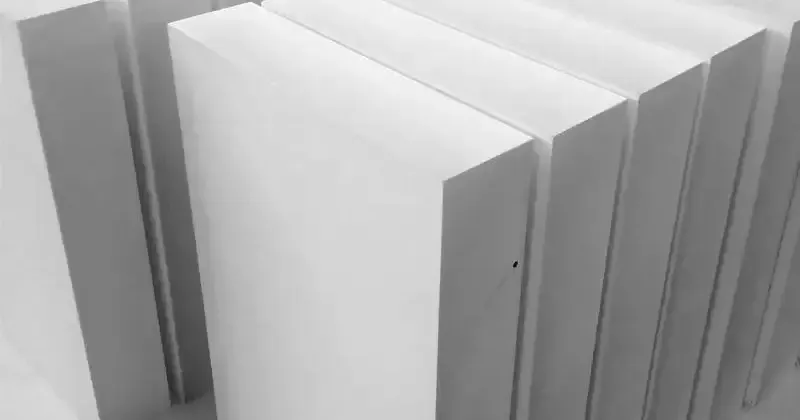
Polycrystalline mullite fiber board (PMFB) is a rigid, ultra-high-temperature insulating board made from interlocked polycrystalline mullite fibers. It fills the gap between standard ceramic fiber boards, which top out near 1260–1430 °C, and dense refractory brick, which is heavy and thermally massive. When the choice is about form rather than grade — board against panel, tile or sheet across the whole material range — the insulation board and panel forms guide sets the vocabulary out family by family. The result is a lightweight board that can withstand continuous service up to 1600–1700 °C and short-term peaks approaching 1900 °C.
For standard dimensions and grade options, see our polycrystalline mullite fiber board product page.
What Makes Polycrystalline Mullite Different
Standard ceramic fiber board is produced from spun aluminosilicate glass fibers that are then needled and bonded. At temperatures above 1100–1200 °C, the glassy phase begins to devitrify and shrink, limiting long-term use.
Polycrystalline mullite fiber is made by sol–gel processing and controlled crystallization. The fibers consist almost entirely of 3Al₂O₃·2SiO₂ (mullite) crystals, with no residual glass phase. This crystalline structure gives PMFB three decisive advantages:
- Higher temperature ceiling — continuous 1600–1700 °C, short-term 1800–1900 °C
- Lower shrinkage — ≤0.5 % linear shrinkage after 24 h at 1500 °C in many grades
- Higher purity — typical Al₂O₃ content 72–75 %, with high-purity grades reaching 80 %+
| Property | PMFB | Standard Ceramic Fiber Board | Dense Refractory Brick |
|---|---|---|---|
| Bulk density | 0.6–1.2 g/cm³ | 0.25–0.35 g/cm³ | 2.0–2.6 g/cm³ |
| Thermal conductivity (mean 800 °C) | 0.15–0.35 W/(m·K) | 0.12–0.18 W/(m·K) | 0.8–1.5 W/(m·K) |
| Max continuous use | 1600–1700 °C | 1000–1400 °C | 1650–1800 °C |
| Short-term peak | ~1900 °C | ~1300 °C | ~1800 °C |
| Compressive strength | 2–8 MPa | 0.1–0.5 MPa | 20–80 MPa |
The tradeoff is clear: PMFB is heavier and stiffer than blanket, but far lighter and easier to cut than refractory brick, with thermal conductivity roughly one-third to one-half that of brick.
Key Performance Characteristics
Thermal Stability and Shrinkage
The defining performance metric for ultra-high-temp boards is shrinkage at temperature, not just the maximum rating. Many refractory materials look good on paper but lose 3–5 % of their volume after the first heat-up, creating gaps and hot spots.
Polycrystalline mullite boards typically show:
- Linear shrinkage ≤0.5 % after 24 h at 1500 °C
- Linear shrinkage 1–3 % after 24 h at 1600 °C, depending on grade
- Decomposition begins around 1830–1850 °C as mullite dissociates into alumina and liquid silica
This means the "1900 °C" figure is a short-term survival limit, not a continuous operating temperature. For reliable 24/7 service, designers should stay within the 1600–1700 °C envelope and allow extra thickness for the predicted shrinkage zone.
Thermal Shock and Mechanical Strength
PMFB handles thermal cycling better than dense brick because its fibrous microstructure can absorb differential expansion. Reported performance includes:
- Thermal shock resistance: survives repeated cycling between room temperature and 1500 °C without through-cracking in properly graded boards
- Compressive strength: 2–8 MPa — adequate for self-supporting boards, baffles, and burner surrounds
- Thermal expansion coefficient: approximately 5 × 10⁻⁶ /K, matching most refractory linings
The board can be machined with standard woodworking tools when cold, but cutting after first firing is more difficult due to surface sintering.
Chemical Resistance
High alumina content makes PMFB resistant to most furnace atmospheres, including:
- Oxidizing atmospheres up to the temperature ceiling
- Neutral and mildly reducing conditions
- Most molten aluminum and non-ferrous slags
- Weak acids and alkalis
It is not recommended in environments with strong alkalis, hydrofluoric acid, or prolonged contact with iron oxide-rich slags above 1500 °C.
Where Polycrystalline Mullite Board Is Used
High-Temperature Industrial Furnaces
PMFB is widely used as hot-face insulation, back-up insulation, and baffles in furnaces where standard fiber boards would shrink or degrade. Common positions include:
- Soaking pits and reheating furnaces in steel plants
- Ladle and tundish covers
- Heat-treatment furnace hot faces
- Ceramic kiln car tops and burner walls
- Glass furnace regenerator walls and crown backup
Because the board is rigid, it can support its own weight as a vertical or horizontal baffle, eliminating the need for metal supports inside the hot zone.
Laboratory and Specialty Furnaces
Laboratory box furnaces, tube furnaces, and atmosphere-controlled furnaces frequently specify polycrystalline mullite boards for the chamber lining because:
- They reach 1700–1800 °C without contamination from binders that burn out at lower temperatures
- The surface does not powder or flake into the chamber
- They provide a stable, flat mounting surface for heating elements and crucibles
Nuclear and Aerospace Applications
In nuclear-power and high-temperature test environments, PMFB serves as:
- Thermal insulation around high-temperature test fixtures
- Backup lining for hot isostatic presses (HIP)
- Heat shields and standoffs in plasma and arc-heater facilities
Its low neutron activation potential and thermal stability under transient heat loads make it preferable to organic or glass-fiber insulations in these roles.
Semiconductor and Crystal Growth
Crystal-growth furnaces, CVD reactors, and diffusion furnaces need a chemically stable hot-zone insulation that does not outgas or particle-shed at 1400–1700 °C. Polycrystalline mullite board meets this requirement and is easier to replace than monolithic castables.
How PMFB Compares Above 1500 °C
At 1500 °C and above the field narrows to four realistic options, and the choice is about shrinkage and chemistry more than headline temperature.
| Material | Continuous limit | Shrinkage at 1500 °C | Relative cost | Choose it when |
|---|---|---|---|---|
| Polycrystalline mullite fiber board | 1600–1700 °C | 1–3 % | Medium-high | General ultra-high-temp rigid lining |
| Alumina fiber board | 1600–1800 °C | <1 % | High | Higher purity or tighter shrinkage control |
| Zirconia ceramic fiber | 1350–1600 °C | Low | Very high | Alkali-bearing atmospheres |
| Dense refractory brick | 1650–1800 °C | Low | Low–medium | Load-bearing, slag resistance |
| Standard ceramic fiber board | 1000–1400 °C | 3–5 %+ (fails) | Low | Not applicable at this temperature |
Where the PCW-versus-conventional-fiber trade-off needs a full walkthrough - crystal structure, binder behaviour and cost crossover points - our polycrystalline wool vs standard ceramic fiber comparison covers it.
The practical read: PMFB is the value point. Alumina fiber buys you tighter shrinkage and a higher ceiling at a significant price premium. Zirconia fiber is a chemistry choice, not a temperature choice — you specify it for alkali resistance even though its ceiling is lower. Brick is cheaper per kilogram but carries 3–5× the thermal mass and roughly 4× the conductivity, so it costs more in energy over the campaign. Standard ceramic fiber is simply out of its depth here. For the Y-PSZ zirconia insulation tier above 1800 °C and its selection against AZS, see our guide to alumina zirconia ultra-high-temperature fiber.
How to Select the Right Grade
By Temperature
| Service temperature | Recommended grade | Notes |
|---|---|---|
| 1400–1500 °C | Standard polycrystalline mullite | Cost-effective replacement for high-grade ceramic fiber board |
| 1500–1650 °C | High-purity mullite (72–75 % Al₂O₃) | Best balance of shrinkage resistance and strength |
| 1650–1800 °C | Ultra-high-purity mullite (≥80 % Al₂O₃) | Short-term cycling, laboratory furnaces |
| >1800 °C | Consider zirconia or alumina fiber systems | PMFB is not rated for continuous service here |
By Density
- 0.6–0.8 g/cm³ — lightest, lowest thermal mass, lower mechanical strength
- 0.8–1.0 g/cm³ — general-purpose industrial grade
- 1.0–1.2 g/cm³ — highest strength and erosion resistance, used where gas velocity is high
By Thickness
Typical boards are supplied in 25 mm, 50 mm, and 100 mm thicknesses. Multi-layer systems usually pair a thin, dense hot-face board with a thicker, lower-density backup board to balance hot-face durability and overall insulation value.
Specifying PMFB: What to Put on the Purchase Order
"1900 °C polycrystalline mullite board" is not a specification — a supplier can satisfy it with almost any grade in the range. A purchase order that gets you the board you actually need states all of the following:
- Grade by Al₂O₃ content — 72–75 % for standard, 80 %+ for high-purity duty
- Bulk density — 0.6–1.2 g/cm³, with a tolerance
- Maximum continuous service temperature — not the classification temperature
- Linear shrinkage limit — e.g. ≤1 % after 24 h at 1500 °C, with the test method named
- Cold crushing strength minimum — typically ≥2 MPa for self-supporting boards
- Dimensions and tolerances, plus any machining, drilling or cut-outs
- Atmosphere — oxidising, reducing, vacuum, or alkali-bearing
The three that matter most are continuous temperature, shrinkage limit, and density. Miss the shrinkage figure and you can receive a board that meets the temperature rating but loses 4 % of its volume on first heat-up, opening the gaps you were trying to avoid.
For standard dimensions and available grades, see the polycrystalline mullite fiberboard product page.
Failure Modes and Realistic Service Life
PMFB is robust within its envelope but it has hard limits:
- Above 1830–1850 °C mullite dissociates into alumina and a liquid silica phase. This is a structural failure, not gradual degradation, and it is why the 1900 °C figure is a survival peak.
- Sustained service above 1700 °C accumulates shrinkage slowly. Design extra thickness to absorb it, or plan on a shorter campaign.
- Strong alkalis and hydrofluoric acid attack the alumina content.
- Iron-oxide-rich slag above 1500 °C forms low-melting eutectics with the board surface.
- Mechanical impact — the board is rigid and relatively brittle; edges and corners chip, so handle and store it accordingly.
Realistic expectations: in stable service at 1600 °C, PMFB typically runs 3–8 years. Above 1700 °C, or with frequent thermal cycling, plan for 1–3 years. Those numbers are comparable to dense brick and substantially better than any standard ceramic fiber board, which is the comparison that justifies the price.
Installation and Handling Best Practices
Surface Preparation
- Mount on a flat, stable metal or refractory substrate
- Leave an expansion gap of 3–5 mm per meter of lining at room temperature
- Use stainless steel or ceramic anchors designed for the peak service temperature
Cutting and Shaping
- Cut with a carbide-tipped blade or fine-tooth band saw when green (unfired)
- Wear PPE; fibers are classified as RCF and should not be inhaled
- After first firing, the board surface sinters; subsequent machining requires diamond tooling
Joint Treatment
- Stagger joints between layers
- Fill gaps with ceramic fiber bulk or rope of matching temperature grade
- Avoid through-joints that create straight heat-loss paths
When PMFB Is — and Is Not — the Right Choice
Choose polycrystalline mullite board when:
- Continuous operating temperature exceeds 1400 °C
- Standard ceramic fiber board shrinks too much after heat-up
- You need a rigid, self-supporting shape without heavy refractory mass
- Chemical purity is important (semiconductor, lab, specialty metal furnaces)
Consider alternatives when:
- Temperature stays below 1200 °C — standard ceramic fiber board is lighter and cheaper
- Severe abrasion or slag erosion is present — castables or dense brick may last longer
- The application requires continuous service above 1700 °C — ultra-high-purity alumina or zirconia boards are needed
Bottom Line
Polycrystalline mullite fiber board is the practical bridge between lightweight ceramic fiber insulation and heavy refractory brick. With continuous service ratings of 1600–1700 °C and short-term tolerance to 1900 °C, it is the default choice for furnaces, laboratories, and high-temperature process equipment where standard fiber boards fail and dense brick is overkill.
At Rosewool, we supply ISO 9001-, CE-, and SGS-certified polycrystalline mullite fiber board and related ultra-high-temperature insulation products for industrial, laboratory, and specialty applications worldwide. Contact us for grade selection, thickness recommendations, and installation guidance matched to your peak service temperature and cycle profile.
For a deeper dive into forms, temperature ratings, and application guides, see our ceramic fiber insulation hub.
For the folded-module form of the same polycrystalline fiber - including anchor systems and installation sequence - see our PCW modules specification guide; for procurement due diligence, the PCW module supplier buyer's guide covers datasheet verification and QA checks.
Frequently asked
What is the maximum continuous service temperature of polycrystalline mullite board? +
Most industrial grades are rated for continuous service at 1600–1700 °C. Short-term peaks up to 1800–1900 °C are possible, but sustained operation above 1700 °C accelerates grain growth and shrinkage.
How does polycrystalline mullite board differ from standard ceramic fiber board? +
Standard ceramic fiber board is made from glass-phase aluminosilicate fibers and is typically limited to 1000–1400 °C. Polycrystalline mullite board is fully crystalline mullite (3Al₂O₃·2SiO₂), giving it higher purity, lower shrinkage, and a service ceiling of 1600–1700 °C.
What is the typical bulk density and thermal conductivity of PMFB? +
Bulk density ranges from 0.6–1.2 g/cm³ depending on grade. Thermal conductivity at mean 800 °C is typically 0.15–0.35 W/(m·K), roughly one-third to one-half that of dense refractory brick.
Can polycrystalline mullite board be used in a 1900 °C furnace? +
Only for short-term exposure or thermal cycling. The 1900 °C figure is a survival limit, not a continuous operating temperature. For reliable service above 1700 °C, ultra-high-purity alumina or zirconia-based boards are recommended.
What are the main applications of polycrystalline mullite fiber board? +
Common uses include steel reheating furnaces, heat-treatment furnaces, ceramic and glass kiln linings, laboratory and tube furnaces, nuclear high-temperature test fixtures, hot isostatic press backup linings, and semiconductor crystal-growth furnaces.
Request a quote
Interested in our insulation solutions? Send us your requirements and our team responds within one business day.