
Cryogenic Insulation Applications: Cold Storage, Cold Chain and LNG
Cryogenic insulation by scenario: cold storage, cold chain and LNG duty compared, with the materials that carry thermal resistance and the ones that do not.
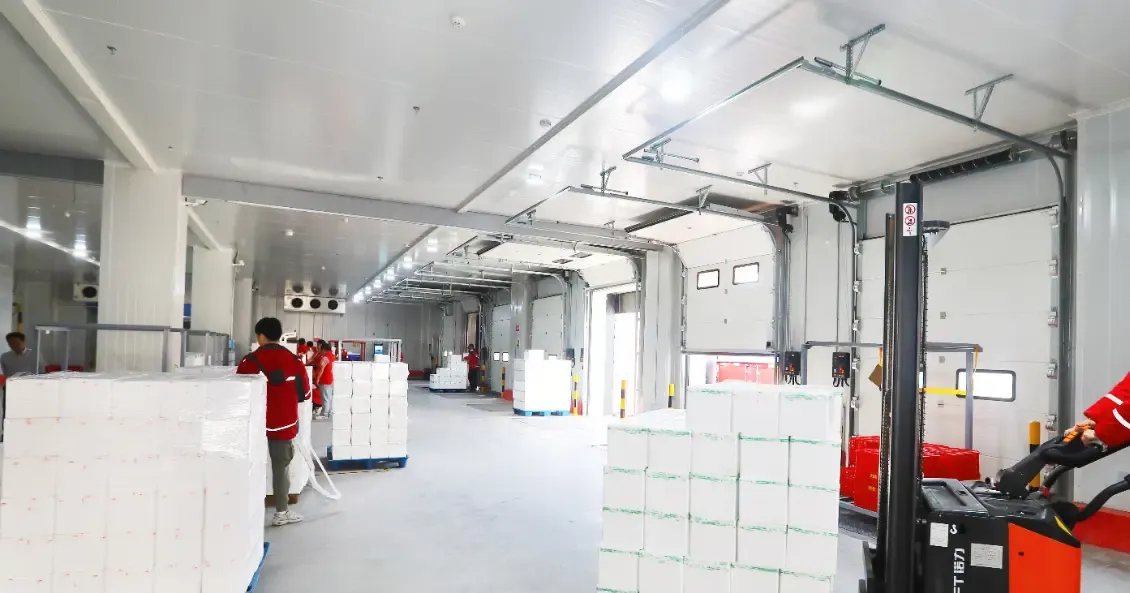
Quick answer: Cryogenic insulation is specified by scenario, not by material data sheet. Three bands cover almost every job: cold storage from about +10 °C down to -45 °C, cold chain transport and packaging between +8 °C and -18 °C, and LNG at -162 °C. In the first two, closed-cell rigid foam carries the thermal resistance and the fibre products are limited to fire breaks, facings and acoustic linings. In LNG, the real thermal resistance comes from expanded perlite, foam glass and closed-cell cryogenic foam, with aerogel blanket taking thin sections, valves and retrofits. The first decision in every band is moisture, not conductivity: ice conducts roughly 2.2 W/(m·K), about eighty times dry air, and once it forms inside the layer the damage is permanent.
Most insulation guides rank materials by thermal conductivity and stop there. That approach works for a hot pipe and fails for cryogenic insulation, because the numbers on the data sheet are measured dry. In cold service that ranking is close to useless, because the numbers are quoted dry and at ambient, and the failure mode that actually ends a cryogenic insulation system is water that got in and froze. This guide works through the three application bands, then places each material where it genuinely belongs.
What Counts as Cryogenic: Three Temperature Bands
"Cryogenic" is used loosely in the trade, so it is worth fixing the bands before anything else.
| Band | Typical range | Sub-divisions | What drives the design |
|---|---|---|---|
| Cold storage | +10 °C to -45 °C | Chill 0 to 10 °C, cold store -2 to 5 °C, frozen -18 to -25 °C, blast freezing -35 to -45 °C | Humidity load, door openings, floor frost heave |
| Cold chain | +8 °C to -18 °C; pharma 2 to 8 °C; special -60 °C | Refrigerated vehicles and containers, pharma shippers, dry ice and liquid nitrogen | Weight, puncture resistance, hold time |
| LNG | -162 °C throughout | Liquefaction, storage tank, carrier, regasification, BOG lines | Vapour drive, thermal cycling, boil-off rate |
Cold storage and cold chain are not, strictly speaking, deep cryogenic duty — the physics of moisture still governs them, which is why they belong in the same discussion. LNG is the only band where the temperature itself rules materials out.
Why Cryogenic Insulation Fails Differently
In a warm building, an insulation layer that gets damp can dry out again. On a cold line or a cold wall, the surface sits permanently below the ambient dew point, so water vapour moves towards the cold face under a partial-pressure difference that never reverses. There is no drying phase. Whatever gets in, stays in — and freezes.
Two consequences follow, and both are unforgiving.
First, ice is a conductor. At roughly 2.2 W/(m·K) it conducts about eighty times better than still air and more than fifty times better than a dry fibre mat. A layer that is only a few percent ice by volume has already lost a large part of its thermal value, and the loss is not recovered when the plant warms up, because the melt water is still there.
Second, water expands about 9 % when it freezes. That expansion prises open joints, splits rigid boards, lifts facing materials off the substrate and opens the very paths that let more vapour in. The failure accelerates.
This is why the first question in any cryogenic insulation specification is about water vapour permeance and closed-cell content, not about the ambient conductivity number quoted at the top of a data sheet. Once moisture is under control, conductivity becomes a fair comparison again — and only then.
The Vapour Barrier Belongs on the Warm Side
The single most common installation error in cold work is putting the vapour retarder on the wrong face. It belongs on the warm, high vapour-pressure side of the insulation — the outside of a cold room wall, the outside of a chilled line. Set it on the cold side and the whole insulation layer sits inside the condensing zone for its entire service life.
Design practice in cold storage requires a vapour barrier whenever the temperature difference across the envelope exceeds about 5 °C, which in this duty is always. Every cryogenic insulation system is, in the end, a vapour control system with a thermal layer inside it. In practice that means a continuous membrane, fully sealed laps, foil tape over every board joint, and penetrations foamed rather than stuffed.
Cold Storage Facilities: +10 °C to -45 °C
The main thermal resistance in a cold store — and the part most people mean when they say cryogenic insulation for a building — is closed-cell organic foam: metal-faced PIR or PUR sandwich panels at roughly 0.020–0.024 W/(m·K) with a closed-cell content above 90 %, or site-applied sprayed foam where a seam-free envelope is wanted. Floors use extruded polystyrene, typically specified at 200 kPa compressive strength or better, combined with a ventilated or heated sub-floor to stop frost heave.
Indicative thicknesses: 100–120 mm for a 0 °C chill room, around 150 mm at -18 °C, and 200 mm or more below -35 °C.
Where does mineral wool fit? Not as the main thermal layer. Rock wool and glass wool appear in cold storage as the facing of a PIR sandwich panel, as fire breaks dividing a large envelope, as an external fire-rated layer outside the main insulation, and in acoustic linings. The reason is the one given earlier: these are open-cell products, water repellent treatment sheds liquid water but does not stop vapour, and once the fibre is wet its conductivity climbs steeply. Water conducts at about 0.6 W/(m·K), twenty-odd times air.
Cold Chain Transport and Packaging
Transport bodies are integral-skin rigid foam or composite sandwich panels with sealed door frames — weight and structural integrity matter as much as thermal value. The interesting engineering is in packaging.
Cold chain packaging is where cryogenic insulation design gets closest to precision engineering, because weight and hold time are both money. High-value pharmaceutical shippers use a composite: a structural PU shell, VIP vacuum insulation panels embedded in it, and phase-change material packs arranged on all six faces. A well-built shipper holds 2–8 °C for 72 to 120 hours in a 35 °C ambient. VIP cores give conductivity down to 0.002–0.008 W/(m·K), four to eight times the thermal resistance of conventional foam in the same thickness.
The trade-offs are real. A VIP cannot be cut on site — it has to be ordered to size and the panel layout designed around it. Puncture destroys it. Vacuum life is commonly five to ten years, and over ten to twenty-five years conductivity drifts towards one and a half to two times its initial value. For a reusable shipper that is a maintenance question, not a deal-breaker; for a buried tank it would be.
LNG: The Deep Cryogenic End
At -162 °C the material list collapses to what survives thermal cycling, vapour drive and mechanical load at that temperature. This is the band where cryogenic insulation stops being a building services question and becomes a process engineering one.
Onshore full-containment tanks. An elastic felt layer — mineral wool or glass wool, around 400 mm — sits directly against the inner tank wall. It is not there for thermal resistance; it absorbs the contraction of the inner tank during cooldown and cushions the pressure of the fill behind it. The annulus is filled with expanded perlite, roughly 800 mm, which is the actual thermal resistance. The tank bottom uses foam glass brick, around 200 mm, chosen because it carries load, resists vapour and survives frost heave. The annular space is kept at a slight positive pressure with dry nitrogen so that any leak path flows outwards.
Carriers. Modern membrane containment systems use a thin corrugated metal primary barrier over insulated boxes filled with reinforced closed-cell foam; spherical designs carry multi-layer insulation externally under an aluminium weather cover.
Process piping and regasification. Closed-cell cryogenic foam is the standard, installed in two or three staggered layers once total thickness passes about 127 mm. Foam glass is used at pipe supports and anywhere a load has to cross the insulation — the cold bridge positions. Aerogel blanket is specified for valves, complex shapes, congested areas and retrofit work, where its low conductivity allows 50–60 % less thickness than foam or foam glass for the same duty, and where its fire performance helps meet jet-fire protection requirements under NFPA 59A.
Design targets are tight: a large full-containment tank is typically specified for a boil-off rate at or below 0.05 % per day.
Where Rock Wool and Glass Wool Actually Fit
This is the question our customers ask most often, and the honest answer is more useful than a flattering one. Rock wool has a real place in cryogenic insulation, and it is not the place most specifications try to put it.
Rock wool with hydrophobic treatment at 99 % or better, installed with a continuous vapour barrier and metal jacketing, performs reliably down to about -50 °C. That covers a large part of cold storage, all pharmaceutical cold rooms, chilled water and most industrial cold ductwork. It is A1 non-combustible, which matters wherever fire separation is part of the specification, it is economical, and it is straightforward to install on site. Our rock wool pipe sections and rock wool board are specified into exactly this band.
Below -50 °C the picture changes, and at -162 °C rock wool is not a primary thermal resistance material. The fibre itself is not the limiting factor — mineral wool survives temperatures far below this without embrittling, and it is routinely used in plant that sees cryogenic duty. What changes is the consequence of moisture: at these temperatures any water vapour that reaches the layer turns to ice, and ice conducts roughly fifty times better than the dry fibre it displaces. It still has a role: the elastic felt layer against an LNG inner tank wall described above is a mineral wool or glass wool product, and it is doing mechanical work — compensating contraction and cushioning the perlite — rather than thermal work.
Glass wool sits lower again. It can be hydrophobic treated, but it is best kept above about -20 °C, and in cold storage it earns its place through acoustic linings and duct insulation rather than through the envelope.
| Material | Practical cold limit | Role it actually plays |
|---|---|---|
| Hydrophobic rock wool | About -50 °C | Cold rooms, chilled lines, fire breaks, LNG tank elastic felt |
| Hydrophobic glass wool | About -20 °C | Ducts, acoustic linings, filling |
| Calcium silicate | About -20 °C | Ambient-to-warm service, not cold work |
| Ceramic fiber | Not a cold material | High-temperature duty only |
Where Aerogel and Nano-Porous Insulation Win
Aerogel blanket is the one material in this range that is comfortable across the whole cryogenic span, and it is the reason deep cryogenic insulation can now be built thin enough to fit inside existing plant. At -196 °C its conductivity sits around 0.018–0.022 W/(m·K), roughly a third of what conventional materials manage at the same temperature, so a thin layer does the work of a much thicker one. It is flexible enough to wrap a valve body without a single cut joint, it is hydrophobic, and it is non-combustible.
That combination is why aerogel is used where thickness is expensive — offshore modules, congested pipe racks, retrofit inside an existing envelope — rather than across every metre of a long line. Cost per cubic metre runs many times that of foam or mineral wool, and it still needs a vapour barrier system designed around it.
Vacuum insulation panels are a different proposition: unbeatable conductivity, zero tolerance for site cutting or puncture, and best suited to controlled packaging applications. For deep cryogenic plant, the vacuum life under vibration and thermal cycling is not yet reliable enough to make VIP a mainstream choice.
Materials That Do Not Belong in Cold Service
Two products on our own catalogue are asked for in cold specifications and should not be. Saying so plainly costs us an order occasionally and saves a cold room every time, which is a trade worth making.
Ceramic fiber is designed for 1,000–1,400 °C service. It has nothing to offer at -162 °C, it becomes brittle at low temperature, and specifying it in cold work is a category error rather than a marginal call.
Calcium silicate is a rigid, high-strength, high-temperature product. It absorbs water, it is heavy, and freeze-thaw cycling cracks it. Its practical floor is about -20 °C; below that, rock wool or aerogel is the right answer.
Saying this plainly costs us nothing and saves a cold room.
Cold Bridges and the Details That Fail
Almost every cryogenic insulation failure we get called about is a detail, not a material. The material was chosen correctly, the thickness was calculated correctly, and the system still failed at a joint.
Cold bridges form at slab joints, beams and columns, wall penetrations, door frame fixings and metal pipe supports. They show up as surface condensation, then icing, then frost spreading outwards. The fix is systematic: foamed penetrations, foil tape over joints, thermally broken sections, and foam glass or aerogel pads wherever a load crosses the insulation.
Thermal cycling is the second offender. Pre-cooling and restart crack rigid foam and foam glass if the joint layout does not allow for movement, and the crack then becomes an internal icing site. In perlite-filled annuli, long-term settlement opens a void at the top of the tank, and tank foundation heating that is undersized lets frost heave lift the base. Insufficient insulation shows up directly as excess boil-off gas, which then overloads the recondenser.
Selecting Cryogenic Insulation by Scenario
- Fix the temperature band and the duty cycle. Continuous or cycling, and how far. This rules materials in or out before conductivity is considered.
- Design the vapour barrier first. Warm side, continuous, sealed, and detailed at every penetration.
- Choose the primary thermal resistance. Closed-cell foam for cold storage and cold chain; perlite, foam glass and cryogenic foam for LNG; aerogel where thickness is constrained.
- Assign the secondary roles. Fire separation, elastic buffer, load bearing, acoustics. Rock wool earns its place here in almost every band.
- Detail the joints, supports and penetrations. This is where the warranty is won or lost.
| Scenario | Primary thermal resistance | Secondary roles | Do not use |
|---|---|---|---|
| Cold storage | PIR/PUR panels, sprayed foam, XPS floors | Rock wool as facing, fire break, acoustic | Ceramic fiber, calcium silicate |
| Cold chain | Integral PU; VIP plus PCM for pharma | EPP casing, anti-puncture layers | Open-cell fibre in the cold layer |
| LNG tank | Expanded perlite, foam glass base | Mineral wool elastic felt as buffer | VIP, ceramic fiber, calcium silicate |
| LNG piping | Closed-cell cryogenic foam, foam glass at supports | Aerogel for valves, shapes, retrofit | Single-layer thick foam with unstaggered joints |
Related Reading
- Cryogenic pipe insulation guide — materials, thickness and installation for cold lines
- Aerogel versus traditional insulation — where the thickness saving justifies the cost
- What temperature can rock wool withstand? — the practical limits of the fibre
- Industrial pipe insulation materials compared
Frequently asked
What temperature range counts as cryogenic insulation? +
In practice three bands are grouped together: cold storage from about +10 °C down to -45 °C, cold chain transport and packaging between +8 °C and -18 °C with pharmaceutical work at 2–8 °C, and LNG at -162 °C throughout. Only the last is true deep cryogenic duty, but all three are governed by the same moisture-driven failure mechanism, which is why they are specified the same way. Most materials are comfortable in the upper band and ruled out by the lower one.
Can rock wool be used for cryogenic insulation? +
Yes, down to about -50 °C, provided it is a hydrophobic grade — 99 % water repellency or better — and provided it is installed with a continuous vapour barrier and metal jacketing. That covers cold rooms, chilled water lines, pharmaceutical cold stores and most industrial cold ductwork. Below -50 °C it is not a primary thermal resistance material, though it still appears in LNG tank construction as the elastic felt layer against the inner tank wall, where it absorbs contraction rather than carrying thermal duty.
Why must the vapour barrier go on the warm side? +
Because vapour moves from high partial pressure to low, which on a cold line means inwards. If the retarder is on the cold face, the entire insulation layer sits inside the condensing zone and never dries. On the warm face it stops vapour before it reaches cold material. Cold storage design codes require a vapour barrier whenever the temperature difference across the envelope exceeds about 5 °C, which in this duty is always the case. Laps must be sealed, joints taped and penetrations foamed, because a barrier with holes is not a barrier.
What insulation is used in LNG storage tanks? +
A full-containment tank uses several materials, each doing a different job. Expanded perlite, roughly 800 mm deep, fills the annulus and carries the thermal resistance. An elastic mineral wool or glass wool felt around 400 mm sits against the inner tank wall to absorb contraction and cushion the perlite load. Foam glass brick, about 200 mm, forms the tank base because it carries load, blocks vapour and resists frost heave. The annular space is held at a slight positive pressure with dry nitrogen so any leak path flows outwards rather than inwards.
Is aerogel worth the cost for cryogenic duty? +
Where thickness is constrained, yes. Aerogel blanket runs around 0.018–0.022 W/(m·K) at -196 °C, so it can replace 50–60 % of the thickness that closed-cell foam or foam glass would need for the same duty, and it wraps valves and complex shapes without cut joints. That makes it the practical choice for congested pipe racks, offshore modules, retrofit inside an existing envelope and anywhere jet-fire protection is required. On a long, accessible line with space to spare, foam or mineral wool usually wins on economics, and aerogel still needs a vapour barrier designed around it.
Can I use ceramic fiber or calcium silicate for cold service? +
No. Ceramic fiber is a 1,000–1,400 °C material with nothing to offer at cold temperatures, and it becomes brittle as it cools. Calcium silicate is rigid and strong but absorbs water and cracks under freeze-thaw cycling, with a practical floor around -20 °C. Specifying either in cold work is a category error rather than a marginal call — use hydrophobic rock wool down to about -50 °C, and aerogel, closed-cell cryogenic foam or foam glass below that.
Which cryogenic insulation failures are most common? +
Moisture ingress is first, and it is almost always a detailing failure rather than a material failure — a vapour barrier on the wrong face, an unsealed lap, a penetration that was stuffed instead of foamed. Cold bridges at supports, slab joints and door fixings come second. Third is thermal cycling: pre-cooling and restart crack rigid foam and foam glass when the joint layout does not allow for movement, and the crack then becomes an internal icing site. In perlite systems, long-term settlement opens a void at the top of the annulus, and under-sized foundation heating lets frost heave lift the tank base.
Request a quote
Interested in our insulation solutions? Send us your requirements and our team responds within one business day.