
Ceramic Fiber Bulk, Blanket and Board: One Fibre, Three Structures
Ceramic fiber bulk, blanket and board are one fibre in three structures. How each is made, why density beats form at high temperature, and how the three work together.
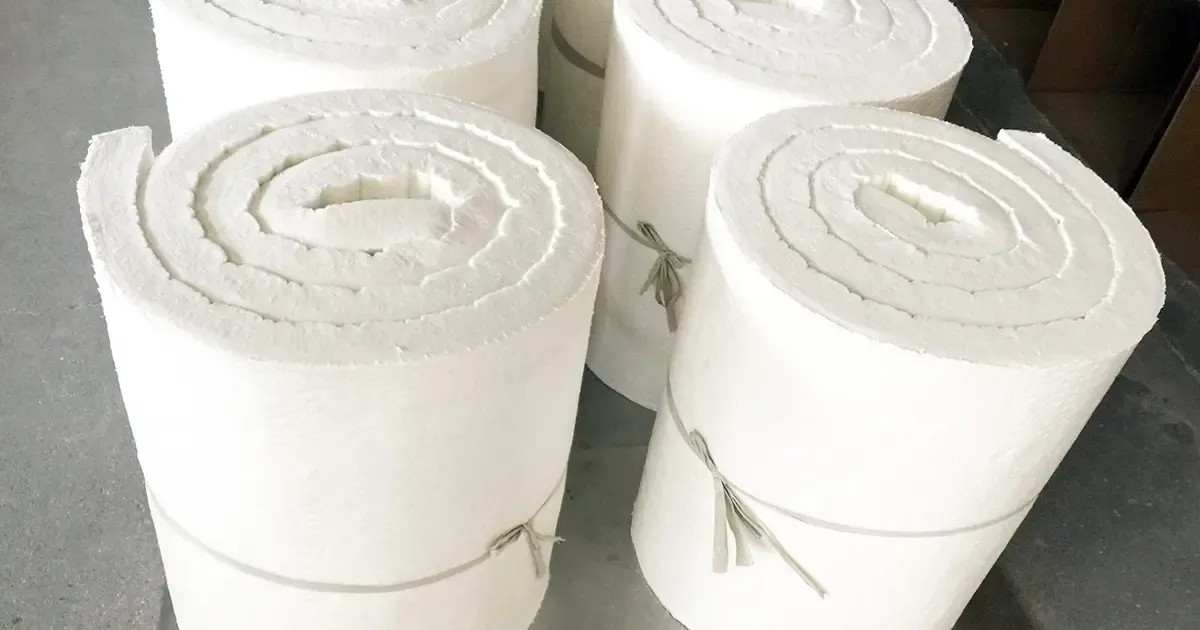
Quick answer: Ceramic fiber bulk, ceramic fiber blanket and ceramic fiber board are the same alumino-silicate fibre in three structural states. Bulk is the loose, unformed fibre that comes off the fibre line, and everything else is made from it. Blanket is bulk that has been needled into a flexible, binder-free mat at roughly 96–160 kg/m³. Board is bulk that has been slurried, dosed with an inorganic binder and vacuum formed into a rigid panel at 220–400 kg/m³. Chemistry and temperature class are frequently identical across the three. What actually changes is density, stiffness, thermal shock behaviour, and the way each form fails.
Most buyers meet these products as a choice — which form do I order? That comparison is worth doing, and it is covered properly elsewhere. This article takes the question underneath it: the three forms are not competing products so much as three points on one manufacturing chain, and understanding where the chain forks explains behaviour that a specification table cannot. Once you can see bulk as the feedstock, blanket as the mechanically bonded branch and board as the binder-bonded branch, the rest of the specification — why a ceramic fiber board cracks where a blanket does not, why low density stops being an advantage above 600 °C, why the best furnace lining usually uses all three — follows directly.
One Fibre, Three Structures
Every ceramic fiber product starts as the same thing: molten alumino-silicate, melted in an electric arc or resistance furnace and then attenuated into fibre. The chemistry is set at that point. A 1260 °C grade is a 1260 °C grade whether it ends up as loose fill, a needled mat or a rigid panel.
What differs is everything that happens afterwards. The fibre leaving the line — bulk — is a low-density mass of randomly oriented filaments with no strength of its own. To become a product, that mass has to be given a structure, and there are only two ways to do it.
The first is mechanical: drive barbed needles through the fibre mat repeatedly so the filaments physically tangle and interlock. That produces ceramic fiber blanket. No adhesive is added; the strength is purely mechanical and the mat stays flexible and compressible.
The second is chemical: disperse the fibre in water, add an inorganic binder, then pull the water out through a screen under vacuum so the fibre and binder deposit as a shaped, coherent solid. That produces ceramic fiber board — and, by the same route, vacuum-formed special shapes.
The fork matters because the two routes buy strength with different currency. Needling buys it with fibre entanglement and keeps the structure compliant. Vacuum forming buys it with binder and makes the structure rigid. Every performance difference that follows — thermal shock tolerance, machinability, behaviour on first firing, erosion resistance — traces back to that single choice.
From Melt to Fibre: Where the Three Forms Diverge
The fibre itself is made by one of two attenuation methods, and the choice sets the raw material character before any forming happens.
In the spun route, the melt stream falls onto a spinning wheel or is flung off a rotor, drawing filaments of roughly 3–4.5 µm diameter that are relatively long and tangled. In the blown route, a high-velocity gas jet attenuates the stream into shorter, finer filaments of about 2–3 µm with lower shot content.
Those small differences propagate. Spun fibre is tougher and holds together under mechanical stress, which makes it the natural feedstock for ceramic fiber blanket, for textile products and for folded modules. Blown fibre is finer and packs more uniformly, which is why it is preferred wherever the material will later be vacuum formed — board, shapes, and lightweight fill.
Then the two forming branches:
Needling. Layers of spun fibre are laid into a mat and needled from both sides. The barbed needles push fibre through the thickness of the mat, creating a three-dimensional mechanical bond through the full section rather than a surface skin. Density is controlled by how many layers go in and how aggressively the mat is needled and calendered — typically 96–160 kg/m³ for a ceramic fiber blanket, with 128 kg/m³ the common industrial figure. Nothing is added. A finished blanket is essentially 100% fibre.
Vacuum forming. Bulk fibre is dispersed into a water slurry with a binder — usually an inorganic system based on silica or alumina sol, sometimes with a small organic fraction for green strength. A shaped screen is immersed, vacuum draws the water out, and the fibre and binder deposit on the screen in the shape of the screen. The wet form is then dried, and often pressed or calendered to a final density. Board normally lands at 220–400 kg/m³, roughly two to three times a blanket.
The binder is the important part. It is what lets a ceramic fiber board be cut, drilled, stood on edge and anchored without tearing. It is also what makes the board a different material at first heat: the binder has to cure and stabilise in service, and during the first firing a board will normally lose mass and, if heated too quickly, can crack or spall as binder residues and moisture leave the section.
Bulk: The Unformed Feedstock
Ceramic fiber bulk is fibre with no structure imposed on it — loose, white, 60–100 kg/m³, and with no tensile or compressive strength worth naming. It is the cheapest of the three by a wide margin and the least capable on its own.
Its jobs are correspondingly specific. Bulk is used to fill irregular cavities that no flat product can reach, to pack around penetrations and burner blocks, to stuff expansion joints, to be blown into voids behind a lining, and to be mixed into refractory castables and coatings as a lightweight aggregate. It is also the feedstock for vacuum-formed ceramic fiber board and shapes, and the raw material for many textile products, which is why a supplier's bulk grade and its board grade usually share a chemistry.
The honest limitations: bulk settles. Under vibration, thermal cycling, or simply its own weight over time, loose fibre consolidates downward and leaves a void at the top of a cavity, which shows up as a hot spot on the shell. It has no erosion resistance, so any gas velocity above a few metres per second will move it. And it cannot be counted on for a designed thickness, because a filled cavity rarely has a uniform packing density. Where a lining has to keep a specified thermal resistance for years, bulk is a supplement, not the working layer.
Blanket: Needled and Binder-Free
A ceramic fiber blanket is bulk that has been given a mechanical structure and nothing else. The needling process tangles filaments through the thickness of the mat, so the blanket develops enough handling strength to be cut, wrapped around a pipe, draped over a crown, and impaled on anchors without falling apart — while remaining soft enough to compress by hand.
The binder-free construction is the reason blanket behaves the way it does. With no binder to burn out, there is no first-firing mass loss, no smoke and no cure schedule to respect. More importantly, the compliant structure absorbs strain: when a furnace cycles from ambient to 1000 °C and back, the blanket compresses and recovers rather than cracking. That is why a ceramic fiber blanket is the default answer wherever thermal shock is the governing risk, and why it is the standard choice for the back-up layers behind a hotter hot-face material.
The trade is mechanical. Tensile strength is low — on the order of 0.04 MPa — so a ceramic fiber blanket tears at anchor points and at any attachment that carries load. It erodes under high gas velocity, which is the usual reason a blanket hot face fails in a furnace with a strong draft. And because it is compressible, it loses thickness under sustained mechanical load, so a ceramic fiber blanket used where something bears against it will deliver less insulation than the nominal thickness suggests.
Standard thicknesses run 6–50 mm and the product is supplied in rolls, which is a large part of why it is economical: a two-layer blanket installation goes on fast, and the labour saving usually outweighs the material cost difference against board.
Board: Vacuum-Formed Rigidity
A ceramic fiber board is the same fibre with a binder and a shaping process. The vacuum-forming route produces a flat, self-supporting panel with a smooth face, a consistent thickness, and enough rigidity to be handled as a piece of material rather than a layer of insulation.
That rigidity changes the application set completely. Ceramic fiber board is the form you specify when the insulation has to resist gas velocity, take a mechanical fix, hold a flat surface against a casing, or be machined to a profile. It can be cut, drilled, routed and sanded, which is why it turns up as baffles, door linings, hot-face panels, and backup board behind dense refractory. It is also the form used when a lining has to be self-supporting between anchors rather than impaled on them.
The costs are real. Board is denser, so it stores more heat per unit volume in a cycling furnace — thicker board means longer heat-up and more energy held in the lining. It is rigid, so it has far less strain tolerance than blanket and will crack under severe thermal shock. And because of the binder, the first heat has to be managed: most suppliers publish a bake-out schedule, and heating a board lining too fast through the binder-stabilisation range is a common cause of early cracking.
Typical density is 220–400 kg/m³. Ceramic fiber board is more expensive per kilogram than bulk and generally more expensive per square metre than the equivalent blanket thickness, which is why it is used where its rigidity earns its keep rather than as a universal substitute.
Modules and Vacuum-Formed Shapes: The Two Derivatives
Two products sit just off the main three and are worth naming because they confuse specifications.
A ceramic fiber module is not a separate material. It is blanket — folded and compressed, or stacked in cut strips — pre-compressed to roughly 200–260 kg/m³ and fitted with an anchoring system, so that it can be bolted or welded to the furnace shell and then released to expand into place. The compression is deliberate: once installed and released, the module presses against its neighbours and closes the joints between them. Modules buy installation speed and a continuous hot face, and they should be specified as a system — module density, anchor alloy, and the release mechanism all belong on the same line of the enquiry.
Vacuum-formed shapes take the board route but into a shaped screen instead of a flat one: cones, riser sleeves, burner blocks, ladle shrouds, custom collars. They are made from bulk-based slurry and are the reason the phrase "vacuum formed" appears on ceramic fiber datasheets that have nothing to do with flat board. If a drawing calls for a shaped ceramic fiber part, it is a vacuum-formed shape made from bulk, not a machined board.
Both belong in the same conversation as the three main forms, because the same enquiry frequently contains all five.
Why Density Governs High-Temperature Conductivity, Not Form
This is the part that a form comparison table cannot show, and it is where most specifications go wrong.
At ambient and moderate temperature, heat moves through a ceramic fiber product mainly by conduction along the fibre skeleton and through the still gas in the pores. Under those conditions, lower density is better — less solid path, more still gas — and the low-density forms measure lower. That is the regime the published conductivity figures usually describe, and it is the regime most comparison tables quote, typically at 200 °C or 400 °C mean.
Above roughly 600–800 °C the picture changes, because radiation across the pore space starts to dominate. Radiative transfer scales very steeply with absolute temperature, and it is attenuated by the fibre itself: every filament surface in the path absorbs and re-scatters infrared. More fibre per unit volume means more attenuation. So as mean temperature rises, the low-density forms lose their advantage, and the denser forms start to close the gap and then overtake them — until solid conduction through the fibre skeleton begins to climb again and produces a conductivity minimum at a density that itself rises with temperature.
Typical figures for standard-grade alumino-silicate fibre make the shift visible:
| Mean temperature | Ceramic fiber blanket, 128 kg/m³ | Ceramic fiber board, 300 kg/m³ |
|---|---|---|
| 400 °C | 0.09–0.13 W/(m·K) | 0.10–0.15 W/(m·K) |
| 600 °C | 0.13–0.17 W/(m·K) | 0.13–0.17 W/(m·K) |
| 800 °C | 0.19–0.24 W/(m·K) | 0.18–0.22 W/(m·K) |
| 1000 °C | 0.27–0.34 W/(m·K) | 0.24–0.30 W/(m·K) |
These are indicative ranges for standard grades, not design values — work from your supplier's measured curve for anything that matters. What counts is the shape of the change: the denser ceramic fiber board starts marginally worse and ends measurably better, because it is suppressing a radiative term that the 400 °C column barely shows.
Three practical consequences follow.
Comparing conductivity figures measured at 200 °C tells you almost nothing about behaviour at 1000 °C. Always ask for the curve, or at least figures at mean service temperature.
Specifying the lowest available density in a high-temperature position is often backwards. A ceramic fiber board or a module at 260–320 kg/m³ can outperform a 128 kg/m³ blanket at 1000 °C despite a worse figure on the datasheet, because the denser structure suppresses the radiative component that dominates there.
And form matters at high temperature mostly through the density it implies, not through the shape itself. Blanket, board and module at the same density and the same mean temperature perform far more alike than the product names suggest. Form still decides stiffness, erosion resistance and shock tolerance — but it is not the lever that controls high-temperature heat flow.
Combined Linings: Where All Three Work Together
The most common real furnace lining uses all three forms, and the reason is that each one covers a weakness in the others.
A typical full-fibre hot-face construction puts a rigid layer — ceramic fiber board, or ceramic fiber module where fast installation matters — on the hot face, where it resists gas velocity and mechanical contact. Behind it go two or three layers of ceramic fiber blanket, which supply thickness cheaply, absorb the differential movement between the hot face and the shell, and never crack because they are not rigid. Ceramic fiber bulk then goes into the places the flat products cannot reach: around penetrations, behind burner blocks, into the irregular void at the crown, and as compressed packing at expansion joints.
The economics are straightforward. Board and module are expensive per square metre and are used thick enough to survive the hot face and no thicker. Ceramic fiber blanket is cheaper per unit thickness and is used to reach the total thermal resistance. Bulk is cheapest of all and is used only where geometry prevents the other two.
The combination also fixes the failure modes. A rigid hot face alone cracks under thermal shock; give it a compliant ceramic fiber blanket back-up and the strain is spread through layers that can move. A blanket-only lining erodes at the hot face and compresses at the anchors; give it a board or module hot face and the erosion-prone layer is the one that can take it. A bulk-filled cavity alone settles and leaves a void; use bulk as packing around a structured lining and settling stops mattering, because the structured layers are carrying the thermal duty.
Anchor selection sits inside the same decision. Metallic anchors are the economical choice but their usable limit sits well below the fibre's own rating, so a lining running above roughly 1000 °C at the hot face generally needs ceramic anchors or a design that keeps the metal in the cooler back-up layers.
How the Three Forms Fail: And What Each Failure Tells You
Failure mode is the most useful diagnostic a maintenance team can carry, because each form fails in a characteristic way.
Bulk settles. The symptom is a rising shell temperature at the top of a filled cavity or above a penetration, with nothing visibly wrong on the outside. The fix is access and refill, and the prevention is to design so that bulk is never carrying the thermal duty on its own.
Blanket tears and erodes. Tearing shows up as splits radiating from anchor points and as mat that has pulled away from the shell. Erosion shows as a thinned, polished hot face with fibre missing in the direction of gas flow, and it is almost always worse near burners, dampers and off-takes. Both point to a specification issue: too low a density, too few anchors, or a gas velocity that required a rigid hot face.
Board cracks and shrinks. Cracking appears as straight, full-thickness breaks, usually after a fast heat-up or a severe thermal cycle, and is often the signature of a bake-out schedule that was skipped or compressed. Shrinkage opens gaps at the board joints, and because the joints are straight and continuous, a small shrinkage leaves a straight hot line on the shell — easier to find than blanket failure, and easier to fix with a strip of bulk or a compressible joint filler.
Read together, the three failure modes argue for the same specification habit: put the rigid form where the mechanical and gas-velocity load is, put the compliant form where the movement is, and treat bulk as the filler that makes the geometry work.
Fibre Chemistry at a Glance: RCF, AES and PCW
Form and chemistry are independent axes, and it is worth knowing which one you are choosing on.
Refractory ceramic fibre (RCF) is the alumino-silicate standard: 1260 °C for the general-purpose grade, 1360 °C for high-purity and high-alumina grades, and 1430 °C where zirconia is added. It covers the great majority of industrial furnace work and is the cheapest of the three chemistries.
Alkaline earth silicate (AES) fibre, sometimes called soluble fibre, is designed for lower bio-persistence and is used where handling and exposure rules push the specification that way. Its temperature capability is lower than RCF and its shrinkage behaviour differs, so a like-for-like substitution is not automatic.
Polycrystalline wool (PCW) is mullite or alumina crystal rather than glassy fibre, and it extends the range past 1600 °C at a substantially higher price. It is used where nothing else survives.
All three chemistries are available as bulk, blanket and board, so the form decision and the chemistry decision should be made separately and then combined. Where the operating temperature approaches the top of a chemistry's range, the chemistry choice will dominate both cost and service life, and it is worth a dedicated comparison before the form question is settled.
Specifying All Three Forms on One Enquiry
A mixed order is normal, and the enquiry that gets an accurate quotation back is the one that separates the fields the three forms do not share.
- Form and chemistry for each line item — bulk, blanket, board, module or shape, plus RCF, AES or PCW, and the classification temperature in degrees Celsius
- Density in kg/m³ — the single most consequential number, and the one most often omitted
- Thickness with tolerance, and whether nominal or minimum — matters most for blanket, which is compressible
- Dimensions and format — roll width and length, board size and edge profile, module size and anchor type, or the drawing number for a vacuum-formed shape
- Continuous and peak service temperature, plus the cycle — how often, and how fast, the lining goes from cold to hot
- Atmosphere and gas velocity — oxidising, reducing, or vacuum, and whether there is any entrained dust, slag or alkali
- Bake-out constraints — whether the plant can run a controlled first heat, which governs how much binder the board can carry
- Test method behind each figure — conductivity measured at what mean temperature, and shrinkage measured against which standard
- Quantity, packing and certification — and whether a production sample will be held for comparison against the delivered lot
One note on temperature numbers that saves arguments: suppliers quote classification temperature under more than one convention, and the same grade can be listed at different figures depending on whether the criterion is 24-hour property retention or a shrinkage limit. Our own range is graded at 1000, 1100, 1260, 1360 and 1430 °C. Where a datasheet shows a lower figure for what sounds like the same grade, check the test criterion before assuming the products differ — and always specify by continuous service temperature, which is the number that describes what the lining will actually do.
Related Reading
The selection decision itself — which form for which application, with a decision tree and industry mapping — is covered in ceramic fiber blanket, board, paper and cloth compared. For the bulk end in depth, including grades, shot content and application methods, see ceramic fiber bulk: grades and uses. The procurement side of the flexible forms is covered in our rope, tape, cloth and paper buying guide, and raw material chemistry and fibre production are set out in ceramic fiber raw materials and manufacturing.
Where the choice is between board materials rather than forms, see refractory board selection: calcium silicate and ceramic fiber, calcium silicate vs ceramic fiber board and ceramic fiber vs rock wool for furnace linings. Above the RCF range, polycrystalline wool vs standard ceramic fiber sets out where PCW earns its cost.
Product ranges: ceramic fiber blanket, ceramic fiber board, ceramic fiber bulk, ceramic fiber modules and vacuum-formed special shapes.
Frequently asked
Is ceramic fiber bulk just the raw material for the other forms? +
Largely, yes, and that is the useful way to think about it. Bulk is the loose fibre as it comes off the fibre line at 60–100 kg/m³, with no structure imposed on it. It is the feedstock for vacuum-formed ceramic fiber board and shapes, and for most textile products. It is also sold in its own right for filling irregular cavities, packing around penetrations, stuffing expansion joints, and as a lightweight aggregate in castables. What bulk cannot do is hold a designed thickness on its own, because loose fibre consolidates under vibration and thermal cycling and leaves a void at the top of a cavity.
Why does ceramic fiber blanket have no binder but board does? +
Because the two forms get their strength from different mechanisms. Blanket is needled: barbed needles are driven through the fibre mat so the filaments mechanically interlock through the full thickness, which needs nothing added. Board is vacuum formed: the fibre is dispersed in a water slurry, an inorganic binder is added, and vacuum pulls the water out so fibre and binder deposit as a rigid solid. The binder is what lets a ceramic fiber board be cut, drilled and anchored, and it is also why board has to be heated through a controlled bake-out on first firing while blanket does not.
Which ceramic fiber form has the lowest thermal conductivity? +
It depends entirely on the temperature, and that is the point most specifications miss. At ambient and moderate temperature the low-density forms measure lower, because conduction through the fibre skeleton and the still pore gas dominates and less solid material means less path. Above roughly 600–800 °C radiation across the pores takes over, and radiation is attenuated by fibre surface — so the denser forms close the gap and then overtake. A ceramic fiber board or module at 260–320 kg/m³ can outperform a 128 kg/m³ blanket at 1000 °C despite a worse figure on the datasheet. Always compare conductivity at mean service temperature, not at 200 °C.
Can ceramic fiber bulk replace blanket in a furnace lining? +
Not in a position that has to hold a specified thermal resistance. Bulk has no tensile strength, no erosion resistance, and it settles — under its own weight, under vibration and under thermal cycling — so a bulk-filled cavity develops a void at the top and a hot spot on the shell. Bulk is correctly used as a supplement: filling irregular voids, packing around penetrations and burner blocks, and as compressible joint filler in a lining whose thermal duty is carried by blanket, board or modules. If the drawing shows bulk as the working layer, it is worth asking why before ordering.
Why does ceramic fiber board crack when blanket does not? +
Strain tolerance. A needled ceramic fiber blanket is compliant: when the lining cycles from cold to hot, the mat compresses and recovers instead of fracturing, and it has no binder that has to stabilise. A ceramic fiber board is rigid by design, so it has far less capacity to absorb differential movement, and cracking is the expected result of severe thermal shock or of heating too quickly through the range where binder residues and moisture leave the section. Straight, full-thickness breaks appearing after a fast heat-up almost always point to a compressed or skipped bake-out schedule rather than to a defective board.
Are ceramic fiber modules blanket or board? +
Modules are blanket — folded or stacked blanket, pre-compressed to roughly 200–260 kg/m³ and fitted with an anchoring system so the whole unit can be fixed to the shell and then released to expand into place and close the joints against its neighbours. They are not a separate chemistry and not a vacuum-formed product. The practical consequence is that a module should be specified as a system: module density, the anchor alloy and the release mechanism all belong on the same line of the enquiry, because anchor temperature limits are usually the binding constraint rather than the fibre.
What temperature grades does ceramic fiber come in? +
Our range is graded at 1000, 1100, 1260, 1360 and 1430 °C classification temperature, with polycrystalline wool extending past 1600 °C for the highest-duty positions. Note that suppliers quote classification temperature under more than one convention, so the same grade is sometimes listed at a different figure depending on whether the test criterion is 24-hour property retention or a shrinkage limit — check the criterion before assuming two datasheets describe different products. In every case, specify by continuous service temperature, which for oxidising atmospheres normally sits 150–200 °C below the classification figure and can sit further below in reducing or vacuum atmospheres.
Request a quote
Interested in our insulation solutions? Send us your requirements and our team responds within one business day.