
Ceramic Fiber Rope, Tape, Cloth & Paper: Buying Guide (2026)
Compare ceramic fiber rope, tape, cloth and paper — temperature limits, constructions, reinforcement options, sizing rules and what to put in an enquiry.
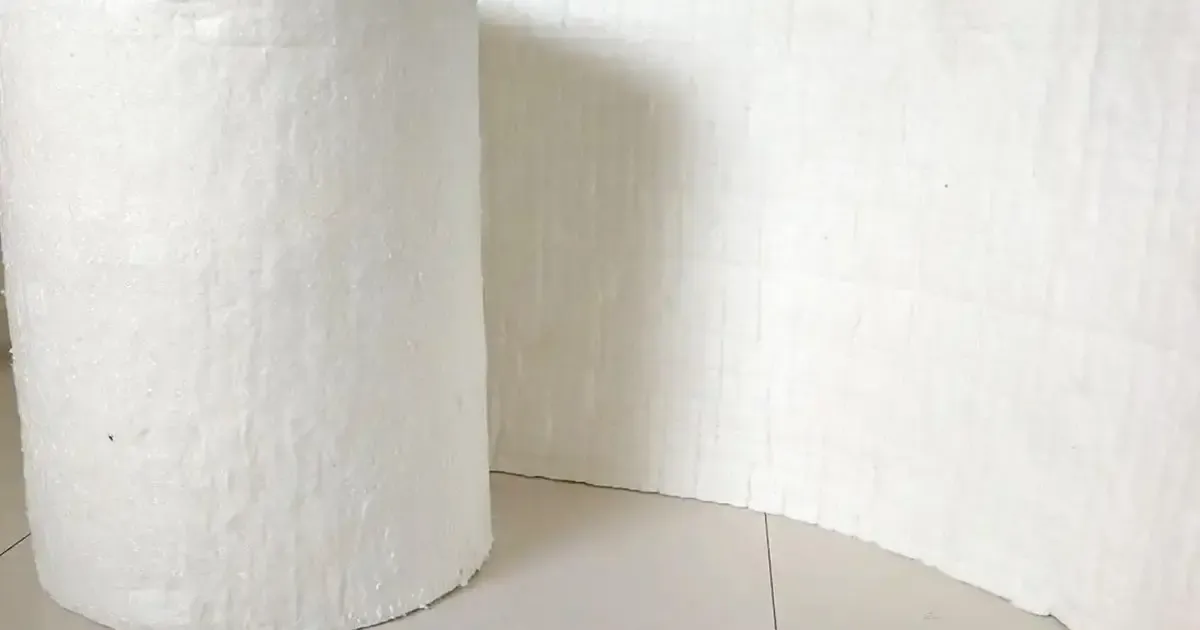
Quick answer: Ceramic fiber rope, tape, cloth and paper are made from the same aluminosilicate fiber but are built differently, and that difference decides where each one works. Choose ceramic fiber rope for seals around furnace doors, manways and flanges; ceramic fiber tape for wrapping pipe, valves and irregular runs; ceramic fiber cloth for large or awkward surfaces that need cutting and sewing; and ceramic fiber paper for thin gaskets, parting layers and electrical isolation. Pick the fiber grade by continuous service temperature first, then check the reinforcement — the wire, not the fiber, usually sets the real ceiling.
Nearly every failed order in this product family comes down to two errors. The first is buying to classification temperature instead of continuous use temperature, which can be 100–150 °C lower. The second is buying a ceramic fiber rope or tape whose reinforcement wire has a lower temperature limit than the duty requires. Get those two right and most of the remaining specification is straightforward.
This guide covers all four forms, how they are constructed, where each one belongs, how to size them, and exactly what to put in your enquiry so the material that arrives matches the material you specified.
The Four Forms at a Glance
Ceramic fiber rope, ceramic fiber tape, ceramic fiber cloth and ceramic fiber paper start from the same raw fiber. What changes is what happens next: braiding and twisting gives ceramic fiber rope, weaving a narrow strip gives ceramic fiber tape, weaving a full-width fabric gives ceramic fiber cloth, and wet-laying a slurry gives ceramic fiber paper. Each route trades strength for conformability, and that trade is what a buyer is really choosing between.
| Form | Typical continuous range | Core strength | Main limitation | Typical application |
|---|---|---|---|---|
| Ceramic fiber rope | 650–1,350 °C | Seals irregular gaps and compresses to fill | Consumes a lot of material on wide gaps | Furnace doors, manways, flange and expansion joints |
| Ceramic fiber tape | 650–1,100 °C | Fast wrapping of pipe and cylindrical runs | Weak crosswise; not for repeated flexing | Pipe, valve and exhaust wrapping |
| Ceramic fiber cloth | 650–1,260 °C | Cut and sewn to shape for large surfaces | Poor abrasion resistance, sheds fiber when rubbed | Removable covers, fire curtains, expansion joint liners |
| Ceramic fiber paper | 1,000–1,350 °C | Very thin, flat, easily die-cut | Almost no tensile strength; softens when wet | Thin gaskets, parting layers, element isolation |
The ranges overlap because the fiber grade inside the product can be changed, and because the reinforcement — where there is one — pulls the ceiling down. Read the two rows together: the fiber sets the upper bound and the reinforcement sets the real one.
Step One: The Fiber Grade Sets the Temperature Ceiling
Before comparing forms, fix the fiber grade. All four forms can be made in any of the standard grades below, and specifying ceramic fiber rope or ceramic fiber tape without naming the grade is like ordering steel by shape.
| Grade | Classification temp | Continuous use temp | Where it is used |
|---|---|---|---|
| Common | 1,050 °C | ≤ 1,000 °C | Flues, ducts, low-temperature plant |
| Standard | 1,260 °C | ≤ 1,100 °C | General furnace seals, boiler penetrations, most pipe wrapping |
| High-purity | 1,260 °C | ≤ 1,100 °C | Processes sensitive to iron contamination |
| High-alumina | 1,350–1,400 °C | ≤ 1,200 °C | Heat-treatment furnaces, ceramic kilns, hotter hot faces |
| Zirconia | 1,430 °C | ≤ 1,350 °C | Glass contact, severe cycling, peak excursions |
Take the temperature at the seal or wrap line, not the furnace interior. A door seal sits between the hot face and the external steelwork and normally runs far cooler than the chamber it closes. Add a safety margin of at least 100 °C to the measured figure, then read the continuous use column. For a fuller explanation of how the two temperature numbers differ across insulation wool families, see our high-temperature insulation wool temperature ratings guide.
Ceramic Fiber Rope: Constructions, Reinforcement and Sizing
Ceramic fiber rope is the most specified of the four, and the one most often wrongly specified, because "rope" covers three quite different constructions.
Twisted ceramic fiber rope is the cheapest and loosest. The yarn is simply twisted together, which means it frays badly when cut and has poor resilience under repeated compression. It suits static, low-pressure gaps that are filled once and left alone.
Square braided ceramic fiber rope is dense, holds its shape, and recovers well after compression. It is the default for furnace doors, manway covers and any seal that has to be opened and closed repeatedly, because it resists being squeezed out of the joint.
Round braided ceramic fiber rope has a smooth, even surface and is used where the rope sits in a machined groove or around a circular flange, particularly where appearance and consistent contact matter.
Sizing is where most field problems start. Two rules cover nearly every case:
- In a machined groove: free rope diameter = groove width × 1.1–1.2. A little oversizing gives full contact without forcing the joint apart.
- In an unconfined gap: rope diameter = gap × 1.3. The extra diameter is deliberate pre-compression, since a rope that merely touches both faces will leak as soon as the joint moves.
Above roughly 25 mm diameter, specify metallic reinforcement. An unreinforced rope that thick tends to slump under its own weight once hot, and the loss of resilience is permanent.
Two impregnations are worth knowing. Graphite impregnation improves gas tightness and reduces friction where a seal is compressed against a moving face. Vermiculite impregnation improves resistance to radiant heat and reduces surface erosion. Neither raises the temperature ceiling, and neither should be treated as a substitute for choosing the right grade. We cover the seal-side detail — joint design, compression and gasketing practice — in ceramic fiber rope sealing and gasketing applications. Our ceramic fiber rope range covers the standard braided constructions.
Ceramic Fiber Tape: Wrapping Pipe, Valves and Irregular Runs
Ceramic fiber tape is a narrow woven strip, typically 20–150 mm wide and 1.5–6 mm thick. It exists because wrapping is often faster than fitting a preformed section: a valve body, a short spool, a flanged joint or an exhaust run can all be insulated by spiral-wrapping tape in a fraction of the time a shaped cover takes to fit.
Reinforcement runs lengthwise, which is why tape is strong along its length and weak across it. That directional strength is intentional — it is what stops the tape stretching as it is pulled tight around a pipe — but it means ceramic fiber tape is the wrong choice wherever the joint flexes repeatedly or vibrates hard. A tape wrap on a vibrating line will crack across the weave.
Where radiant heat is significant, tape can be supplied with an aluminium foil facing on one side to reflect radiation back toward the pipe. The foil does not change the insulation value of the fiber; it reduces the heat arriving at the fiber in the first place, which keeps the wrap thinner than it would otherwise need to be.
Typical duties include steam and hot-air lines, temporary or permanent insulation of exhaust runs, covering valve bodies and flanges, and as a base layer beneath a removable cover. See ceramic fiber tape for the standard widths and reinforcement options.
Ceramic Fiber Cloth: Sewable Insulation for Large and Awkward Surfaces
Ceramic fiber cloth is woven at full width and behaves like a fabric: it can be cut, sewn, pleated and layered. That makes it the only one of the four that adapts to a genuinely complex shape without being custom manufactured.
Weave density drives everything. A denser weave gives higher tensile strength and better abrasion resistance, but marginally higher thermal conductivity, because there is more fiber per unit volume conducting heat. A looser weave insulates slightly better but sheds more. Where the cloth will be sewn into a removable insulation cover, strength usually wins and a denser weave is specified; where it will be laid as a static curtain or liner, the looser weave is acceptable.
Reinforcement is available in both warp and weft directions, and cloth can also be laminated with aluminium foil on one or both faces for radiant duty.
The honest limitations deserve stating plainly. Ceramic fiber cloth powders at the surface under repeated friction, so it is not a wearing surface. It should not be used where it will sit permanently soaked in strong acid or alkali, because the fiber is attacked and the fabric loses integrity. And it is heavier per square metre than blanket, so for a simple flat panel it is rarely the economical choice — ceramic fiber blanket usually wins there. Where the question is how the forms are made rather than which one to buy — bulk as the feedstock, needling against vacuum forming — our ceramic fiber bulk, blanket and board structures guide covers the whole chain. Our comparison of blanket, board, paper and cloth forms walks through that decision form by form. For the cross-material view — where board, panel, tile and sheet sit across calcium silicate, rock wool, glass wool and ceramic fiber — see our insulation board and panel forms guide. See ceramic fiber cloth for the woven range.
Ceramic Fiber Paper: Thin Gaskets, Parting Layers and Electrical Isolation
Ceramic fiber paper is made by wet-laying a short-fiber slurry — no weave at all. It is thin, flat and dimensionally even, which is why it is the form used wherever a tight tolerance matters more than strength.
Thickness typically runs 0.5–6 mm, with density controlled during manufacture. That combination makes ceramic fiber paper easy to die-cut into shaped gaskets, flange spacers, and precision shims, and it is the reason it appears in applications the other three forms cannot serve at all: thin electrical isolation between heating elements and their supports, parting layers between refractory sections, and backing for instrument probe assemblies.
Its limitations follow directly from having no weave. Ceramic fiber paper has almost no tensile strength, so it cannot be wrapped, pulled or used where it carries any load. It softens and loses integrity when wet, which rules out damp locations unless it is protected. Where a paper gasket will see any movement or clamping load, it needs the adjacent metalwork to do the work rather than the paper itself. See ceramic fiber paper for thickness and density options.
The Reinforcement Wire Is Usually the Weakest Link
This is the point that catches experienced buyers, and it deserves its own section. The ceramic fiber itself is rated to 1,260 °C or more, but the wire threaded through it to give strength rarely is. Specify a ceramic fiber rope or tape by fiber grade alone and you can end up with a product whose reinforcement fails long before the fiber does.
| Reinforcement | Practical continuous limit | Notes |
|---|---|---|
| Glass filament | Up to about 650 °C | Above this the filament embrittles and loses all tensile contribution |
| Stainless steel wire | About 1,000–1,100 °C | The standard step-up; widely available and adequate for most furnace duties |
| High-nickel alloy wire | Highest of the three | Chosen where repeated thermal cycling causes creep; the most expensive option |
Two practical rules follow. Below about 650 °C, glass filament reinforcement is usually sufficient and considerably cheaper, so specifying metal there is simply spending money for nothing. Above about 1,100 °C continuous, or wherever the seal cycles hard, metal reinforcement is not optional — and where cycling is severe, the high-nickel option earns its cost by resisting creep.
Where a product has no reinforcement at all, say so in the enquiry. Unreinforced ceramic fiber cloth and paper are perfectly reasonable choices for static linings, and asking for them explicitly avoids paying for strength that will never be used.
A Five-Step Selection Method
Working the four forms into a repeatable decision prevents most mis-buys:
- Measure the duty temperature at the seal line, not the furnace setpoint. Add at least 100 °C of margin, then select the fiber grade from the continuous use column.
- Assess the atmosphere. Standard grades suit mildly acidic flue gas. Alkali-rich environments — glass and cement kilns especially — call for high-alumina fiber. No grade in this family should be placed in direct contact with molten metal.
- Measure the geometry. Gap width for a rope, wrap circumference and width for tape, surface area and shape complexity for cloth, and tolerance and thickness for paper. This step produces the order dimensions.
- Choose construction and reinforcement. Square braid for doors that open, round braid for grooves, ceramic fiber tape for cylindrical runs, ceramic fiber cloth for anything that will be sewn, ceramic fiber paper for anything thin. Then set the reinforcement to the temperature and cycling duty.
- Confirm the surface treatment. Graphite impregnation where gas tightness matters, vermiculite where radiation does, foil facing where the wrap is exposed to radiant load.
What to Put in Your Enquiry
Nine lines in an enquiry remove nearly all ambiguity, and most suppliers will quote faster when they see them:
- Form — rope, tape, cloth or paper
- Fiber grade — common, standard, high-purity, high-alumina, zirconia, or low-biopersistence fiber
- Dimensions — rope diameter; tape width × thickness; cloth width × thickness; paper thickness × density
- Construction — for rope: twisted, square braided or round braided
- Reinforcement — none, glass filament, stainless steel wire, or high-nickel alloy wire
- Surface treatment — none, graphite impregnated, vermiculite impregnated, or foil faced
- Units — per kilogram, per metre or per square metre
- Acceptance criteria — permanent linear change after heating, shot content, thermal conductivity at the service temperature
- Documentation — material test report, safety data sheet, and the national product standard or its ASTM equivalent that the product is declared to
Line 9 is the one most often skipped, and it is the one that decides whether a delivery can be rejected. Ask for the standard before delivery rather than after a dispute.
Acceptance Checks Before You Sign Off
Four checks are quick to run and catch most non-conforming deliveries:
- Permanent linear change after heating. A common requirement is 3.5 % or less after a defined soak — often quoted at 1,000 °C for 24 hours. Higher figures mean the product will shrink away from the joint in service.
- Shot content. Roughly 12 % or less for standard fiber and 8 % or less for high-purity grades. High shot content makes cloth and tape dusty, uneven and weaker.
- Thermal conductivity at service temperature. Ask for the value at the actual mean temperature rather than at ambient.
- Visual inspection. No delamination, broken yarn runs or hard lumps. Ceramic fiber tape and ceramic fiber cloth must not have missing yarn runs, and ceramic fiber paper must be free of pinholes.
Installation, Compression and Safe Handling
Installation practice determines whether a correctly specified ceramic fiber rope performs. Three points matter most:
Compression. A seal rope is normally compressed to 25–40 % of its free thickness. Under-compress and it leaks; over-compress and the fiber takes a permanent set, loses resilience and leaks after the first thermal cycle. Follow the sizing rules above rather than compressing to taste.
First heat check. After the first thermal cycle, inspect every joint and wrap while the plant is cold. Ceramic fiber rope that has taken a permanent set, ceramic fiber tape whose overlaps have opened, and ceramic fiber cloth whose seams have pulled are all signs that the compression or the sizing was wrong, and they are far cheaper to correct before the second cycle than after it.
Wet service. Insulation performance falls sharply once ceramic fiber is soaked. In permanently damp locations either specify a protective coating or choose a different material class, because no amount of careful installation recovers performance from wet fiber.
Dust and handling. Cutting and abrading any product in this family releases airborne fiber. Work ventilated, wear a P100-class respirator, goggles, gloves and overalls, and collect offcuts rather than dry-sweeping them. Below roughly 900 °C, low-biopersistence fiber increasingly replaces traditional aluminosilicate because it reduces the cost of occupational protection; where the duty permits, ask for it in the enquiry rather than retrofitting it after a hygiene audit.
Related Reading
- Ceramic Fiber Rope — twisted, square braided and round braided constructions
- Ceramic Fiber Tape — widths, thicknesses and foil-faced options
- Ceramic Fiber Cloth — woven fabric for covers, curtains and liners
- Ceramic Fiber Paper — thin gasket and parting-layer grades
- Ceramic Fiber Blanket — the economical choice for flat panels
- Ceramic Fiber Rope Sealing and Gasketing Applications
- Ceramic Fiber Blanket vs Board vs Paper vs Cloth
- Ceramic Fiber Bulk: Grades, Uses and Application
- Ceramic Fiber Raw Materials and Manufacturing Process
- High-Temperature Insulation Wool Temperature Ratings
Manufacturer & Supplier of Ceramic Fiber Rope, Tape, Cloth & Paper
When buyers search for a ceramic fiber manufacturer or a ceramic fiber tape manufacturer, what they are really qualifying is the mill's control of fibre diameter, shot content and the alumina-silica ratio across every form — rope, tape, cloth and paper — not just one product line. A trader can quote all four; only a producer controls the chemistry that sets the 1100–1430 °C service window.
What a qualified ceramic fiber manufacturer provides
- A single alumina-silica base stock spun into multiple forms, so rope, tape, cloth and paper share the same thermal and chemical behaviour
- Documented density and thickness ranges for each form, with test reports from an accredited laboratory
- ISO 9001 quality management, CE marking and SGS verification on the produced grades
- Batch traceability from raw material to finished coil or roll
Forms and where they are specified
- Ceramic Fiber Tape — wrapped on pipe, valves and irregular runs up to 1430 °C
- Ceramic Fiber Rope — braided and twisted seals for furnace and kiln doors
- Ceramic Fiber Cloth — sewn blankets and removable covers for large surfaces
- Ceramic Fiber Paper — thin gaskets, parting layers and electrical isolation
For the full material overview, see the Ceramic Fiber Insulation hub.
Why source from an established manufacturer
Rosewool has produced ceramic fiber forms since 1982 and exports to 60+ countries across power, petrochemical, foundry and heat-treatment sectors. Because we run the fibre line ourselves, a refractory ceramic fiber manufacturer enquiry and a ceramic fiber cloth manufacturer or ceramic fiber paper manufacturer enquiry are answered from the same production batch — not three separate vendors. Contact our engineering team for density selection, thickness calculation and project-specific specifications.
Frequently asked
What is the difference between ceramic fiber rope and ceramic fiber tape? +
Ceramic fiber rope is braided or twisted into a round or square cross-section and is compressed into a joint to seal it, so it is chosen for gaps — furnace doors, manways, flanges and expansion joints. Ceramic fiber tape is woven flat, typically 20–150 mm wide and 1.5–6 mm thick, and is spiral-wrapped around cylindrical objects such as pipe, valve bodies and exhaust runs. Rope seals; tape wraps. Choose rope for a static joint you compress, and tape for a surface you cover.
What temperature can ceramic fiber rope withstand? +
The ceramic fiber itself is graded up to a 1,430 °C classification temperature with about 1,350 °C continuous use, but the reinforcement almost always governs the real answer. Glass filament reinforcement is limited to roughly 650 °C, stainless steel wire to about 1,000–1,100 °C, and high-nickel alloy wire is specified above that for severe cycling. State both the fiber grade and the reinforcement when you enquire, because a standard grade with glass filament reinforcement is a very different product from the same grade with metal reinforcement.
How do I size ceramic fiber rope for a gap? +
For a machined groove, use a free rope diameter of about 1.1 to 1.2 times the groove width so the rope fills the groove without forcing the joint apart. For an unconfined gap, use about 1.3 times the gap width, because the extra diameter provides the pre-compression a joint needs once it moves. At installation, compress a seal rope to 25–40 % of its free thickness — compressing further risks permanent set and loss of resilience after the first thermal cycle. Above roughly 25 mm diameter, specify metallic reinforcement to prevent slumping.
When should I choose ceramic fiber cloth over ceramic fiber blanket? +
Choose ceramic fiber cloth when the surface is complex enough that the material has to be cut and sewn to fit — removable insulation covers, fire curtains, expansion joint liners, and awkwardly shaped equipment. Cloth is also right where the insulation has to be opened and closed repeatedly. For a simple flat panel or a large plain run, ceramic fiber blanket is normally cheaper and installs faster, since it does not need sewing.
Is ceramic fiber paper suitable for gaskets? +
Yes, and it is one of its main uses. Ceramic fiber paper is wet-laid rather than woven, so it is flat, even and easy to die-cut into precise gasket shapes, typically from 0.5 to 6 mm thick. Its limits follow from that construction: it has almost no tensile strength, so it cannot be wrapped or loaded, and it softens when wet, so damp locations are unsuitable unless it is protected. The metalwork around it should carry clamping load rather than the paper itself.
What reinforcement should I specify for ceramic fiber rope or tape? +
Match the reinforcement to the duty temperature rather than buying the strongest option. Below about 650 °C, glass filament reinforcement is adequate and considerably cheaper. From there to roughly 1,100 °C, stainless steel wire is the standard step-up. Above that, or wherever repeated thermal cycling causes the joint to be compressed and released many times, high-nickel alloy wire resists creep better and holds resilience longer. If the product will be static and carry no load, unreinforced is a legitimate and economical choice — say so explicitly in the enquiry.
What should I check before accepting a ceramic fiber delivery? +
Four checks cover most failures. First, permanent linear change after heating — commonly 3.5 % or less after a defined soak, often 1,000 °C for 24 hours — since higher numbers mean the seal will shrink away from the joint. Second, shot content, roughly 12 % or less for standard fiber and 8 % or less for high-purity grades. Third, thermal conductivity quoted at the actual mean service temperature rather than at ambient. Fourth, a visual check for delamination, broken or missing yarn runs, hard lumps and, in paper, pinholes. Request the declared standard and test report in the enquiry so the delivery can be assessed against something.
Request a quote
Interested in our insulation solutions? Send us your requirements and our team responds within one business day.