
Ceramic Fiber Blanket vs Board vs Paper vs Cloth: Which Form When?
Choose the right ceramic fiber form for your application: blanket, board, paper, cloth, rope, tape, or bulk. Compare density, temperature, thermal conductivity, and typical industrial uses.
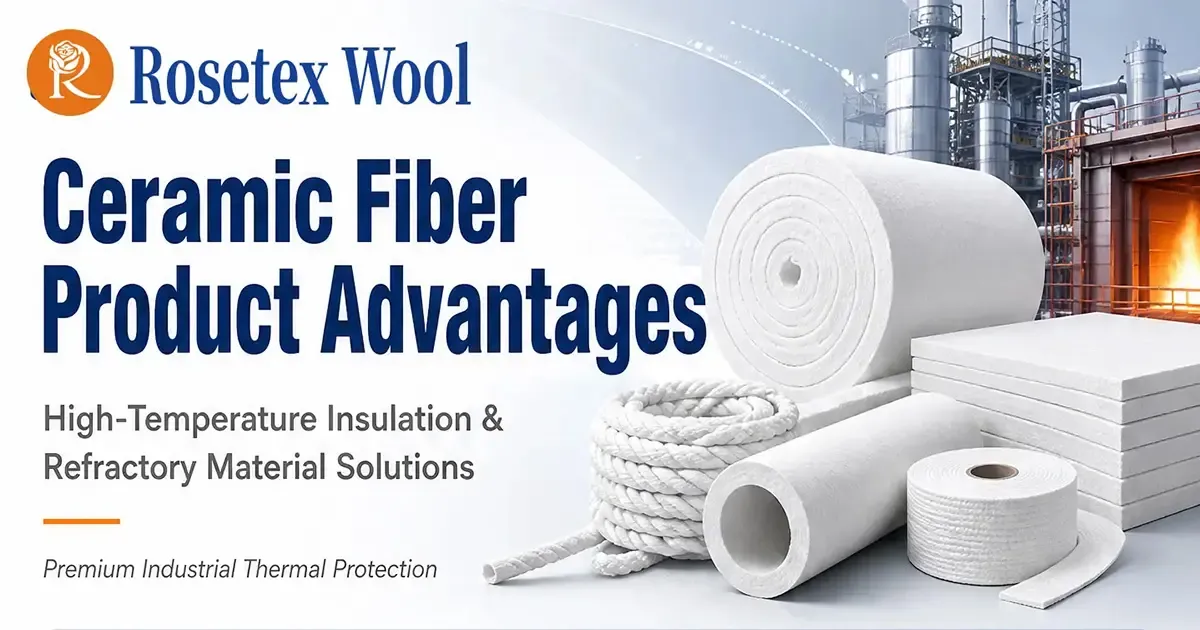
Ceramic fiber is sold in more shapes than most engineers realise. The same alumina-silica material can be needled into a flexible blanket, pressed into a rigid board, vacuum-formed into thin paper, woven into cloth, twisted into rope, or supplied as loose bulk. Each form solves a different problem, and choosing the wrong one usually means poor insulation, faster wear, or a difficult installation.
This guide compares the main ceramic fiber forms — blanket, board, paper, cloth, plus rope, tape, and bulk — so you can match form to function.
How the Forms Are Made
The manufacturing process decides the final structure. All ceramic fiber forms start from melt-spun or blown alumina-silicate fibres, but the post-processing is different. Our rope, tape, cloth and paper buying guide takes the same forms from the procurement side — sizing, reinforcement temperature limits and what to put in an enquiry.
| Form | Manufacturing route | Fiber structure | Main characteristic |
|---|---|---|---|
| Blanket | Needle-punching layers of fiber | Random 3D mesh | Flexible, compressible, excellent thermal shock resistance |
| Board | Slurry + vacuum forming + pressing | Layered / compressed | Rigid, self-supporting, flat surface |
| Paper | Wet-lay vacuum forming | Dense, aligned sheet | Thin, lightweight, easy to die-cut |
| Cloth | Weaving with reinforcement yarn | Woven grid | Strong, flexible, abrasion-resistant |
| Rope | Twisted / braided fibres | Twisted strand | Round or square cross-section for seals and packings |
| Tape | Woven strip, often with reinforcement | Woven band | Edge-stable strip for flange and door seals |
| Bulk | Loose fibre, no binder | Loose random | Filling, blowing, mixing into other products |
The key point is that chemistry can be identical, yet the engineering behaviour is completely different. A 1260 °C blanket and a 1260 °C board contain similar fibres, but one drapes over a pipe and the other supports its own weight on a furnace wall. That split begins at the forming step — needling against vacuum forming — and our ceramic fiber bulk, blanket and board explained guide follows the fibre from the melt line through both routes.
Temperature Classes: What the Numbers Mean
Ceramic fiber products are grouped by classification temperature — the temperature at which the fibre retains a defined percentage of its original properties after 24 hours. Classification temperature is not the same as continuous service temperature.
| Grade | Classification temp | Typical continuous service | Fibre chemistry |
|---|---|---|---|
| Standard | 1050 °C (1922 °F) | ≤ 900 °C | Aluminosilicate |
| High-purity | 1200 °C (2192 °F) | ≤ 1050 °C | Higher alumina |
| High-alumina | 1350 °C (2462 °F) | ≤ 1200 °C | High alumina |
| Zirconia | 1430 °C (2606 °F) | ≤ 1300 °C | Alumina-zirconia-silica |
| Polycrystalline | 1600 °C+ (2912 °F+) | ≤ 1500 °C | Mullite / alumina |
In oxidising atmospheres, continuous service temperature is usually 100–150 °C below classification temperature. In reducing or vacuum furnaces the gap can be 200–400 °C. Always specify by continuous service temperature, not the catalogue classification number.
Density, Strength and Thermal Conductivity
Form has a bigger effect on density and mechanical strength than most buyers expect. The table below shows typical industrial ranges.
| Form | Bulk density | Typical thickness | Compressive / tensile | Thermal conductivity @ 400 °C |
|---|---|---|---|---|
| Blanket | 96–160 kg/m³ | 6–50 mm | Low tensile (~0.04 MPa) | 0.09–0.13 W/(m·K) |
| Board | 220–400 kg/m³ | 10–100 mm | Rigid, compressible | 0.10–0.15 W/(m·K) |
| Paper | 180–250 kg/m³ | 0.5–10 mm | Low, tearable by hand | 0.08–0.12 W/(m·K) |
| Cloth | 400–600 kg/m³ | 2–5 mm | High tensile, reinforced | 0.10–0.14 W/(m·K) |
| Rope | ~300–500 kg/m³ | 6–50 mm dia. | Flexible, compressible | Similar to blanket |
| Tape | ~400–600 kg/m³ | 2–5 mm thick | High edge strength | Similar to cloth |
| Bulk | ~60–100 kg/m³ | Loose fill | N/A | Lowest, but settles |
Blankets and boards are the workhorses of furnace insulation. Paper and cloth are specialists. Rope and tape solve sealing problems. Bulk is used for filling, repairs, and as raw material for module production.
Thermal Shock and Handling Behaviour
Thermal shock resistance matters when equipment cycles quickly. A furnace that heats to 1200 °C and cools to ambient every shift will destroy a rigid board faster than a flexible blanket.
| Form | Thermal shock resistance | Handling notes |
|---|---|---|
| Blanket | Excellent — fibres move with expansion | Cuts cleanly, low dust, wraps around curves |
| Board | Moderate — can crack under rapid cycling | Machines and saws like wood; produces dust |
| Paper | Moderate | Clean edges, easy to punch; tears if mishandled |
| Cloth | Good | Drapes well; reinforced edges resist tearing |
| Rope | Excellent | Compresses into gaps; easy to pack |
| Tape | Good | Stays flat; good for flange covers |
| Bulk | Excellent as fill, poor as surface | Requires containment; can settle over time |
Which Form for Which Application
Furnace linings and hot faces
For the hot face of industrial furnaces, kilns, and heaters, the choice is usually between blanket and board.
- Blanket is preferred when the lining must conform to a curved shell, absorb thermal expansion, or tolerate thermal cycling. It is installed in layers and held by anchors or modules.
- Board is preferred for flat walls, doors, and baffles where a rigid, abrasion-resistant surface is needed. Boards are also common as backup insulation behind castable or brick hot faces.
For very high temperatures or severe chemical attack, polycrystalline fibre board or modules are the next step up. The full property set — 1600-1700 °C continuous service, ≤0.5 % shrinkage at 1500 °C, and the 2-8 MPa strength range — is covered in our polycrystalline mullite fiber board guide.
Seals, gaskets and expansion joints
Where the job is to stop hot gas leakage or fill a moving joint, flexible forms win.
- Rope is the default for door seals, ladle lids, and expansion joints in round grooves.
- Tape is used for flanges, door edges, and straight-run seals.
- Paper is ideal for thin gaskets, sight-glass seals, and precision-cut shims.
- Cloth is used for curtains, blankets, and removable insulation pads that see handling.
Our ceramic fiber rope sealing guide covers rope and tape selection in more detail.
Pipe, duct and vessel wrapping
For cylindrical equipment, blankets and cloth are the natural choices.
- Blanket is wrapped around pipes and vessels in specified thicknesses, then banded or wired in place.
- Cloth is used for removable wraps, pipe penetration seals, and cable protection where abrasion resistance matters.
Filling, blowing and repairs
Bulk fibre is the right form when the insulation must be poured, blown, or packed into irregular cavities. It is also the raw material used to manufacture folded modules. Because it has no binder, it keeps full temperature rating, but it needs containment and may settle if not packed correctly. Packing density and shot content govern how it performs once installed — see our ceramic fiber bulk grades and application guide for target densities, grade selection, and the blown-versus-spun choice.
Selection Decision Tree
Use the following questions to narrow the choice.
What is the continuous operating temperature?
- Above 1300 °C continuously → zirconia grade or polycrystalline
- 1000–1300 °C → high-alumina or zirconia grades
- Below 1000 °C → standard or high-purity grades
Does the surface need to support itself?
- Yes, flat self-supporting wall → board
- No, wraps around a shell → blanket or cloth
- Fills a gap → rope, tape, paper, or bulk
Will the equipment cycle rapidly?
- Frequent thermal cycling → blanket, cloth, rope, or bulk
- Steady-state operation → board or paper
Is abrasion or mechanical handling expected?
- High abrasion → board or cloth
- Occasional handling → cloth or rope
- Static insulation → blanket, paper, or bulk
What is the installation environment?
- Clean room, low dust → paper or pre-cut cloth
- Field cutting acceptable → blanket or board
- Confined space → blanket, rope, or tape
Industry-Specific Quick Guide
| Industry | Common forms | Typical grades |
|---|---|---|
| Steel — reheating furnaces, ladles | Board backup, blanket modules, rope seals | 1260–1430 °C |
| Petrochemical — reformers, crackers | Blanket modules, board hot face, rope seals | 1260–1430 °C |
| Cement — kilns, preheaters | Blanket, board, bulk fill | 1200–1400 °C |
| Aluminium — melting and holding | Blanket, board, cloth covers | 1200–1260 °C |
| Power — boilers, ductwork | Blanket, board, paper gaskets | 1000–1260 °C |
| Ceramics — kilns and kiln cars | Board, blanket, bulk | 1200–1430 °C |
Common Specification Mistakes
- Confusing classification temperature with service temperature — a 1430 °C classification fibre may only be rated for 1250–1300 °C continuous service depending on atmosphere.
- Using board where blanket is needed — rigid boards crack in highly cyclic furnaces.
- Ignoring density tolerance — a "220 kg/m³" board with ±10 % tolerance can vary from 198 to 242 kg/m³.
- Choosing paper for load-bearing seals — paper is a gasket material, not a structural seal.
- Forgetting reinforcement in cloth — cloth strength comes from the glass or stainless-steel reinforcement yarn; check the reinforcement temperature rating.
Bottom Line
Ceramic fiber blanket, board, paper, cloth, rope, tape, and bulk are the same material family in different engineered forms. Blanket handles curves and thermal shock. Board provides rigid, self-supporting insulation. Paper solves thin-seal problems. Cloth and rope handle seals, curtains, and removable pads. Bulk fills cavities and feeds module production.
The right choice depends on temperature, mechanical load, thermal cycling, and installation constraints. In most plants, several forms are used together — board for the wall, blanket for the lining, rope for the door seal, and paper for the gasket.
At Rosewool we supply ceramic fiber blanket, board, paper, cloth, rope, tape, and bulk in standard, high-purity, high-alumina, and zirconia grades, certified to ISO 9001, CE, and SGS. Contact our technical team for form and grade selection based on your furnace or process conditions.
For a deeper dive into forms, temperature ratings, and application guides, see our ceramic fiber insulation hub.
Frequently asked
What is the difference between ceramic fiber blanket and board? +
Ceramic fiber blanket is a flexible, needled material that drapes around curved surfaces and absorbs thermal expansion. Ceramic fiber board is a rigid, pressed product used for flat, self-supporting walls and baffles. Blankets handle thermal shock better; boards resist abrasion and hold their shape without support.
When should I use ceramic fiber paper instead of cloth? +
Use ceramic fiber paper for thin, precision gaskets, sight-glass seals, and die-cut shims where low thickness and clean edges matter. Use ceramic fiber cloth for applications that need strength, abrasion resistance, or repeated handling, such as curtains, removable pads, and cable protection.
What is ceramic fiber rope used for? +
Ceramic fiber rope is used for round-section seals, expansion joints, door and lid packings, ladle seals, and gland packing. It compresses into grooves and tolerates movement better than rigid boards or papers.
What is the maximum temperature for ceramic fiber blanket? +
Standard ceramic fiber blankets are rated for continuous service up to about 900–1050 °C, depending on grade. High-alumina grades reach 1200 °C, zirconia grades about 1250–1300 °C, and polycrystalline fibre blankets can exceed 1400 °C. Continuous service temperature is usually 100–150 °C below the catalogue classification temperature.
Can ceramic fiber board be used as a hot face lining? +
Yes, ceramic fiber board can be used as a hot face lining in steady-state furnaces with low abrasion and limited thermal cycling. In furnaces with rapid heating and cooling cycles, a fibre blanket or module lining usually performs better because it resists thermal shock cracking.
What is ceramic fiber bulk used for? +
Ceramic fiber bulk is loose fibre used for filling irregular cavities, blown insulation, repair packing, and as the raw material for folded modules. It has no binder, so it retains full temperature rating, but it must be contained and may settle if not packed correctly.
How do I choose the right ceramic fiber form? +
Start with continuous service temperature, then decide whether the surface needs self-support. Use board for rigid flat walls, blanket for curved or cyclic surfaces, paper for thin seals, cloth for handled covers, rope and tape for seals and packings, and bulk for filling. Also consider installation access, abrasion, and whether the equipment cycles.
Is ceramic fiber the same as glass wool or rock wool? +
No. Ceramic fiber is an alumina-silica refractory fibre designed for temperatures from 1000 °C up to 1600 °C. Glass wool is used up to about 350 °C, and rock wool up to about 650–750 °C. For a detailed comparison, see our guide on high-temperature insulation materials.
Request a quote
Interested in our insulation solutions? Send us your requirements and our team responds within one business day.