
Calcium Silicate Insulation: The Complete Buyer's Guide (2026)
2026 buyer's guide to calcium silicate insulation: temperature ratings, density, thermal conductivity, forms, and how to specify calsil for industrial projects.
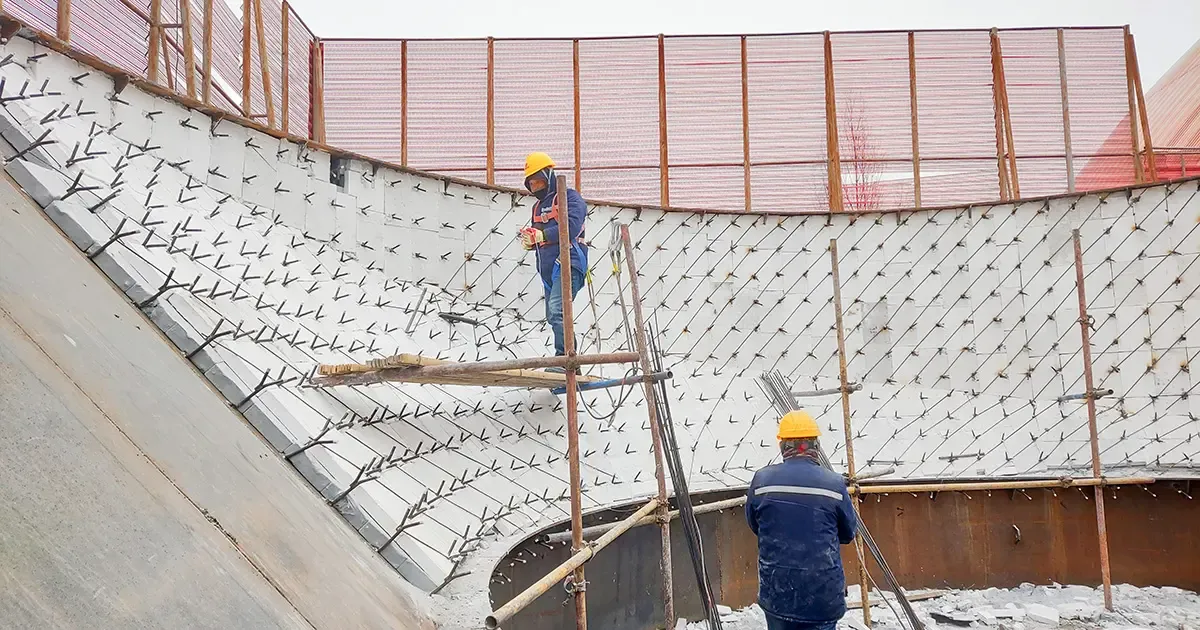
Calcium silicate insulation — also called calsil or cal-sil — is a rigid, asbestos-free, inorganic material used to insulate pipes, vessels, and equipment from roughly 650 °C up to 1050 °C. It is the material engineers turn to when a lining must stay flat, carry load, and survive high humidity or occasional water contact without slumping.
This guide is written for procurement and engineering teams who need to specify calcium silicate in 2026. It covers what the material is, how the grades differ, which form to order, and the checklist that separates a successful specification from a site problem.
What Is Calcium Silicate Insulation?
Calcium silicate insulation is manufactured by reacting lime (calcium oxide) and silica under high-pressure steam in an autoclave. The reaction forms crystalline calcium silicate hydrates — mainly the tobermorite phase in standard boards and the xonotlite phase in many high-temperature grades. These crystal structures give calsil its low thermal conductivity, dimensional stability, and rigidity.
The manufacturing sequence matters for buyers because it explains why calsil behaves differently from fibrous insulants. A slurry of lime, silica, and reinforcing fiber is cast or pressed into shape, then cured under saturated steam at temperatures typically between 170 °C and 210 °C. The result is a pre-crystallized, load-bearing solid rather than a bonded mat of fibers. Because the structure is crystalline, it does not soften or lose strength at its rated service temperature.
Unlike flexible mineral-wool blankets, calcium silicate is a rigid board or pipe section. It does not rely on a binder to hold its shape, so it keeps its dimensions after repeated heating and cooling cycles. Modern formulations are reinforced with non-asbestos fibers for handling strength and are classified as A1 non-combustible under EN 13501-1.
For a shorter introduction to the material, see our article on what is calsil (calcium silicate) insulation.
Temperature Ratings: Standard Grade vs High-Temperature Grade
The first specification decision is temperature class. Calcium silicate products fall into two broad groups:
| Grade | Max continuous service temp | Typical crystal phase | Common uses |
|---|---|---|---|
| Standard | 650 °C (1200 °F) | Tobermorite | Steam pipes, boiler casings, HVAC ducts, fire-rated walls |
| High-temp | 1000–1050 °C (1830–1920 °F) | Xonotlite | Furnace backup linings, cement kiln transitions, petrochemical heaters |
A common mistake is to size calsil for a 650 °C average when the skin temperature spikes above 1000 °C during upset conditions. If the continuous operating temperature is above 650 °C, specify the high-temperature grade. If the temperature is above 1050 °C continuously, switch to ceramic fiber blanket or polycrystalline mullite fiberboard.
High-temperature grades achieve their extra headroom through higher xonotlite content and tighter process control during autoclaving. They cost more than standard grades, but they eliminate the risk of shrinkage, cracking, and loss of compressive strength in hot zones. For buyers, the safest rule is: size for the peak continuous temperature, not the average.
Density, Thermal Conductivity & Mechanical Strength
Density is the next filter after temperature. Higher density means higher compressive strength and slightly higher thermal conductivity at low temperatures, but better durability and load-bearing capacity. The table below shows typical industrial grades.
| Density grade | Bulk density | Compressive strength (10 %) | Thermal conductivity @ 200 °C | Best for |
|---|---|---|---|---|
| Light | 170–200 kg/m³ | 0.4–0.6 MPa | ≤ 0.055 W/m·K | Low-load pipe and duct insulation |
| Standard | 200–240 kg/m³ | 0.6–1.0 MPa | ≤ 0.060 W/m·K | General industrial pipe and equipment |
| High-density (HD) | 240–300 kg/m³ | ≥ 1.0 MPa | ≤ 0.065 W/m·K | Load-bearing pads, kiln car decks, heavy equipment |
At higher temperatures, thermal conductivity rises. A board rated at 0.050 W/m·K at 100 °C may read 0.110–0.130 W/m·K at 600 °C. Always ask suppliers for the mean-temperature curve across the full service range, not a single room-temperature value. Designing from a single low-temperature conductivity number is one of the most common causes of under-specified insulation thickness on hot process lines.
Mechanical strength is just as important as thermal performance in many applications. Standard calcium silicate can support light foot traffic and cladding loads. High-density boards can support structural loads such as kiln car decks, ladle covers, and equipment pads. If your application involves bolt-through fixings, point loads, or vibration, specify compressive strength explicitly and confirm the test method.
Forms: Board, Pipe, Block & Custom Shapes
Calcium silicate is supplied in four main forms. Choosing the right one reduces field cutting, improves joint quality, and shortens installation time.
Board
Flat rectangular boards are the most common form. Standard dimensions are often 1200 × 2400 mm or 1000 × 2000 mm, with thicknesses from 10 mm to 100 mm. Boards are used for:
- Furnace and kiln backup linings
- Fire-rated wall and ceiling cores
- Boiler and duct casings
- Equipment pads where a flat, structural surface is needed
For high-load areas, specify high-density calcium silicate board.
Pipe sections
Pre-curved segments match common pipe diameters and are supplied in halves or segments for easy fitting. They are widely used in:
- Power plant steam and hot-water lines
- Petrochemical process piping
- Refinery heaters and transfer lines
See the full calcium silicate pipe range for diameter and thickness options.
Block & custom shapes
Thicker blocks and engineered shapes are used for kiln car decks, ladle covers, and furnace components where standard boards would require too many joints. Custom shapes are normally CNC-machined or cast to drawing.
Calsil vs Rock Wool vs Ceramic Fiber
Calcium silicate is often compared with rock wool and ceramic fiber. The choice depends on temperature, form, and whether the surface must carry load.
| Property | Calcium silicate | Rock wool | Ceramic fiber |
|---|---|---|---|
| Max continuous temp | 650–1050 °C | ~750 °C | up to 1430 °C |
| Form | Rigid board / pipe | Flexible blanket / board / pipe | Flexible blanket / module / board |
| Compressive strength | High (load-bearing) | Low | Very low |
| Water resistance | Low uptake, dimensionally stable | Repels water if treated; can sag if saturated | Poor — absorbs water and loses insulation value |
| Handling dust | Minimal | Fibrous | Fibrous (PPE required) |
| Relative cost | Mid | Low | Higher |
Decision rule: use calcium silicate insulation board where rigidity, dimensional stability, or load-bearing matters; use rock wool blanket for curved or irregular surfaces on a budget; use ceramic fiber blanket when temperatures exceed 1000 °C continuously.
For a deeper look at the rock-wool temperature ceiling, read our guide on what temperature rock wool can withstand.
Where Calcium Silicate Insulation Is Used
Calsil appears wherever a rigid, high-temperature insulant is required. Typical 2026 applications include:
- Power generation — boiler casings, steam piping, flues, and ductwork. The rigid pipe sections stay in place on long horizontal runs without sagging.
- Petrochemical — heater and reformer backup linings, pipe supports, and hot process piping. The material resists hydrocarbon exposure and supports cladding.
- Cement & lime — kiln transition zones, preheater towers, and cooler roofs. High-temperature grades handle the cyclic thermal shock of kiln rotation.
- Metals — reheating furnace backup, ladle covers, and tundish linings. High-density boards carry the mechanical loads of molten-metal handling equipment.
- Marine & offshore — A-60 fire-rated bulkheads and deckheads. Calsil's A1 rating and low smoke emission make it ideal for SOLAS fire divisions.
- Building services — fire-rated walls, smoke-extract ducts, and penetration seals. Boards provide a flat, stable substrate for cladding systems.
In composite linings, calsil usually sits on the cold side as a structural backup, while ceramic fiber or rock wool handles the hot face. This combination gives the hot-face temperature resistance of fiber and the structural integrity of a rigid board.
Global Standards & Certifications
Industrial calcium silicate is covered by several standards. Specifying the correct standard avoids mismatched test methods and false claims.
| Standard | Region | Scope |
|---|---|---|
| ASTM C533 | United States | Calcium silicate block and pipe thermal insulation |
| EN 14306 | Europe | Calcium silicate products for industrial installations |
| GB/T 10699 | China | Calcium silicate insulation products |
| ISO 8142 | International | Reference for preformed insulation dimensions |
For export projects, CE marking and SGS test reports are usually required. For fire-critical applications, request an A1 non-combustible classification report to EN ISO 1182 and EN ISO 1716. An asbestos-free declaration should be on the supplier's letterhead, not just a generic material safety data sheet.
Procurement Checklist: What to Specify
A complete calcium silicate specification should include the following items. Missing any of them is a common cause of rejected deliveries or field delays.
1. Temperature class
State the maximum continuous operating temperature and any upset or cyclic peak. Use 650 °C standard grade or 1000–1050 °C high-temp grade accordingly. If the peak exceeds 1050 °C for more than a few hours per year, consider ceramic fiber or mullite instead.
2. Density and mechanical strength
Define the required density range and compressive strength at 10 % deformation. For walkable or load-bearing surfaces, specify high-density board ≥ 240 kg/m³ with compressive strength ≥ 1.0 MPa. For simple pipe insulation, 200–240 kg/m³ is usually sufficient.
3. Dimensions and tolerances
List board size, thickness, pipe nominal diameter, segment length, and acceptable dimensional tolerance. For pipe sections, confirm whether the inner diameter is nominal bore or outer diameter. Tolerances of ±2 mm on thickness and ±5 mm on length are common for machined boards.
4. Thermal conductivity curve
Require thermal conductivity values at 100 °C, 200 °C, 400 °C, and 600 °C minimum. A single-point value is not enough for design calculations. Request the curve at mean temperatures that cover your actual service range.
5. Fire and environmental certification
Ask for:
- A1 non-combustible test report (EN ISO 1182 / EN ISO 1716)
- Asbestos-free declaration
- ISO 9001 quality management certification
- CE or SGS marks for export projects
6. Batch testing and traceability
For large projects, require mill test certificates tied to the production batch. Consider third-party sampling for density, conductivity, and compressive strength before acceptance. Marking each pack with batch number, production date, and density grade is the minimum traceability requirement.
7. Facing and finish
Specify whether boards need a facing (aluminum foil, glass tissue, or none) and whether edges should be square, beveled, or tongue-and-groove. Foil facing can reduce dust during installation and act as a vapor barrier; un-faced boards bond better with high-temperature cements.
Common Specification Mistakes to Avoid
Even experienced buyers can mis-specify calcium silicate. The most frequent errors include:
- Mixing up standard and high-temp grades — a standard 650 °C board placed in a 900 °C zone will shrink and crack within months.
- Designing from a single conductivity value — insulation thickness must be calculated from the mean-temperature curve, not the room-temperature brochure figure.
- Ignoring compressive strength — walking on or bolting through a low-density board causes crushing and hot spots.
- Wrong pipe ID — pipe sections sized by nominal bore may not fit over the actual outer diameter including existing insulation or coating.
- No batch testing — relying solely on the supplier's initial type-test report instead of per-batch certificates invites out-of-spec material.
Installation & Handling Notes
Calcium silicate is easy to handle but brittle. Follow these practices on site:
- Storage — keep boards and pipe sections dry and off the ground. Calsil is water-resistant, not waterproof; prolonged soaking can weaken surface layers.
- Cutting — use a fine-tooth saw or carbide-tipped cutter. Wear a dust mask even though the material is low-dust.
- Fixing — boards can be mechanically fixed with studs and washers or adhered with compatible high-temperature adhesives. Pipe sections are usually wired or banded in place.
- Joints — stagger board joints between layers. Fill gaps with compatible calcium silicate cement or insulating filler.
- Protection — finish with aluminum, galvanized steel, or stainless-steel cladding in outdoor or wash-down areas.
For multi-layer systems, the outer layer should overlap the joints of the inner layer by at least 100 mm. On vertical pipes and vessels, install sections from the bottom up so that each upper section overlaps the one below, preventing water ingress.
Cost, Service Life & ROI
Calcium silicate costs more per square metre than rock wool but less than ceramic fiber or aerogel. Its value comes from longevity and low maintenance. In high-temperature industrial service, a correctly specified calsil lining can last 15–30 years with minimal degradation.
Energy savings from reduced heat loss usually repay the material cost within 2–4 years on hot process lines. The bigger payback often comes from avoided downtime: a rigid, dimensionally stable lining does not slump or hot-set like some flexible materials, so reline cycles are longer and emergency repairs are fewer.
When evaluating quotes, compare total installed cost rather than material price alone. Calsil's rigidity can reduce support steel, cladding complexity, and labor hours on pipe runs. On equipment pads and kiln cars, the higher compressive strength of high-density boards reduces creep and extends service life.
Bottom Line
Calcium silicate insulation is the right choice when your application needs a rigid, load-bearing, high-temperature insulant that stays dimensionally stable in humid or cyclic conditions. Start with the temperature class, then select density and form. Specify the full thermal conductivity curve, confirm A1 non-combustible and asbestos-free certification, and tie acceptance testing to the production batch.
At Rosewool we have manufactured calcium silicate boards, pipes, and custom shapes since 1982, supplying power, petrochemical, cement, and marine projects with ISO 9001, CE, and SGS certified materials. Contact our engineering team for density selection, thickness calculations, and project-specific specifications.
Manufacturer & Supplier of Calcium Silicate Insulation
A calcium silicate insulation supplier is only as good as the dimensional stability and batch consistency of the boards and pipe sections it ships. When you shortlist a calcium silicate board manufacturer, confirm the mill can hold flatness, edge squareness and the declared density across the full 1000–1100 °C temperature class — not just on a sample panel.
What to verify before you order
- Independent test reports covering thermal conductivity, compressive strength and A1 non-combustible classification
- ISO 9001, CE and SGS certification scoped to the actual product line being quoted
- Density and thickness tolerances tied to the production batch, with traceability to raw material
- Capacity to supply board, pipe sections and custom shapes from one source
Product forms we supply
- Calcium Silicate Pipe — pre-formed sections for steam and process lines
- Calcium Silicate Insulation Board — rigid load-bearing panels for furnaces and vessels
- Calcium Silicate Insulation hub for grades, sizes and project data
A bulk calcium silicate pipe covering insulation distributor should show mill-direct origin and batch certificates; Rosewool manufactures these shapes in-house and has done so since 1982, serving power, petrochemical, cement and marine projects worldwide. Contact our engineering team for density selection and thickness calculations.
The pipe form earns its own deep dive: our calcium silicate pipe insulation guide covers xonotlite vs tobermorite grades, steam-line thickness design and the stainless-steel compliance package.
For a deeper dive into forms, temperature ratings, and application guides, see our ceramic fiber insulation hub.
Frequently asked
What is calcium silicate insulation used for? +
Calcium silicate insulation is used for high-temperature pipe, vessel, and equipment insulation where rigidity and dimensional stability matter. Common applications include steam piping, boiler casings, furnace backup linings, cement kilns, petrochemical heaters, and A-60 marine fire barriers.
What is the maximum temperature for calcium silicate insulation? +
Standard calcium silicate insulation is rated for continuous service up to 650 °C. High-temperature grades reach 1000–1050 °C. Above 1050 °C, ceramic fiber or polycrystalline mullite boards are the better choice.
Is calcium silicate insulation waterproof? +
Calcium silicate is water-resistant, not waterproof. It has low capillary absorption and stays dimensionally stable if it gets wet, but prolonged immersion should be avoided. Outdoor or wash-down applications should be protected with metal cladding.
How does calsil compare to rock wool? +
Calsil is rigid and load-bearing, rated to 650–1050 °C, and holds its shape under compression. Rock wool is flexible, lower cost, and rated to about 750 °C. Use calsil for structural, rigid surfaces; use rock wool for curved or irregular surfaces on a budget.
What density calcium silicate board should I specify? +
For general pipe and equipment insulation, 200–240 kg/m³ is standard. For load-bearing surfaces such as kiln car decks or walkable platforms, specify high-density board at 240–300 kg/m³ with compressive strength ≥ 1.0 MPa.
Is calcium silicate insulation asbestos-free? +
Yes. Modern calcium silicate insulation is made from lime, silica, and non-asbestos reinforcing fibers. It contains no asbestos and is safe to handle with normal site PPE.
Request a quote
Interested in our insulation solutions? Send us your requirements and our team responds within one business day.