
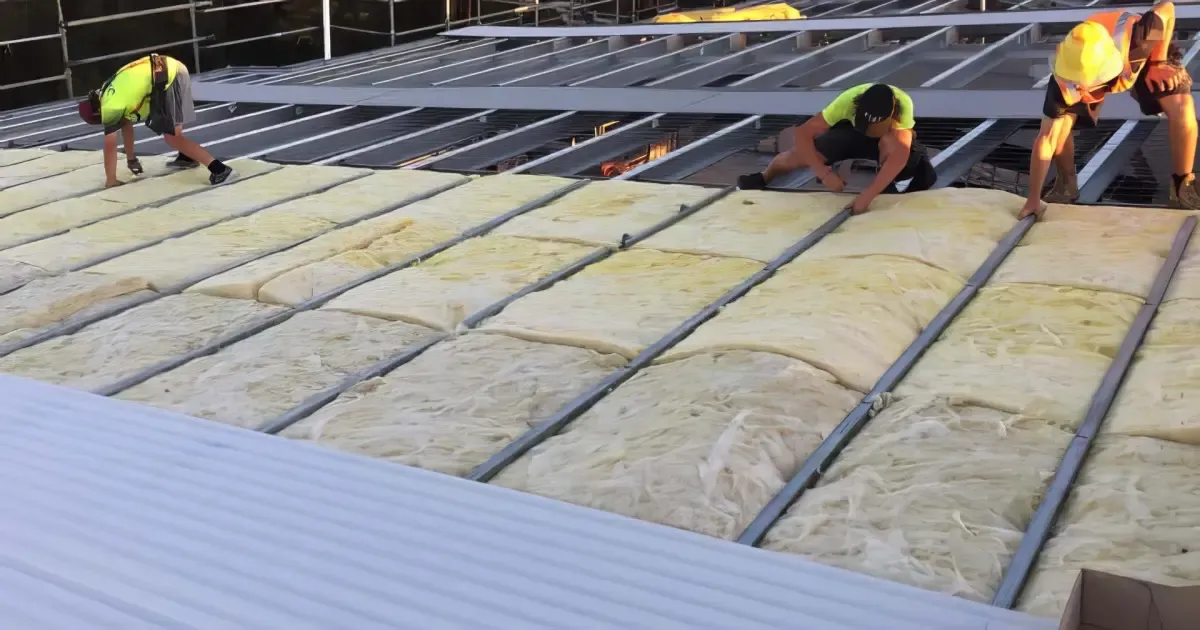
Roof Insulation
Roof insulation types, R-value by climate zone, and standards for fiberglass, mineral wool and rigid board on metal, flat and low-slope roofs.
Overview
What Roof Insulation Does and Why It Matters
Roof insulation sits at or just below the roof deck to slow heat flow between the conditioned space and the outdoors, cut heating and cooling loads, control condensation, damp rain and equipment noise, and lift the whole building's thermal envelope. On low-slope commercial roofs, warehouse and factory decks, and metal buildings, the bare deck can dominate annual energy cost, so continuous insulation above the deck is now the default in modern energy codes. The right specification depends on roof type (metal, built-up, single-ply, standing seam), slope, climate zone, fire requirement and whether the assembly must also control sound. For building-envelope context, see our building insulation and green building insulation guides.
Materials & Forms
Roof Insulation Materials and Forms
Three families cover most roofs: glass wool (fiberglass), mineral wool (stone wool), and factory-laminated rigid foam boards (polyisocyanurate, extruded and expanded polystyrene). Glass and mineral wool are supplied as flexible or semi-rigid blankets, rolls and boards; foam boards are rigid panels.
| Material | Common roof form | R-value / inch | Max service temp* | Fire class |
|---|---|---|---|---|
| Glass wool roof board / blanket | Semi-rigid board, faced roll | R-3.5 to R-4.5 | -120 to 400 °C | ASTM E84 25/50, non-comb. |
| Mineral wool roof board | Rigid / semi-rigid board | R-3.8 to R-4.0 | up to 650 °C | A1 (EN 13501-1) |
| Polyisocyanurate (PIR) board | Rigid foam board | R-5.5 to R-5.7 (LTTR) | ~120 °C | ASTM E84, FM rated |
| Extruded / expanded polystyrene (XPS / EPS) | Rigid foam board | R-4.0 to R-5.0 | ~75 °C | ASTM E84, FM rated |
*Continuous service temperature: inorganic glass and mineral wool tolerate roof-deck heat and fire exposure far better than foam boards, which are typically limited to ~75 to 120 °C and rely on a non-combustible cover board for fire-rated assemblies. Explore our glass wool board, mineral wool board, glass wool blanket and mineral wool blanket product lines.
Standards
Standards and Compliance
Roof insulation is specified against published material, fire and energy standards rather than brand names:
- ASTM C1289 — facing-attached rigid cellular polyisocyanurate thermal insulation board.
- ASTM C578 — rigid cellular polystyrene (EPS and XPS) thermal insulation board.
- ASTM C726 — mineral-fiber roof insulation board (wet-felted).
- ASTM C165 — test method for compressive strength of thermal insulations.
- EN 13162 / EN 13164 / EN 13165 — European specs for factory-made mineral wool, XPS and PIR boards for buildings.
- EN 13501-1 — reaction-to-fire classification; glass and mineral wool boards are A1 (non-combustible).
- ASTM E84 — surface burning (flame spread / smoke developed), commonly 25/50 for roof decks.
- ASHRAE 90.1 / IECC — minimum above-deck R-values by climate zone.
- FM Global / UL — roof deck fire and wind-uplift classifications for rated assemblies.
R-Value
R-Value and Thickness by Climate Zone
ASHRAE 90.1 and the IECC set minimum continuous insulation values above the roof deck. Planning values commonly used:
| Climate zone group | Min above-deck R (typical) | Approx. mineral wool board |
|---|---|---|
| Hot (zones 1 to 3) | R-20 | ~5.0 to 5.5 in (125 to 140 mm) |
| Mixed (zones 4 to 6) | R-25 | ~6.5 in (165 mm) |
| Cold (zones 7 to 8) | R-30 | ~7.5 to 8.0 in (190 to 200 mm) |
R-value scales with thickness: 1 in (25 mm) of mineral wool board is about R-3.8 to R-4.0, glass wool board about R-3.5 to R-4.5, and polyiso about R-5.5 (note: polyiso is often de-rated in cold zones, so verify the local code value). Always confirm against the local energy code and the project's green-building target (see green building insulation). For pipe and duct R-values, see our pipe insulation and duct insulation guides.
Temperature & Fire
Service Temperature and Fire Performance
Glass wool roof products are rated from about -120 to 400 °C, and mineral wool board up to about 650 °C — both are non-combustible and classified A1 under EN 13501-1 (glass wool typically meets ASTM E84 25/50). That makes them the natural choice where the deck sees high temperature, where a fire-rated assembly is required, or as a cover board over combustible foam. Foam boards (PIR, XPS, EPS) are limited to roughly 75 to 120 °C and depend on an overlying non-combustible layer for the fire rating. For rated roof-deck and fire-resistance assemblies, specify a documented system. See our fire protection insulation guide for adjacent fire-rated detail.
Vapour & Moisture
Vapour Retarder and Condensation Control
On heated buildings in cold climates, a vapour retarder is placed on the warm side of the assembly to keep interior moisture from condensing in the roof. With modern continuous insulation above the deck, the retarder is most often a separate membrane directly under the deck or integrated into the single-ply membrane, while the insulation itself stays vapour-permeable enough to dry outward. In humid or mixed climates the placement and type of retarder follow the dew-point and the local code. Keep the top surface dry and protect the assembly from wind-driven rain with a properly sealed membrane and detailing at penetrations and edges.
Selection
How to Choose the Right Roof Insulation
- Metal / standing-seam roof: a faced glass or mineral wool blanket laid over the purlins, or rigid board over a deck, controls both heat and rain noise; a continuous vapour barrier stops condensation in cold storage and conditioned spaces.
- Low-slope / flat roof: rigid boards (mineral wool, glass wool, or PIR) in a continuous layer above the deck, often two layers staggered, with a cover board and membrane.
- Fire-rated assembly: choose A1 mineral or glass wool board (or a non-combustible cover board over foam) and a documented FM/UL-rated system.
- Sound control: mineral and glass wool excel at damping rain and hail impact noise on metal roofs — foam boards add little acoustically.
- Retrofit over an old deck: a tapered or flat board layer re-establishes slope and thermal performance without removing the existing roof.
Installation
Installation Best Practice
- Lay boards in a continuous, full-coverage layer directly above the deck; use two layers with staggered (offset) joints to eliminate thermal bridges at seams.
- Secure with the correct fasteners and plates for the deck type; mechanical fasteners create local thermal bridges, so follow the tested fastening pattern — poorly placed fasteners can add 10 to 30% of heat loss through the assembly.
- Use a compatible cover board where the membrane or fire rating requires it; seal all membrane seams and penetrations per the system detail.
- For metal roofs, install a continuous vapour barrier on the warm side and keep the insulation dry during storage and installation.
- Use PPE (gloves, eye protection, fitted respirator) and ventilate when cutting fibrous insulation.
Applications
Where Roof Insulation Is Used
Roof insulation serves commercial and industrial low-slope roofs, warehouse and factory decks, metal buildings, cold storage and food plants, data centers, airports and retail. It is also specified for equipment penthouses, parking-structure decks, and process facilities such as petrochemical, power generation and marine and offshore sites. For related fibre-glass cost and R-value detail, our 2026 fiberglass insulation cost guide and fiberglass pipe insulation guide cover adjacent topics.
Why Rosetexwool
Key Benefits
Why Roof Insulation operations choose Rosetexwool insulation solutions.
Lower Energy Load
Continuous above-deck insulation from R-20 (hot) to R-30 (cold) cuts heating and cooling demand and shrinks plant size.
Non-Combustible A1
Glass wool (to 400 °C) and mineral wool (to 650 °C) are A1 under EN 13501-1 and meet ASTM E84 25/50 — ideal for fire-rated decks.
Rain-Noise Control
Mineral and glass wool damp rain and hail impact noise on metal roofs far better than rigid foam boards.
Condensation Control
A continuous vapour barrier and correct retarder placement stop sweating in cold-storage and conditioned roof spaces.
Support
Frequently asked questions
What is roof insulation and why is it needed? +
Roof insulation is thermal material placed at or just below the roof deck to slow heat flow, cut heating and cooling loads, control condensation and damp rain noise. On commercial, industrial and metal roofs the deck is a major heat path, so modern energy codes require continuous insulation above the deck to meet minimum R-values.
What R-value does roof insulation need by climate zone? +
ASHRAE 90.1 and the IECC set minimum continuous above-deck R-values that rise with climate severity: roughly R-20 in hot zones 1 to 3, R-25 in mixed zones 4 to 6, and R-30 in cold zones 7 to 8. Local codes and green-building targets may require more.
Fiberglass vs mineral wool roof insulation? +
Both are non-combustible. Glass wool roof board is rated about -120 to 400 °C at R-3.5 to R-4.5 per inch and is light and low-cost. Mineral wool board is rated up to about 650 °C at R-3.8 to R-4.0 per inch, carries the A1 fire class, and controls rain noise better — often chosen where fire performance or acoustics drive the spec.
Best insulation for a flat or low-slope roof? +
A continuous layer of rigid board above the deck — mineral wool, glass wool or polyisocyanurate — usually in two staggered layers with a cover board and membrane. Mineral and glass wool add non-combustibility; polyiso gives the highest R per inch.
What insulation for a metal roof? +
Lay a faced glass or mineral wool blanket over the purlins, or rigid board over the deck. Mineral and glass wool also damp rain and hail noise, and a continuous vapour barrier on the warm side prevents condensation in cold-storage and conditioned spaces.
Which standards apply to roof insulation? +
Key references are ASTM C1289 (polyiso board), ASTM C578 (EPS/XPS board), ASTM C726 (mineral-fibre board), ASTM E84 (flame and smoke 25/50), EN 13162/13164/13165 (European boards), EN 13501-1 (A1 classification), ASHRAE 90.1 / IECC (minimum R-values) and FM/UL (fire and wind-uplift ratings).
How do you install roof insulation to avoid thermal bridging? +
Lay boards in a continuous full-coverage layer above the deck and use two layers with staggered joints so seams never line up. Follow the tested fastener pattern for the deck type, because poorly placed mechanical fasteners can add 10 to 30% of the assembly's heat loss through local thermal bridges.
Ready to start? Tell us your specs — we'll quote within 24 hours.
Get pricing
Request a quote for Roof Insulation solutions
Tell us about your roof insulation project requirements — our team responds within one business day.