
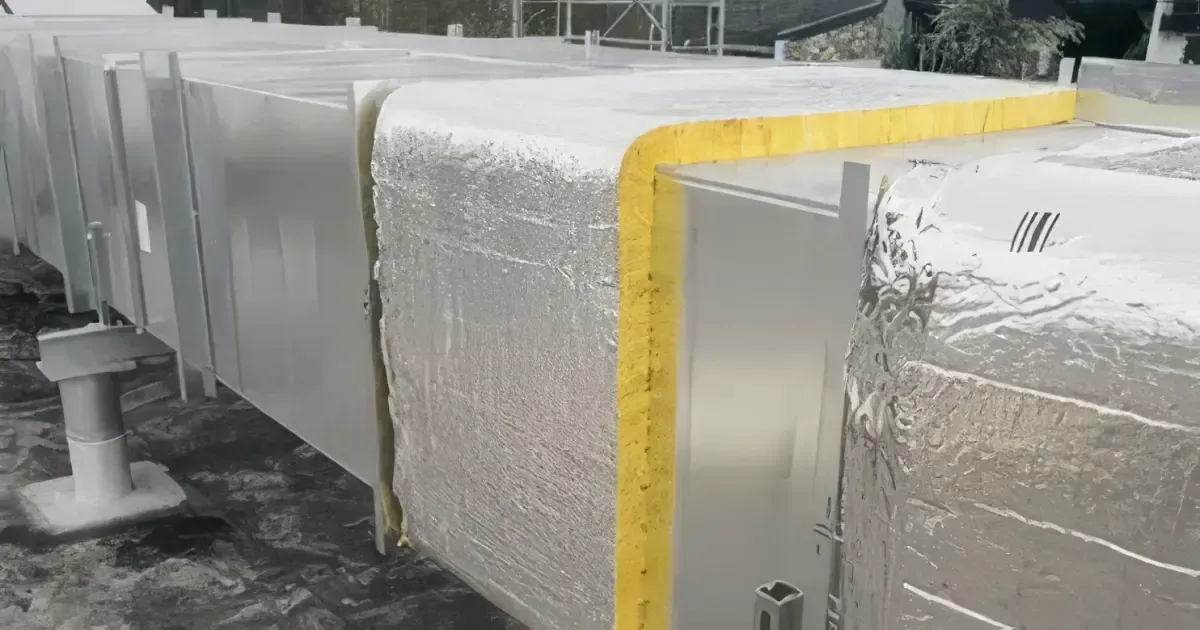
Duct Insulation
Duct insulation types, R-value by climate zone, and standards for fiberglass and mineral wool HVAC duct wrap, board and liner.
Overview
What Duct Insulation Does and Why It Matters
Duct insulation is applied to heating, ventilation and air-conditioning (HVAC) ductwork to control heat gain and loss on supply and return runs, prevent condensation on chilled surfaces, reduce HVAC noise, and meet energy-code minimums. On any duct routed through an unconditioned or indirectly conditioned space — attics, crawlspaces, parking garages, mechanical shafts, above-ceiling plenums — bare sheet metal can waste 10 to 30% of delivered heating or cooling before it reaches the zone. The right specification depends on duct location, air temperature, ambient humidity and the applicable code. For broader mechanical-insulation context, see our pipe insulation and building insulation guides.
Materials & Forms
Duct Insulation Materials and Forms
Two inorganic fibre families dominate commercial and industrial ductwork: glass wool (fiberglass) and mineral wool (stone wool). Both are non-combustible and available as flexible wraps, semi-rigid slabs and rigid boards.
| Material | Common form | R-value / inch | Max service temp* | Fire class |
|---|---|---|---|---|
| Glass wool duct wrap | Foil-faced flexible blanket (FSK / ASJ) | R-4 to R-8 | ~230 °C (foil limit) | ASTM E84 25/50, Class A |
| Glass wool duct board | Rigid / semi-rigid board | R-3.5 to R-4.5 | Core up to 400 °C | ASTM E84 25/50 |
| Mineral wool duct wrap / slab | Flexible roll or semi-rigid slab | R-3.5 to R-4.5 | ~230 °C (foil limit) | A1 (EN 13501-1) |
| Mineral wool duct board | Rigid board | R-3.5 to R-4.5 | Higher core rating | A1 (EN 13501-1) |
*Continuous service temperature is limited by the aluminium foil facing bond; select thickness so the outer foil stays below its rated surface temperature. Explore our glass wool blanket, glass wool board, mineral wool blanket and mineral wool board product lines.
Standards
Standards and Compliance
Duct insulation is specified against published material and fire standards rather than brand names:
- ASTM C1290 — mineral-fiber duct wrap (flexible blanket).
- ASTM C1071 — mineral-fiber duct liner (internal).
- ASTM C665 — mineral-fiber blanket and felt thermal/acoustical insulation.
- ASTM C612 — mineral-fiber block and board (rigid forms).
- UL 181 — factory-made air ducts and connectors (Class 1 / 181B-FX for flexible duct).
- EN 14303 — European specification for factory-made mineral-wool (MW) products for building equipment and industrial installations, including duct wrap and slab.
- ASTM E84 — surface burning (flame spread / smoke developed), commonly specified at 25/50 for plenum use.
- EN 13501-1 — reaction-to-fire classification; mineral wool products are A1 (non-combustible).
- SMACNA / ASHRAE 90.1 — installation practice and minimum R-values by climate zone.
R-Value
R-Value and Thickness Selection
ASHRAE 90.1 sets minimum duct insulation R-values that rise with climate severity. Typical planning values for ducts in unconditioned spaces:
| Climate zones | Supply duct (min) | Return duct (min) |
|---|---|---|
| 1 to 4 (hot / mixed) | R-6 | R-3.5 |
| 5 to 6 | R-8 | R-4 to R-6 |
| 7 to 8 (cold) | R-12 | R-6 |
Installed R-value scales with thickness: 1 in (25 mm) duct wrap is about R-4 to R-4.5, 1.5 in (40 mm) about R-6, 2 in (50 mm) about R-8, and 3 in (75 mm) about R-12. Always verify against the local energy code and the project's green-building target (see green building insulation).
Temperature & Fire
Service Temperature and Fire Performance
Glass wool duct wrap is commonly rated for continuous service around 230 °C, set by the aluminium foil facing bond rather than the fibre core; the glass wool core itself supports the broader glass wool range up to 400 °C. Mineral wool duct products carry the same ~230 °C foil limit, with the stone wool core rated higher. Both materials are non-combustible: mineral wool is classified A1 under EN 13501-1, and glass wool duct products typically meet ASTM E84 25/50 (Class A). For smoke-extraction and fire-resistance-rated shafts, specify a documented fire-rated duct system rather than a generic wrap. See our fire protection insulation guide for rated assemblies.
Condensation
Vapour Barrier and Condensation Control
On below-ambient or chilled ductwork, a continuous vapour barrier is essential. Most duct wrap is factory-laminated with a foil-scrim-kraft (FSK) or all-service jacket (ASJ) facing; seams, joints and fixing penetrations must be sealed with UL-listed foil tape (UL 181A-P / 181B-FX) to maintain the barrier. Select thickness from the dew-point calculation for the design condition — a thin wrap that allows the outer surface to fall below the ambient dew point will sweat regardless of the fibre's R-value. Keep the facing intact and avoid compressing the blanket, which reduces effective thickness.
Selection
How to Choose the Right Duct Insulation
- Circular vs rectangular: flexible DuctWrap rolls suit round and oval ducts; semi-rigid DuctSlab suits square and rectangular duct and plenums.
- Internal vs external: duct liner or board is applied inside the duct for combined acoustic and thermal effect (where airstream velocity and cleanability allow); external wrap is the standard for distribution duct.
- Thermal vs acoustic priority: external wrap is thermal-only; internal liner adds sound absorption in fan rooms and plenums.
- Hot vs chilled: chilled runs demand a continuous vapour barrier and dew-point-based thickness; hot supply runs focus on R-value and surface-temperature limits.
Installation
Installation Best Practice
- Wrap the insulation around the duct and secure with appropriate stick pins, bands or adhesive per the manufacturer's guidance; avoid excessive compression.
- Seal all longitudinal seams and transverse joints with UL-listed foil tape; maintain facing continuity at branches and supports.
- Label the R-value on exposed duct segments where the code requires it; support ducts at SMACNA spacing (commonly every 4 ft / 1.2 m).
- For external installations, provide weatherproof cladding — the foil facing alone is not a weather barrier.
- Use PPE (gloves, eye protection, fitted respirator) and ventilate the work area when cutting fibrous insulation.
Applications
Where Duct Insulation Is Used
Duct insulation serves commercial HVAC, above-ceiling plenums, mechanical shafts, parking garages, cleanrooms (external only) and process exhaust. It is also specified for chilled-water and refrigerant lines, data-center cooling distribution, and industrial plants such as petrochemical, power generation and marine and offshore facilities. For related fibre-glass cost and R-value detail, our fiberglass pipe insulation guide and 2026 fiberglass insulation cost guide cover adjacent topics.
Why Rosetexwool
Key Benefits
Why Duct Insulation operations choose Rosetexwool insulation solutions.
Lower HVAC Energy Loss
R-6 to R-12 duct wrap cuts heat gain and loss on supply and return runs routed through unconditioned spaces, reducing plant load.
Condensation Control
Foil-scrim-kraft and all-service jackets form a continuous vapour barrier that prevents sweating on chilled ductwork when seams are sealed.
Non-Combustible Rating
Glass wool meets ASTM E84 25/50 (Class A); mineral wool is A1 under EN 13501-1 — suitable for plenums and fire-rated duct systems.
Acoustic Comfort
Internal duct liner and board absorb HVAC fan and airflow noise in plenums, while external wrap keeps surface temperatures safe to touch.
Support
Frequently asked questions
What is duct insulation and why is it required? +
Duct insulation is thermal and acoustical material applied to HVAC ductwork to cut heat loss or gain on runs through unconditioned spaces, stop condensation on chilled ducts, reduce noise, and satisfy energy-code minimum R-values (for example ASHRAE 90.1). Without it, 10 to 30% of conditioned-air energy can be lost before reaching the zone.
What is the difference between fiberglass and mineral wool duct insulation? +
Both are non-combustible inorganic fibres. Glass wool (fiberglass) duct wrap is lightweight and low-cost, rated around 230 °C at the foil facing with an R-4 to R-8 per inch range. Mineral wool (stone wool) wrap and slab carry an A1 fire class and a higher core temperature rating, often chosen where fire performance or durability drives the spec; it typically costs 30 to 50% more.
What R-value do HVAC ducts need? +
Minimum R-values follow ASHRAE 90.1 by climate zone: roughly R-6 supply in zones 1 to 4, R-8 in zones 5 to 6, and R-12 in zones 7 to 8, with return-duct minimums of R-3.5 to R-6. Local codes and green-building targets may require more.
Which standards apply to duct insulation? +
Key references are ASTM C1290 (duct wrap), ASTM C1071 (liner), ASTM C665 (blanket), ASTM C612 (board), UL 181 (factory-made ducts), EN 14303 (European MW duct products), ASTM E84 (flame and smoke 25/50) and EN 13501-1 (A1 classification).
What is the maximum service temperature for duct wrap? +
Glass wool duct wrap is commonly rated for continuous service near 230 °C, limited by the aluminium foil facing bond rather than the fibre; the glass wool core itself is rated up to 400 °C. Specify thickness so the outer foil stays below its rated surface temperature.
How do you stop condensation on insulated ducts? +
Use a duct wrap with a continuous factory-applied vapour barrier (FSK or ASJ facing) and seal every seam and joint with UL-listed foil tape. Size thickness from the dew-point at the design condition so the outer surface never falls below the ambient dew point.
Duct wrap vs duct board vs duct liner — what is the difference? +
Duct wrap is a flexible blanket applied to the outside of existing duct. Duct board is a rigid or semi-rigid panel used to fabricate duct or insulate rectangular plenums. Duct liner is applied to the inside of the duct, adding both thermal and acoustic performance where airstream velocity and cleanability allow.
Ready to start? Tell us your specs — we'll quote within 24 hours.
Get pricing
Request a quote for Duct Insulation solutions
Tell us about your duct insulation project requirements — our team responds within one business day.