
Calcium Silicate Board: Density, Thickness & Thermal Conductivity — Spec Guide
Spec guide for calcium silicate insulation board: density grades 170–270 kg/m³, thickness selection 25–140 mm, thermal conductivity curves, and how to specify size/tolerance for industrial projects.
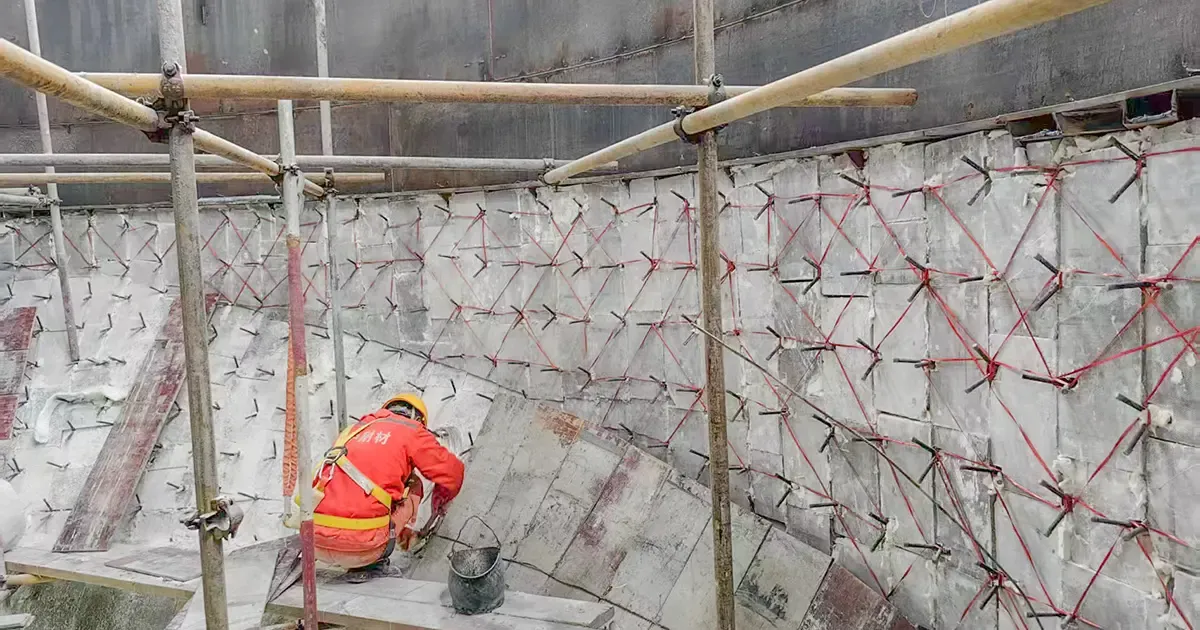
Calcium silicate insulation board is specified by three numbers: density, thickness, and thermal conductivity. Get any one of them wrong and the board either fails mechanically on site, overheats in service, or costs more than the application needs.
This guide gives procurement and engineering teams the data they need to specify calcium silicate insulation board correctly. It covers density grades, thickness ranges, how thermal conductivity changes with temperature, and the checklist that turns a generic inquiry into a clear purchase order.
Why Density, Thickness & Conductivity Are Linked
Density controls mechanical strength. Thickness controls total thermal resistance. Thermal conductivity tells you how much heat passes through each millimetre.
These three parameters are not independent choices:
- A low-density board insulates better per millimetre but cannot carry load.
- A thicker board increases R-value but adds weight and support cost.
- Conductivity rises with temperature, so a value that looks good at 100 °C may be unacceptable at 600 °C.
The right specification finds the intersection of temperature, mechanical load, energy loss target, and budget. For a broader overview of calsil grades and forms, see our Calcium Silicate Insulation Buyer's Guide (2026).
For the wider picture on the material itself — composition, the two temperature grades and where calcium silicate insulation sits against the flexible wools — start with our calcium silicate insulation overview guide.
Density Grades: Type I, Type II & Industrial Classes
Calcium silicate boards are grouped by maximum service temperature and bulk density.
Temperature classes
| Class | Max continuous temp | Typical crystal phase | Best for |
|---|---|---|---|
| Type I | 650 °C (1200 °F) | Tobermorite | Steam systems, boiler casings, building services |
| Type II | 1000–1050 °C (1830–1920 °F) | Xonotlite | Furnace backup, cement kiln transitions, petrochemical heaters |
Within each temperature class, density determines strength. Industrial practice commonly uses three density grades, even though national standards label them differently.
Industrial density grades
| Grade | Bulk density | Compressive strength (10 %) | Flexural strength | Best for |
|---|---|---|---|---|
| Light | 170–200 kg/m³ | ≥ 0.40 MPa | ≥ 0.30 MPa | Low-load pipe and duct insulation |
| Standard | 200–240 kg/m³ | ≥ 0.50 MPa | ≥ 0.35 MPa | General industrial pipe and equipment |
| High-density (HD) | 240–270 kg/m³ | ≥ 0.60 MPa | ≥ 0.40 MPa | Kiln car decks, ladle covers, load-bearing pads |
Type II high-density grades are sometimes called HCS-220 or HCS-270 in supplier catalogues. The numbers refer to nominal density. A high-density calcium silicate board should always be ordered with a density tolerance, for example 220 ± 10 % or 270 ± 10 %, and a certified compressive-strength test report.
The grades above stop roughly where most general industrial board ranges stop. Where a spec genuinely depends on carrying load — kiln car decks, ladle covers, aluminium cell components — density runs well past 270 kg/m³, into 800–1200 kg/m³ load-bearing grades and up to 1500 kg/m³ structural grades, and the strength-versus-conductivity trade-off changes shape along the way. Our high-density calcium silicate board properties and uses guide covers that upper range, including why the crystal phase sets the temperature ceiling rather than the density.
Thermal Conductivity: The Temperature Curve Matters
Calcium silicate conductivity increases almost linearly with temperature. Do not specify from a single room-temperature brochure value.
The typical relationship is:
λ = λ₀ + 0.00011 × t
Where λ is the thermal conductivity in W/m·K, λ₀ is the room-temperature baseline, and t is the mean temperature in °C.
Conductivity by grade and temperature
| Grade | λ₀ @ 25 °C | @ 100 °C | @ 300 °C | @ 600 °C | @ 1000 °C |
|---|---|---|---|---|---|
| Light (170 kg/m³) | ≤ 0.048 | ≤ 0.059 | ≤ 0.081 | ≤ 0.114 | — |
| Standard (220 kg/m³) | ≤ 0.050 | ≤ 0.061 | ≤ 0.083 | ≤ 0.116 | ≤ 0.166 |
| High-density (270 kg/m³) | ≤ 0.056 | ≤ 0.067 | ≤ 0.089 | ≤ 0.122 | ≤ 0.166 |
All values are typical maximums in W/m·K. Always ask the supplier for the mean-temperature curve across your actual service range, not a single point.
For high-temperature design, engineers usually size thickness using the conductivity at the mean temperature of the hot and cold faces. Using the 25 °C value on a 900 °C process line will undersize the insulation and lead to excess heat loss.
Thickness Range & Thermal Resistance
Industrial calcium silicate boards are commonly supplied in thicknesses from 25 mm to 140 mm. Standard board sizes include 600 × 300 mm, 1000 × 500 mm, 1200 × 600 mm, and 1200 × 2400 mm. Custom thicknesses down to 10 mm and special formats are available on request.
Thermal resistance R = δ / λ
Where δ is thickness in metres and λ is the mean thermal conductivity. The table below shows typical R-values for common thicknesses.
| Thickness | Light grade R-value | Standard grade R-value | HD grade R-value |
|---|---|---|---|
| 25 mm | 0.42 m²·K/W | 0.40 m²·K/W | 0.36 m²·K/W |
| 50 mm | 0.85 m²·K/W | 0.81 m²·K/W | 0.73 m²·K/W |
| 80 mm | 1.36 m²·K/W | 1.29 m²·K/W | 1.16 m²·K/W |
| 100 mm | 1.70 m²·K/W | 1.61 m²·K/W | 1.45 m²·K/W |
| 120 mm | 2.04 m²·K/W | 1.94 m²·K/W | 1.75 m²·K/W |
| 140 mm | 2.38 m²·K/W | 2.26 m²·K/W | 2.03 m²·K/W |
R-values are calculated at a mean temperature of approximately 200 °C using typical maximum conductivity values. Your project calculation should use the supplier's certified curve.
Layering rule: when total thickness exceeds 80 mm, install in two or more layers with staggered joints. This avoids through-joints and reduces thermal bridging. A common build-up is 80 mm + 40 mm rather than a single 120 mm layer.
Thickness Selection by Application
The right thickness depends on hot-face temperature, target surface temperature, allowable heat loss, and structural constraints. The examples below are typical industrial starting points.
Cement plant
| Location | Hot-face temp | Suggested grade | Suggested thickness |
|---|---|---|---|
| Cyclone cone / cylinder | 750–950 °C | Type II, 220 kg/m³ | 100–115 mm |
| Tertiary air duct | 750–950 °C | Type II, 220 kg/m³ | 80–120 mm |
| Kiln transition zone | 1000–1050 °C | Type II, 270 kg/m³ | 120–140 mm |
Steel and metals
| Location | Hot-face temp | Suggested grade | Suggested thickness |
|---|---|---|---|
| Reheating furnace wall | 1000–1050 °C | Type II, 270 kg/m³ | ≥ 120 mm |
| Annealing furnace | 800–950 °C | Type II, 220 kg/m³ | 80–100 mm |
| Hot blast pipe | 500–700 °C | Type I/II, 220 kg/m³ | 60–80 mm |
Petrochemical
| Location | Hot-face temp | Suggested grade | Suggested thickness |
|---|---|---|---|
| Ethylene cracking furnace | 900–1000 °C | Type II, 270 kg/m³ | 80–120 mm |
| Hydrotreater | 700–800 °C | Type II, 220 kg/m³ | 60–90 mm |
| FCC unit | 600–750 °C | Type II, 220 kg/m³ | 70–100 mm |
Power and boiler
| Location | Hot-face temp | Suggested grade | Suggested thickness |
|---|---|---|---|
| Boiler casing / duct | 300–500 °C | Type I, 170–220 kg/m³ | 50–70 mm |
| Steam pipe | 300–600 °C | Type I/II, 220 kg/m³ | 60–100 mm |
These are starting points. Final thickness should be calculated using the project's heat-loss target, for example GB/T 4272-2024 or equivalent plant standards that limit surface temperature to ≤ 50 °C and heat loss to ≤ 80 W/m².
Board Size, Tolerance & Finish
A complete order specification should state:
- Board dimensions: length × width × thickness, for example 1200 × 600 × 50 mm
- Density grade: 170, 220, or 270 kg/m³, with tolerance, for example 220 ± 10 %
- Temperature class: Type I (650 °C) or Type II (1000–1050 °C)
- Dimensional tolerance: typically ±2 mm on thickness, ±5 mm on length/width for machined boards
- Edge finish: square, bevelled, or tongue-and-groove
- Facing: plain, aluminium foil, or glass tissue
- Marking: batch number, density grade, production date, and certificate reference on each pack
For pipe sections, specify inner diameter, segment length, and whether the inside diameter is based on nominal bore or outside diameter including any existing coating.
How to Specify: A 7-Point Checklist
- Maximum continuous operating temperature — choose Type I or Type II; account for upset peaks
- Peak mechanical load — specify HD grade (≥ 240 kg/m³) for walkable, bolted, or vibration-loaded surfaces
- Thermal conductivity curve — require values at 100 °C, 200 °C, 400 °C, 600 °C, and 1000 °C as applicable
- Thickness and layering — calculate from heat-loss target, not from a catalogue thickness
- Dimensions and tolerances — state length, width, thickness, ID/OD for pipes, and acceptable tolerances
- Certification — request A1 non-combustible report, asbestos-free declaration, ISO 9001, CE or SGS marks
- Batch traceability — require mill test certificates tied to the production batch
Missing one of these is a common reason for rejected deliveries or costly field changes.
Common Specification Mistakes
- Using room-temperature conductivity for hot-face design — always use the mean-temperature curve
- Ordering standard density for a walkable platform — HD grade is needed for point loads and foot traffic
- Single-layer thick boards — above 80 mm, layer in two stages with staggered joints
- Ignoring tolerance on density — a 220 kg/m³ board with ±10 % tolerance can range from 198 to 242 kg/m³; this affects strength calculations
- No batch testing — rely on supplier type tests plus project-specific sampling for critical jobs
Bottom Line
Specifying calcium silicate board comes down to matching density, thickness, and thermal conductivity to the real operating conditions. Start with temperature to choose Type I or Type II, then use mechanical load to select the density grade, then calculate thickness from the certified conductivity curve and the project's heat-loss target. Always require batch traceability and A1 / asbestos-free certification.
At Rosewool we supply calcium silicate insulation board and high-density calcium silicate board in densities from 170 to 270 kg/m³ and thicknesses from 25 mm to 140 mm, certified to ISO 9001, CE, and SGS. Contact our technical team for thickness calculations, density selection, and project-specific specifications.
Frequently asked
What is the standard density of calcium silicate board? +
The most common industrial density for calcium silicate board is 220 kg/m³, with a typical tolerance of ±10 %. Light grades are 170–200 kg/m³ for better insulation on low-load surfaces. High-density grades are 240–270 kg/m³ for load-bearing or walkable areas.
What thickness does calcium silicate board come in? +
Calcium silicate board is typically supplied in thicknesses from 25 mm to 140 mm. Common sizes are 25, 40, 50, 65, 80, 100, 120, and 140 mm. Custom thicknesses down to 10 mm and special formats are available on request.
How does thermal conductivity of calcium silicate change with temperature? +
Thermal conductivity increases roughly linearly with temperature. A typical relationship is λ = λ₀ + 0.00011 × t, where λ₀ is about 0.048–0.056 W/m·K at room temperature. At 600 °C, conductivity can be roughly double the room-temperature value, so designs must use the mean-temperature curve.
What is the thermal resistance of 50 mm calcium silicate board? +
A 50 mm calcium silicate board has a typical thermal resistance of 0.73–0.85 m²·K/W, depending on density. Lower-density boards have slightly higher R-values because their conductivity is lower.
When should I specify high-density calcium silicate board? +
Specify high-density calcium silicate board (≥ 240 kg/m³) when the surface must carry load, support foot traffic, accept bolt-through fixings, or resist vibration. Typical uses include kiln car decks, ladle covers, equipment pads, and furnace components.
What is the maximum temperature for Type II calcium silicate board? +
Type II calcium silicate board is rated for continuous service up to 1000 °C, with some high-density formulations reaching 1050 °C. Above 1050 °C continuously, switch to ceramic fiber or polycrystalline mullite insulation.
Request a quote
Interested in our insulation solutions? Send us your requirements and our team responds within one business day.