
High-Density Calcium Silicate Board: Properties & Uses
HD calcium silicate board offers compressive strength and 1050 °C service temperature. Learn how it differs from standard calsil and where it is used.
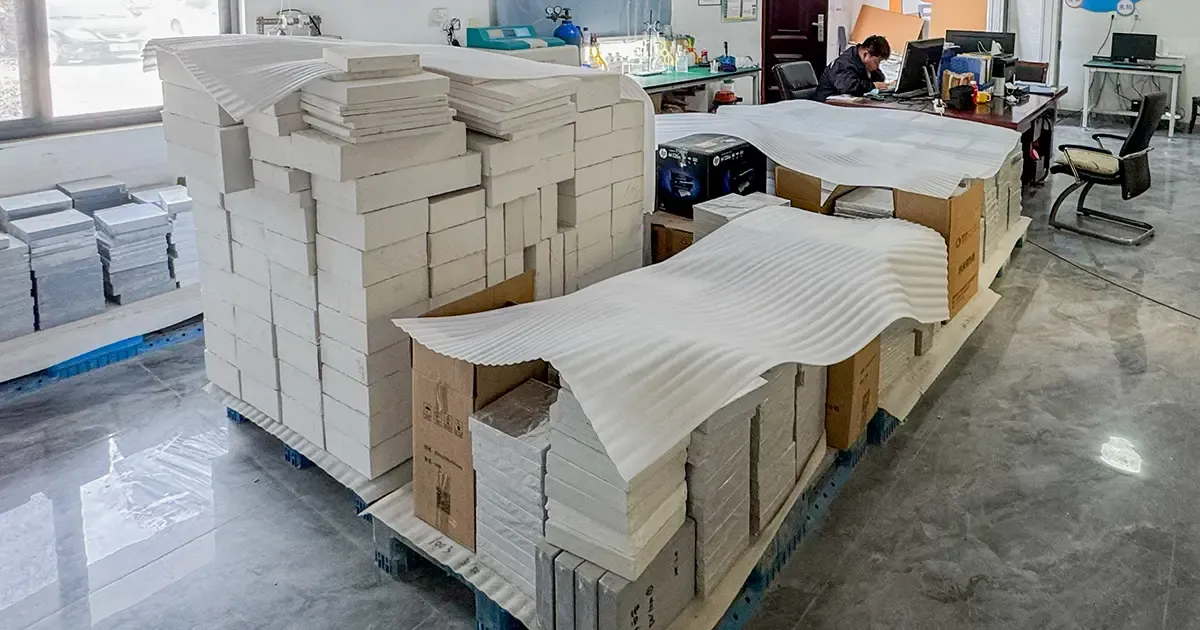
High-density calcium silicate board (HD calsil) is the workhorse version of standard calcium silicate insulation. Where the standard grade is valued for light weight and easy handling, the high-density grade — including our high-density calcium silicate board — trades a little of that lightness for compressive strength, dimensional stability, and load-bearing capacity at temperatures up to 1050 °C. For plant engineers specifying backup insulation behind refractory linings, pipe supports, kiln casings, and aluminum-cell components, HD board is often the only material that satisfies both the thermal and mechanical requirements in one layer.
At Rosetex Wool, we manufacture HD calsil boards from xonotlite-based formulations with glass or mineral-fiber reinforcement, press-formed and autoclave-cured. The result is a rigid, non-combustible board with predictable thermal conductivity, low shrinkage, and enough mechanical integrity to be drilled, sawn, and CNC-machined to close tolerances. This guide explains what "high-density" means in practice, how the properties compare to standard calsil, and where the material pays for itself in metallurgy, cement, and other high-load industries.
What Makes a Calcium Silicate Board "High-Density"?
In industrial insulation terminology, "high-density" calcium silicate board generally starts at about 240 kg/m³. That is already significantly denser than the lightweight micro-porous calsil used for pipe and equipment insulation (commonly 170–220 kg/m³). However, many load-bearing industrial grades are supplied in the 800–1200 kg/m³ range, and specialized structural boards can reach 1200–1500 kg/m³ when the application calls for high compressive strength rather than minimum thermal conductivity.
The density difference is not just about weight. It reflects the crystal structure and the reinforcement strategy:
- Xonotlite-based formulations dominate the high-temperature segment because the xonotlite crystal phase remains stable to roughly 1050 °C, whereas tobermorite-based boards are normally limited to about 650 °C.
- Reinforcement fibers — glass, mineral, or carbon — increase flexural and compressive strength and reduce cracking during thermal cycling.
- Autoclave curing under 0.8–1.1 MPa steam pressure at 160–175 °C produces a denser, more uniform microstructure than atmospheric curing.
For buyers, the practical meaning is that HD board can sit directly behind a hot face, support the weight of a refractory lining, or form a load-bearing backup layer without the creep or crushing that would occur with lower-density insulation. Where the question is which board form suits the job rather than which grade — board against panel, tile or sheet, across calcium silicate, rock wool, glass wool and ceramic fiber — see the insulation board and panel forms comparison.
Key Physical & Mechanical Properties
The exact numbers vary with density grade and reinforcement, but typical industrial HD calsil boards fall within the following ranges:
| Property | Typical HD industrial grade | Notes |
|---|---|---|
| Density | 800–1200 kg/m³ | Structural grades up to 1500 kg/m³ |
| Compressive strength | 0.5–20 MPa | Carbon/mineral-fiber grades at the upper end |
| Flexural strength | 0.3–18 MPa | Depends on fiber type and board thickness |
| Thermal conductivity at 100 °C | ≤0.06 W/(m·K) | Measured to ASTM C335 / EN 12667 |
| Thermal conductivity at 500 °C | ≤0.115 W/(m·K) | Still competitive versus many alternatives |
| Maximum service temperature | 650–1050 °C | Xonotlite grades at the high end |
| Linear shrinkage at 1000 °C × 12 h | ≤2.0 % | Critical for long hot-face service |
| Moisture absorption | ≤10 % | Lower with hydrophobic surface treatment |
| Hydrophobicity | ≥98 % | Industrial water-repellent grades |
The relationship between density and compressive strength is roughly linear: a 10 % increase in density typically delivers about 15 % higher compressive strength and about 10 % higher flexural strength. That is why a 1000 kg/m³ board can support mechanical loads that would crush a 220 kg/m³ pipe-insulation board.
At the same time, thermal conductivity does rise slightly with density. The design trade-off, therefore, is to choose the lowest density that still survives the mechanical and thermal loads — not the highest density available.
Moisture & Chemical Resistance
HD calsil is an inorganic, asbestos-free material. In its standard form it will absorb some water if directly immersed, but industrial grades are supplied with hydrophobic treatment that achieves ≥98 % water repellency and moisture absorption below 10 % by volume. After drying, the board recovers most of its thermal and mechanical properties, which makes it suitable for humid climates, steam-pipe supports, and outdoor installations with weather protection.
Chemical resistance is generally good against neutral and alkaline environments. It withstands the flue-gas atmospheres found in cement and metallurgical plants better than organic insulation, and it does not support mold growth or biological attack. Acidic environments below pH 4 can attack the calcium silicate matrix over time, so concentrated acid service should be checked case by case.
High-Density vs Standard Calcium Silicate Board
| Feature | High-density calsil | Standard calsil |
|---|---|---|
| Density | ≥240 kg/m³, often 800–1200 kg/m³ | 170–280 kg/m³ typical for insulation |
| Max temperature | Up to 1050 °C (xonotlite) | Up to 650–800 °C (tobermorite) |
| Compressive strength | 0.5–20 MPa | 0.4–0.7 MPa typical |
| Flexural strength | 0.3–18 MPa | 0.2–0.4 MPa typical |
| Load-bearing backup | Yes | No |
| Machining tolerance | ±0.5 mm possible with CNC | Limited by lower strength |
| Best use | Hot-face backup, kiln casing, supports | Pipe and vessel insulation |
The standard grade is the better thermal insulator per kilogram, but it cannot carry structural loads or resist the abrasion and compression that occur behind a refractory lining. HD board fills that gap. In many furnaces and kilns the standard approach is a dual-layer system: lightweight calsil or ceramic fiber next to the shell for low conductivity, and HD board at the load-bearing interface.
Industrial Applications
Metallurgy: Furnaces, Ladles, and Aluminum Cells
In steel and non-ferrous plants, HD calsil is used behind the hot-face refractory in walking-beam furnaces, soaking pits, and ladle backup linings. The board absorbs the mechanical load of the refractory, reduces shell temperatures, and keeps heat inside the process. Typical benefits reported in field installations include 15–20 % lower heat loss and 2–3 years longer campaign life compared with older backup designs.
Because this is a back-up position, the board is chosen on load and temperature margin rather than conductivity — the distinction is set out in our refractory board selection guide.
In aluminum electrolysis, a specialized non-wetting grade is used around cells and troughs. The surface treatment prevents molten aluminum from wetting or penetrating the board, while the high compressive strength (≥15 MPa in carbon-fiber reinforced grades) supports the cell structure. Cell rebuild intervals can be extended and metal losses reduced.
Cement: Rotary Kilns, Preheaters, and Tertiary Air Ducts
Cement rotary kilns operate with shell temperatures that stress both insulation and steel. HD calsil is placed between the refractory lining and the kiln shell, or as backup in the preheater tower and tertiary-air ducts. The board's low shrinkage at 1000 °C means the lining does not loosen after the first heat-up cycles, and its rigidity simplifies installation on curved shells when pre-cut segments are supplied.
A common cement-plant specification calls for 80–120 mm thickness of 800–1000 kg/m³ HD board behind high-alumina refractory, depending on the target shell temperature and the internal process temperature.
High-Load Mechanical Backup
Any hot equipment that needs a rigid, machinable backup layer is a candidate: reactor vessel supports, gas-turbine exhaust ducts, incinerator linings, and high-temperature flues. In these applications the board may be drilled for anchors, cut into segmented rings, or laminated into thicker blocks. CNC machining to ±0.5 mm is routine for the denser grades, allowing precise fit-up around nozzles and burner openings.
For a broader comparison with other rigid insulation options, see our calcium silicate vs ceramic fiber board guide.
Custom Sizes, Shapes, and Surface Treatments
One of the practical advantages of HD calsil is the ease of customization. Typical supply formats include:
- Flat boards: 600 × 300 mm, 500 × 500 mm, 1000 × 500 mm, 1000 × 1000 mm, with thicknesses from 25 mm to 140 mm.
- Pre-cut segments: rings, arches, and curved pieces for kilns and vessels.
- Special shapes: nozzles, flow tubes, tap-out cones, and cover boards, machined to drawing.
Surface treatments can be specified to match the environment:
- Plain / smooth — general backup insulation.
- Hydrophobic — ≥98 % water repellency for humid or outdoor service.
- Non-wetting — for aluminum and other molten-metal contact zones.
- Coated / painted — decorative or additional chemical protection where required.
When you request a quote, providing the operating temperature, maximum mechanical load, dimensional envelope, and required surface finish lets the supplier recommend the most cost-effective density and reinforcement.
Specification Checklist for Buyers
Use this checklist when writing a technical specification for HD calcium silicate board:
- Service temperature — confirm whether the peak temperature is continuous or cyclic, and whether it exceeds 650 °C (which normally requires xonotlite rather than tobermorite).
- Density / compressive strength — match the mechanical load. Backup behind castable refractory typically needs 800+ kg/m³; lower-load applications may use 240–400 kg/m³.
- Thermal conductivity — request values at 100 °C, 300 °C, and 500 °C, not just room temperature.
- Linear shrinkage — limit to ≤2 % at the maximum service temperature for long campaigns.
- Moisture resistance — specify hydrophobic treatment if rain, steam, or wash-down is possible.
- Dimensional tolerance — ±1 mm is standard; ±0.5 mm is achievable with machining.
- Fire classification — non-combustible A1 equivalent to EN 13501-1.
- Anchoring — plan stainless-steel anchors, studs, or clips compatible with the service temperature and board thickness.
If you are new to calcium silicate selection, start with what is calsil, then read our calcium silicate insulation buyer's guide and the density & thermal-conductivity spec guide.
Conclusion
High-density calcium silicate board is not simply a heavier version of standard calsil. It is a distinct engineering material that combines high-temperature stability, mechanical strength, and machinability in a single rigid board. In metallurgy, cement, and other load-bearing thermal applications, it often replaces multi-layer backup designs and reduces both installation complexity and long-term maintenance.
Choosing the right density, reinforcement, and surface treatment for the actual operating conditions is the key to getting the best value. A 1500 kg/m³ structural board is overkill for a low-load pipe support, while a 220 kg/m³ insulation board will fail behind a refractory lining. Match the material to the load and temperature, and HD calsil will outlast and outperform softer alternatives.
For a deeper dive into forms, temperature ratings, and application guides, see our ceramic fiber insulation hub.
Frequently asked
What density counts as high-density calcium silicate board? +
Industrial usage generally labels calcium silicate board as high-density from about 240 kg/m³ upward. Load-bearing grades for furnace backup and high-strength applications are usually supplied in the 800–1200 kg/m³ range, with specialized structural boards reaching 1200–1500 kg/m³.
How does high-density calsil differ from standard calsil? +
High-density board has higher compressive and flexural strength, lower shrinkage at temperature, and can carry mechanical loads. Standard calsil is lighter and offers lower thermal conductivity per kilogram, but it is not designed for load-bearing backup layers.
What is the maximum temperature for high-density calcium silicate board? +
Xonotlite-based high-density boards are typically rated for continuous service up to 1050 °C. Tobermorite-based boards are generally limited to about 650 °C. Always confirm the crystal phase with the supplier for applications above 650 °C.
Is high-density calcium silicate board waterproof? +
Standard grades absorb limited water if immersed, but industrial hydrophobic treatments achieve ≥98 % water repellency and moisture absorption below 10 % by volume. For humid, steam, or outdoor service, specify the hydrophobic version.
Where is high-density calsil used most? +
Major applications include metallurgical furnaces and aluminum electrolysis cells, cement rotary kilns and preheaters, high-temperature flues, reactor supports, and any location that needs a rigid, machinable backup insulation layer.
Can high-density calcium silicate board be machined to custom shapes? +
Yes. The denser grades can be cut with woodworking tools and machined on CNC equipment to tolerances of ±0.5 mm. Common custom parts include kiln segments, nozzles, flow tubes, tap-out cones, and cover boards.
What thickness should I choose for 1000 °C service? +
For 1000 °C service behind a hot-face refractory, backup board thickness is normally 80–120 mm depending on the allowable shell temperature and the thermal conductivity of the specific grade. A heat-loss calculation using ASTM C680 or EN ISO 12241 methods is recommended.
How does HD calsil compare to ceramic fiber board? +
Ceramic fiber board is lighter and has lower thermal mass, but it has lower compressive strength and is less rigid. HD calsil is the better choice when the backup layer must support load, maintain precise dimensions, or resist mechanical abuse.
Does high-density calsil require stainless steel anchoring? +
Yes, rigid backup boards are normally held by stainless-steel anchors, studs, or clips selected for the service temperature. The anchor pattern and material grade should match the board thickness and the expected thermal movement.
What certifications should I request? +
Request a test report covering density, compressive strength, flexural strength, thermal conductivity at multiple temperatures, linear shrinkage, and non-combustibility. Typical norms are ASTM C533 for calcium silicate insulation and EN 13501-1 for fire reaction class. ISO 9001 quality-system certification and CE or SGS factory inspection reports are also standard.
Request a quote
Interested in our insulation solutions? Send us your requirements and our team responds within one business day.