
Calcium Silicate vs Rock Wool Insulation: Which to Specify?
Calcium silicate vs rock wool compared by product grade, temperature, conductivity, fire, mechanics, moisture and life-cycle cost — ending in a condition-based selection matrix.
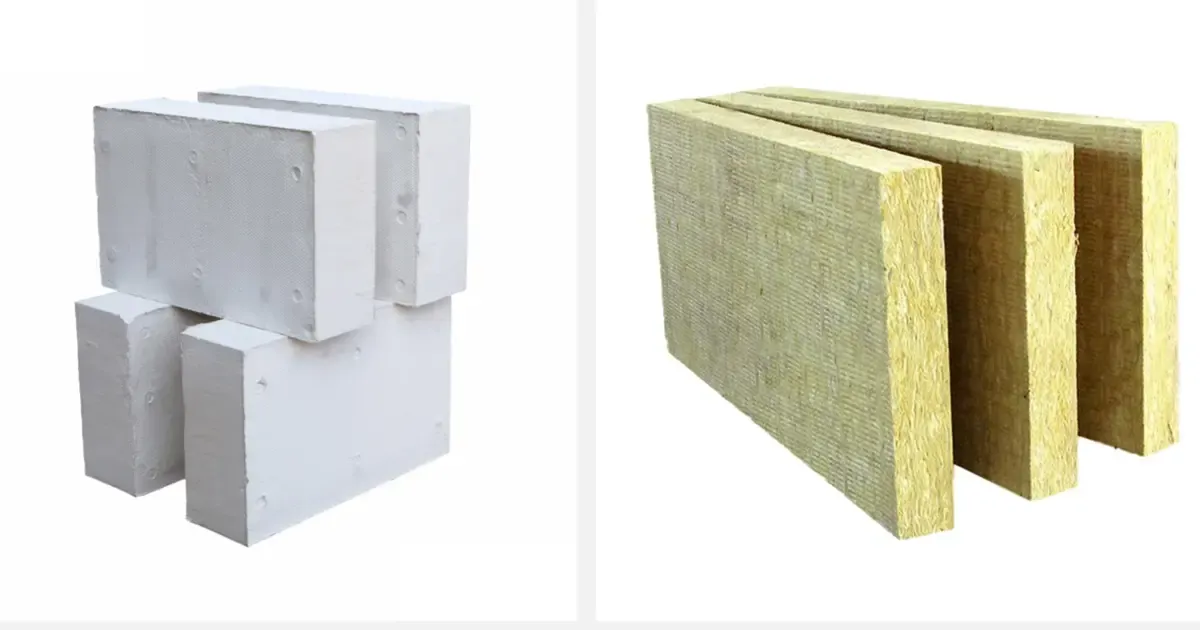
Calcium silicate and rock wool are both inorganic, essentially non-combustible industrial insulations, and that shared fire pedigree is exactly why specification mistakes happen: buyers treat them as interchangeable and pick on price per cubic meter. They are not interchangeable. One is a rigid, hydraulically reacted calcium silicate hydrate product; the other is a spun mineral fiber product. Their strengths sit at opposite ends of the geometry, load and maintenance spectrum, and the correct answer is almost always "by duty condition," not "by brand of physics."
This guide compares the two the way a project engineer has to: by product grade, by temperature envelope, by measured conductivity at real mean temperatures, by fire behavior of the whole system, by mechanical and moisture behavior, and finally by life-cycle cost. If you need a refresher on the material itself first, start with what calcium silicate insulation is; for the fiber-side family tree, our rock wool insulation hub covers grades and forms.
First, Lock the Definitions: Grades, Not Names
"Calcium silicate" is not one material. Hydrothermal reaction of siliceous and calcareous raw materials produces different calcium silicate hydrate phases: tobermorite-based products are the common workhorse grade designed around roughly 650 °C hot-face service, while xonotlite-based products extend toward about 1000–1100 °C with correspondingly different density, shrinkage and strength data. Both are fiber-reinforced, autoclaved, and supplied as rigid boards, curved sections, pipe halves and pre-formed shapes — see the industrial forms on our calcium silicate insulation board page.
"Rock wool" is a subset of mineral wool: fibers spun from basaltic or diabasic rock melt, distinct from slag wool spun from metallurgical by-product. That origin difference drives acidity coefficient, chemical durability, soluble-ion risk and hot-service shrinkage, so a test report for one density or fiber diameter cannot be extrapolated to all rock wool. Products span boards, blankets, felts, pipe sections, wire-mesh mattresses and facing-composites — the form range is visible on our rock wool board page.
The specification consequence is simple: a document that says only "calcium silicate" or "rock wool" without grade, density, form and facing is not a specification. It is a name.
Temperature: Two Different Ceilings, Stated the Same Way
Neither material has a single "maximum temperature." The honest envelope is hot-face temperature plus exposure time plus product grade, validated by a hot-face performance test — not a melting point.
- Calcium silicate: tobermorite grades are engineered for continuous service around 650 °C; xonotlite-based high-temperature grades extend to roughly 1000–1100 °C with their own linear-shrinkage and hot-conductivity evidence. Rigid calsil holds thickness and geometry under load, which is why it owns load-bearing blocks and support rings.
- Rock wool: continuous service tops out around 650 °C by grade. The fiber itself is refractory, but binders, facings and adhesives degrade earlier; vertical installation can settle under vibration and load, so the governing limit is the product's hot-face classification — never the fiber's softening behavior.
A practical dividing line emerges: above the ~650 °C class and below the ceramic-fiber regime, high-temperature calcium silicate grades are the natural rigid choice. For a worked example of grade selection on hot pipework, see our calcium silicate pipe insulation guide.
Conductivity: Declare the Mean Temperature or It Means Nothing
Thermal conductivity for both materials rises with mean temperature, but not along one curve. Design values must be stated as a table or equation against mean temperature, at the product's density, in the dry condition, with the test method and edition identified. A room-temperature k-value pasted into a 400 °C line calculation is not conservative — it is fiction.
Density behaves differently in each family. For rock wool, density is a tuning knob: higher density improves mechanical strength and reduces convection but eventually raises solid conduction, which is why product families offer several densities per form. For calcium silicate, raising density mostly buys compressive strength, not better insulation per millimeter — and it adds weight, cost and transport breakage. Compare conductivity only at matched mean temperatures and dry states; anything else is marketing.
Moisture is the silent multiplier for both. Water filling pores conducts far better than air: published test series on mineral wool show thermal conductivity roughly tripling between the dry state and about 25 percent volumetric moisture content at room temperature. Hydrophobic treatment delays capillary wetting; it does not stop vapor diffusion, direct water ingress or freeze-thaw damage in saturated calcium silicate. Vapor barriers, weatherproof cladding and sealed terminations belong to the system, whatever the core material's water-repellent rating.
Fire: Compare Systems, Not Fiber Names
Both fiber skeletons classify as non-combustible, and both families routinely reach the top Euroclass in tests aligned with EN 13501-1 — calcium silicate essentially by composition, rock wool with binder content low enough to keep the class. But fire performance in service is a system result:
- Rock wool risk points: organic binders can decompose, smoke or lose mass at temperature; facings, foil and adhesives may fail before the fiber does; the batt can shrink, embrittle or slump once unsupported.
- Calcium silicate risk points: high-temperature shrinkage and cracking, plus debonding at facing or coating interfaces. No molten drips — it is not a thermoplastic — but geometric integrity after exposure must be demonstrated, not assumed.
For fire barriers, duct wrapping or passive protection, accept only system-level test reports that state whether cladding, adhesive and fixings were included. "The fiber is non-combustible" is a materials statement, not a fire-resistance rating. Our A1 fire rating explainer unpacks what the classes actually certify.
Mechanics: Rigid Load-Bearing vs Flexible Conforming
This is the clearest physical difference and the fastest way to choose.
Calcium silicate is rigid and load-bearing: quantified compressive and flexural strength, low linear shrinkage, stable thickness on flat and cylindrical surfaces. It is the default for straight pipe, tank shells, equipment heads and load-bearing insulation blocks. Its weaknesses are brittleness (transport and sawing waste), the need for load rings, layered joints and expansion gaps on thick sections, and poor tolerance of large displacements — a rigid layer cannot absorb what an expansion joint is designed to absorb.
Rock wool is compliant and conformable: blankets and mattresses wrap bends, valves and irregular equipment; high-density boards carry limited loads; stripped-and-vertical-fiber products trade direction-dependent tensile behavior for resilience. The same compliance is the weakness: low and medium density products compress under sustained load, thin out on vibration, and sag on vertical faces without pins, mesh, ties and cladding. Noise control is a quiet bonus — rock wool's fiber structure absorbs acoustic energy in a way rigid calsil cannot.
| Duty | Lean calcium silicate | Lean rock wool |
|---|---|---|
| Straight hot pipe 300–650 °C, dry, fixed geometry | ✔ pipe halves, layered staggered joints | possible, but thickness stability is weaker |
| Bends, valves, flanges, frequent maintenance | only as pre-formed removable boxes | ✔ blankets and mattresses refit fast |
| Vertical risers, tank shells, load points | ✔ load rings, support blocks | high-density board, but needs pinning |
| Pumps, fans, compressors, vibrating lines | brittle; do not use to absorb movement | ✔ conforms, absorbs displacement, dampens noise |
| Boiler casings, irregular equipment, flue exteriors | possible on flat sections | ✔ wraps complex geometry |
| Wet outdoor equipment | only with full weatherproofing system | hydrophobic grades + cladding, still needs sealing |
Standards and Stainless Steel: The Same Test Bench for Both
International product standards frame both families: calcium silicate block and pipe under ASTM C533 / ISO 8143 / EN 14306; mineral wool blankets, felts and boards under ASTM C553, C592 and C612 / EN 14303. Hot-face performance and maximum-use-temperature estimation follow ASTM C411 and C447 practice; water vapor sorption follows ASTM C1104. Specifying "standard + edition" is mandatory — a conformance claim against a superseded edition is worthless.
Where either material touches austenitic stainless steel, the same chemistry gate applies: soluble chlorides, fluorides, silicates, sodium and pH must comply with ASTM C795, verified by the C871/C692 test pair (with C929 practice for assembly evaluation). "Inorganic, therefore safe" is not a corrosion argument; stress-corrosion cracking under wet insulation has sunk both materials equally. Our calcium silicate buyer's guide shows how to fold these clauses into an RFQ.
Cost: Compare Systems Over Life, Not Cubic-Meter Stickers
Upfront, rock wool usually wins on material price and conformability; calcium silicate wins where factory preforming, dimensional stability and fewer intermediate fixings cut site labor on regular geometry. But material price is a fraction of delivered cost. A fair comparison loads both sides with the same items: prefabrication, site cutting waste, fixings and support rings, vapor barrier and cladding, scaffolding, inspection, downtime windows, removal and disposal — then runs the energy loss through a layered heat-transfer model at real operating temperatures, and annualizes maintenance and failure risk.
Two honest asymmetries: calcium silicate's weight and brittleness raise transport and handling cost, while its rigidity reduces long-term thickness loss; rock wool's flexibility reduces preforming cost on complex equipment, while compression and settling can erode installed performance on vertical or vibrating duty if the fixing system is underspecified. Where vibration, wet-cycling or freeze risk disqualify both compromises, step outside the pair — aerogel composite or closed-cell systems — rather than forcing a winner. For the neighboring trade-off at higher temperature, see our calcium silicate vs ceramic fiber board comparison, and for the fiber-family split, glass wool vs rock wool.
The Selection Matrix: Score by Condition, Veto by Red Line
A disciplined selection scores each duty 0–5 and applies hard vetoes first: hot-face temperature exceeded, austenitic stainless chemistry unmet, fire regulation unmet, or no third-party report — any one disqualifies a material regardless of score.
| Criterion (typical weight) | Calcium silicate | Rock wool |
|---|---|---|
| Long-term hot-face compliance (veto-adjacent, high) | 4–5 by grade (650 °C class to ~1100 °C) | 3–4 (≤650 °C class) |
| Regular straight pipe, fixed geometry (high) | 5 | 3–4 |
| Irregular equipment, valves, maintenance access (high) | 2–3 | 5 |
| Load-bearing and dimensional stability (medium) | 5 | 2–4 |
| Vibration and acoustic duty (medium) | 2 | 5 |
| Wet or cyclic environments (medium) | 2–3 | 2–4 |
| Initial material economy (low–medium) | 3 | 4 |
The pattern to remember: geometry, load and temperature class push you to calcium silicate; movement, maintenance and acoustics push you to rock wool; moisture pushes you to whichever system — core plus barrier plus cladding — is better engineered. The strongest specifications are hybrids: rigid calsil on the hot straight runs, compliant rock wool at transitions and equipment, removable preformed sections at valves, one continuous weatherproof system over all of it.
Frequently asked
Which is better for high temperature, calcium silicate or rock wool? +
Calcium silicate reaches higher service temperatures by grade: tobermorite-based products are engineered around roughly 650 °C hot-face service, while xonotlite-based grades extend toward 1000–1100 °C with their own shrinkage and hot-conductivity evidence. Rock wool tops out around 650 °C continuous by product grade, limited by binders and facings rather than the fiber itself. Above the 650 °C class, high-temperature calcium silicate is the natural rigid choice.
Is calcium silicate or rock wool more fire resistant? +
Both fiber systems achieve top non-combustible classifications under tests aligned with EN 13501-1. The difference is the risk profile: rock wool's binders, facings and adhesives can smoke or fail before the fiber does, and batts can slump when unsupported; calcium silicate risks high-temperature shrinkage and cracking. Fire performance is a system result — accept only test reports that state whether cladding and fixings were included.
When should I choose rock wool instead of calcium silicate? +
Choose rock wool for irregular geometry, bends, valves and equipment that need frequent maintenance access, vibrating machinery neighborhoods, and acoustic performance — blankets and mattresses conform, absorb movement and dampen noise. Choose calcium silicate for straight hot pipe, tank shells and any point carrying load, where rigid dimensional stability and load-bearing blocks matter.
Does hydrophobic rock wool still need a vapor barrier? +
Yes. Water-repellent treatment delays capillary wetting but does not stop vapor diffusion or direct water ingress, and wet insulation can triple in thermal conductivity at moderate moisture content. Below-ambient systems need a continuous vapor barrier with sealed terminations; outdoor hot systems need weatherproof cladding. The core material's hydrophobic rating never replaces system sealing.
Can both materials be used on austenitic stainless steel piping? +
Only if the product passes the chemistry gate: soluble chlorides, fluorides, silicates, sodium and pH within ASTM C795 limits, verified by the C871/C692 test methods. Both calcium silicate and rock wool can meet these limits when properly formulated, but 'inorganic' alone proves nothing — stress-corrosion cracking under wet insulation affects both families equally, so demand the report per product and edition.
Is a hybrid insulation system worth the complexity? +
On mixed-geometry, high-temperature equipment, yes: rigid calcium silicate on straight hot runs where thickness stability matters, compliant rock wool at transitions and vibrating equipment, removable preformed sections at valves and flanges, all under one continuous weatherproof and vapor-control system. The interfaces need engineering management, but the combination captures each material's strengths instead of compromising both.
Request a quote
Interested in our insulation solutions? Send us your requirements and our team responds within one business day.