
Types of Thermal Insulation Materials: Complete Selection Guide
Compare thermal insulation materials — mineral wool, aerogel, calcium silicate, ceramic fiber, foams and more — by conductivity, temperature, fire and cost, with a six-factor selection matrix.
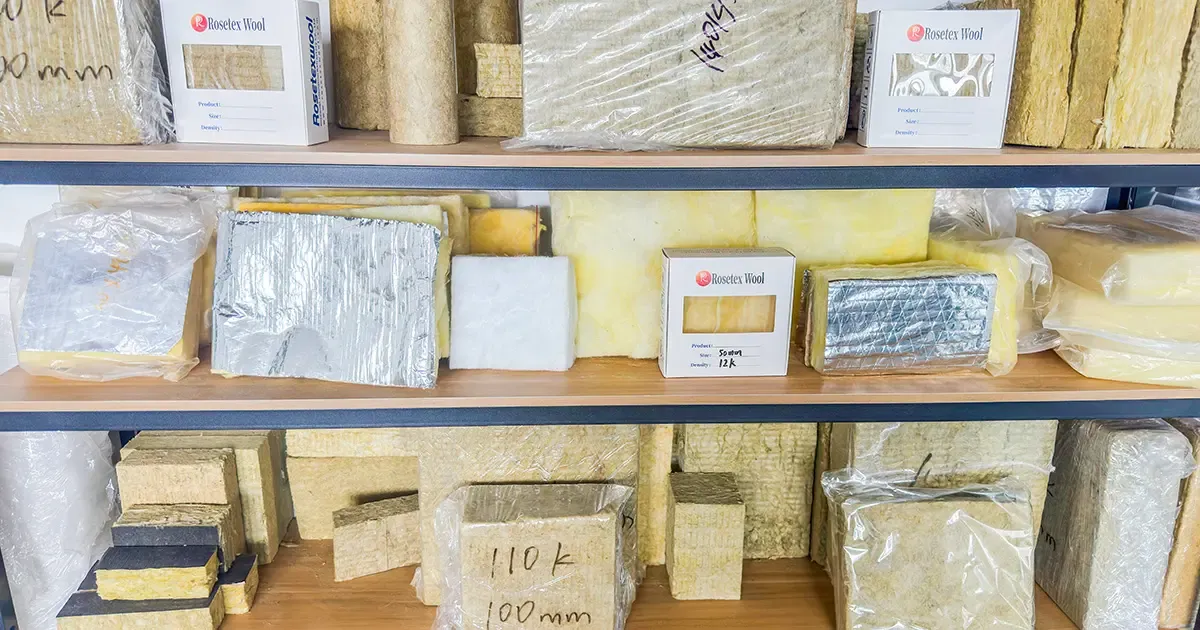
Choosing the right thermal insulation material is rarely about finding a single "best" product. It is a selection problem: first rule out materials that cannot survive your continuous operating temperature, then choose among the survivors by fire rating, moisture exposure, available thickness, cost and maintenance needs. This guide maps the full family of thermal insulation materials — fibrous mineral wools, high-temperature boards, foam plastics, inorganic rigids and reflective systems — and shows how to narrow the field to a shortlist for buildings, industry and high-temperature plant.
How thermal insulation performance is measured
Thermal insulation reduces heat transfer by conduction, convection and radiation. Conductivity is written as k or λ, in W/m·K — the lower the value, the less heat the material transmits per metre of thickness under the stated conditions. Thermal resistance R is thickness divided by k, adjusted for the actual assembly. Laboratory k values are measured with steady-state methods such as ASTM C177 (guarded hot plate), but reported numbers always depend on the mean test temperature, product density, moisture content, facing and ageing.
Temperature matters because k is not constant. A stone-wool slab tested under EN 14303, for example, may show a k of about 0.040 W/m·K at a 50 °C mean temperature rising to roughly 0.122 W/m·K at 350 °C. That is why published values must always be read together with their test conditions, and why R-per-inch comparisons are only valid between products tested at similar densities and mean temperatures.
Reaction to fire must also be reported precisely. EN 13501-1 Euroclass runs from A1 (non-combustible) through A2, B, C, D, E to F, with optional smoke (s1–s3) and droplet (d0–d2) subclasses. ASTM E84 measures surface flame spread and smoke development under a specific tunnel exposure; a good E84 result alone does not prove non-combustibility. The two systems are related but not interchangeable.
Materials × properties comparison table
The table below is a pre-selection map of the main thermal insulation material families. Values are typical declared ranges for common product grades; always confirm the specific product data sheet at your actual mean temperature.
| Material family | Typical k (W/m·K) | Approx. R/inch | Typical service temperature | Density (kg/m³) | Common forms |
|---|---|---|---|---|---|
| Rock wool / stone wool | 0.034–0.041 | 3.5–4.2 | Up to ~650 °C by grade | 40–200+ | Batt, slab, roll, wired mat, pipe section |
| Glass wool / fiberglass | 0.030–0.044 | 2.7–4.2 | Typically −120 to 400 °C (industrial grades) | 10–100+ | Batt, roll, duct liner, loose fill |
| Cellulose | 0.038–0.042 | 3.2–3.8 | Ambient building cavities | 30–60 | Blown / dense pack |
| Silica aerogel blanket | 0.015–0.023 | 4.3–6.7 | Blanket commonly to 650 °C; microporous rigid to 1000 °C | 160–240 | Flexible blanket, roll |
| Calcium silicate | 0.049–0.070 | 2.3–3.4 | Up to 1100 °C by grade | 135–300 | Rigid board, pipe section, block |
| Ceramic fibre | 0.05–0.14 | 1.4–3.0 | 1100–1430 °C classification by grade | 64–320 | Blanket, board, module, paper |
| Insulating refractory | 0.10–0.30+ | 0.7–2.0 | 1000–1800 °C+ by product | 300–2500+ | Brick, castable, monolithic |
| Polyurethane (PUR/SPF) foam | 0.022–0.028 | 3.6–5.5 (closed cell) | Often ≤120 °C | 8–60 | Spray, board, laminate |
| Polyisocyanurate (PIR) | 0.020–0.027 | 4.0–5.7 | Often ≤120 °C | 30–50 | Board, panel, sheet |
| EPS | 0.031–0.038 | 3.8–4.6 | Usually ≤75 °C | 15–40 | Board, bead, block |
| XPS | 0.029–0.036 | 4.0–5.0 | Usually ≤75 °C | 25–50 | Board |
| Phenolic foam | 0.018–0.025 | 4.6–6.0 | Often ≤120 °C | 30–60 | Rigid board |
| Foam glass / cellular glass | 0.038–0.045 | 3.1–4.2 | Product data to ~482 °C | 100–160 | Block, pipe section, segment |
| Elastomeric foam (NBR/PVC) | 0.033–0.038 | 3.3–3.9 | Example −57 to 125 °C | 40–80 | Tube, sheet, roll |
| Perlite | 0.040–0.075 | 2.1–3.3 | To ~650–815 °C by grade | 100–240 | Board, loose fill, pipe |
| Vermiculite | 0.050–0.090 | 1.7–2.5 | High temperature by product | 300–900 (board) | Board, loose fill |
| Reflective foil / bubble | Emittance-driven | R-1 to low single digits with air space | Radiation-dominated assemblies | Low | Roll, faced sheet |
Fire classifications apply to tested products and assemblies, not automatically to every product in a family. Mineral wools, calcium silicate, ceramic fibre, foam glass, perlite and vermiculite are inorganic families where A1-classified products are common; the foam plastics are combustible polymers that need tested assemblies and, in many codes, protection barriers.
Classification by material family
Fibrous insulation traps still air in a network of mineral, glass or natural fibres. Rock wool, glass wool, ceramic fibre and cellulose sit here. Fibre products are often vapour-open, strongly acoustic and adaptable to irregular surfaces, but they need correct support and protection against air washing and compression.
Cellular-foam insulation — polyurethane, polyisocyanurate, EPS, XPS, phenolic, elastomeric and foam glass — holds gas in closed or open cells. Closed-cell products generally resist liquid water better, but seams, penetrations and vapour-drive still decide real-world performance. Foam plastics are combustible; their fire behavior is governed by the complete tested assembly.
Loose-fill and granular insulation such as cellulose, perlite, vermiculite and aerogel granules fills irregular cavities, vessels and hard-to-reach spaces. Settlement, density and moisture management must be specified, not assumed.
Reflective and hybrid systems (aluminium foil, metallized film, bubble laminate) address radiant transfer and only work with a specified air gap facing the foil. They complement bulk insulation; they rarely replace it in heating-dominated climates.
Classification by continuous service temperature
Temperature is the first filter in any insulation decision, because it eliminates whole families before cost or k-value ever matters.
| Temperature band | Common candidate materials | Engineering priority |
|---|---|---|
| Cryogenic, ≤ −50 °C | Polyurethane, PIR, silica aerogel, perlite, foam glass, elastomeric systems | Continuous vapour barrier, CUI prevention, cryogenic qualification |
| −50 to 200 °C | Glass wool, rock wool, EPS, XPS, PUR/PIR, phenolic, elastomeric foam | R-value, moisture control, code compliance, fire barriers |
| 200 to 650 °C | Rock wool, calcium silicate, perlite, silica aerogel | Heat loss, personnel protection, jacketing, maintenance access |
| 650 to 1000 °C | Microporous silica, selected calcium silicate, ceramic fibre, aerogel grades | Shrinkage, thermal shock, fibre type, hot-face design |
| Above 1000 °C | Ceramic fibre grades (to 1430 °C) and refractory working linings | Hot-face chemistry, erosion, structural load, thermal cycling |
For a worked example of the cryogenic band, see our cryogenic insulation materials overview.
Mineral wool: rock wool and glass wool
Mineral wool is an umbrella term covering two distinct product paths. Rock wool (stone wool) is spun from molten rock such as basalt; glass wool (fiberglass) is drawn from molten glass, often with a high recycled content. Both families include non-combustible A1-classified products, but their typical duty differs.
Rock wool is generally the stronger fit for industrial heat, fire separation and maintenance-driven projects. Its higher density and stiffness give dimensional stability on tanks, vessels, columns and pipe racks, and flexible mats and wired mats follow curved equipment. EN 13162 product standards and EN 14303 pipe-section standards define the declared values; a dense stone-wool slab can carry continuous service up to about 650 °C, which is why it dominates industrial hot service in that band. For a deeper dive, see the rock wool insulation hub.
Glass wool is the lighter, easier-to-cut path, well suited to framed cavities, roofs, HVAC ducts and general building envelopes. Industrial grades serve chilled and dual-temperature service from about −120 to 400 °C. Water-repellent treatments help individual products, but the complete wall or duct assembly — joints, compression, vapour control — still determines field performance. Details by form and density are in the glass wool insulation hub.
Installation safety is a specification item for both: mineral fibres can irritate skin, eyes and airways during handling, so gloves, long sleeves, eye protection and dust control should be written into the work method, following the product safety data sheet and local occupational rules.
High-temperature materials
Silica aerogel blanket delivers some of the lowest declared k values of any commercial insulation — commonly 0.015–0.023 W/m·K — in a thin, flexible, hydrophobic format. It excels on congested pipe racks, valves, flanges and thermal bridges where thickness budget is the binding constraint; the trade-off is premium material cost. Microporous rigid products extend the inorganic high-temperature path to about 1000 °C. Compare options in the aerogel insulation hub and the aerogel cost analysis.
Calcium silicate is a rigid, inorganic, compression-resistant insulation used on hot plant equipment, pipe supports and walk-on areas, with grades rated up to 1100 °C. It is heavier and thicker than foams or aerogel but tolerates mechanical abuse. See the calcium silicate insulation hub.
Ceramic fibre blankets, boards and modules serve furnace linings, kilns, expansion joints and boiler back-up insulation, with classification temperatures from 1100 to 1430 °C. Selection must weigh linear shrinkage, gas velocity, chemistry and handling controls for the specific fibre type. Details in the ceramic fibre insulation hub, and for the highest band see our top 10 high-temperature insulation materials.
Insulating refractories — firebrick, castables, monolithics — protect equipment above roughly 1000 °C from direct flame, erosion and chemical attack. They are selected for hot-face duty first, then paired with a compatible back-up insulation layer such as ceramic fibre or microporous board.
Foam plastics and rigid boards
Polyurethane spray foam seals complex cavities and combines insulation with air control; closed-cell foam resists liquid water better than open-cell. PIR boards offer one of the best thickness-to-R ratios among mainstream foams and dominate tapered roof and wall panel markets. EPS is the low-cost workhorse for walls, floors and protected assemblies; XPS adds low water uptake and high compressive strength for below-grade and inverted-roof duty. Phenolic foam achieves very low k in thin boards but needs careful joint and facing detail. Elastomeric NBR/PVC foam is the default for chilled-water pipes and refrigeration because its closed cells provide built-in vapour resistance.
All of these are combustible polymers. Their reaction-to-fire depends on the tested assembly, facings and any required thermal or ignition barriers — never on the generic material name. For a head-to-head with mineral fibre, read mineral wool vs spray foam insulation.
Inorganic rigid and loose-fill materials
Foam glass is a closed-cell, inorganic material with near-zero water-vapour permeability, documented product data to about 482 °C, and good compressive strength — a natural fit for below-grade, buried, cryogenic and corrosive service where moisture is the enemy. Perlite and vermiculite are expanded inorganic granulates available as rigid board, pipe sections or loose fill, serving high-temperature back-up, fire-stopping and cavity-fill roles at moderate cost.
For rigid boards across all families, our insulation boards types and selection guide compares mineral, ceramic, calcium silicate and microporous formats in detail.
Six-factor selection matrix
Work the filters in this order and most projects narrow to two or three candidates quickly:
- Temperature: fix the lowest and highest continuous service temperatures, plus excursion peaks.
- Fire: define the required reaction-to-fire class and any assembly fire-resistance rating.
- Moisture: identify the dominant risk — rain, groundwater, condensation, vapour drive or CUI.
- Conductivity: convert the target R-value or heat-loss budget into thickness at the real mean temperature.
- Cost: compare installed cost, including fixings, jackets, scaffolding, downtime and waste.
- Acoustics and maintenance: include sound control, inspection access and reuse of removable covers.
| Situation | Shortlist | Why | Watch out for |
|---|---|---|---|
| Hot industrial pipe, 200–650 °C, frequent maintenance | Rock wool mat, calcium silicate, aerogel | Temperature, fire, formability, inspection access | Compression, weather jacket, hot spots |
| Fire-rated wall or acoustic ceiling | Rock wool or glass wool batt/board | A1-classified products, sound absorption | Density, support, system approval |
| Wet below-grade wall or inverted roof | XPS, foam glass | Low water uptake, vapour-tight options | Seams, protection board, frost, load |
| Cold pipe and condensation control | Elastomeric foam, closed-cell PUR/PIR, foam glass | Built-in vapour resistance, formability | Continuous sealed jacket, thickness |
| Congested valve rack or thermal bridge | Silica aerogel blanket | Thinnest profile, flexibility | Material cost, edge compression |
| Furnace or kiln above 1000 °C | Ceramic fibre module plus back-up layer | Hot-face durability, heat storage | Shrinkage, chemistry, structural load |
| Budget attic or cavity retrofit | Glass wool, cellulose, EPS | Lowest material cost, easy fill | Air leakage, settlement, fire detailing |
Budget cost and service-life expectations
Cost tiers below are planning guidance for relative material budgets, not quotations. Installed cost adds labour, fixings, membranes, cladding, access and downtime, which can reorder the ranking entirely.
| Tier | Typical options | Where it is cost-effective | Typical service life |
|---|---|---|---|
| 1 | EPS, glass wool, reflective foil | Large dry areas, simple geometry | 20–50+ years when protected |
| 2 | Cellulose, rock wool, perlite | Fire, acoustic and dry-fill duty | 30–50+ years with correct facing |
| 3 | XPS, elastomeric foam, PUR/PIR | Moisture-sensitive or thin-profile work | 20–40+ years; check seams and ageing |
| 4 | Phenolic, ceramic fibre, foam glass | High temperature, corrosion, load-bearing | 30–50+ years depending on duty |
| 5 | Silica aerogel, multilayer systems | Severe space constraints, valves, thermal bridges | Thinness may offset premium price |
Installation and maintenance risks
Gaps, compression, thermal bridges and uncontrolled airflow erase real-world performance even when the labelled R-value is high. Pipe and duct insulation must follow penetrations and supports without voids; below-ambient systems need continuous vapour control; above-ambient industrial systems need weather jackets and safe surface-temperature provisions.
Removable insulation covers repay themselves around valves, flanges and inspection points: a well-designed cover opens for checks and reinstalls without demolition, and the core can be rock wool, ceramic fibre or aerogel chosen for temperature and reuse frequency. For system-level guidance on industrial hot service, see industrial pipe insulation types and our piping insulation applications page, or the power generation insulation overview. If you are weighing premium thin materials, the aerogel vs fiberglass comparison breaks down when the thickness saving justifies the cost.
Next steps
Tell us your continuous operating temperature, environment, available thickness, fire and acoustic requirements, and maintenance expectations — for industrial projects, include pipe or vessel diameter, medium and inspection frequency. Our engineering team supplies rock wool, glass wool, ceramic fibre, calcium silicate and microporous product families in blanket, board, pipe-section and custom formats, exported to 60+ countries with ISO 9001, CE and SGS certification since 1982.
This page is general technical information, not a product specification, engineering design or fire-rating certificate. Thermal conductivity varies with density, mean temperature, moisture, facing, ageing and test method. Reaction-to-fire results apply to tested products and assemblies. Obtain current data sheets and qualified design advice before specifying or installing.
Frequently asked
What is the best thermal insulation? +
There is no universally best material. The right choice is the system that meets continuous operating temperature, fire and acoustic requirements, moisture conditions, available thickness, budget and maintenance access. PIR or aerogel may be preferable when space is tight; rock wool or calcium silicate suit high-temperature industrial service; XPS or foam glass fits wet below-grade systems.
What type of insulation has the lowest thermal conductivity? +
Silica aerogel blankets commonly show some of the lowest declared k values, around 0.015–0.023 W/m·K depending on product and mean temperature. Low k is not a category guarantee: grade, density, facing, ageing and the actual operating temperature must be confirmed on the product data sheet.
What is the best insulation for high temperature? +
Up to about 650 °C, stone wool, calcium silicate, perlite and some aerogel products are common. From 650–1000 °C, microporous silica, selected calcium silicate and ceramic fiber become relevant. Above 1000 °C generally requires refractory working linings with a back-up insulation layer, selected for thermal shock, process chemistry and maintenance access.
What is the cheapest type of thermal insulation? +
At material level, EPS, glass wool and reflective foil are usually the lowest-cost options. Cheapest can be false economy if the assembly needs fire barriers, vapor control or frequent replacement, so compare installed cost and service life rather than board price alone.
Is mineral wool the same as rock wool and glass wool? +
Mineral wool is a broad family name. Rock wool (stone wool) is spun from molten rock, while glass wool is drawn from molten glass. Both families include non-combustible A1-classified products, but their temperature limits, density, handling and preferred forms differ by product.
Does a higher R-value always mean better insulation? +
No. R-value compares layers under defined conditions, but whole-system performance also depends on temperature, moisture, air leakage, thermal bridging, installation quality and the material's continuous service range.
Request a quote
Interested in our insulation solutions? Send us your requirements and our team responds within one business day.