
Rock Wool Blanket Buying Guide: Density, Specs, Standards & Inspection
A buyer's guide to rock wool blanket: product forms, density selection by application, ASTM C553 / EN 14303 standards, datasheet red flags, and arrival inspection.
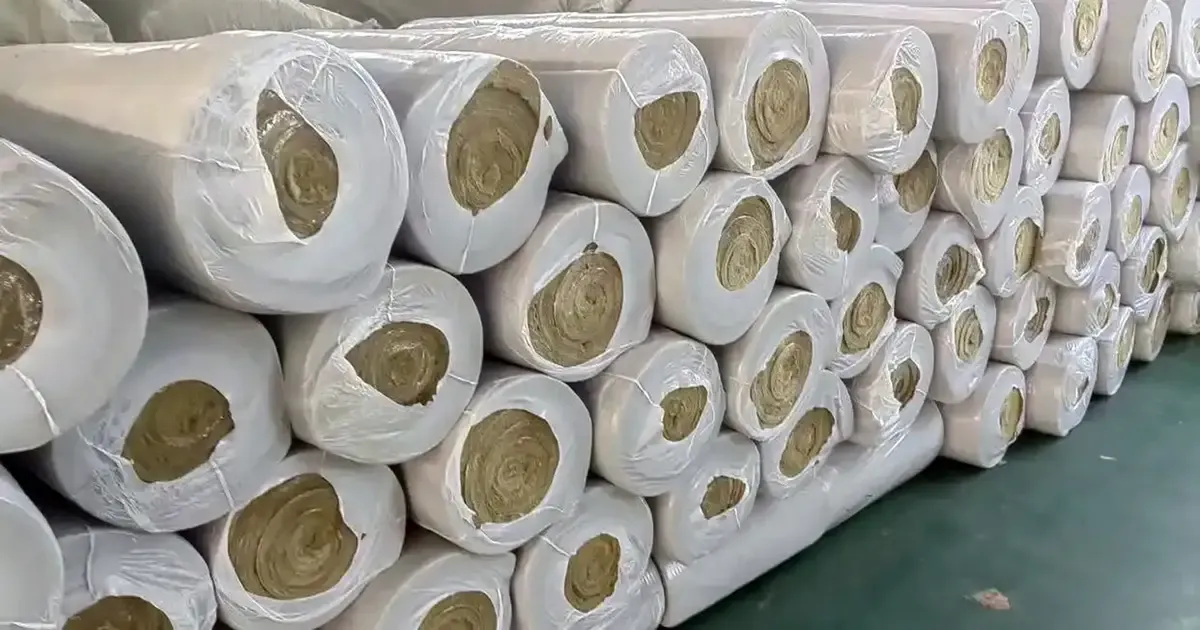
Rock wool blanket is one of the most requested industrial insulation products in global RFQs — and one of the most frequently mis-specified. The single word "blanket" hides a family of products with different fiber orientations, facings, densities, and temperature limits, and buyers who quote on the name alone routinely receive material that does not fit the application. This guide is written for purchasing decisions: what to specify, which standards should sit behind your purchase order, how to read a datasheet like a buyer, and what to check when the rolls arrive.
One Name, Several Different Products
"Rock wool blanket" is not a specification — it is a product family. Before comparing prices, define which construction you are actually buying:
| Product form | Construction | Typical applications | Key buying point |
|---|---|---|---|
| Flexible blanket (parallel-fiber) | Soft roll, fibers primarily parallel to the faces | Large-diameter pipes, tanks, vessels, irregular surfaces, voids | Conforms to curvature; not load-bearing |
| Wired mat (stitched / wire mesh) | Blanket locked by wire mesh and stitching on one or both faces | High-temperature pipes, flues, boilers, tanks | Mesh material, mesh size, and stitch thread temperature rating must be stated |
| Glass-mesh faced blanket | Blanket with glass-fiber mesh facing | Facings where tear resistance and handling strength matter | Facing changes fire and vapor behavior — test the finished product |
| Board (rigid / semi-rigid) | Higher density, higher compressive strength | Flat walls, tank shells, roofs, acoustic linings | Different fiber orientation and mechanics — never price against blanket per kilo |
| Pipe sections (pre-formed) | Vertical-fiber, pre-cut to pipe diameter | Small and medium-diameter piping | Defined by inner diameter and wall thickness, not by blanket specs |
The distinction is not pedantic. ASTM C553, the reference US specification for commercial and industrial mineral fiber blanket, explicitly covers material whose fibers run primarily parallel to the principal surfaces — and explicitly excludes pre-formed vertical-fiber pipe and tank coverings, which belong under their own product standards. In Europe, EN 13162 covers factory-made mineral wool for building applications, while EN 14303 covers building equipment and industrial installations. Ordering "blanket" against the wrong standard family is the most common root cause of rejected shipments.
Typical Specification Ranges at a Glance
Commercially, industrial rock wool blanket is bought within these working ranges — always confirmed against the specific product datasheet:
| Parameter | Typical commercial range | Buyer's note |
|---|---|---|
| Density | 60–150 kg/m³ | Nominal value ± tolerance; state whether wire mesh weight is included |
| Thickness | 25–100 mm | Multi-layer build-ups (e.g. 2 × 50 mm) are standard above 50 mm |
| Roll width | 1.0–1.2 m (600 mm common in wired mats) | State minimum guaranteed roll length, not just nominal length |
| Continuous service temperature | up to about 650 °C hot face | Not the melting point — see the datasheet section below |
| Thermal conductivity | ~0.035–0.045 W/(m·K) at 25 °C mean | Always ask for the λ(T) curve, not the single 25 °C figure |
| Facing options | Unfaced, glass cloth, aluminum foil, wire mesh | Facings change fire, vapor, and temperature performance |
Our rock wool blanket product page lists the standard grades and dimensions we ship; wired mat and glass-mesh faced variants are specified separately for high-temperature and mechanical-strength applications.
Which Standards Should Sit Behind the PO
Match the standard to the end use before comparing offers:
- ASTM projects (North America and ASTM-specified contracts): ASTM C553 governs commercial and industrial mineral fiber blanket, covering classification, physical properties, dimensions, maximum use temperature, thermal resistance, water vapor sorption, flexibility, and surface burning. Pre-formed pipe and tank coverings fall outside it.
- EU building products: EN 13162 with a Declaration of Performance (DoP) and CE marking under the Construction Products Regulation. The standard defines test methods — the required performance levels for a specific application come from the project specification and local regulations.
- EU industrial installations: EN 14303 governs factory-made mineral wool for building equipment and industrial installations (blankets, wired mats, boards, pipe sections).
- Fire classification: EN 13501-1 in Europe, ASTM E84 surface-burning characteristics in the US. Both classify the finished product as tested — an unfaced rock wool core result cannot be transferred to a foil-faced roll.
One CE-related point that saves disputes: CE marking proves the DoP declaration, not fitness for every use. If your application is industrial equipment rather than a construction product, ask for EN 14303 evidence and project-specified tests — do not accept a building-product CE file as blanket approval.
Density Selection: Matching Weight to Application
Density is the lever that trades flexibility against mechanical strength. Buying "80 kg/m³ blanket" without a rationale is how the wrong product arrives:
| Application | Recommended density | Why |
|---|---|---|
| Large tank shells, domes, large-diameter pipework | 60–80 kg/m³ | Conformability and coverage per roll matter more than compression strength |
| General industrial equipment, flues, ducts | 80–100 kg/m³ | Balanced thermal and mechanical performance |
| Machinery enclosures, acoustic treatment, moderate loads | 100–150 kg/m³ | Higher density improves sound absorption and surface durability |
| Flat surfaces, walking areas, external walls | Use board, not blanket | Compression and fixings demand rigid products — see our rock wool board |
State density as finished-product value with tolerance, sampling position, and whether mesh or facing weight is included. Low-ball quotations are frequently achieved by dropping density — verify per batch, not per brochure.
Reading the Datasheet Like a Buyer
Four parameters deserve contractual attention:
Thermal conductivity is a curve, not a number. λ rises with temperature. A single 25 °C figure is marketing; high-temperature heat-loss calculations need declared λ values at the relevant mean temperatures, with test method and product construction stated. If a supplier offers only a 25 °C minimum λ, treat the high-temperature calculation as unverified.
Maximum service temperature is bound to conditions. For rock wool blanket the meaningful figure is continuous service temperature — about 650 °C for standard industrial grades — not the ~1000 °C melting point of the fiber itself. A valid claim binds hot-face temperature, facing construction, exposure duration, and thickness. Ask for hot-surface performance evidence (e.g. linear shrinkage and visual condition after sustained hot-face exposure per the relevant test method) for the exact product, density, and facing you are buying.
Dimensions need tolerances and minimums. Specify nominal thickness with tolerance, roll width, and — critically — minimum guaranteed roll length per roll, plus the number of joints allowed per roll. Under-length rolls discovered at installation are a classic hidden cost.
Water-related claims split into two different properties. Water repellency (the fiber matrix resisting liquid water) and water vapor permeability are different things. ASTM C1104 measures vapor sorption of the unfaced core only — it says nothing about the facing or a system's vapor performance. For below-ambient service, the vapor barrier is a separate, continuous sealing design — never the blanket itself. Our cryogenic pipe insulation guide covers the condensation-control system design in depth.
Stainless Steel Contact: a Corrosion Clause Worth Having
Where blanket touches austenitic stainless steel, request evidence against ASTM C795: the insulation must pass the preproduction stress-corrosion test (ASTM C692) with chemical composition controlled per ASTM C871. This applies to the blanket, the facing, the mesh, and any adhesives in contact. It is a standard clause in petrochemical and power projects, and it is cheap to demand at RFQ stage and expensive to litigate after pitting appears.
Quality Inspection: Three Layers of Acceptance
Layer 1 — documents and identity. Purchase order vs packing list; manufacturer, model, origin; batch numbers and dates; labels and datasheets; DoP/CoC where required; certificates matched to the actual model (not an "equivalent" product).
Layer 2 — arrival condition. Packaging integrity, water staining, crushed rolls, torn facings, delaminated foil, rusted mesh, loose stitching, short rolls, mixed batches. Photograph before unpacking. Damaged packaging does not auto-reject the batch — sample-test density, thickness, and moisture in quarantine first.
Layer 3 — performance verification. For each batch: thickness at multiple positions, density (state whether mesh included), and for critical high-temperature or stainless-steel applications, third-party testing of hot-face performance and chemistry. First orders, new batches, and any process change from the supplier should trigger re-testing.
Fiber quality sits behind these checks: well-processed rock wool blanket shows low shot (unfiberized particle) content, resilient fibers that recover after compression, and consistent texture without layering. These are inspection observations — make them measurable in your acceptance criteria rather than leaving them as opinions.
Application-Specific Buying Notes
- Industrial piping: for small and medium diameters, pre-formed pipe sections usually beat blanket on fit and speed; blanket wins on large diameters, valves, flanges, and irregular runs. Specify inner-diameter basis, thickness, longitudinal-joint staggering, and securement. Our industrial pipe insulation materials guide and rock wool pipe specs cover the section-by-section choices.
- Tanks and vessels: prioritize coverage per roll, weather protection, and uplift from wind; buy on cost per square meter of compliant thickness, not per kilo.
- High-temperature equipment: build a temperature ladder — if the hot face exceeds ~650 °C, rock wool blanket belongs behind a hot-face layer (or the duty moves to ceramic fiber), never as the exposed working layer. Our metallurgy applications guide shows the layering logic in furnace environments.
- Building envelopes: this is a system purchase — fixings, render, fire breaks, and wind loading dominate. Use building-grade board/external wall systems; our external wall installation guide walks the system requirements.
Red Flags in Quotes and Datasheets
- λ quoted only at 25 °C for a high-temperature duty.
- "Withstands 1000 °C+" — that is the melting point, not the continuous service temperature.
- Density stated without tolerance, sampling basis, or mesh-inclusion clarity.
- Certificates referencing a different model, facing, or density than the quote.
- "Waterproof" used to imply a vapor barrier for cold service.
- Prices that win by dropping density, thickness, or guaranteed roll length.
For the broader material family — boards, pipe sections, and where each fits — start from our rock wool insulation hub.
RFQ Checklist: One Line per Configuration
A quotable RFQ line looks like this, not like "rock wool blanket, 50 mm":
- Product form: flexible blanket / wired mat / faced blanket — with facing type per side.
- Standard: ASTM C553, EN 14303, or project-specified equivalent, fire classification per the finished product.
- Dimensions: thickness (± tolerance), width, minimum guaranteed roll length, joints per roll.
- Density: nominal ± tolerance, finished-product basis, mesh/facing weight stated.
- Thermal: λ values or curve at stated mean temperatures, test method.
- Temperature: continuous service temperature with hot-face conditions, evidence for the exact construction.
- Special: stainless-steel contact chemistry (ASTM C795/C692/C871) where applicable; vapor-sealing responsibilities assigned separately for cold service.
- Documents: CoC, batch traceability, DoP where required, language.
Buy rock wool blanket the way the standards read it — a defined construction under a defined standard for a defined duty — and the quotes you receive finally become comparable. When you are ready to compare a specific grade, the rock wool blanket product page lists our standard configurations, and our team quotes to your exact RFQ line.
Frequently asked
What density rock wool blanket should I buy? +
Match density to the application: 60–80 kg/m³ for large tank shells and large-diameter pipework where conformability matters, 80–100 kg/m³ for general industrial equipment and flues, and 100–150 kg/m³ for machinery enclosures and acoustic work. Flat or load-bearing surfaces need rock wool board, not blanket. Always state density as a finished-product value with tolerance, and clarify whether mesh weight is included.
What is the maximum service temperature of rock wool blanket? +
Standard industrial rock wool blanket grades carry a continuous service temperature of about 650 °C at the hot face. The fiber's melting point near 1000 °C is not a service rating. Above roughly 650 °C hot face, rock wool belongs behind a hot-face layer or the duty moves to ceramic fiber products.
Is rock wool blanket waterproof? +
Rock wool is water-repellent — the fiber matrix resists liquid water — but repellency is not a vapor barrier. ASTM C1104 measures vapor sorption of the unfaced core only. For below-ambient or cold service, condensation control requires a separate, continuous vapor-barrier system with sealed joints; the blanket alone never provides it.
What is the difference between rock wool blanket and rock wool board? +
Blanket is a flexible parallel-fiber roll that conforms to tanks, vessels, and irregular surfaces, but it is not load-bearing. Board is rigid or semi-rigid, denser where needed, and carries compression — which is why walls, roofs, and any surface subject to loads or fixings are specified in board. They follow different product standards and should be priced separately, never per kilo against each other.
Which standard applies to rock wool blanket: ASTM C553 or EN 14303? +
Follow the end use and the project's jurisdiction. ASTM C553 governs commercial and industrial mineral fiber blanket in the ASTM system — it excludes pre-formed vertical-fiber pipe and tank coverings. In Europe, EN 13162 covers building products (with DoP and CE marking) and EN 14303 covers building equipment and industrial installations. Match the standard to the application, and have fire classification tested on the finished, faced product.
Can rock wool blanket be used on austenitic stainless steel? +
Yes, if it is qualified. Require compliance with ASTM C795, which means passing the ASTM C692 preproduction stress-corrosion test with chemistry controlled per ASTM C871. The requirement covers the blanket core, facing, mesh, and any adhesives in contact with the steel — a standard clause for petrochemical and power projects.
Request a quote
Interested in our insulation solutions? Send us your requirements and our team responds within one business day.