
Nano & Microporous Insulation: Ultra-Thin High-Performance for Industrial Service
Nano microporous board delivers 0.016–0.030 W/(m·K) at up to 650 °C, cutting insulation thickness 50–70 %: how the pore structure works, ISO 18959:2025 classes, and the seven checks before you buy.
Every industrial plant has the same three insulation problems: not enough space, too much heat escaping, and a surface someone can burn a hand on. Nano microporous board is the material that attacks all three at once — it reaches thermal conductivity of 0.016–0.030 W/(m·K) in service up to 650 °C, which is roughly a third of what a conventional mineral wool or ceramic fibre board needs to do the same job. In practice that means insulation thickness drops by 50–70 %, shell temperature falls by 30–40 %, and equipment that could never be insulated properly suddenly can be.
This guide covers what nano microporous insulation actually is, the three physical mechanisms that make it work, the temperature classes defined by ISO 18959:2025, the physical and mechanical numbers you should see on a datasheet, where it fits across steel, petrochemical and power applications, how thin you can realistically go, and the seven checks to run before you sign a purchase order. It is written for procurement teams and plant engineers specifying ultra-thin high-temperature insulation for the first time.
For the wider material landscape — where nano microporous board sits against aerogel, calcium silicate and ceramic fibre — see our top 10 high-temperature insulation materials guide.
What Nano and Microporous Insulation Actually Is
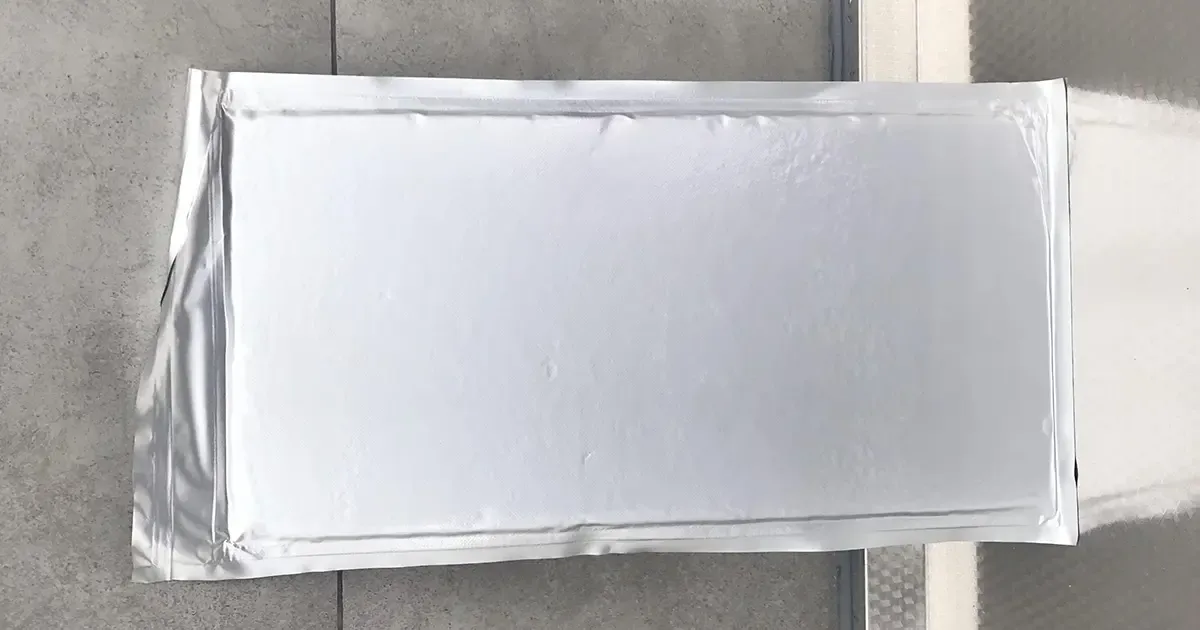
The naming is genuinely confusing, so start here. The same family of products is sold as nano microporous board, nanoporous insulation, nano-porous silica board, fumed silica board and microporous thermal insulation. They are all the same basic construction: an inorganic powder blend — fumed silica in most commercial grades — reinforced with a small fraction of fibre and loaded with an infrared opacifier, pressed into a rigid board or a preformed pipe section and sealed inside a high-barrier film or foil envelope.
The sealing matters more than buyers expect. The performance comes from the pore structure, not from a vacuum in the everyday sense, but the envelope protects the board from moisture and mechanical damage during handling. A board that arrives with a punctured envelope has already lost part of its service life — which is why the foil-wrapped panel is the standard delivery form, and why damage in transit is a rejection reason rather than a cosmetic issue.
It is worth separating this from aerogel, because the two get compared constantly. Aerogel insulation is a monolithic or blanket-form nanostructured network; nano microporous board is a pressed powder composite with an opacifier. Aerogel generally wins on very low conductivity at lower temperatures and on flexibility; the pressed microporous board wins on compressive strength, dimensional stability and rigidity at temperature. If your specification calls for a board that can be clamped, bolted or used as a load-bearing backup layer, the microporous board is usually the right answer. For a thickness-versus-cost comparison against aerogel and conventional materials, see our aerogel versus traditional insulation thickness and cost analysis.
If you are still choosing between the three ultra-thin families rather than specifying one of them, our aerogel, nano and microporous insulation compared side by side guide puts all three on the same five axes.
Three Mechanisms That Block Heat Transfer
Heat moves through insulation by three routes — gas conduction and convection in the pores, solid conduction through the skeleton, and radiation across the pore space at temperature. Nano microporous board attacks all three.
Pore size below the mean free path of air. The pores in a commercial board are typically 20–50 nm across. The mean free path of an air molecule at atmospheric pressure is about 70 nm. When the pore is smaller than the distance a molecule can travel before it collides with another molecule, gas-phase conduction collapses — the molecule meets a wall before it can pass energy along. This is the single biggest reason the material outperforms conventional insulation by a factor of three to four at 600 °C.
A long, thin solid path. The skeleton is a packed powder with point contacts between particles. Solid conduction has to travel a tortuous route through countless contact points, each one a thermal resistance. The result is a solid-phase contribution far lower than in a fibre mat, where fibres form continuous conduction paths.
Infrared opacification. At 600 °C and above, radiation becomes a serious share of total heat transfer through any low-density insulation. The opacifier — silicon carbide in most grades, sometimes a titanate — scatters and absorbs infrared across the wavelengths that matter. This is why the board's conductivity curve stays flat as temperature rises, while conventional materials climb steeply once radiation takes over.
Put together, these mechanisms give a measured thermal conductivity 30–40 % below conventional insulation at 600 °C and around 40–50 % below at 400 °C. In the field that translates to thickness reductions of 50–70 % for the same shell temperature, and energy savings typically quoted in the 10–30 % range for retrofit work.
ISO 18959:2025 and the Three Temperature Classes
Until recently there was no dedicated international specification for this product family. ISO 18959:2025, published in September 2025 by ISO/TC 163/SC 3, changed that. It specifies requirements for factory-made rigid nano-microporous insulation used on industrial surfaces from 100 °C to 1 150 °C, delivered as board or pipe section, and it defines test procedures, conformity evaluation, marking and labelling.
The standard sorts products into three classes by service temperature:
| Class | Service temperature | Thermal conductivity at 500 °C | Permanent linear change | Compressive stress at 10 % deformation |
|---|---|---|---|---|
| Type 950 | up to 950 °C | ≤ 0.036 W/(m·K) | ≤ 3.0 % | ≥ 200–500 kPa |
| Type 1050 | up to 1 050 °C | ≤ 0.045 W/(m·K) | ≤ 3.0 % | ≥ 200–500 kPa |
| Type 1150 | up to 1 150 °C | ≤ 0.045 W/(m·K) | ≤ 3.0 % | ≥ 200–500 kPa |
Two practical points follow. First, the temperature class in the standard is normally set 50–100 °C below the material's actual short-term capability, so a Type 950 board is comfortably specified for the 650 °C duty this guide focuses on — and it carries the tighter conductivity limit of the three. Second, ISO 18959:2025 deliberately does not state the performance level a product must reach for a given application; that level comes from your project specification or from a non-conflicting national standard. So the class tells you what the product is, and your own thermal calculation tells you how much of it you need.
If you are weighing this against the fibre and wool families, our high-temperature insulation wool temperature ratings guide maps the temperature ladder across material types.
Physical and Mechanical Properties
The datasheet numbers that matter for specification work:
| Property | Nano microporous board | Conventional insulation |
|---|---|---|
| Thermal conductivity | 0.016–0.030 W/(m·K) | 0.055–0.085 W/(m·K) at 600 °C |
| Density | 200–320 kg/m³ | 100–200 kg/m³ |
| Compressive strength | ≥ 0.3 MPa | 0.05–0.2 MPa |
| Linear shrinkage, 800 °C × 24 h | ≤ 2.0 % | 3.0–5.0 % |
| Fire classification | A1 non-combustible | B1 in many grades |
| Service life | 5–10 years | 3–5 years |
| Shell temperature in service | 50–60 °C | 80–90 °C |
Two of these deserve comment. The density is genuinely higher than conventional insulation — 200–320 kg/m³ against 100–200 kg/m³ — yet compressive strength is five to six times better at 0.3 MPa or above. That combination is what makes the board usable in vibrating equipment and in positions where it carries load, rather than sitting protected inside a casing. The shrinkage figure is the second one: at 2.0 % or less after 24 hours at 800 °C, the board holds its geometry where conventional materials close up joints and open gaps.
Chemically the product is fully inorganic, A1 non-combustible, and available in low-chloride grades. That last point is not optional on stainless steel.
Where It Fits: Steel, Petrochemical and Power
Steel — heat treatment furnaces and ladles. Furnace interiors run at 1 000–1 200 °C, but the shell has to stay below 650 °C and there is rarely room for a thick lining. A 7 mm microporous board has replaced conventional ceramic fibre in ladle applications where the benefit was measured directly: molten steel temperature drop fell from more than 2 °C per minute to about 1 °C per minute, and shell temperature dropped by 70–90 °C. Installation practice matters as much as the material — stagger the joints to break the thermal bridge, keep gaps to 1 mm or less, seal joints with foil tape so powder cannot escape, and fix with stainless steel banding or rivets rather than adhesive. On stainless shells, specify a low-chloride grade at 50 mg/kg chloride or below to avoid stress-corrosion cracking.
Petrochemical — hot pipework and vessels. Process lines typically run 300–600 °C, with some services reaching 650 °C, and the available clearance around a pipe is often fixed by the original design. At 650 °C the microporous solution needs roughly one third of the thickness of mineral wool for the same heat loss, which is frequently the difference between a line that fits and one that does not. The material is inorganic, A1 rated and chloride-free, so it suits corrosive environments. Seal every joint with a high-temperature sealant so condensate cannot wick into the insulation, and wrap with foil or glass cloth for mechanical protection. In wet service, use a hydrophobic grade or add a waterproof jacket — a non-hydrophobic board that takes water has lost most of its advantage.
For a broader view of pipe insulation options by material, see our industrial pipe insulation materials hub.
Power — boilers, piping and casings. Boiler surfaces and steam piping span 200–600 °C, and the driver here is usually safety and efficiency together. Retrofit work on high-pressure steam piping has taken surface temperature from about 85 °C down to roughly 45 °C while cutting insulation thickness by 60–70 %. The board resists vibration and does not powder at temperature, which is why it holds up on boiler casings where fibre products break down. Use a metal outer jacket — stainless where the environment demands it — and specify a hydrophobic grade or waterproof cladding in damp areas.
Board, Pipe Section and How Thin You Can Go
Commercial board is commonly supplied from about 7 mm upward, with 7–20 mm covering the majority of industrial retrofits. Pipe sections are produced to the pipe diameter, and shaped or cut pieces are available for valves, flanges and irregular geometry.
The temptation is always to go as thin as the thermal calculation allows. Resist it slightly. Below a certain thickness you are trading two real risks for space: more joints per square metre, each one a thermal bridge and a potential powder leak, and less mechanical margin against vibration and handling damage. A 7 mm board on a ladle works because the surface is smooth, the fixing is mechanical and the run is short. The same thickness on a long vibrating pipe run with twenty joints is a different proposition.
Two installation details decide whether the calculated performance is achieved on site. Stagger joints between layers and between adjacent boards, and hold the joint gap to 1 mm or less. Then seal every joint with foil tape. Powder migration through an unsealed joint is slow, invisible, and permanent — the board thins at the seam and a hot line appears directly over it.
Sourcing: Seven Things to Verify Before You Sign
Match the temperature class to the duty, not to the marketing. For service up to 650 °C, Type 950 per ISO 18959:2025 is the right specification and carries the strictest conductivity limit of the three classes.
Ask for the conductivity curve, not a single number. A datasheet quoting only a value at 25 °C tells you nothing about service. You want the figure at your operating temperature — 0.030–0.040 W/(m·K) at 600 °C and 0.024–0.029 W/(m·K) at 400 °C are the ranges a credible board should meet.
Set the chloride limit in writing. 50 mg/kg or below for anything mounted on austenitic stainless steel, with the value on the lot certificate rather than in an email.
Confirm mechanical and dimensional numbers. Density 200–320 kg/m³, compressive strength at 0.3 MPa or above, linear shrinkage 2.0 % or below at 800 °C for 24 hours.
Inspect the envelope. Reject boards with punctured, creased or delaminated foil. Seal integrity is a performance property, not packaging.
Require lot-level testing and traceability. Density, conductivity at a stated reference temperature, compressive strength at 10 % deformation, water repellency where specified, and the chloride number. For critical service, independent third-party verification is worth the lead time.
Send a proper enquiry. State the operating temperature, the geometry — pipe diameter or vessel outside diameter — the available clearance, the environment, and annual volume. Custom shapes and non-standard thicknesses are routine but they move both lead time and minimum order quantity.
On channel choice, direct-from-mill buying gives the best price and the strongest custom capability on large projects, while distributors and integrators trade some price for faster delivery and better technical support on smaller ones. Either way, ask for samples and put them in a test rig before committing volume — the difference between grades is not visible on a datasheet. For a worked example of how thickness assumptions change the economics, see our pyrogel insulation thickness guide.
Closing
Nano microporous insulation is not a universal replacement for mineral wool or ceramic fibre — it is a specialist tool for the jobs where space, shell temperature or service life is the binding constraint. Where it fits, it fits decisively: half to two thirds of the thickness, a third of the conductivity, and a shell temperature your maintenance team can work next to.
Send us your operating temperature, geometry, clearance and annual volume, and our engineers will return a thickness calculation, a sample plan and a quotation within two weeks.
For the full material comparison across high-temperature insulation families, see our top 10 high-temperature insulation materials guide. For definitions of the terminology used across these product families, see our insulation glossary.
Frequently asked
What is the difference between nano microporous board and aerogel insulation?
Aerogel is a monolithic or blanket-form nanostructured network that generally achieves very low conductivity at lower temperatures and offers flexibility. Nano microporous board is a pressed inorganic powder composite with an infrared opacifier, sealed in a barrier film — it is rigid, considerably stronger in compression at 0.3 MPa or above, and dimensionally stable at temperature. Choose aerogel where you need a flexible thin layer; choose the pressed board where the insulation must be clamped, bolted or used as a rigid backup layer.
How thin can nano microporous insulation be?
Commercial board starts at about 7 mm and is routinely supplied in the 7–20 mm range for industrial retrofits; pipe sections are made to diameter. Going thinner than the thermal calculation requires is usually a mistake, because thinner board means more joints per square metre, and every joint is a thermal bridge plus a potential powder-leak path.
What temperature classes does ISO 18959:2025 define?
Three, by service temperature: Type 950 up to 950 °C with thermal conductivity at 500 °C of 0.036 W/(m·K) or less; Type 1050 up to 1 050 °C at 0.045 W/(m·K) or less; and Type 1150 up to 1 150 °C at 0.045 W/(m·K) or less. All three carry a permanent linear change limit of 3.0 % and a compressive stress at 10 % deformation of 200–500 kPa or above. The standard covers surfaces from 100 °C to 1 150 °C.
Is nano microporous board non-combustible?
Yes — the product is fully inorganic and classified A1 non-combustible, which is one grade above the B1 classification typical of many conventional organic-bonded insulation products. That classification is part of why it is specified on furnace shells, boiler casings and pipework where fire performance is written into the project specification.
Does nano microporous board need protection from moisture?
Standard grades do. The pore structure works because the pores are dry and gas-filled; water in the pores restores conduction paths and the advantage disappears. In damp or outdoor service, specify a hydrophobic grade, add a waterproof jacket, or both. Always seal joints with foil tape so condensate cannot wick into the board.
What chloride limit applies for stainless steel service?
50 mg/kg or below, and it should appear on the lot certificate rather than only in correspondence. Chloride plus moisture plus tensile stress is the classic recipe for stress-corrosion cracking in austenitic stainless steel, and insulation is a well-documented source of the chloride.
How long does nano microporous insulation last in service?
Five to ten years is the normal expectation, against three to five years for conventional insulation — roughly two to three times the service life. The two failure modes that shorten it are envelope damage during handling or installation, and water ingress through unsealed joints.
Can the board be cut on site?
It can be cut with standard tools, but every cut edge is an unsealed edge. If you cut a board, seal the cut face with foil tape before installation. Where possible, order pre-cut shapes and pipe sections from the producer so the factory envelope stays intact.
Is nano microporous board worth the price compared with ceramic fibre?
On first cost, no — the board is more expensive per square metre. On installed cost, frequently yes: 3–4 times the insulation efficiency means 50–70 % less thickness, less support steel, faster installation and 2–3 times the service life. The comparison to run is cost per unit of thermal resistance over the planned service life, not cost per square metre.
What should I send to get an accurate quotation?
Operating temperature, the geometry — pipe diameter or vessel outside diameter — the clearance available for insulation, the environment including any water exposure, whether the substrate is stainless, and your annual volume. With those five items a producer can return a thickness calculation and a firm price rather than a range.
Explore flexible aerogel and microporous insulation options in our aerogel insulation guide.
Frequently asked
What is the difference between nano microporous board and aerogel insulation? +
Aerogel is a monolithic or blanket-form nanostructured network that generally achieves very low conductivity at lower temperatures and offers flexibility. Nano microporous board is a pressed inorganic powder composite with an infrared opacifier, sealed in a barrier film — it is rigid, considerably stronger in compression at 0.3 MPa or above, and dimensionally stable at temperature. Choose aerogel where you need a flexible thin layer; choose the pressed board where the insulation must be clamped, bolted or used as a rigid backup layer.
How thin can nano microporous insulation be? +
Commercial board starts at about 7 mm and is routinely supplied in the 7–20 mm range for industrial retrofits; pipe sections are made to diameter. Going thinner than the thermal calculation requires is usually a mistake, because thinner board means more joints per square metre, and every joint is a thermal bridge plus a potential powder-leak path.
What temperature classes does ISO 18959:2025 define? +
Three, by service temperature: Type 950 up to 950 °C with thermal conductivity at 500 °C of 0.036 W/(m·K) or less; Type 1050 up to 1 050 °C at 0.045 W/(m·K) or less; and Type 1150 up to 1 150 °C at 0.045 W/(m·K) or less. All three carry a permanent linear change limit of 3.0 % and a compressive stress at 10 % deformation of 200–500 kPa or above. The standard covers surfaces from 100 °C to 1 150 °C.
Is nano microporous board non-combustible? +
Yes — the product is fully inorganic and classified A1 non-combustible, one grade above the B1 classification typical of many conventional organic-bonded insulation products. That classification is part of why it is specified on furnace shells, boiler casings and pipework where fire performance is written into the project specification.
Does nano microporous board need protection from moisture? +
Standard grades do. The pore structure works because the pores are dry and gas-filled; water in the pores restores conduction paths and the advantage disappears. In damp or outdoor service, specify a hydrophobic grade, add a waterproof jacket, or both. Always seal joints with foil tape so condensate cannot wick into the board.
What chloride limit applies for stainless steel service? +
50 mg/kg or below, and it should appear on the lot certificate rather than only in correspondence. Chloride plus moisture plus tensile stress is the classic recipe for stress-corrosion cracking in austenitic stainless steel, and insulation is a well-documented source of the chloride.
How long does nano microporous insulation last in service? +
Five to ten years is the normal expectation, against three to five years for conventional insulation — roughly two to three times the service life. The two failure modes that shorten it are envelope damage during handling or installation, and water ingress through unsealed joints.
Can the board be cut on site? +
It can be cut with standard tools, but every cut edge is an unsealed edge. If you cut a board, seal the cut face with foil tape before installation. Where possible, order pre-cut shapes and pipe sections from the producer so the factory envelope stays intact.
Is nano microporous board worth the price compared with ceramic fibre? +
On first cost, no — the board is more expensive per square metre. On installed cost, frequently yes: 3–4 times the insulation efficiency means 50–70 % less thickness, less support steel, faster installation and 2–3 times the service life. The comparison to run is cost per unit of thermal resistance over the planned service life, not cost per square metre.
What should I send to get an accurate quotation? +
Operating temperature, the geometry — pipe diameter or vessel outside diameter — the clearance available for insulation, the environment including any water exposure, whether the substrate is stainless, and your annual volume. With those five items a producer can return a thickness calculation and a firm price rather than a range.
Request a quote
Interested in our insulation solutions? Send us your requirements and our team responds within one business day.