
EN 14303 vs ASTM C547: Pipe Insulation Standards Compared
Procurement-grade comparison of EN 14303 and ASTM C547: scope, version control, type and grade logic, thermal test routes, corrosion, conformity evidence, and dual-standard specification practice.
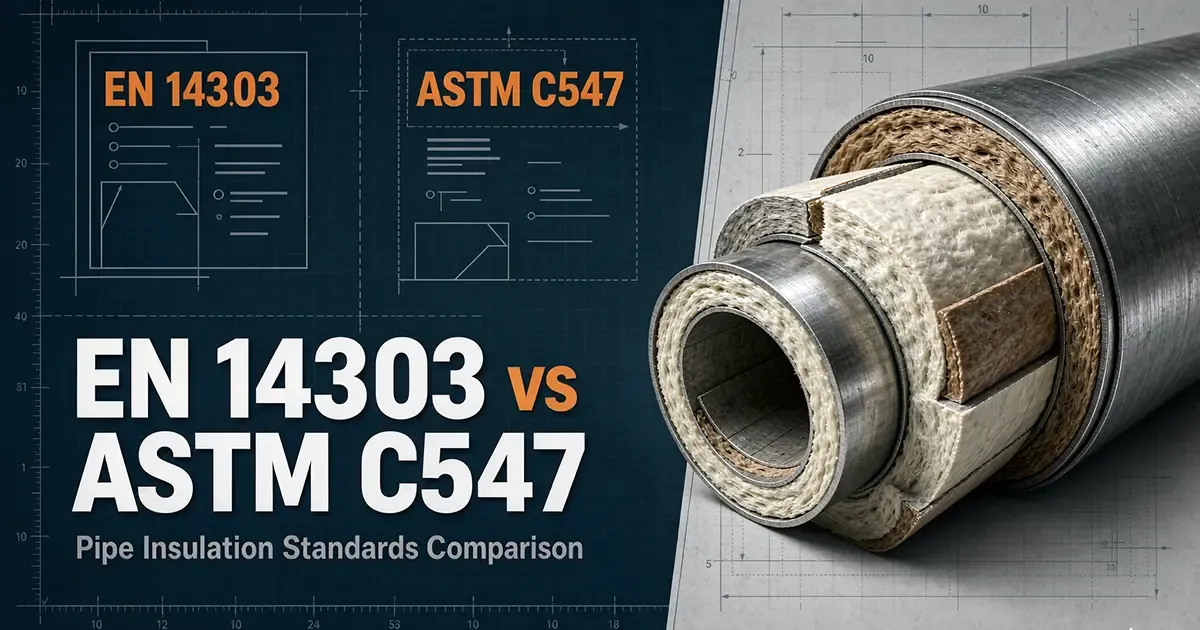
EN 14303 and ASTM C547 are not two editions of the same document, and "dual certified" does not mean interchangeable. EN 14303 is the European product standard for factory-made mineral wool products, including preformed pipe sections, and it works by declaration: the manufacturer declares values for thermal performance, maximum service temperature, water absorption, vapour resistance, reaction to fire and release of corrosive substances, inside the framework of the EU Construction Products Regulation. ASTM C547 is a US product specification built the other way round - it fixes five product types and two grades, names the test method behind each property, and leaves sampling and acceptance to the purchase order.
One-sentence conclusion: EN 14303 gives you a method and a blank you must fill; ASTM C547 gives you a number you can write straight into a purchase order - and neither one converts into the other by table lookup.
The most consequential procurement rule is therefore not "CE plus ASTM". It is to require a single, project-controlled qualification matrix that preserves the applicable declaration from each system while adding the conditions neither product standard establishes: actual hot-face and cold-face temperatures, pipe diameter and insulation thickness, orientation, load, jacket and adhesive limits, vapour-control configuration, substrate, corrosion environment, and inspection and acceptance method.
This guide covers the scope boundary, version control, the type-and-grade logic that has no European equivalent, thermal test routes, hot-face and shrinkage evidence, the assembly-layer trap, corrosion and stress cracking, conformity paperwork, and how dual-standard specifications are actually written in practice. Material-specific selection for mineral wool pipe sections is covered separately in our rock wool pipe insulation guide, and downstream construction details in our pipe insulation types overview.
1. Scope: Same Product Family, Different Legal and Technical Contracts
EN 14303 covers factory-made mineral wool products for the thermal insulation of building equipment and industrial installations, with an operating-temperature range of approximately 0 °C to +800 °C. Product forms include rolls, boards, slabs, mats, felts, quilts, wired mats, lamella mats, bevelled lags and pipe sections, with or without facing or coating. Products with a declared thermal conductivity greater than 0.065 W/(m·K) at 10 °C are outside the standard, as are in-situ blown or poured products and insulation of the building structure itself.
That 0 °C to +800 °C figure is a scope boundary, not a promise that every mineral wool pipe section is fit to +800 °C. This single misunderstanding causes more specification disputes than any other, and section 4 returns to it.
| Procurement question | EN 14303 answer | ASTM C547 answer | What the purchaser must still close |
|---|---|---|---|
| Product family | Factory-made mineral wool, including pipe sections | Mineral-fibre pipe insulation only | State geometry, fibre type and facing separately |
| Compliance anchor | Harmonised standard under the EU Construction Products Regulation; CE marking and declaration of performance for the EU market | Voluntary consensus specification in ASTM-using projects; local codes still apply | Do not infer EU market access from ASTM, or US acceptance from CE |
| How performance is expressed | Declared values and levels, plus a conformity framework | Named test methods, fixed types and grades, purchase-order requirements | Require a cross-walk table, not a logo |
| Temperature limit | Maximum service temperature ST(+) is declared | Type and temperature class are specified | State hot face, cold face, excursions, heat-up, orientation, thickness |
| Thermal test route | Declared value; method and reference temperature must be identified | Pipe-apparatus method specified for the product | Require mean temperature, faces, diameter, thickness, conditioning |
| Stress corrosion | No dedicated test established in the available evidence | Additional ASTM test invoked separately | Add the corrosion test explicitly, do not assume it |
| Installation | Not an installation code | Not an installation code | Cite a project installation standard and inspection plan separately |
1.1 The "or equivalent" clause is where disputes start
A line such as "mineral wool pipe sections to EN 14303 or equivalent ASTM C547" is ambiguous unless the project also states which type, which class, which declared values, which test methods, which report format, and which additional conditions apply. Equivalence is property-specific, not product-specific.
A product may carry an EN-declared thermal conductivity measured on a flat specimen and an ASTM pipe-test curve that brackets the project mean temperature. That is useful correlation evidence, and nothing more. Conversely, identical nominal density and a matching fire class do not make a faced, wire-reinforced, stainless-service product equivalent to a plain section, if the jacket binder, leachable ions or high-temperature deformation behaviour differ.
Note also that the two systems divide product forms differently. Europe uses one standard per material for all forms; the ASTM system uses one standard per form. Mineral wool pipe sections sit in EN 14303 in Europe but in ASTM C547 in the US; mineral wool blanket sits in EN 14303 in Europe but in ASTM C553 (unfaced) or ASTM C592 (metal-mesh covered) in the US; mineral wool board sits in EN 14303 in Europe but in ASTM C612 in the US. "C547 is the ASTM equivalent of EN 14303" is only true for the pipe-section form.
2. Version Control: Fix the Edition in the Contract
Both standards exist in multiple editions, and both are quoted loosely in tender documents. Two facts are worth stating plainly.
EN 14303:2015 is the current edition. It replaced EN 14303:2009+A1:2013. A surprising number of supplier data sheets, certificates and tender schedules still carry the older designation, which is a documentation defect rather than a product defect - but it means the declaration of performance must be read against the edition actually printed on it.
ASTM C547-25 is the current edition. Earlier editions remain in wide circulation in project archives, and older editions allowed a slightly different shot-content limit, which section 6 covers.
The purchasing rule that follows is not complicated:
Cite the standard with its edition, and require supplier test reports to identify the exact edition and clause used. Where the purchaser later references a revision, the revision date must be stated.
This prevents a supplier from benefiting from a favourable historical tolerance while silently applying a newer test temperature or reporting convention. It also prevents the opposite failure, where a contractor rejects a perfectly good current report because it does not match a decade-old specification schedule.
For the European side there is a second layer. CE marking is a market-access instrument tied to the edition in force at the time of placing on the market, and national adoptions and corrigenda can differ. Check the standard identification printed on the declaration of performance against the position in the destination market at the shipment date, not against a supplier brochure.
3. The Classification Gap: Types and Grades Have No European Equivalent
This is the single most practical difference between the two documents, and the one most often lost when a specification is copied from one market to another.
ASTM C547 classifies products on two axes. The type is set by the forming process and the maximum use temperature. The grade is set by whether the product can be brought to that temperature without a controlled heat-up.
| Type | Forming method | Maximum use temperature |
|---|---|---|
| Type I | Molded | 850 °F (454 °C) |
| Type II | Molded | 1200 °F (650 °C) |
| Type III | Precision v-groove | 1200 °F (650 °C) |
| Type IV | Molded | 1000 °F (538 °C) |
| Type V | Molded | 1400 °F (760 °C) |
| Grade | Requirement |
|---|---|
| Grade A | Requires no heat-up schedule |
| Grade B | Heat-up schedule is required |
Grade B is not a lower quality grade. It is an operating instruction. The standard warns explicitly that Grade B products are designed to be used with a heat-up schedule, that failure to follow one can lead to an exothermic reaction depending on thickness and temperature, and that Grade B may not be suitable where hot installation at the maximum temperature is required. The associated requirement is quantitative: during hot-surface exposure the insulation's internal temperature rise must not exceed the pipe temperature by more than 200 °F (111 °C).
EN 14303 has no type-and-grade grid. It declares a maximum service temperature ST(+) and leaves the heat-up question to the application. There is therefore no one-line European equivalent of "C547 Type II Grade A". You either accept a set of declared values and qualify them against the duty, or you write the heat-up requirement into the specification yourself.
A substitution that ignores this point fails quietly. Replacing a Grade A product with a European product does not give you a "no heat-up schedule required" guarantee, and replacing Grade A with Grade B can damage the insulation or ignite organic material on a cold start, before anyone thinks to check the paperwork.
One temperature anchor for our own range: our rock wool pipe sections are offered to 650 °C, which coincides with the Type II and Type III ceiling. Type V at 760 °C is a different product family, not an upgraded version of the same section. If a specification calls up Type V, treat it as a material change and not as a documentation change. The wider product range and its temperature limits are set out in our rock wool insulation overview.
4. Temperature: Two Completely Different Kinds of Claim
The confusion is easy to explain. C547 fixes a temperature per type, so a specification writer can write "Type II" and be done. EN 14303 does not fix a temperature per product; it defines how the maximum service temperature must be determined and declared.
The European test methods were renumbered in 2022, and a good deal of published guidance, including older supplier literature, still cites the withdrawn numbers:
| Withdrawn or superseded | Current | What it determines |
|---|---|---|
| EN 14706:2012 | EN ISO 18097:2022 | Maximum service temperature of flat products |
| EN 14707:2012 (and ISO 18096:2013) | EN ISO 18096:2022 | Maximum service temperature of preformed pipe insulation |
| EN 13467:2018 | EN ISO 12628:2022 | Dimensions, squareness and linearity of preformed pipe insulation |
| EN 13470:2001 | EN ISO 18098:2022 | Apparent density of preformed pipe insulation |
This matters commercially as well as technically. If a supplier report cites EN 14707, it is citing a method that has been superseded; the result may still be valid, but the document is not current. If a tender asks for EN 13467 dimensional data on pipe sections, the correct reference is now EN ISO 12628.
4.1 A declared ST(+) is not a continuous duty temperature
A declaration of ST(+) equal to, say, 450 °C means that the manufacturer determined and declared a maximum service temperature under the standard's test basis. It does not establish that:
- the product will survive 450 °C with a factory-applied foil, scrim or coating in place;
- the adhesive, seam tape, wire, mesh, jacket or stainless band will survive 450 °C;
- the 450 °C condition includes a 48-hour upset, repeated shutdown, or the load of a heavy cladding;
- the declared thermal conductivity at a 50 °C mean temperature is valid against a 420 °C hot face;
- the thickness selected keeps the jacket below its own temperature limit.
The project specification must therefore separate core ST(+) from system maximum temperature, then qualify each layer. Classification temperature is a standardised test and reporting basis. Continuous-use temperature is an application conclusion that includes thermal gradient, time, mechanical stress, chemical exposure, assembly and maintenance.
The ASTM side carries a parallel trap. Maximum-use-temperature statements can come from a hot-surface performance test or from an estimation practice, and the two answer adjacent but different questions. A "maximum temperature per C447" statement cannot silently replace a C411 hot-surface performance result where the safety case requires observed post-exposure integrity.
5. Thermal Conductivity: Why the Numbers Are Not Comparable
ASTM C547 does not ask for "thermal conductivity" in the abstract. It specifies the characterisation route. The relevant clause family in the specification requires thermal conductivity to be determined by the pipe test method, C335/C335M, on a nominal 3 in. NPS by 2 in. pipe insulation specimen, with at least two additional tests distributed across the remaining temperature range, the data reduced to a conductivity-versus-temperature relationship under C1045, and an effective conductivity calculated under C680 using the specific hot and cold surface temperatures for comparison against the specification limits.
Three conclusions follow, and the second one is the one that keeps engineers out of trouble.
First, the characterisation route is cylindrical. C335 measures steady-state heat transfer through a pipe specimen, so the result carries the curvature, the circumferential seam and the radial heat flow of the actual product geometry.
Second, the specification does not state a universal prohibition on guarded-hot-plate data. It is inaccurate to reject a C177 report on the theory that the method is globally forbidden. It is accurate to reject it where the purchase order makes C335/C335M mandatory, where the project thermal model relies on a C547-type effective-conductivity comparison, or where the flat-plate report omits the diameter, thickness, orientation, conditioning, temperature gradient and uncertainty needed to correlate.
Third, C335 is itself a cylindrical method whose note cross-references guarded-hot-plate and heat-flow-meter methods as related references. That cross-reference is evidence that C177 is a related thermal-transmission reference, not evidence that it satisfies the C547 characterisation route.
The magnitude of the problem is visible in the published limits. The specification's property table caps apparent thermal conductivity for every type, at mean temperatures from 38 °C upward:
| Mean temperature | Type I | Type II, III, IV, V |
|---|---|---|
| 100 °F (38 °C) | 0.25 Btu·in/(h·ft²·°F) - 0.036 W/(m·K) | 0.25 - 0.036 |
| 200 °F (93 °C) | 0.31 - 0.045 | 0.31 - 0.045 |
| 300 °F (149 °C) | 0.40 - 0.058 | 0.37 - 0.053 |
| 400 °F (204 °C) | 0.51 - 0.074 | 0.45 - 0.065 |
| 500 °F (280 °C) | 0.64 - 0.092 | 0.54 - 0.078 |
| 600 °F (316 °C) | - | 0.65 - 0.094 |
| 700 °F (371 °C) | - | 0.77 - 0.111 |
Note the reference temperature. These are limits at stated mean temperatures, and the lowest published reference band is 38 °C mean. European declarations are commonly referenced to a 10 °C mean temperature, with the temperature dependence handled through a declared conductivity curve. Comparing a 38 °C mean figure against a 10 °C mean figure is not a comparison. It is two different measurements of two different quantities, and it can produce exactly the wrong conclusion about which product performs better.
5.1 What to demand instead of "thermal conductivity per ASTM"
Ask for a report that answers the heat-transfer question. The minimum fields are:
| Field | Required report content |
|---|---|
| Method and edition | Test method with edition, apparatus type, horizontal or vertical axis |
| Specimen | Nominal size or outside diameter, wall thickness, single or multi-layer, seam, density, moisture state, facing present or excluded |
| Thermal boundary | Hot-face temperature, cold-face temperature, mean-temperature definition, ambient, duration, steady-state criterion |
| Result | Conductivity-versus-temperature fit where applicable; lineal resistance and effective conductivity distinguished |
| Project comparison | Calculation using actual hot face, cold face, diameter, thickness and layer sequence, with assumptions stated |
| EN cross-reference | EN-declared value at its stated reference temperature, test method, specimen geometry and heat-flow direction |
| Uncertainty | Laboratory measurement uncertainty, plus any correction for facing, seams or end effects |
A guarded-hot-plate report can be useful supplementary engineering data. It is not automatically substitutable for a pipe test, and the reverse is equally true: a pipe-test curve is not automatically usable inside a flat-product European declaration unless the product, the test basis and the conversion rationale are valid.
6. Hot Face, Sag and Shrinkage: Map the Methods Before Comparing Numbers
The ASTM specification imposes quantitative limits on the properties that decide whether a section survives at temperature. These are the values worth carrying into a specification review:
| Property | Requirement |
|---|---|
| Sag resistance | Thickness change of 5 percent or less at maximum use temperature, assessed on a 6 in. (152 mm) nominal thickness specimen |
| Linear shrinkage | 2 percent or less after soaking at maximum use temperature |
| Water vapour sorption | 5 percent by weight or less at 120 °F (49 °C) and 95 percent relative humidity |
| Surface burning | Flame spread index 25 or less; smoke developed index 50 or less |
| Non-fibrous (shot) content | 25 percent by weight or less for rock- or slag-based product in the current edition; older editions permitted 30 percent |
| Asbestos | Not permitted as an ingredient or component |
| Thickness range | 13 mm to 152 mm nominal, single or double layer, in 13 mm increments for most sizes |
| Section length | 3 ft (0.91 m); length tolerance plus or minus 3 mm |
| Concentricity | Deviation from concentricity not exceeding 5 mm |
| Bore and wall dimensions | Per the dimensional practice for nominal pipe and tubing sizes |
The European route reaches equivalent questions by a different path, and the mapping is not one-to-one:
| Engineering attribute | ASTM route | European route | What procurement must add |
|---|---|---|---|
| Hot-surface performance | Hot-surface performance test, plus maximum-use-temperature estimation | ST(+) declaration, with the pipe-section determination under EN ISO 18096:2022 and the flat-product determination under EN ISO 18097:2022 | Hot face, duration, ramp rate, orientation, support spacing, facing on or off, post-test observations |
| Sag or anti-sag | Hot-surface test at the product's maximum use temperature, with edition-specific specimen and nesting rules | No single universal sag property identified for all mineral wool pipe sections | Whether the property is required at all, the load and span, exposed or enclosed installation, acceptance criteria |
| Linear shrinkage | Dedicated linear shrinkage method | Not a one-for-one identical label; high-temperature dimensional behaviour must be checked against the purchased text and the declared characteristic | Heating cycle, specimen direction (axial or circumferential), soak, cooling, reference length, tolerance |
| Dimensions after exposure | Density and dimension methods, plus hot-surface context | Dimensional methods and product-form tolerances, with temperature-dependent data for ST(+/-) confirmation | Do not compare a room-temperature diameter tolerance against a post-exposure axial gap |
Method direction is a hidden source of non-equivalence. A flat-board test measures in the geometry and heat-flow direction of the specimen supplied. A pipe test has curvature, a circumferential seam and radial heat flow. A mesh-reinforced or faced product can behave differently in the axial and circumferential directions. Reports must identify specimen orientation and, for pipe sections, whether the test used a full annular section, a segment or a flat surrogate.
6.1 A conservative rejection rule
Reject a cross-standard comparison that does any of the following:
- converts a declared ST(+) directly into a continuous operating temperature without thermal-gradient and assembly evidence;
- compares a shrinkage percentage measured at an undisclosed orientation and duration with a European dimensional tolerance class;
- uses a flat-board result as the sole proof of a faced pipe section's hot-face performance where the project requires direct pipe evidence;
- claims a sag pass because the core did not burn, melt or collapse in a test that did not include the project's span, load or jacket;
- substitutes a room-temperature dimension report for post-thermal-ageing dimensional stability.
7. Facing, Jacket and Adhesive: The System-Temperature Cliff
The ASTM principle is visible in the test-method language: properties are generally determined on the insulation with jacketing excluded unless stated otherwise, and the hot-surface method excludes jackets unless the jacket is integral to holding the product together. This is not an administrative detail. It means a bare-core pass can coexist with a facing that deforms, a pressure-sensitive adhesive that bleeds, or a jacket seam that fails at a lower temperature.
For water vapour the European framework is sharper still. It distinguishes the diffusion resistance factor of a homogeneous product from the vapour resistance of a faced or non-homogeneous product. A bare mineral wool diffusion factor tells almost nothing about the vapour performance of an aluminium-foil, scrim and kraft laminate, its overlaps, or a punctured cladding.
| Assembly layer | European declaration target | ASTM evidence target | Acceptance evidence |
|---|---|---|---|
| Mineral wool core | Conductivity, ST(+/-), reaction to fire, release properties, dimensions | Pipe thermal test, hot-surface performance, shrinkage, density and dimensions as specified | Batch report plus project qualification |
| Factory facing, foil or scrim | Declared as part of the product; vapour resistance rather than diffusion factor may apply | Tested with or without jacket per the method's stated condition | Component temperature limits and full construction list |
| Adhesive or laminate | Not assumed equal to core ST(+) | No automatic pass from a core hot-surface result | Binder and adhesive technical data, temperature rating, ageing test |
| Jacket or cladding | Usually a separate product or system declaration | Default may exclude jacket unless stated | Jacket standard, seam detail, corrosion, UV, impact, temperature test |
| Seams and fasteners | The product standard does not install the site joint | Field assembly is outside the product specimen | Hold point: visual, pull or twist where specified, seal continuity, band load |
The lesson is an engineering inference rather than a reported incident. The test boundary is visible in both systems, and service failures commonly occur at the interface: foil delamination, adhesive creep, wire cut-through, jacket oil absorption, vapour-barrier discontinuity. A project that buys a core declaration and then adds a jacket on site has changed the tested system. The remedy is a system drawing, approved material deviations and site hold points, not a longer core certificate.
A clause that closes this gap contractually:
The manufacturer shall declare the maximum continuous and short-term temperatures of the mineral wool core, each facing, the laminating or adhesive system, the seam tape or closure, the mesh or wire, and the outer jacket with its fixings. Where any component limit is lower than the design hot face, the supplier shall identify the limiting component and propose an alternative. Hot-surface testing shall be performed on the assembled system unless a technical justification for bare-core testing is approved.
8. Corrosion and Stress Cracking: EN 13468 Is Not the ASTM Test
This is the asymmetry with the highest consequence for stainless steel piping, and it is routinely lost in translation.
The European test standard EN 13468 determines trace quantities of water-soluble chloride, fluoride, silicate and sodium ions, plus pH, in an aqueous extract of the product. Its purpose is explicitly connected to austenitic stainless steel substrates, where those ions can affect the risk of stress corrosion cracking. What it produces is a declared release characteristic. That is valuable input to a corrosion assessment.
It is not a stress corrosion test. It does not subject a stressed austenitic coupon to the insulation, water transport, heat flux, oxygen and concentration mechanism that actually generates cracking.
The ASTM route layers three documents: a judgement chart for acceptable chloride versus sodium-plus-silicate content, a chemical analysis method for leachable chloride, and a 28-day test that transports distilled water through the insulation to the hot surface of a stressed Type 304 coupon and then examines it. The test method's own scope states that it evaluates whether insulation materials contribute to external stress corrosion cracking due to soluble chlorides, and that the laboratory procedure is not intended to cover all possible field conditions. It is primarily a pre-production qualification of the basic chemical composition, not a routine lot-release test.
| Service condition | Minimum technical document | Do not accept as a substitute |
|---|---|---|
| Carbon steel, dry, inert environment | European release declaration, or project chemical limits | A stress corrosion pass, which is unnecessary unless specified |
| Austenitic stainless steel, outdoor, cyclic wetting, insulation breach possible | Leachables report plus pre-production stress corrosion qualification | The leachables report alone |
| Austenitic stainless steel, traced pipe, hot spots, credible chloride ingress route | Stress corrosion qualification aligned to project temperature, stress and wet-dry exposure, with steel grade and heat-affected-zone condition defined | A "low chloride" certificate with no detection limit or method |
| Existing insulation replacement | Forensic leachables, substrate condition, corrosion-under-insulation inspection, change-control review | A new declaration of performance alone |
A deliberately limited conclusion. No dedicated European stress-corrosion test for mineral wool pipe sections was identified in the sources reviewed for this article. The correct statement is therefore that EN 13468 supports a corrosive-species-release declaration, and that where project risk requires a stress-corrosion performance statement, the specification must invoke an explicit test method. It is not a claim that no European method exists, only that one could not be established from the available evidence.
That distinction is worth keeping in the document itself, because the failure mode it prevents is specific: a supplier offering an ion-content certificate as proof that stress corrosion has been addressed, and a buyer accepting it because the numbers look small.
9. Conformity: Reading the Mark and the Declaration Without Reverse-Engineering a Certificate
Under the EU Construction Products Regulation, a product within the scope of a harmonised standard follows the declaration-of-performance and assessment route when placed on the market. Which assessment system applies depends on the product and the characteristics being declared, not on the material name.
| Assessment route | Who does what | When a notified body number appears |
|---|---|---|
| System 1 | A notified product-certification body determines the product type, carries out or validates initial type testing, audits factory production control and performs continuing surveillance; the manufacturer maintains factory production control | The body issues or controls the certificate of constancy of performance |
| System 3 | A notified testing laboratory determines the product type through initial type testing; the manufacturer maintains factory production control | A body is involved in type testing, so its identification appears in the conformity documentation |
| System 4 | The manufacturer determines the product type through initial type testing, calculation, or tabulated documentation, and maintains factory production control | No notified body intervention is required for that characteristic; a body number must not be invented to make the file look stronger |
"All mineral wool pipe sections are System 1" is not a supportable statement. Public certification material associates EN 14303 with more than one system, and reaction to fire in particular can change the involvement model for that characteristic. A single pipe-section SKU may therefore have a body-backed fire route while other declared properties follow a different logic. This variation is exactly why the purchaser must read the assessment route actually assigned, not the one implied by a logo.
The trigger for a given route is not the material. It is the intended use in a work, the harmonised standard or European technical assessment covering that use, the essential characteristics being declared, the performance level or class, and the assessment conditions valid at the time of placing on the market.
For Great Britain the market path is separate, uses UK-designated standards, and must not be assumed to follow from an EU CE mark. Northern Ireland has its own ruleset and should not be handled with Great Britain guidance. In all three cases the underlying technical file must be traceable to the actual test, the factory production control and the body involved.
9.1 An eight-field audit
The mark and the declaration are linked documents, and there is no single layout that prints every property. This is the minimum useful reading order, and it doubles as a purchasing gate:
| Field | What to check | Red flag |
|---|---|---|
| Product identity chain | Model or SKU, facing, density, nominal thickness and bore range, lot, manufacturing date | Generic "mineral wool" identity with no way to link the label to a report |
| Intended use and standard | Standard edition or assessment number, territory, pipe-section form, faced or unfaced | Assessment conditions ignored; a building standard used for a non-building duty |
| Thermal declaration | Conductivity or resistance, reference temperature, method, flat or pipe basis, uncertainty | A brochure figure with no test condition |
| Temperature and durability | ST(+), ST(-), test method, post-exposure dimensions and appearance, component limits | ST(+) presented as continuous duty; jacket and adhesive absent from the declaration |
| Water, vapour, corrosion | Short-term water absorption, diffusion factor or vapour resistance, leachables, stress corrosion where specified | Leachables offered as proof of no stress corrosion |
| Fire and hazardous release | Euroclass, report number, product, facing and thickness boundary, dangerous-substance release | Fire class tested on a bare core while the site uses a different facing |
| Conformity evidence | Assessment system, body identity and role, certificate number, factory production control, report dates and scope | A body number on a System 4 declaration; an expired or out-of-scope certificate |
| Project linkage | Declaration identifier, purchase order, test report numbers, batch, installation drawing, inspection plan | A real certificate for a different model, thickness, facing or plant |
The eight fields are not invented mandatory boxes. They are the minimum information that makes a legal document usable for materials engineering.
Two common errors are worth naming. Treating a notified body number as a product grade is one: the number identifies an assessment role, not a quality level, and its lawful absence from a System 4 characteristic is not a defect. Accepting a certificate photograph with a large logo, no scope and no validity period is the other.
10. One Shipment, Two Compliance Systems
The question "can one test report serve both?" has a precise answer: only property by property, and only when the report answers both questions.
| Property | Possible single-report use | Condition |
|---|---|---|
| Pipe thermal test to the ASTM method | May support both an ASTM tender and a European engineering review | Report carries full boundary conditions; the European declaration still uses its stated method and reference |
| Pipe thermal test to the European method | Potentially useful as ASTM engineering data | Purchaser accepts the method and the data are reduced to the required basis |
| Hot-surface performance test | Supports the ASTM requirement | The European side still needs a declared ST(+) traceable to its own method |
| European leachables report | Supports the European release declaration | Does not satisfy a stress-corrosion requirement unless the project mistakenly accepts it |
| Stress corrosion test | Supports project corrosion qualification | Does not make the product compliant with the European product standard; it is an additional test |
There is no general doctrine under which a European test report becomes an ASTM report, or the reverse. Even where methods overlap, the edition, specimen, conditioning, calculations and declaration format can differ. Mutual recognition in commercial testing means the purchaser has formally agreed to accept defined data across systems. That is a contract term, not a property of the standards.
A defensible document control plan has five packages rather than two:
- a product qualification dossier covering core, facing and jacket construction;
- a European conformity package - declaration of performance, initial type testing and factory production control evidence, body certificate where applicable;
- an ASTM compliance package - type and grade evidence, method reports, sampling and acceptance per purchase order;
- a project-added qualification package - corrosion testing, thermal design, system hot-spot testing, vapour, fire or acoustic evidence as specified;
- a batch traceability package linking the shipment to the qualified product and its factory production control.
One laboratory may perform several of these tests in a single campaign, so the number of reports is an administrative decision. It should follow the conformity routes and the auditor's need to trace a claim to a method, not a supplier's preference for issuing one attractive certificate.
11. Dual-Standard Specifications: What Real Documents Do
Real projects rarely choose. They name both systems as acceptable and then impose their own acceptance criteria on top, which is a third layer that neither product standard supplies.
A verified public example is the supplementary specification issued for an international offshore oil and gas project against the Norwegian NORSOK M-004 insulation standard. Its material data sheet for mineral wool states plainly that either the ASTM or the EN standard shall be used, then lists the applicable ASTM and EN clauses side by side and adds project acceptance criteria for each property: a thermal conductivity ceiling tabulated by temperature across eight points and across three product forms (pipe, mats and wired mats, block and board), a water absorption limit, a water-soluble chloride limit, a pH range, a reaction-to-fire class, and a density reference to the European standard's annex.
What this pattern demonstrates is more useful than a slogan about harmonisation. The project did not translate one standard into the other. It kept both, then defined the numbers that matter to the asset owner, and required the supplier to evidence them by whichever route applied. That is the structure a dual-standard specification should copy:
| Column | Content |
|---|---|
| Requirement | The property, in the owner's terms |
| ASTM clause | The clause, method and type or grade that evidences it |
| European clause | The clause, declared characteristic and test method that evidences it |
| Project acceptance value | The number the owner requires, which may be stricter than either standard |
| Test method | The specific method and edition accepted as evidence |
| Document | What the supplier must submit |
11.1 The honest gap
A second public specification that cites both EN 14303 and ASTM C547 together and adds system-level acceptance requirements such as corrosion qualification, hot-surface testing on the assembled system, and installation hold points was not found. Such documents exist inside vendor declarations, technical assessment files and tender packages, but they are behind login walls, redacted, or not reusable as public evidence.
The right response is not to invent a second example. It is to turn the gap into a document request in the invitation to bid: submit one redacted but auditable project specification that invokes both standards, identifies who owns the reconciliation, and lists the added acceptance tests.
11.2 Neither standard is an installation standard
Both documents are product specifications. Neither replaces an installation standard, a thermal design calculation, or a post-installation commissioning test. A product test report cannot validate field joints, support spacing, vapour-barrier continuity, weatherproofing or achieved thermal performance. Those belong in the project installation standard, the contractor's inspection and test plan, and the design calculation - for which our cladding and weatherproofing guide covers the outer-layer side of the problem.
If a tender cites an installation standard whose current status you cannot confirm, request the full reference: organisation, number, year, title, adopting standard, and the edition fixed by the contract. Treat it as an unverified contract reference until that is supplied.
12. Substitution Control: Do Not Let the Certificate Survive the Assembly Change
A specification-review scenario that recurs often enough to be worth writing down.
A project team receives mineral wool pipe sections with a valid European declaration and a strong declared maximum service temperature. The declaration's test basis is a bare core. The site assembly uses a factory facing, an adhesive closure, and a field-applied metallic jacket with a different vapour-barrier layer. During design review someone asks whether the declared ST(+) applies to the facing and adhesive or only to the wool. The supplier's first answer is the core declaration. The second request - separate temperature limits for each layer, plus a system hot-spot test - reveals that the binder, not the wool, is the limiting component.
The evidentiary basis for this scenario is the standards boundary itself: the European declaration may cover a faced product but must be read against the product actually tested, and the ASTM test language excludes jackets unless stated, so a bare-core hot-surface pass cannot validate a site assembly. The engineering inference is that the replacement decision should be made on the weakest temperature-rated component in the system, not on the headline number.
The control is simple. Every approved material substitution triggers a re-check of seven items:
- core
- facing
- adhesive or laminate
- closure
- mesh or wire
- jacket
- fixings
If any one changes, the original temperature, vapour, fire and corrosion file is no longer self-sufficient.
13. Inspection and Acceptance: Turning Paper Compliance Into Installed Performance
| Stage | Hold point | Evidence | Rejection trigger |
|---|---|---|---|
| Pre-order | Product definition locked | Data sheet, cross-standard matrix, component stack drawing | A pipe-section line with no bore, facing or jacket definition |
| Laboratory qualification | Core and assembly tested | Pipe thermal test, hot-surface or ST(+) evidence, shrinkage, leachables, corrosion test where required | Wrong edition; a bare-core test presented as a jacketed-system test |
| Conformity review | Declaration and assessment route matched | Declaration identifier, standard edition, declared levels, body scope, factory production control | Body number inconsistent with the assessment route; assessment conditions unmet |
| Manufacturing | Factory production control and batch controls | Lot traceability, control chart summary, nonconformance log | Unauthorised line, plant or formulation change |
| Goods receipt | Identity and damage | Label and declaration identifier, purchase order, batch, dimensions, moisture and damage check | Declaration or model mismatch; crushed, wet or contaminated sections |
| Pre-installation | System build review | Core-to-jacket stack, closure, banding, supports, vapour laps | Binder or adhesive limit below the design hot face; unqualified jacket seam |
| Installation | Joint, seam, support and barrier continuity | Photographs, dimensions, signed inspection and test plan, preheat record | Gaps, compression, punctured vapour barrier, unsupported heavy jacket |
| Commissioning | Operating-temperature observation | Surface temperatures, hot spots, absence of abnormal odour, smoke or cracking; thermal survey where specified | Declared ST(+) exceeded, jacket degradation, localised overheating |
| Post-upset review | After first heat-up or upset | Inspection record, any dimensional, chemical or corrosion findings | New gaps, delamination, chloride ingress or stress-corrosion indicators |
Commissioning is where the product standards end and engineering begins. A product can be fully compliant with either standard and still fail, because the thickness was selected from a steady-state mean-temperature table that ignored a traced-line upset, or because a field joint let water reach a hot austenitic surface. The inspection plan must therefore test the system, not re-open the factory report. Pipe material selection across the five common families is covered in our industrial pipe insulation materials overview, and the application-side requirements for process and utility pipework in the piping application overview.
14. Seven Decision Rules for "Cannot Directly Interchange"
Use these as formal contract gate checks.
- Different geometry or heat flow. A flat-plate conductivity is not a pipe-section conductivity without a justified correlation and project approval.
- Different temperature basis. A European declared ST(+), an ASTM maximum-use temperature derived from the estimation practice, and an ASTM observed hot-surface performance are not synonyms.
- Different assembly. A faced, foil-scrim, mesh-reinforced, adhesive-closed or jacketed product cannot be interchanged with a bare core using only the wool's declaration.
- Different substrate risk. Carbon steel and austenitic stainless steel have different corrosion failure modes. Corrosion testing and leachables are project additions, not automatic outputs of either product standard.
- Different regulatory market. CE marking is an EU market instrument; ASTM compliance is not its legal substitute. Great Britain and Northern Ireland require their own current-path check.
- Different installation reality. Neither standard certifies the field joint, support, vapour barrier, weatherproofing or commissioning result.
- Different report edition. An older edition clause is background evidence, not a substitute for the contracted edition. Require the current standard and the report title page.
15. When the Material Is Not Mineral Wool
The same structural difference repeats across the material families, and two cases in our own product range are worth knowing.
Calcium silicate. In Europe, factory-made calcium silicate products fall under EN 14306, which covers an operating range of approximately -170 °C to +1100 °C in the form of boards, pipe sections, segments and prefabricated ware, and excludes products with a declared conductivity above 0.6 W/(m·K) at 10 °C. In the ASTM system the corresponding specification covers calcium silicate block and pipe insulation with a highest type around 927 °C and a lower type around 649 °C. The asymmetry is real: a European declaration can reach 1100 °C where the US specification has no equivalent top class. Specifying a 1050 °C calcium silicate pipe section and then accepting it against the ASTM specification is not a documentation slip - it is not possible, because that standard has no such class. Our calcium silicate pipe range sits within the European envelope, and the selection logic is set out in the calcium silicate pipe insulation guide. Material properties and fire performance for the family are covered in the calcium silicate insulation overview.
Cellular glass. The European family has its own factory-made standard for cellular glass, with its own scope temperature; the ASTM counterpart for cellular glass insulation covers a lower maximum temperature than many specifiers assume. The comparison of cellular glass against calcium silicate by duty is covered in our cellular glass versus calcium silicate comparison.
Reaction to fire repeats the pattern. The European classification and the ASTM surface-burning indices are built on different test sets and are not convertible; a product can score at the top of both without the two numbers being equivalent. The classification logic itself is covered in our Euroclass fire classification guide.
16. Key Takeaways
- EN 14303 is a declaration framework; ASTM C547 is a product specification with fixed types and grades. They are not editions of one document.
- "Dual certified" is a claim about documents, not a demonstration of equivalence. Equivalence is property-specific.
- The 0 °C to +800 °C range in EN 14303 is a scope boundary. It is not a product rating, and no product is fit to the top of the range by default.
- C547 Type II and Type III top out at 650 °C, Type V at 760 °C. Grade A needs no heat-up schedule; Grade B does, and ignoring it risks an exothermic reaction.
- There is no one-line European equivalent of "C547 Type II Grade A". You either qualify a set of declared values or write the heat-up requirement yourself.
- The European maximum-service-temperature, dimensional and density methods were renumbered in 2022. Reports citing the withdrawn numbers are not current.
- ASTM C547 characterises thermal conductivity on a pipe specimen and reduces the data to a temperature-dependent curve. A guarded-hot-plate report is supplementary data, not the specified route, and the specification does not contain a universal prohibition on that method either.
- Published conductivity limits are referenced to stated mean temperatures, and the lowest ASTM reference band is 38 °C. Comparing them against a European declaration referenced to 10 °C is invalid.
- A core declaration does not cover the facing, adhesive, closure, mesh or jacket. The limiting component decides the system temperature.
- The European corrosive-species release test is not a stress-corrosion test. Where stress corrosion matters, the specification must invoke an explicit test method.
- CE marking and an ASTM report answer different questions in different legal systems. Neither substitutes for the other, and Great Britain and Northern Ireland follow separate paths.
- Real projects keep both systems and add their own acceptance criteria. Copy that structure, and demand a property-level cross-walk rather than a certificate.
Frequently asked
Is EN 14303 equivalent to ASTM C547? +
No. EN 14303 is a European declaration framework for factory-made mineral wool products, covering pipe sections along with blankets, boards and other forms. ASTM C547 is a US product specification for mineral fibre pipe insulation alone, built around five types, two grades and named test methods. Only the pipe-section form overlaps, and even there the two documents ask for different things: one asks you to declare values, the other fixes a type and a grade.
Does EN 14303 specify a maximum service temperature? +
It specifies how the maximum service temperature must be determined and declared, not what the value is. The 0 °C to +800 °C figure in the scope is the range the standard covers, not a product rating. The manufacturer declares ST(+) for a specific product after testing to the applicable method, and that declared value then has to be qualified against the actual duty, including the facing and jacket.
What is the difference between ASTM C547 Type I and Type II? +
Type I is a molded section rated to 850 °F (454 °C). Type II is also molded but rated to 1200 °F (650 °C), so the difference is the maximum use temperature rather than the process. Type III reaches the same 650 °C by precision v-groove machining, Type IV is molded to 1000 °F (538 °C), and Type V is molded to 1400 °F (760 °C).
What do Grade A and Grade B mean in ASTM C547? +
Grade A requires no heat-up schedule, so the product can be taken straight to its maximum use temperature. Grade B requires a controlled heat-up schedule, because failing to follow one can cause an exothermic reaction that pushes the internal temperature above the pipe temperature by more than the permitted limit. Grade B is an operating instruction, not a lower quality level, and it may not suit applications that need hot installation.
Can I substitute an EN 14303 product for a C547 Type II Grade A product? +
Not on the basis of the standard numbers. You need a property-level reconciliation covering conductivity at the project mean temperature, maximum service temperature with the same facing and jacket, water absorption, vapour resistance, reaction to fire and leachable ions. You also lose the Grade A guarantee, because the European standard has no equivalent classification, so the no-heat-up requirement must be written into the specification and evidenced separately.
Which standard replaced EN 14707? +
EN ISO 18096:2022 replaced EN 14707:2012 and ISO 18096:2013 for determining the maximum service temperature of preformed pipe insulation. In the same 2022 revision, EN ISO 18097:2022 replaced EN 14706 for flat products, EN ISO 12628:2022 replaced EN 13467 for dimensions of preformed pipe insulation, and EN ISO 18098:2022 replaced EN 13470 for apparent density of preformed pipe insulation.
Is ASTM C547 an inch-pound standard? +
Yes. The specification states that inch-pound values are the standard, and the SI values in parentheses are mathematical conversions provided for information only and not considered standard. This matters during design checks, because a rounded metric figure quoted from the standard is not the governing value, and tolerance stack-ups should be resolved in the standard units before conversion.
Which standard covers calcium silicate pipe insulation, EN 14303 or EN 14306? +
EN 14306. It covers factory-made calcium silicate products for building equipment and industrial installations over roughly -170 °C to +1100 °C, supplied as boards, pipe sections, segments and prefabricated ware. EN 14303 applies to mineral wool. The ASTM counterpart for calcium silicate block and pipe is a separate specification whose highest type is well below the European ceiling.
What chloride limit applies to insulation on stainless steel? +
There is no single universal number, because the two systems measure different things. The European route declares water-soluble chloride, fluoride, silicate and sodium ion levels plus pH from an aqueous extract. The ASTM route applies a judgement chart of chloride against sodium plus silicate, backed by a chemical analysis method and a 28-day stress corrosion test. The limit that applies is the one written into the project specification, and it should state the method and detection limit alongside the number.
Is a leachables report proof that stress corrosion has been addressed? +
No. A leachables report on ion content is a declaration of what the product releases, not a demonstration that a stressed stainless steel surface will not crack. It does not reproduce the water transport, heat flux and concentration mechanism that drives external stress corrosion cracking. Where that risk exists, the specification must invoke an explicit stress-corrosion test method as an additional qualification.
Do I need CE marking to sell pipe insulation in the EU? +
A product within the scope of a harmonised European standard follows the declaration-of-performance route when placed on the market for incorporation in a work, which means the declaration and marking regime applies. The assessment system behind it depends on the product and the characteristics being declared, not on the material name, so both the declaration and the body involvement have to be read for the specific characteristic rather than assumed.
Can one test report satisfy both EN 14303 and ASTM C547? +
Only property by property, and only when the report carries the boundary conditions both systems need. A pipe thermal test with full specimen and temperature details may support both an ASTM tender and a European engineering review, but the European declaration still uses its own stated method and reference temperature. There is no general rule under which one system's report becomes the other's.
Request a quote
Interested in our insulation solutions? Send us your requirements and our team responds within one business day.