
Space Launch and Reentry Thermal Protection Materials
Space launch and reentry thermal protection materials explained by mission phase: the evidence ladder from industrial blanket to flight-proven TPS, and why ablation, not insulation, owns the hot face.
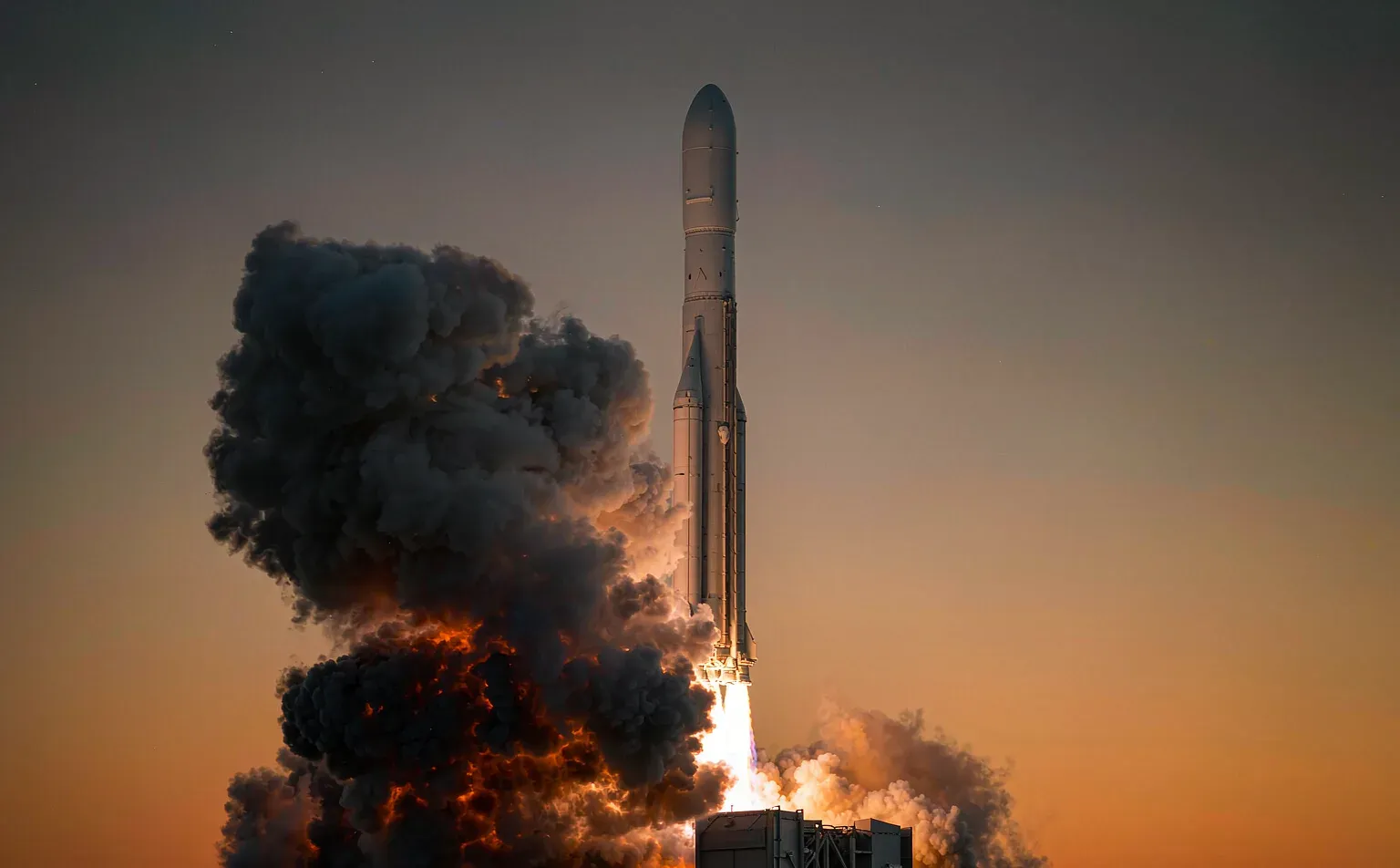
A rock wool blanket and a reentry heat shield both fight heat, yet they belong to different engineering worlds. The most common sourcing mistake in space-adjacent projects is treating thermal protection as a single materials category and reaching for the highest-temperature industrial product on the shelf. In reality, a launch-and-return mission is a chain of very different thermal environments — cryogenic ground hold, vibro-acoustic ascent, hypersonic flight, atmospheric reentry, and post-landing recovery — and each phase selects its own materials.
This guide maps industrial insulation families to that chain with an evidence-based discipline: what is directly proven, what is a space-grade derivative of an industrial material, and what is only a physical analogy. For the wider defense and launch context, start with our aerospace and defense thermal insulation overview.
Launch and Reentry Are Not One Thermal Problem
Ground operations and ascent already look nothing alike. On the pad, cryogenic propellant tanks and lines fight boil-off, condensation, frost and ice shedding under ambient pressure and weather; low-permeability aerogel composite blankets have outperformed sprayed foam in launch-environment simulations of upper-stage hydrogen tanks, which is a cryogenic duty — not a reentry qualification.
Ascent adds mechanical hostility: random vibration, acoustic fatigue, pressure fluctuation and plume impingement. The early failure mode of the Space Shuttle's flexible blanket insulation was stitching: seam threads broke, outer fabric fluttered and tore in the acoustic environment, and heavier stitching with stiffer outer fabric became the fix. Any fibrous insulation that cannot survive its stitching, enclosure and acoustic spectrum never gets to prove its thermal numbers.
Hypersonic and reentry phases add gas chemistry. At high enthalpy, surface catalytic recombination of dissociated air can push surface temperature well above a purely convective prediction, so coatings that control emissivity and catalycity decide whether the insulation beneath survives. And after touchdown, residual heat, water, salt, dust and handling shock make recovery a second life cycle that the design must also survive.
The Evidence Ladder: Four Levels of "Application"
The disciplined way to read any material claim is to assign it an evidence level:
- Direct flight application — the material, as manufactured, flew in a thermal protection role and was inspected after return.
- Space-grade derivative — an industrial fiber or aerogel chemically reworked for flight: higher purity, no combustible binder, space-specific coating, stitching and strain-isolation.
- Non-reentry space duty — real space use, but in cryogenic tanks, electronics bays or orbital thermal control, not the hot face.
- Analogy only — shared physics, no mission evidence.
Two cautions keep this ladder honest. First, a datasheet "maximum use temperature" can mean classification temperature, long-term rating, single-exposure limit or structural failure onset — these are not interchangeable. Second, published conductivity values shift enormously with pressure: flexible silica-fiber blanket data roughly doubles between atmospheric pressure and near-vacuum, so lining up numbers from different reports without their test conditions proves nothing.
Rock Wool and Glass Wool: Clear Boundaries
Stone wool is a centrifugally spun silicate fiber made from basaltic melt, and its weaknesses in launch service are chemical and systemic, not merely thermal. Alkali and iron impurities promote softening and crystallization near 1000 °C; moisture raises conductivity and freezes into interface loads; acoustic vibration pulverizes loose fiber into dust that can migrate into valves and electronics. No public program document shows industrial stone wool, as manufactured, serving as a reentry primary structure or windward surface. Its credible duties are ground facilities, propellant-line supports and non-hot-zone panels — with hydrophobicity, outgassing and vibration screening.
Glass wool tells a sharper story. Space Shuttle leeward surfaces flew a quilted ceramic blanket whose core was high-purity silica fiber sewn between glass fabrics — a flight-proven, formally mature system, yet by composition and process a space-grade product, not construction glass wool. The famous rigid tiles of the Shuttle windward side were about 94 percent air by volume and 99.9 percent pure silica fiber. Ordinary E-glass or building glass wool shares the oxide family, not the impurity control, binders or traceability. The honest verdict: borrowed physics, no direct flight evidence, superb derivatives already proven.
Ceramic Fiber: The Proven Bridge to Flight
Between industrial blankets and flight tiles sits a graded family of oxide fibers:
- Amorphous alumino-silicate fiber (industrial ceramic fiber) carries mid-hot zones near 1000 °C but devitrifies above roughly 950–1000 °C, so space derivatives control purity and binders tightly.
- Continuous alumino-borosilicate oxide fibers weave into high-temperature fabrics, seals, barrier textiles and micrometeoroid shielding; boron improves textile processing but volatilizes in hot, humid service, which caps where the uncoated fiber may sit.
- Mullite and polycrystalline alumina fibers raise crystalline stability; polycrystalline mullite needled blanket is rated near 1500 °C in industrial service — the closest industrial relative of space-grade oxide insulation, though flight derivatives strip combustible binders and add space-specific coatings. See our polycrystalline mullite fiberboard for the industrial form.
Flight-proven derivatives define the top of the ladder: rigid high-purity silica tiles reusable near 1260 °C on Shuttle windward areas; later fiber-reinforced tiles toughened with alumino-borosilicate fiber from 1981 onward; the flexible quilted blankets rated about 650 °C across vast leeward areas; and a toughened two-piece composite system — high-emissivity oxidation-resistant surface over fibrous insulation — proven on the U.S. Air Force's reusable space plane. The pattern is consistent: high-purity oxide fiber skeleton, engineered coating, strain-isolated attachment, inspect-and-repair lifecycle.
What turns an industrial fiber into a flight article is a documented conversion, not a rename. Purity is raised until alkali and iron impurities sit at trace levels; organic binders are replaced with colloidal oxide or sintered-node structures that cannot burn, outgas or slough; fiber diameter and shot content are controlled batch by batch; coatings are matched to emissivity, catalycity and oxidation targets; and every lot carries traceability from fiber to installed assembly. Industrial producers who already control melt chemistry, fiberization and shot content hold a genuine head start on that path — but the head start is an entry ticket, not an equivalency certificate.
Silica Aerogel: Cryogenic Champion, Not a Hot-Face Material
Silica aerogel wins on thermal physics: nanoscale pores below the mean free path of air suppress gas conduction, and a fragile skeleton suppresses solid conduction. That is why aerogel is the insulation of choice where every millimeter counts at low temperature — our nano aerogel insulation blanket page profiles the industrial form.
The flight record deserves careful splitting. NASA-funded fiber-reinforced flexible silica aerogel blanket flew on cryogenic hydrogen and oxygen umbilical hardware of an experimental single-stage-to-orbit demonstrator in 1996 — a launch-support cryogenic duty. Block aerogel with graphite opacifier insulated Mars rover electronics against roughly −20 to 90 °C surface conditions — thermal control, not reentry. Aerogel-loaded fibrous ceramic tiles that mimic vacuum-level conductivity at ambient pressure remain ground-validated concepts at low technology readiness. Meanwhile, pure silica aerogel sinters noticeably from about 600 °C and densifies near 1000 °C, and infrared transparency raises effective conductivity at temperature.
The engineering conclusion: put aerogel inside the temperature isotherm, backed by a ceramic-fiber load-bearing layer — never alone on the reentry hot face. For the family-level trade-off, see aerogel vs ceramic fiber at high temperature, and for tank insulation practice see cryogenic tank and LNG insulation.
When Insulation Is Not Enough: Ablators and Hot Structures
Above roughly a hundred watts per square centimeter of peak heat flux, the question changes from "how do we slow heat down" to "how do we spend surface material to carry energy away." Ablators — resin systems that pyrolyze, outgas, char and recede in a controlled way — carried the Apollo-era capsules and still carry the largest modern crew-capsule heat shield, a 5-meter-class ablator. Carbon/carbon and reinforced carbon-carbon protect leading edges; ceramic-matrix composites and refractory metals form hot structures; the toughened fibrous composite system proven on the reusable space plane shows how a high-emissivity cap plus fibrous insulation divides the labor.
A reusable vehicle therefore stacks functions: an oxidation-resistant, high-emissivity outer layer radiates heat back; a replaceable fibrous or aerogel composite core carries the temperature drop; strain-isolation pads decouple tile from aluminum structure; and the underlying airframe stays cold. Industrial insulation knows nothing about catalytic heating, receding surfaces or post-flight inspection — which is precisely why "same oxide family" is not "same material."
Selection Framework by Mission Phase
| Duty | Sensible route | Do not assume |
|---|---|---|
| Cryogenic tanks, lines, umbilicals | low-permeability fiber-reinforced aerogel blanket or closed-cell foam, hydrophobic, vibration-screened | a hot-face TPS rating covers cryogenic duty |
| Ground facilities, pad equipment | industrial stone wool, glass wool, calcium silicate per standard practice | flight traceability is needed here |
| Non-hot-zone avionics and panels | low-outgassing glass or ceramic fiber, secured against migration | bulk k-value decides; dust and fastening decide more |
| Leeward large-area surfaces | space-grade flexible silica-fiber blankets (proven about 650 °C) | industrial ceramic blanket is a drop-in equivalent |
| Windward mid-flux surfaces | rigid high-purity oxide tiles or toughened fiber composites (proven near 1260 °C) | one conductivity value replaces trajectory analysis |
| Leading edges, stagnation, deep-space return | ablators, carbon/carbon, CMC, refractory metals | any fibrous insulation substitutes |
This division of labor is why our propulsion coverage in aerospace thermal management for propulsion and our orbital-side notes in satellite and spacecraft thermal insulation read as different articles: nozzle and thruster insulation, orbital thermal control and reentry TPS share materials but never share duty statements.
Qualification: Testing Beyond the Datasheet
Flight thermal protection is qualified as a material-structure-trajectory system, not a coupon. A credible sequence braids environments instead of stacking separate passes: vacuum bakeout and outgassing, humidity cycling, cryogenic soak, acoustic and random vibration, then arc-jet or radiant heating, repeated, followed by post-test microscopy, porosity, chemistry and conductivity checks.
Every test type has a blind spot. Arc jets reproduce high-enthalpy heating but not full-scale pressure, transition, shear and noise; radiant lamps nail steady conductivity and cycling but miss catalysis and aero-shear; plasma tunnels are size-limited. Numerical modeling, material response tests, component tests and flight exposure must close the loop in sequence — and on-orbit exposure programs have shown even non-material failures, such as cracked multi-layer insulation after years in orbit, disabling an entire blanket.
Procurement teams can borrow one more habit from flight programs: write the acceptance envelope, not the favorite number. Specify conductivity at the temperatures and pressures the part will actually see, at three thicknesses and a minimum of two densities; record outgassing limits, hydrophobicity after thermal-wet aging, stitch pull-out values and post-vibration dust release. A supplier who can populate that table has the process control that space derivatives demand; a supplier who can only quote a room-temperature nameplate value has not yet entered the conversation.
Finally, treat reusability as data, not a slogan: record flight, component, environment, cycles and post-return inspection for every reuse. That lifecycle discipline — inspect, repair, requalify — is exactly what separates a flight insulation article from a warehouse roll, and it is the same mindset we apply to civil aviation blankets in aircraft nacelle and equipment-bay insulation.
Frequently asked
Can rock wool or glass wool be used on spacecraft reentry surfaces? +
No verifiable flight evidence shows industrial stone wool or construction glass wool serving as a reentry primary thermal structure. Their credible duties are ground facilities, cryogenic propellant support and non-hot-zone panels. Space-grade silica-fiber blankets and rigid tiles are chemically related derivatives with far higher purity, no combustible binder and flight-specific coatings, stitching and strain isolation.
What is the difference between ablative and reusable thermal protection? +
Ablators carry heat away by pyrolysis, outgassing and controlled surface recession, spending material on a single mission — typical for capsule heat shields and the highest heat fluxes. Reusable systems keep their surface: a high-emissivity, oxidation-resistant outer layer radiates heat while a fibrous tile or blanket core insulates, surviving many missions at moderate flux. They are selected by heat flux, pressure, duration and reuse requirement, not by temperature rating alone.
Why can't silica aerogel handle the reentry hot face by itself? +
Pure silica aerogel begins to sinter noticeably from about 600 °C and densifies near 1000 °C, its pore structure collapses, and infrared transparency raises effective conductivity at temperature. It is also brittle and needs encapsulation. Correct practice embeds aerogel inside the temperature isotherm, backed by a ceramic-fiber load-bearing layer, or uses it for cryogenic tanks and electronics-bay thermal control — roles in which it has real flight heritage.
Which thermal protection materials are actually flight-proven on reusable vehicles? +
The proven set includes rigid high-purity silica tiles reusable near 1260 °C on windward surfaces, fiber-reinforced toughened tiles flown since 1981, flexible quilted silica-fiber blankets rated about 650 °C across leeward areas, and a toughened two-piece composite system proven on an unmanned reusable space plane. All combine a high-purity oxide fiber skeleton with engineered coatings and strain-isolated attachment.
How are cryogenic propellant tanks insulated during launch operations? +
Ground and ascent cryogenic duty is managed with low-permeability, hydrophobic insulation such as fiber-reinforced silica aerogel blankets or closed-cell foams, screened for boil-down, condensation, ice shedding, vibration and outgassing. Simulations of upper-stage hydrogen tanks show aerogel composites outperforming sprayed foam under vacuum. This is launch-support insulation, distinct from any reentry hot-face material.
How is a thermal protection material qualified for flight? +
As a material-structure-trajectory system: vacuum bakeout and outgassing, humidity and thermal cycling, cryogenic soak, acoustic and random vibration, repeated arc-jet or radiant heating, then post-test microscopy, chemistry and conductivity verification. Each test type has blind spots — arc jets miss full-scale pressure and shear, radiant lamps miss catalysis — so modeling, component tests and flight exposure must close the loop, with inspect-repair-requalify discipline for reuse.
Request a quote
Interested in our insulation solutions? Send us your requirements and our team responds within one business day.