
Rock-Wool Density (kg/m3) Explained: The International Buyer's and Designer's Guide
Rock wool density (kg/m3) explained: what the number means, the kg/m3 to lb/ft3 conversion, and how to choose the right grade for blankets, boards and pipe sections.
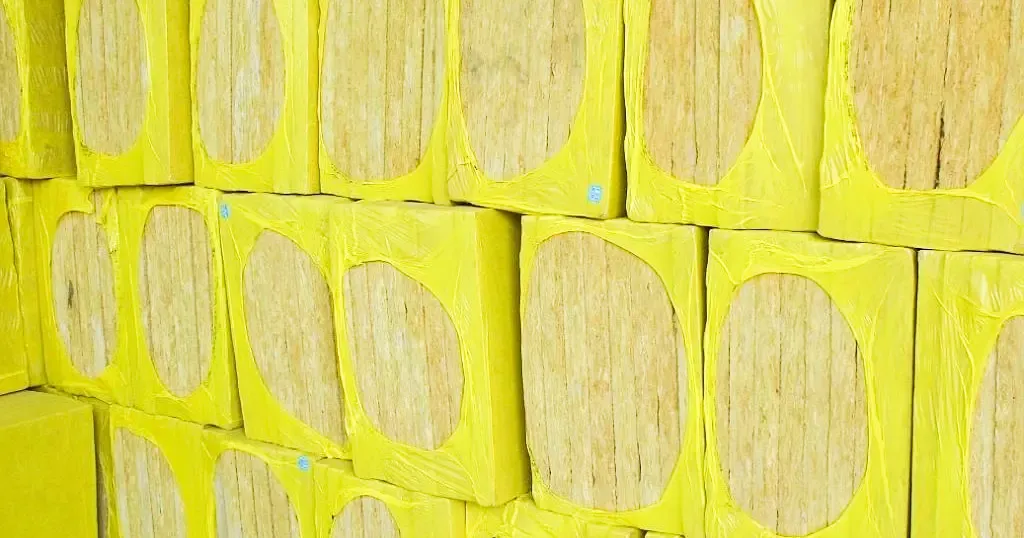
Executive summary: density is a manufacturing grade, not a universal performance score
Rock-wool density is mass per unit installed/product volume, usually declared in kilograms per cubic metre (kg/m³). It is a concise product identifier, not a standalone warranty of thermal, acoustic, fire or structural performance. A light building batt at 30 kg/m³ can carry a declared design conductivity of 0.032 W/(m·K), while a 100 kg/m³ board may be declared at 0.0364 W/(m·K) for a different job. Conversely, a 180 kg/m³ roofing board may be deliberately “worse” in tabular λ because it is engineered for permanent load, point load and system compatibility—not to win a thermal competition.
Three conclusions follow.
- Density is necessary but insufficient for selection. Treat it as a short-form grade, then verify the property that actually limits the design: λD and its temperature basis, compressive creep or point load, tensile strength, dimensional stability, sound-absorption spectrum, service temperature, fire-system approval and the current Declaration of Performance (DoP), ETA or equivalent project document.
- A1 is a material reaction-to-fire class, not a fire-resistance duration. Euroclass A1 under EN 13501-1 addresses how the product contributes to fire growth. A penetrated assembly, fire stop, curtain wall detail or loadbearing enclosure still needs its own tested system evidence.
- The “higher density = better insulation” rule is false. Heat moves through solid fiber, trapped air and radiation; adding solid can initially suppress convection and improve resilience, but beyond a product-specific microstructure it increases solid conduction and weight. Temperature, fiber diameter, shot content, binder, facing, porosity, thickness and compressive history can dominate the comparison.
For product-specific grades and availability, see our rock wool insulation overview. This guide uses international and European normative documents as the compliance frame, with ASTM routes described where they are materially different. Values are deliberately not offered as universal grades. They are identified as standard scopes, research measurements or manufacturer declarations, and are valid only for the product, thickness, condition and market cited.
1. Density is a volume-normalised mass claim—and the wrong volume changes the answer
The number on a datasheet is an apparent/product density tied to a test and conditioning state, not the loose fiber count you would obtain by shoveling rock wool into a box. Getting the definition right is the first quality-control step because blanket, board and pipe-shell products are handled, compressed and measured differently.
For a homogeneous-ish specimen, the arithmetic is simple:
[kg/m3]
In insulation practice, however, the result depends on what is meant by V. EN 13162:2012+A1:2015 covers factory-made mineral wool (MW) mats/blankets, boards and slabs for building thermal insulation. It specifies product characteristics, test procedures, conformity assessment and marking; it does not set the performance level needed for a particular wall, roof or fire detail. The related test route for apparent density is EN 1602. A German-language ÖKOBAUDAT EPD dataset likewise reports “bulk density according to DIN EN 1602” for a medium-density stone-wool portfolio at 61–120 kg/m³, with an average of 96 kg/m³ for the declared LCA unit. In this context “bulk density” is the product’s apparent density, not loose-fill bulk density.
| Term | What it means | Do not use it to mean… |
|---|---|---|
| Apparent / product density | Mass of the finished product or test specimen divided by its measured geometric volume, usually after conditioning | Loose, unconstrained pour density |
| Nominal density | Manufacturer’s named grade/target, often with a declared tolerance | A measured value for every pallet |
| Declared density | The value published for compliance, an EPD, DoP or tender, tied to a method and range | A universal physical constant |
| Package / ship-loose density | Mass in a package divided by the shipped carton or bale envelope, often including compression, film and air | Installed product density |
| Loose-fill / pour density | Material settled in a container without the finished-mat constraints | A bonded board or pre-formed pipe shell |
The distinction is operationally important. A roll may be factory-compressed for packaging, then recover to a larger installed thickness; a rigid board is supplied closer to its service geometry; a pipe shell has a curved segment volume and a slit. If a buyer compares “kg/m³ from the bale label” with “kg/m³ from a 200 × 200 mm laboratory coupon,” the apparent disagreement may be a definition mismatch rather than a quality problem.
Density tolerance is a commercial and verification matter, not an invention of this article. A UK/European fire-protection rock mineral wool EPD declares 70 kg/m³ ±10% under EN 1602 for its declared product. A supplier data sheet for a Chinese-sourced pipe product states “apparent density 100–140 kg/m³” and a bulk-density tolerance of ±10% under a different procurement specification. These are product declarations, not proof that ±10% is mandated by EN 13162 or EN 14303. Specify the tolerance, test method, sampling plan, conditioning, facing exclusion (if relevant) and whether the volume is installed or as-supplied in the purchasing document.
kg/m³ ↔ lb/ft³: use the conversion, not a rounded folklore factor
The exact conversion is:
[kg/m3]
Divide lb/ft³ by 0.0624280 (or multiply by 16.0185) to return to kg/m³. The table below keeps four significant figures in the converted value because a single decimal place in lb/ft³ can otherwise shift a procurement bracket.
| kg/m³ | lb/ft³ | Typical use of the row |
|---|---|---|
| 20 | 1.249 | Very light mat / low-density product family lower bound reported in an EPD context |
| 30 | 1.873 | Light building batt reference product in a Nordic EPD |
| 40 | 2.497 | Low-to-mid cavity/blanket grade |
| 50 | 3.121 | Light industrial blanket / building transition grade |
| 60 | 3.746 | Flexible-to-self-supporting transition |
| 70 | 4.370 | Mid-density fire/thermal product declaration |
| 80 | 4.994 | General board / pipe-shell transition grade |
| 100 | 6.243 | Rigid board / high-duty mat family |
| 120 | 7.491 | Board, high-density pipe shell, industrial duty |
| 140 | 8.739 | Industrial/structural-duty family |
| 150 | 9.364 | High-density research specimen / heavy board family |
| 180 | 11.239 | Heavy roofing-board example |
| 200 | 12.486 | Upper end of some marketed board ranges, not a global limit |
Conversion: 1 kg/m³ = 0.062428 lb/ft³; rounded to three decimal places. Density rows are illustrative international grade markers, not an EN or ASTM approved ladder.
2. Product forms trade density for different things—and the standard routes diverge
Blankets/rolls, boards and pipe shells should not be selected from one ladder. They fail differently. A blanket must recover and stay put; a board must carry declared load without creeping; a pipe shell must fit, resist hot-load shrinkage and accommodate its cladding system.
Blankets and rolls: resilience and fit first, stiffness second
A rock wool blanket or roll is a flexible or semi-rigid mat, usually supplied unfaced or with a facing, wire mesh, foil or tissue depending on the system. EN 13162 includes mats/blankets, boards and slabs for building thermal insulation, but excludes in-situ products and products for building equipment/industrial installations. For industrial flexible mats, mesh-covered blankets and large-diameter blanket-type pipe insulation, ASTM C592 is the relevant North American specification family; its current active edition is ASTM C592-24. The historical C592-13 scope covers mineral-fiber blankets and blanket-type pipe insulation, typically on large diameters, and explicitly says it does not provide the performance requirements of hourly-rated fire systems.
Light grades are attractive where there is no superimposed load, handling robustness matters more than rigidity, and a friction/framing fit holds the layer. But “light” is not an instruction to specify the flimsiest roll available. Verify recovery after packaging, thickness tolerance, facing tear resistance, and tensile strength parallel to the faces for long rolls or vertical cavities. EN 13162 determines the latter by EN 1608; the standard family’s handling principle is that the product must be strong enough to support twice the weight of the full-size item in the relevant test context.
Boards and slabs: density is a structural proxy, not the structural certificate
Rock wool board is the form where buyers most often substitute density for engineering. A higher grade often does mean a stiffer cure, better edge handling and more resistance to indentation—but the purchasing question is kPa at a stated deformation, thickness, duration and temperature, not kg/m³ alone.
EN 826 provides compressive stress/strength measurement; EN 13162’s declaration ladder uses stress at 10% deformation (σ10) or compressive strength. EN 1606 addresses compressive creep, which is often the better question for a flat roof than a single instantaneous strength number. EN 1607 and EN 1608 cover tensile strength perpendicular and parallel to faces, while EN 12430 addresses point load. An EOTA assessment route reproduced below makes the separation explicit: each property is tested and stated in kPa or millimetres, not inferred from density.
A useful real-world counterexample: a published flat-roof board with a nominal 180 kg/m³ carries a declared λ of 0.040 W/(m·K) at 20 °C, yet is marketed for permanent load and impact duty because it declares >80 kPa at 10% deformation, >700 N point load at 5 mm deformation and >7.5 kPa delamination strength. It would be foolish to call it thermally inferior to a 30 kg/m³ batt. They solve different boundary conditions.
Pipe sections and industrial mats: the declared temperature curve matters more than the nameplate density
Rock wool pipe sections are a geometry, not a magical material class. Their density helps control recovery, handling and resistance to sagging, but the service question is a package of maximum surface temperature, linear shrinkage, thermal conductivity at temperature, jacketing compatibility, chloride/corrosion behavior and the joint/direction-of-fiber detail.
EN 14303:2016 is the European specification for factory-made MW products for building equipment and industrial installations, covering rolls, boards, slabs, mats, felts, quilts, wired mats, lamella mats, bevelled lags and pipe sections, at approximately 0–800 °C. It explicitly excludes in-situ material, building-structure insulation and direct airborne-sound/impact-transmission claims. ASTM C612, by contrast, covers semi-rigid and rigid mineral-fiber board for surfaces from -18 to 982 °C, but excludes fabricated pipe and tank wrap whose fibers are oriented perpendicular to the face. The two standards are not interchangeable “pipe insulation standards.”
| Form | Density’s main job | What must outrank density | Relevant standard family |
|---|---|---|---|
| Blanket / roll | Recovery, drape, fit, handling and cavity fill | λ basis, tensile parallel to faces, recovery, facing, installed thickness | EN 13162 (buildings); EN 14303 / ASTM C592 (industrial mats/blankets) |
| Board / slab | Rigidity, creep resistance, point-load and system build | σ10, creep, point load, tensile, dimensional stability, fire-system approval | EN 13162; EN 14303; ASTM C612 |
| Pipe section | Shape retention, hot-load stability, joint tightness | λ(T), max service temp, linear shrinkage, cladding/jacket, corrosion | EN 14303; ASTM C592 for blanket-type; C612 explicitly not fabricated pipe wrap |
3. The λ–density curve is real only inside one controlled microstructure
Thermal conductivity does not belong on a single density axis. It is an apparent transport property of a fiber–air–binder system, and the first error is to compare values at different mean temperatures, thicknesses or facing conditions.
What “λ25” should mean—and why the notation is often abused
Designers write “λ25” as shorthand for thermal conductivity evaluated at a mean temperature near 25 °C. That is useful, but not enough. A defensible schedule states:
- mean temperature (for example 10 °C, 24 °C, 50 °C or the actual service mean);
- test method (EN 12667, EN 12939, ISO 8301, ASTM C518, C335 etc. as applicable);
- product thickness and facing;
- whether the value is declared design conductivity λD or a measured laboratory result;
- whether the temperature is the insulation mean, hot-face temperature or service rating.
EN 13162’s building-product scope excludes products with declared thermal resistance below 0.25 m²K/W or declared conductivity above 0.060 W/(m·K) at 10 °C. This is a scope boundary, not a statement that all stone wool is ≤0.060 at every temperature. Industrial pipe products are routinely declared at higher values as mean temperature rises.
“First falls, then rises” is a ceteris-paribus statement
In a simplified fibrous mat, reducing excessive void space can suppress air movement and improve the stagnant-air structure, while further adding fiber increases solid-phase conduction and reduces the very pores that do the insulating work. That is the physical basis for a U-shaped conductivity-versus-density curve. But the curve is family-specific: shot content, fiber fineness, binder distribution, degree of cure, anisotropy, facings and prior compression can each move the result.
. Sources: Refs , , , . Conditions are not identical; the figure is a warning against causal ranking, not a design curve.*
The controlled study behind the plotted research points is particularly instructive. It measured four stone-wools at roughly 20 °C with densities of 36.8 ± 1.2, 60.7 ± 1.2, 105.1 ± 2.4 and 153.6 ± 6.8 kg/m³; the reported conductivities were 0.037, 0.033, 0.041 and 0.040 W/(m·K respectively. The sequence is not monotonic. A 60 kg/m³ sample outperformed both a lighter and two heavier materials in that experiment. It would be invalid to generalise that “60 is optimal”: the same work notes that density was calculated from the actual specimen mass and volume, and depended on compression during measurement. Different binders, fiber architectures and testing conditions could reorder the series.
Representative numbers are condition statements, not a buyer’s menu
| Bracket | Example declared/measured condition | What it does not prove |
|---|---|---|
| Low density, approx. 20–40 kg/m³ | 30 kg/m³ batt, λD 0.032 W/(m·K) at the EPD’s declared reference; 37 mm for R = 1 m²K/W | That every 30 kg/m³ product is 0.032, or that it can carry traffic |
| Light-to-mid blanket | 36.8 kg/m³ research specimen, λ ≈ 0.037 W/(m·K) at ~20 °C | A universal optimum or an installed λ warranty |
| Mid density | 70 kg/m³ fire/thermal product, λD 0.037 at 10 °C in an EPD | That 70 is a fire-rating threshold |
| Mid-to-high board | 100 kg/m³ board, λD 0.0364 W/(m·K) | That boards need density to be thermally competitive |
| High board | 180 kg/m³ roofing board, λ 0.040 W/(m·K) at 20 °C, but >80 kPa at 10% deformation | That higher λ makes it a worse choice |
The right design move is to separate thermal thickness from structural grade. Choose λ(T) and thickness to meet U-value/R-value, then choose the lowest density that satisfies handling, load, fire-system and dimensional constraints. If a lighter approved product meets all those constraints, it usually saves dead load and material. If the assembly needs a tested fire barrier, traffic load or a heavy cladding rail pattern, do not downgrade merely to chase a slightly lower λ number.
Temperature changes λ far more predictably than a one-digit density guess
Industrial pipe and equipment selections must use a temperature-dependent declaration. The figure below plots one supplier’s declared values for three pipe-shell grades across 50–300 °C. All three start at the same declared 0.039 W/(m·K) at 50 °C, then diverge with temperature and product construction. This is supplier data, not an independent inter-product experiment, but it demonstrates why a “λ25” value is unusable for a 250 °C line.
Figure 2: Declared λ versus temperature for pipe-shell grades nominal 110, 120 and 140 kg/m³. Source: supplier technical data ; declarations, not a controlled same-microstructure density study.
A separate pipe-product data set declares 110/120/140 kg/m³ shells with 0.039 W/(m·K) at 50 °C, 0.044 at 100 °C, roughly 0.050–0.053 at 150 °C, 0.058–0.065 at 200 °C and 0.078–0.094 at 300 °C, with a 650 °C maximum service temperature claim under its stated test regime. The correct procurement clause is therefore: “Declare λ at project mean temperature and at hot/cold extremes; provide method, thickness and facing. Do not extrapolate from λ25.”
4. Mechanical performance: density is a screening signal, declared test values are the specification
A heavier board often feels stronger because it usually is more heavily cured or structured—but a project cannot be signed off on that impression. Mechanical performance is directional, time-dependent and sensitive to thickness, moisture history and temperature.
Compression, point load and creep are different questions
For a walkable or trafficked flat roof, the instantaneous stress at 10% deformation is only a start. Creep under permanent load determines whether the insulation slowly loses thickness and R-value. EN 1606 is the relevant route; EN 13162’s dimensional-stability assessment uses EN 1604 under selected temperature/humidity exposures rather than a generic compression test.
The 180 kg/m³ flat-roof example is a model of how to read a datasheet: it publishes a density grade and >80 kPa at 10% deformation, >700 N point load at 5 mm and >7.5 kPa delamination strength. A 100 kg/m³ board with a better declared σ10 and creep curve may be the superior roofing choice; a 200 kg/m³ board with a poorer facing bond or no approved fixing pattern may not.
Tensile strength is not interchangeable with compressive strength
- Tensile perpendicular to faces (EN 1607) matters for bonding, facing adhesion, and sometimes pull-out of the product from a system.
- Tensile parallel to faces (EN 1608) matters for handling long boards or rolls and for certain cavity/membrane interactions.
- Compressive stress (EN 826) matters for superimposed loads.
- Point load (EN 12430) matters for localized forces such as foot traffic, rails or concentrated details.
An EOTA assessment document for factory-made mats specifies that these are separately tested and separately stated in kPa or load, reinforcing that density is not a substitute for any of them. Even within one form, thickness can change the result: a thin veneer and a 200 mm slab do not have the same buckling, facing or load distribution behavior.
Wind, vibration and settlement are system-level, not “high density, done”
Wind uplift and facade pressure. A dense board may improve local rigidity, but the assembly needs tested fixings, substrate strength, seam/joint layout, membrane or cladding interaction and, where applicable, an approved system. EN 13162 specifies the product; it does not establish the wind-load capacity of a façade. Specify design pressure, exposure, building height, substrate, fixing pattern and the relevant system approval. Then choose the lightest product that meets those constraints.
Vibration and acoustic-mounted plant. Density can add mass and alter damping, but vibration isolation is a path-of-force problem. A heavy mat placed directly on a vibrating casing can simply transmit more force. Check the source frequency, isolation mounts, casing resonance, pipe clamps, jacket continuity and the tested build-up. For industrial blankets on large equipment, C592 itself requires agreement on actual temperature limits and does not certify a fire-resistance system.
Settlement and cavity slump. Mineral wool does not “flow” like loose fill when it is properly bonded and dimensioned, but a too-light, poorly recovered or oversized piece can slump, bridge incompletely, or compress under its own weight in a deep void. Defence is a combination of correct friction/fit, segmentation, mesh or wire where specified, vertical cavity restraints, and dimensional-stability evidence at service temperature—not a blanket order for maximum density.
5. Acoustics: density tunes flow resistivity; thickness, air gap and spectrum do the heavy lifting
NRC is a single-number summary, not a promise about low-frequency control. Rock wool is a porous absorber (the same physics is covered in our glass wool acoustic insulation guide): sound energy makes air oscillate in the tortuous fiber network, and viscous/thermal losses convert part of it to heat. Density influences that process by changing flow resistivity, but so do fiber diameter, shot, binder, porosity, facing, thickness and the cavity behind it.
Why “higher NRC” can still fail a bass problem
NRC is usually the arithmetic mean of sound-absorption coefficients at 250, 500, 1000 and 2000 Hz (exact calculation and mounting must be checked for the cited test). It is useful for comparing products in a stated mounting, but it deliberately says little about 63–125 Hz control. A thin, dense panel may look excellent in a Sabine/NRC summary while doing little for plant hum, HVAC rumble or flanking low-frequency noise.
A small impedance-tube study compared stone wool at 80 and 120 kg/m³ in 25 and 50 mm thicknesses, with and without air gaps. Its key finding was not “120 wins”: impedance and absorption shifted with thickness and air gap, and the effects on impedance were unlike the effects on absorption across frequency. Another study’s abstract reports that density effects were frequency-dependent, including a reversal around 630 Hz for one thickness. These are limited laboratory studies, not a product-rating system—but they are exactly the evidence needed to reject a crude density rule.
A selection workflow that survives real rooms and pipes
| Design target | First lever | Density’s role | Verify with |
|---|---|---|---|
| General office/ceiling reverberation | 50–100 mm absorbent layer + air cavity where possible | Mid grades often balance recovery and workable flow resistivity; do not maximise blindly | ISO 354 absorption spectrum, stated mounting/class |
| Wall cavity, speech-band privacy | Thickness, continuity, resilient layers and mass layers | Fill density must avoid voids without crushing/resilience loss | Full spectrum α / project sound-model, not NRC alone |
| Low-frequency plant/HVAC | Depth and air gap; tuned resonant system if required | May need a specific porous structure, not just “heavier” | 63–250 Hz data, impedance where relevant |
| Pipe/noise enclosure | Wrap continuity, jacket mass, decoupling, stand-off | Dense mat can help durability/mass but may stiffen or transmit | System insertion-loss / transmission-loss data |
| High-temperature plant room | Service-temperature stability and cladding | Density alone does not assure hot-dimensions or corrosion control | λ(T), shrinkage, jacket/corrosion and acoustic tests at condition |
A product/family datasheet that quotes “NRC ≈ 0.85” is only actionable if it also states mounting, thickness, frequency curve, test method and whether the facing was present. For procurement, ask for the absorption coefficient curve, not the NRC alone. If the controlling complaint is a 63–125 Hz tone, ask for that band or a tested enclosure insertion loss; an NRC number is not an adequate answer. The same density-versus-acoustics trade-off applies to data center server room insulation, where rooftop AHU noise and structural dead load both depend on the chosen grade.
6. Fire: A1 comes from non-combustible composition; density buys geometry retention, not the class
Euroclass A1 is not purchased by ordering a denser board. It is a reaction-to-fire classification for a product or material under EN 13501-1, based on non-combustibility and calorific-input criteria. Within the European route, A1 classification of mineral wool relies on its predominantly inorganic nature (see our guide to non-combustible A1 insulation systems) and limited organic content; the classification does not automatically reappear for an arbitrary composite, facing, adhesive, jacket or installed assembly.
EN 13501-1 is the classification standard; for A1, the underlying test routes include EN ISO 1182 (non-combustibility) and EN ISO 1716 (gross heat of combustion), with smoke and droplet subcategories applying to lower Euroclasses. A UK product EPD for a 70 kg/m³ rock mineral wool fire product declares A1 under EN 13501-1 and gives fiber melting point ≥1000 °C under DIN 4102-17 for the declared fiber. That pairing must be kept distinct:
- ≥1000 °C fiber melt / softening characteristic is a material property relevant to thermal exposure.
- A1 is a reaction-to-fire classification.
- EI xx, REI xx, A60 or other duration ratings are assembly/system fire-resistance results.
Where density actually matters in fire engineering
In a penetration seal, cavity barrier, fire curtain detail or loadbearing partition, the insulation may need to stay in place, retain its thickness, resist hot gas flow and support a facing or fill a defined opening. A denser, more dimensionally stable grade can help meet those system requirements. But density cannot substitute for:
- the tested penetration-firestop system and its permitted insulation;
- the cavity-barrier detailing and fixings;
- the cladding/substrate/fixing combination;
- the required integrity, insulation and, where applicable, loadbearing performance;
- the actual project authority having jurisdiction.
ASTM C612 says plainly that it “does not purport to provide the performance requirements of hourly-rated fire systems.” So does ASTM C592. That is not cautionary boilerplate; it is a boundary between material specification and systems fire engineering.
7. Weight, logistics and structural load are linear—until packaging makes them nonlinear
Density converts directly to dead load only after you define the volume honestly. For a homogeneous installed board of thickness t in metres, the product-only mass per square metre is ρ × t. A 100 kg/m³ board at 50 mm is 5 kg/m² of product; at 100 mm it is 10 kg/m²; a 180 kg/m³ board at 50 mm is 9 kg/m². This simple arithmetic is why “use the densest option” has a real structural penalty on large roofs, tall façades, soffits and suspended services.
But shipping weight is not merely ρ × installed volume:
- rolls may be compressed into smaller bales;
- boards have film, banding, corner protection and pallets;
- pipe shells ship in shorter segments with air and packaging;
- facings, wire mesh and jackets add mass and may dominate a thin product;
- a lighter product that needs extra fixings, mesh or a thicker layer may be heavier overall.
Procurement should compare kg of delivered system per m² or per linear metre of pipe, not kg/m³ alone. Include the supporting structure in the budget. For roofs and soffits, add live load, ponding, snow/wind where relevant, and the permanent creep case. For façades, coordinate with cladding dead load and fixing schedules. For pipe racks, remember that insulation mass grows with diameter and thickness, and that repeated thermal cycling plus vibration can matter more than the static number.
8. Scenario-to-density guidance: use these as engineering start points, not a shortcut
Typical duty settings span building insulation, power-generation equipment and petrochemical plants. The table below translates duty into a density screen, then forces the real specification back onto declared performance and approvals. The numerical brackets deliberately describe families observed in public declarations and research, not an EN-mandated schedule. Availability, exact λ, strength and fire documentation vary by country, factory and product generation.
| Scenario | Useful density screen | Why that screen, not the number itself | Mandatory verification |
|---|---|---|---|
| Unloaded horizontal roof, loose-laid flexible blanket/cold build | Low: approx. 20–50 kg/m³ family where the system allows | Minimises dead load; thermal layer needs recovery and continuous fit, not traffic strength | λD at stated mean temp; thickness; recovery; water/dimension stability; wind/uplift system |
| Light stud wall / cavity infill | Low–mid: approx. 30–70 kg/m³ family | Acoustic/thermal fill with handling resilience; avoid over-stiffening assumptions | Full α spectrum, cavity detailing, fire/Acoustic system approval, facing |
| Rainscreen / ventilated façade board | Mid: approx. 70–120 kg/m³ family typical screening range | Needs shape retention, fixing compatibility and often fire detailing | EN 13162 declarations, fixings, wind-load test, fire-system DoP/ETA |
| Trafficked / ballasted flat roof | Mid–high: often 100–180 kg/m³ family | Creep, point load and delamination dominate; a heavy board can be justified | σ10 (EN 826), creep (EN 1606), point load (EN 12430), approved roof build-up |
| Pipe shell, building plant, moderate temperature | Mid: approx. 80–140 kg/m³ family | Segment stability, install fit and hot-load behavior; density is secondary to λ(T) | λ at operating mean, max temp, shrinkage, jacket, chloride/corrosion, EN 14303 family |
| High-temperature equipment / industrial mat | Often mid–high, but chemistry/structure-specific | High temp can demand a different fiber/binder/cure; density is not a temperature rating | Supplier temp curve, EN ISO 18097 route where applicable, C411/C356-type evidence in procurement, jacket |
| Fire board / cavity barrier / penetration support | Often mid–high, system-dependent | Retention, thickness and facing/joint behavior can matter more than A1 | Approved fire-system report/certificate, permitted substitutions, installation details |
| High wind, vibration or suspended heavy cladding | Choose the lowest density that meets the tested system | Mass alone can worsen resonance/load; tested connection geometry is decisive | Wind/fatigue/vibration test report, fixing schedule, deflection and load path |
A worked example: the same R-value does not imply the same roof
Suppose a design needs a certain thermal resistance and two options are tabled:
- Option A: 30 kg/m³ batt, λD 0.032 W/(m·K) in the cited building-product declaration.
- Option B: 180 kg/m³ roofing board, λ 0.040 W/(m·K) at 20 °C, with >80 kPa at 10% deformation and >700 N point load.
Option A needs less material mass per millimetre and may be ideal where the membrane and substrate provide the load path. Option B needs more thickness for the same R-value, but may be required where the project’s tested assembly, maintenance traffic, point-load or long-term creep demand rules out a light batt. Specifying by density alone picks the wrong winner in one of those two buildings.
9. Standards map: what each document promises—and what it does not
Standards define scope, test conditions and conformity language; they do not eliminate the need to read the product’s actual declaration. Treat the following as the minimum compliance checklist for cross-market work.
| Document | Formal subject / role | Important boundary for density buyers |
|---|---|---|
| EN 13162:2012+A1:2015 | Thermal insulation products for buildings — Factory made mineral wool (MW) products — Specification | Mats, boards and slabs for building thermal insulation; describes characteristics, testing, conformity and marking. Does not set the performance required for a specific application, nor cover in-situ or industrial plant insulation. |
| EN 14303:2016 | Thermal insulation products for building equipment and industrial installations — Factory made MW products — Specification | Rolls, boards, slabs, mats, wired mats, lamella mats, lags and pipe sections for plant/industrial use; approx. 0–800 °C scope. Excludes acoustic transmission claims and in-situ products. |
| EN 1602 | Determination of apparent density of thermal-insulating products | Method/family for the reported product density; not a tolerance prescription by itself. |
| EN 1604 | Dimensional stability under specified temperature and humidity | Exposes specimens to selected climate/temperature conditions; stability class and project condition still matter. |
| EN 826 | Compressive stress/strength | Basis for σ10 or compressive strength declarations; never infer from kg/m³. |
| EN 1606 | Compressive creep | Essential for permanent roof/load cases; instantaneous strength is not a substitute. |
| EN 1607 / EN 1608 | Tensile strength perpendicular / parallel to faces | Different failure modes; parallel strength supports handling, perpendicular supports bonding/facing behavior. |
| EN 12430 | Point load | Localised indentation case; important for foot traffic and localized build-ups. |
| EN 13501-1 | Reaction to fire classification (Euroclasses) | A1 is product reaction to fire; not EI/REI duration, not a system fire-resistance certificate. |
| ISO 29767:2019 | Thermal insulating products — Determination of short-term water absorption by partial immersion | Despite the number sometimes being misremembered as a density standard, it is a water-absorption test. Do not cite it for apparent density. |
| ASTM C612 (current C612-25) | Mineral Fiber Block and Board Thermal Insulation | Semi-rigid/rigid rock, slag or glass fiber board for -18 to 982 °C surfaces; class/category system includes temperature and compressive categories. Excludes fabricated pipe/tank wrap. |
| ASTM C592-24 / historical C592-13 | Mineral Fiber Blanket Insulation and Blanket-Type Pipe Insulation (Metal-Mesh Covered) (Industrial Type) | Blankets and large-diameter blanket-type pipe insulation; not an hourly fire-system performance spec. |
DoP, ETA and the “same product name” trap
A Declaration of Performance is a product-specific conformity document under the applicable market regime; an ETA is a European Technical Assessment for a product not fully covered by a harmonised standard or using an alternative route. Either may cite densities, λD, strength classes, fire class and permitted uses. A marketing name such as “Fire Board 100” is not enough for a global project because:
- the factory and region may have different formulations or facing options;
- the declared λ may be at a different mean temperature;
- the thickness you need may not be stocked;
- the local fire approval may be for an assembly, not the bare board;
- the UK, EU, North American, Middle Eastern and Asian specifications may call up different test methods;
- a ±10% density tolerance may be a product statement, not a universal default.
The only safe substitution rule is: same manufacturer, same product identity, same manufacturing source, same thickness/facing, same declared performance and same approval scope—or a documented, approved substitution. “Same color and name” is not that rule.
10. Common myths, corrected in one place
Myth 1: “Higher kg/m³ always means lower λ.”
False. The 36.8–153.6 kg/m³ research series measured 0.037 → 0.033 → 0.041 → 0.040 W/(m·K), not a monotonic decline. Use λ at the actual mean temperature.
Myth 2: “A1 means the wall is fire-rated for 60 minutes.”
False. A1 describes the product’s reaction to fire under EN 13501-1. A cavity barrier, partition or penetration needs a system-level fire-resistance test/report and permitted installation.
Myth 3: “Density is the compressive strength.”
False. Density screens the family; σ10 (kPa), compressive creep, point load and thickness determine the duty. EN 13162/ETA declarations separate these properties.
Myth 4: “A dense board is always better for sound.”
False. Porous absorption depends on thickness, flow resistivity, cavity and frequency. A high-density, thin product may reflect low frequencies rather than absorb them; ask for the curve and test mounting.
Myth 5: “λ25 is close enough for a 300 °C pipe.”
False for industrial work. Supplier pipe-shell declarations show λ climbing from 0.039 W/(m·K) at 50 °C to around 0.078–0.094 at 300 °C for the presented grades. Use λ(T).
Myth 6: “The package says 100 kg/m³, so the installed mat is 100 kg/m³.”
Not necessarily. Packaged bale density includes compression and package geometry. Require apparent density by EN 1602 (or the contract method), conditioning, facing treatment and tolerance.
Myth 7: “All rock wool melts at exactly the same temperature.”
Unsafe. Public declarations commonly state fiber melting point ≥1000 °C under a cited method, but product chemistry, binder, facing and test method differ. The fiber property is not an operating-temperature rating and not a fire-duration rating.
Myth 8: “If it’s stone wool, it can replace any firestop material.”
No. A firestop is an assembled, tested detail with fill, backing, sealants, boards, fixings and geometry. Material A1 status is necessary in some systems, but never sufficient by itself.
11. Procurement and design specification you can actually send to a supplier
Use this clause skeleton and delete what is not applicable:
Provide the exact product identity, manufacturing plant and market, with current DoP / ETA or equivalent conformity document and test reports. State apparent density in kg/m³, test method (for example EN 1602), conditioning, facing inclusion/exclusion, declared tolerance and whether the value is nominal, average or a lot-limit. Do not substitute package density.
State thermal conductivity as a declared value at the project mean temperature, with method, thickness, facing and, for industrial service, a λ-versus-temperature table or curve. For building envelopes, state λD basis and thermal resistance. For pipe/plant, state maximum continuous and excursion temperatures, linear shrinkage and recommended jacket.
State mechanical performance by test, not by density analogy: compressive stress at 10% deformation (EN 826), compressive creep (EN 1606) with load/duration/temperature, point load (EN 12430), tensile perpendicular (EN 1607) and parallel (EN 1608) to faces as relevant. Provide dimensional-stability condition and result (EN 1604 family).
State reaction to fire as Euroclass under EN 13501-1, including report/product scope, and separately provide the tested assembly/firestop/cavity-barrier approval if a duration or system performance is required. For North America or dual-markets, state applicable ASTM C612/C592 classification and any relevant local fire test, without implying equivalence where none exists.
For acoustics, provide the frequency-dependent sound-absorption coefficient and mounting/class per the cited test; report NRC only as a derived value. For low-frequency control, provide data below 250 Hz or system insertion-loss/transmission-loss evidence.
Confirm mass per m² at supplied thickness, palletised shipping dimensions/mass, facing and fixing requirements. Designer will verify structural dead load, wind, thermal bridging, vapour/moisture strategy, corrosion compatibility and local code.
A compact internal decision sequence is:
- What fails first? Heat, load, fire, acoustics, wind, vibration or logistics?
- What is the actual test condition? Mean temperature, load duration, frequency, exposure and assembly.
- Which product declaration matches that condition? Not just the same name.
- What is the lightest/finest-grade solution that passes? Avoid paying for unused mechanical capacity.
- Is there a system approval? If yes, do not reformulate the detail from first principles.
13. Glossary
Apparent density. Mass of a product specimen divided by its geometric volume under the stated conditioning and measurement rules; the relevant family for these products is EN 1602.
Batt / blanket. A flexible or semi-rigid mat, generally supplied in rolls or slabs, used for cavities, roofs, linings and industrial wraps.
Board / slab. A cured, more dimensionally stable form, supplied in flat pieces, used where handling, shape retention or load resistance matters.
Declaration of Performance (DoP). The document linking a specific construction product to its declared characteristics under the applicable market conformity framework.
Dimensional stability. The capacity to stay within declared length, width, thickness and shape limits after a specified exposure; tested via routes such as EN 1604.
ETA (European Technical Assessment). A technical assessment of a product’s fitness for the declared use where the harmonised standard route does not fully cover it.
Flow resistivity. A porous-material property relating pressure drop to air-flow velocity; it helps explain acoustic behavior, but density is only a rough proxy for it.
Lambda (λ), thermal conductivity. The material transport coefficient, W/(m·K); lower is better all else equal. Always check mean temperature and method.
λD. Declared thermal conductivity in the product conformity/sales context; not necessarily identical to every laboratory measurement.
NRC (Noise Reduction Coefficient). A single-number summary derived from sound-absorption coefficients, typically across 250–2000 Hz bands; not a low-frequency guarantee.
Package density. Mass divided by the shipped package envelope; not automatically the installed apparent density.
Point load. Localised force resistance, relevant to foot traffic and concentrated build-up loads (EN 12430 family).
Reaction to fire. How a product contributes to fire development and spread (EN 13501-1 Euroclasses), distinct from fire resistance of an assembly.
Service temperature. The temperature an insulation product is declared to withstand in the intended orientation, load and cladding condition; not inferable from fiber melting point.
Thermal resistance, R. Thickness divided by conductivity for a homogeneous layer (d/λ), commonly m²K/W; the building-performance figure that matters for U-value.
Thermal inertia / thermal mass. Not the same as insulation. Density alone says little about the assembly’s effective heat capacity or time lag.
Frequently asked
What is a "normal" rock-wool density? +
There is no single normal. Public building-product declarations cover roughly 20-200 kg/m3 as a broad market observation, with low-density batts near 30 kg/m3, mid grades near 70-100 kg/m3 and heavy roofing/fire-duty boards extending higher. This is a catalogue of families, not an allowed band.
Is 100 kg/m3 automatically a board? +
No. Form, binder, cure and facing determine board behavior; 100 kg/m3 products appear in boards, dense blankets and pipe shells. Check the product form and mechanical declarations.
Can I convert a US lb/ft3 datasheet to kg/m3 by dividing by 16? +
Use 1 lb/ft3 = 16.0185 kg/m3, or multiply kg/m3 by 0.062428. "Divide by 16" is a field approximation, not a procurement-grade conversion.
Does a denser product always resist settling better? +
Often, but not reliably enough to specify blind. Check dimensional stability, recovery, product geometry, cavity restraints and installation. A well-fitted lighter mat can outperform a poorly installed heavy one.
Will a high-density pipe shell stop fire longer? +
Not by itself. Firestop performance belongs to the assembled, tested penetration or compartment detail. The shell's A1 status, service temperature, shrinkage and compatibility are inputs - not the duration certificate.
How much does a 50 mm board add to the roof? +
Product-only mass = density x 0.05 m. At 100 kg/m3 that is 5 kg/m2; at 180 kg/m3 it is 9 kg/m2. Then add facings, membranes, fixings, drainage and safety factors. Never use the pallet's shipping volume to calculate this.
Request a quote
Interested in our insulation solutions? Send us your requirements and our team responds within one business day.