
Green Building Insulation Materials Guide: Selection, Standards and Specification
A specifier's guide to green insulation: compare materials by assembly U, temperature-dependent k, fire tests, embodied carbon and code — then specify by performance, not brand.
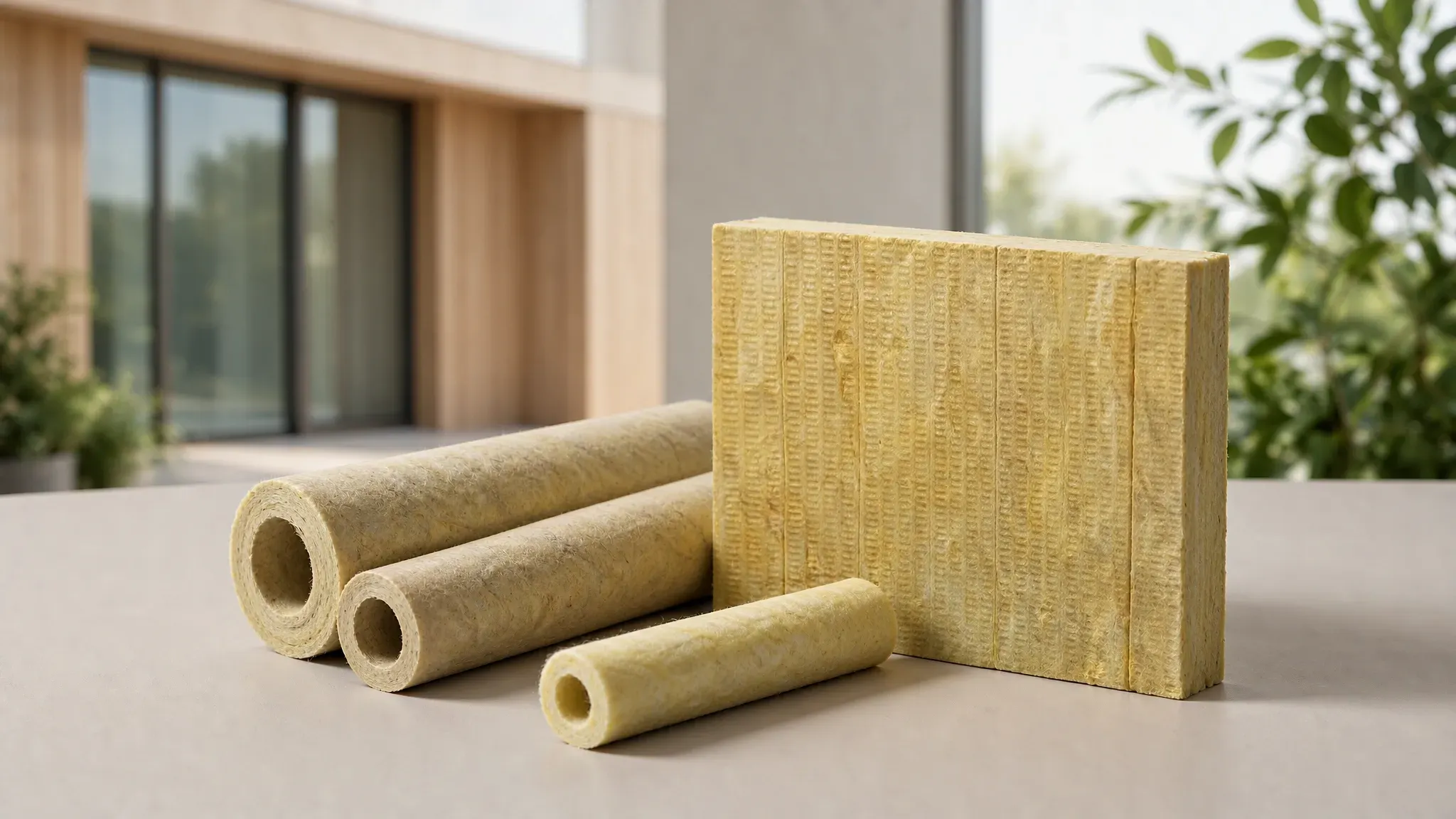
Quick answer: Green insulation is not one R-value. It is a six-way decision — operational energy, embodied carbon, indoor air quality, fire and life safety, durability and acoustics — evaluated at the assembly level, not from a product cut sheet. R-value per inch is a material property at a stated mean temperature; wall performance is an assembly property. Climate, thermal bridging, moisture, facing and installation sit between them. This guide maps the full material landscape, then goes deeper on four inorganic, noncombustible families — rock wool, glass wool, ceramic fiber and calcium silicate — specified by temperature-dependent k, ASTM type and grade, and installation controls.
Key Takeaways
- "Green" is a six-way intersection. Operational energy (effective assembly U, with continuous insulation counted only where continuous), embodied carbon (compare Type III EPDs at one functional unit), indoor air quality, fire and life safety, durability and acoustics. No single dimension licenses "zero carbon", "100% recyclable", "zero VOC", "non-toxic" or "fireproof".
- k is comparable only at the same mean temperature and test method. Request the temperature–k curve (C518/C177 flat stock, C335 pipe, C201/C1114 high temperature, C1363 assemblies), not one ambient figure. R/in @75°F (24°C) is a reference-point planning value.
- The two wools are a division of labour, not a ranking. Mineral wool wins on service temperature, cladding-line stiffness and tested fire/smoke profiles; glass wool on low weight, cavity economics and HVAC. Neither is "better" in the abstract.
- Four fire tests are not interchangeable. E136 is a small-specimen material test, E84 an interior-finish flame-spread/smoke test, E119 an assembly containment/integrity/load test (explicitly not smoke or toxic gas), and NFPA 285 an exterior-wall assembly evaluation. "E136 noncombustible" does not mean the wall passes NFPA 285.
- Specify generic name, standard and performance — not a brand. Ask for ASTM type/grade, density and thickness, mean-temperature k, R/in @75°F, maximum service temperature, E136, E84 with facing, NRC with mounting, sorption/permeance, compressive strength with method and strain, shrinkage, EPD number and functional unit, emissions scope, SDS revision and third-party report number.
What "Green" Actually Means for Insulation
Green is a six-way intersection: operational energy (effective assembly U; continuous insulation counts only where continuous), embodied carbon (EPA: extraction, transport, manufacturing; compare Type III EPDs at one functional unit), indoor air quality (CDPH v1.2-2017 chamber data plus installation exposure), fire and life safety (four distinct tests below), durability (long-term R, stability, moisture, repairability) and acoustics (NRC is a material test, STC an assembly result). No single dimension licenses "zero carbon", "100% recyclable", "zero VOC", "non-toxic" or "fireproof".
The Full Material Map: Performance by Application, Not by Hype
Typical planning ranges at the ASTM 75°F (24°C) reference point unless noted; k and R move with mean temperature, density, thickness, facing and age.
| Material (generic name) | R/in @75°F; k at mean temp | Fits | Constraints |
|---|---|---|---|
| EPS / XPS | R-3.6–4.2 / R-4.5–5.0 nominal | roofs, below grade, foundations | water, solvents, aged R |
| Polyiso / PIR | R-5.6–6.5; 0.022–0.026 W/(m·K) ambient | thin low-slope roofs, exterior ci | low-temperature thermal drift |
| Spray foam | R-3.5–3.7 open / R-6.0–7.0 closed | air sealing, irregular cavities | applicator skill, cure, combustible |
| Cellulose | R-3.2–3.8 (settled thickness) | attics, dense-pack retrofit | settling, moisture, fire treatment |
| Glass wool | R-2.2–4.3; 0.032–0.038 W/(m·K) @24–38°C | cavities, attics, ducts | compression, gaps, facing permeance |
| Mineral wool board / batt | R-3.8–4.3; 0.033–0.040 W/(m·K) @20–24°C | exterior ci, safing, acoustics | density, cutting dust, hot-face binders |
Foam plastics earn their place: polyiso leads on ambient R per inch where roof height is fixed, XPS carries foundation loads, EPS holds R at low temperatures, and spray foam merges insulation, air sealing and vapour control. Their combustibility, barriers, ageing and end-of-life separation belong in the same paragraph. Fibers trade thickness for vapour openness and acoustics; cellulose is specified on settled thickness. Bio-based batts (R-3.0–4.2) are hygroscopic; cellular glass (R-2.5–2.9), aerogel (~R-10) and VIP (~R-25–40 centre) are niche tools.
One rule governs the table: k is comparable only at the same mean temperature and test method — C518/C177 (flat stock), C335 (pipe), C201/C1114 (high temperature), C1363 (assemblies). Request the temperature–k curve, not one ambient figure.
Four Inorganic Materials in Detail
Rock wool / stone wool — the continuous-insulation and fire-detail workhorse
Typical λ is 0.033–0.040 W/(m·K) at 20–24°C mean; a representative 96 kg/m³ (6 pcf) board lists R-4.2 per inch at 75°F (C518) — a product value, not a class constant. Unfaced products commonly report E84 flame spread 0 / smoke developed 0–5 and E136 noncombustibility at 750°C; facings change E84 and permeance, so declare faced/unfaced. NRC 0.90–1.15 at 50–100 mm (C423, Type A mounting); low-frequency absorption stays weak. Hydrophobic but vapour-permeable; a weather-resistive barrier, air barrier and drainage still manage water. The near-1000°C melting point is a material property, not the continuous service limit set by the C612 type and the manufacturer's listing; hot-face binder behaviour needs documented heat-up guidance. See our rock wool board for a product example.
Glass wool / fiberglass — low weight, cavity fill and HVAC
Building-grade λ is 0.032–0.038 W/(m·K) at 24–38°C; R-2.2–4.3 per inch spans loose-fill (low end) to dense board (high end). C665, C553 and C547 cover building blankets, elevated-temperature glass blankets and mineral fiber pipe respectively. Low weight and installed cost per R win in framed cavities, attics and duct liners; the trade-offs are compression, joint gaps, airflow bypass and facing permeance (from tens of perms to near zero), plus C795/C692/C871 for stainless contact. The two wools are a division of labour, not a ranking: one wins on weight and cavity economics, the other on service temperature, cladding-line stiffness and tested fire and smoke profiles. See our glass wool board.
Ceramic fiber — high-temperature linings and complex geometries
Ceramic fiber is a refractory lining, not a fifth wall batt. ASTM C892 covers blankets to 3000°F (1649°C), classifying type and grade by mean-temperature k, tensile strength, linear shrinkage (C356) and shot content (C1335). Typical λ is roughly 0.12–0.22 W/(m·K) at 500–600°C mean and rises steeply with temperature, so an ambient value cannot size a 1000°C lining. Specify classification temperature, k curve, shrinkage, shot content and density (commonly 64–192 kg/m³), then design from heat flux and hot-/cold-face temperatures, not R per inch. Classification temperature is not the continuous service limit. Blankets are flexible and low-mass but not load-bearing, lose value when wetted, and require a site safety plan: follow current OSHA/NIOSH/ACGIH guidance and the SDS, since classification systems differ.
Calcium silicate — rigid, load-capable backup for hot surfaces
Calcium silicate is the rigid, load-capable backup to that blanket. ASTM C533 covers Type I (649°C / 1200°F), Type IA (649°C) and Type II (927°C / 1700°F) block and pipe, with density ceilings, ≥100 psi (688 kPa) compressive strength at 5% deformation, ≥50 psi flexural strength and ≤2% linear shrinkage after heat soak. Conductivity is temperature-dependent: a representative Type I product rises from ~0.050 W/(m·K) at 38°C mean to 0.093 at 371°C; Type II from 0.078 at 93°C to 0.111 at 538°C. Density buys temperature capability and strength, not lower k. Store dry, jacket and heat up gradually; saturated material can generate steam pressure. C533 excludes ceramic fiber, mineral wool, perlite and high-density structural or fire-rated boards. See our calcium silicate insulation board and the calcium silicate buyer's guide.
Specify all four by: generic name; ASTM type/grade; density and thickness; k at a stated mean temperature; R/in @75°F; maximum service temperature; E136; E84 FS/SD with facing; NRC with mounting; sorption and permeance; compressive strength with method and strain; shrinkage; EPD number and functional unit; emissions certificate scope; SDS revision; third-party report number.
Standards That Actually Apply (and the Ones That Do Not)
| Scale | Test | What it proves |
|---|---|---|
| Material | E136 (750°C furnace) | small-specimen noncombustibility; not laminates, smoke or assemblies |
| Interior finish | E84 / UL 723 | flame spread and smoke, with facing, thickness, mounting declared |
| Assembly | E119 | containment, integrity, load; explicitly not smoke or toxic gas |
| Exterior wall | NFPA 285 + 2024 IBC | assembly behaviour via tested assembly, listing or approved analysis |
Penetrations and joints need UL 1479 / E814, UL 2079 and E2307 listings. Other methods: C518/C177, C335, C201/C1114, C1363, E96, C423, C165, C356 and C795/C692/C871.
Energy codes. ASHRAE 90.1-2025 updated opaque-envelope insulation, rigid board installation and effective U treatment of interrupted ci, with clear-field, linear and point thermal bridges. IECC 2024 offers prescriptive, U-factor and performance paths (commercial ducts R-6 unconditioned, R-8 outdoors Zones 0–4, R-12 Zones 5–8). Use the adopted edition, zone and construction class; "R-13 + R-7.5 ci" is one prescriptive case, not a national rule.
Rating systems. LEED certifies projects, not products. LEED v4.1 BD+C EPD Option 1 needs 20 permanently installed products from five manufacturers, a product-specific Type III EPD counting as 1.5, up to two points; Low-Emitting Materials covers insulation inside the waterproofing membrane, generally excluding duct, pipe and exterior insulation. LEED v5 merges EPDs, sourcing and ingredients into a multi-attribute path — confirm the registration version, current credit language and USGBC deadlines.
Emissions. GREENGUARD (UL 2821) is a chamber VOC programme, Gold aligned to CDPH v1.2-2017 — not a fire or ingredient certification; cite certificate number, scope and expiry. Third-party R-value certification covers fiberglass and mineral wool batts and polyiso roof insulation only.
Organic Foams vs Inorganic Fiber and Calcium Silicate: A Two-Sided View
| Dimension | Inorganic fiber / calcium silicate | Foam plastics |
|---|---|---|
| Fire | E136 noncombustible; yet E136 ≠ E84 ≠ E119 ≠ NFPA 285, and facings and assemblies decide | usable in tested assemblies with thermal/ignition barriers; combustible substrate under IBC 2603, NFPA 275 and 285 |
| Emissions | low-emitting matrix, verified by certificate; binders, facings and site chemicals still emit | mature cured formulations; isocyanate exposure and cure-dependent emissions during installation |
| Carbon, recycling | verified recycled content available; melting is energy-intensive, "recyclable" ≠ "recycled at end of life" | low volumetric impact, strong operational savings; blowing-agent GWP, laminate separation and local recovery vary |
Durability cuts both ways: inorganic boards are rigid and non-settling, but wetted ceramic fiber loses value and dust needs PPE; SPF gives a continuous air barrier, yet diffusion, polyiso drift, cellulose settling and joint bridges are real. Compare embodied carbon at one functional unit: a 2021 review of 156 EPDs reports roughly 0.6–1.2 kgCO₂e for glass wool, 1.4–4.2 for stone wool and 1.9–3.5 for EPS per 1 m² at R = 1 m²·K/W over 50 years — literature ranges, not product guarantees. Match declared unit, boundary and impact categories; never compare kgCO₂e per m³.
How to Specify: A Four-Step Method
- Define the assembly. Element, IECC zone (including Marine 4/5), construction class, and cavity / exterior / below-grade / hot-surface position.
- Set requirements, not product names. Effective U with thermal bridges; fire path (E136 / E84 / E119 / NFPA 285 / firestop); low-emitting target; NRC with mounting; vapour profile with WRB and air barrier.
- Compare on equal terms. Request mean-temperature k curves, current TDS, Type III EPD, SDS and listings; separate faced/unfaced data; price access, PPE, cure and hot-work alongside material cost.
- Close with the AHJ. Confirm adopted code edition, LEED version, assembly report number and certificate expiry before submittal.
For a structured overview of board, panel, tile and sheet forms, see insulation boards: types and selection.
Where Each Material Fits
Mineral wool board suits exterior ci and high-rise façades where an NFPA 285 report governs; mineral wool and glass wool serve partitions, safing and penetrations under UL 1479 / E814 and UL 2079. Cavities and attics take glass wool, rock wool, cellulose or SPF, checked against installed density and air sealing. Below grade checks compressive strength, drainage and foam-plastic barriers; ducts, pipes and hot vessels are specified under C547/C553/C533/C892 with duct R-values and C795. Thin retrofits check VIP puncture and edge bridging. In Zones 5–8, cavity fill plus exterior ci is common, with mineral wool where a tested noncombustible assembly is required. The Green Building & Retrofit application covers the project contexts in which these choices are made.
Installation, Durability and Indoor Air Quality
Cutting fibers generates respirable dust: use the SDS, PPE and wet collection. Spray foam needs certified applicators and ventilation through cure; VIPs must never be cut. Calcium silicate and ceramic fiber stay dry and follow a heat-up schedule. Unfaced mineral wool is hydrophobic yet vapour-open — coordinate permeance with the WRB. Verify EPDs, certificates and listings at handover.
Common Myths and Greenwashing Claims to Avoid
- "R-6 per inch is greener than R-4.2 per inch." Only assembly U, service life, carbon, fire safety and maintainability settle that; polyiso needs temperature-dependent data, with no universal derating factor.
- "E136 noncombustible means the wall passes NFPA 285" / "E119 means no smoke". E136 is material-scale and E119 explicitly excludes smoke and toxic gas; the exterior wall needs an assembly report, listing or approved analysis.
- "Mineral wool is waterproof" / "high recycled content means recyclable". It is water-repellent and vapour-open, not waterproof; recycled content and end-of-life recovery are separate claims.
- "LEED-certified insulation" / "thicker is always better". LEED certifies buildings, so write "contributes to LEED v4.1/v5 materials credits, subject to scope, version and documentation"; dew-point position, slab-edge bridges, access and cost bound thickness.
References and Verification Notes
Confirm the edition adopted by the AHJ and read current ASTM tables (C612/C547, C533, C892). Key sources: ASHRAE 90.1; ASTM; 2024 IECC/IBC; NFPA 285; USGBC LEED credits and deadlines; UL 2821/723/1479/2079; US EPA; PIMA; NAIMA R-Value Certification FAQs; Grazieschi et al. (2021), Cleaner Environmental Systems; plus current TDS, Type III EPD, SDS, emissions certificate and test reports.
All numeric ranges here are planning values, not warranties, not specification values, and not a claim that any product is certified under a particular rating system.
Frequently asked
What R-value per inch should I specify?
Start from the assembly U required by the adopted energy code, then work back through thermal bridging and mean temperature; quote R/in at 75°F with product, density and thickness named.
Is rock wool better than fiberglass?
No — it is a division of labour. Rock wool suits higher service temperature, cladding-line stiffness, fire safing and exterior continuous insulation; glass wool suits low weight, cavities, attics and HVAC. Neither is universally better.
Does ASTM E136 mean my wall complies with NFPA 285?
No. E136 is a 750°C small-specimen material test; a wall with combustible components is evaluated as an assembly under NFPA 285 via a tested assembly, listing or approved analysis.
Can polyiso be used in cold climates?
Yes, but obtain the manufacturer's mean-temperature k/R curve and ageing data; the 75°F nominal value is not a winter design value and low-temperature thermal drift must be accounted for.
When should calcium silicate be chosen over ceramic fiber?
Choose calcium silicate for a rigid, load-capable, low-shrinkage backup layer; ceramic fiber blanket for flexible linings, irregular geometry and low thermal mass. Specify both by temperature-dependent k, not a single ambient value.
Request a quote
Interested in our insulation solutions? Send us your requirements and our team responds within one business day.