
Rock Wool Raw Materials and Manufacturing Process: A Technical Study
A technical study of rock wool raw materials — basalt, industrial slag, binders — and the six-stage manufacturing process, quality control and eco-friendly recycling routes.
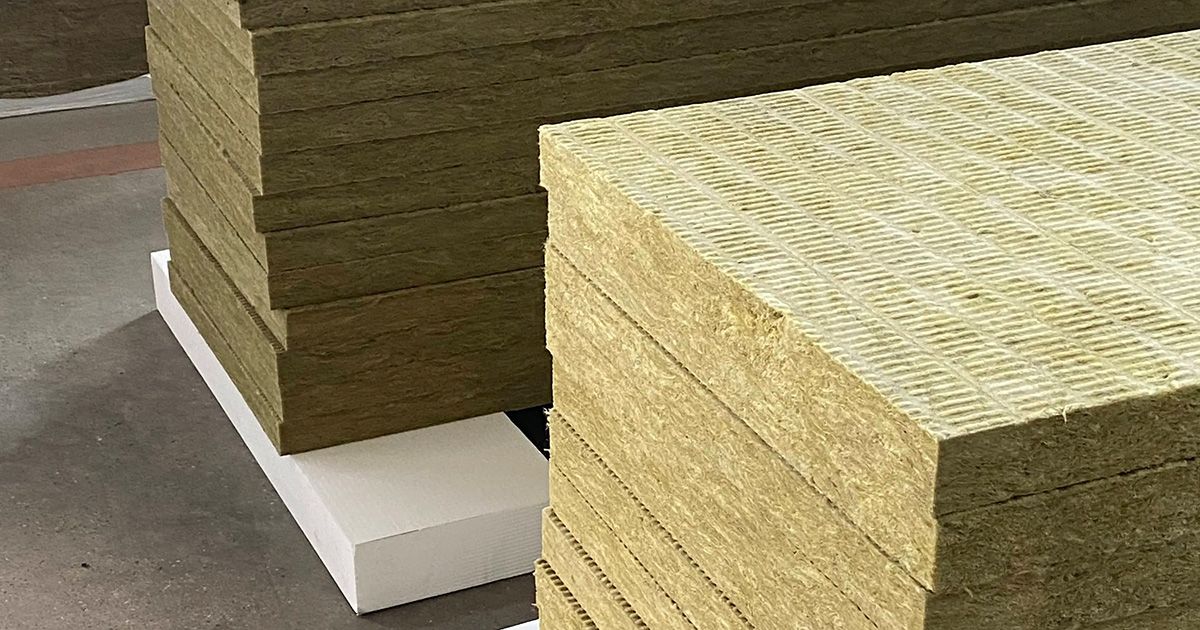
Introduction
Rock wool (rockwool) is a key industrial thermal insulation material valued for its fire resistance, thermal performance and environmental profile. It is widely used in buildings, industry, marine and agriculture. This article examines the raw material composition, the full manufacturing workflow, the key process parameters that govern quality, and the eco-friendly production routes built on industrial waste recycling.
1. Raw Material Composition and Proportions
Primary raw materials
- Basalt — 60–70% of the mix. Typical chemistry: SiO₂ ~46%, CaO ~28%, Al₂O₃ ~15.6%, MgO 7–10%.
- Dolomite / limestone — 10–25%, used to adjust the acidity coefficient and the melt temperature. Chemistry: CaO ~50–52%, MgO 10–12%.
Auxiliary materials
- Coke — 10–23%, acting as both fuel and flux to supply the heat for high-temperature melting.
- Binder — phenolic resin at 5–8% of dry fiber in conventional production; modified phenolic or inorganic binders at 1–4% in eco grades.
- Water repellent — 0.5–3%; silane-based agents (commercially available BS-series products) at about 1.5–2.5 kg per ton of rock wool.
- Silane coupling agent — 0.3–0.8%, improving the fiber–binder interfacial bond and raising bending, internal-bond and tensile strength.
- Flame retardant — 30–40% in fire-rated grades, mainly surface-modified alumina trihydrate and zinc borate, to extend the fire-resistance limit.
Solid-waste utilization (eco rock wool)
- Blast-furnace slag can replace basalt by up to 40–45%.
- Fly ash at 5–10%.
- Recycled rock wool recovery exceeds 85% after crushing and screening, then goes straight back into the furnace.
- A representative eco recipe (parts): rock wool waste 40–45, basalt 35–42, limestone 4–6, coke 14–17, binder 1–4. This cuts reliance on natural minerals and lowers process carbon emissions, supporting China's dual-carbon strategy.
2. The Manufacturing Process (Six Stages)
- Raw material preparation — crush basalt and dolomite to 10–30 mm, blend to the target ratio, screen, and dry to moisture ≤1%. Target chemistry: SiO₂ 40–50%, Al₂O₃ 15–25%, CaO+MgO 20–30%, Fe₂O₃ ≤10%.
- High-temperature melting — cupola furnaces run at 1450–1500°C under slight positive pressure (0.05–0.1 MPa); all-electric furnaces run at 1600–2000°C with ±5°C control and cut energy use by more than 40% per ton.
- Centrifugal fiberization — a four-roll spinner at 7000–15000 r/min draws the melt into fibers 3–7 μm in diameter (about one tenth of a human hair). Shot (non-fibrous particles) is held at ≤7%.
- Binder & repellent application — a spray system at 0.2–0.3 MPa atomizes the binder and water repellent uniformly onto the fiber surface.
- Forming & laying — suction draws the fiber onto a collection belt (50–100 mm mat, width up to 2200 mm, line speed 50–120 m/min); a pendulum lays multi-layer folds with CV ≤3.5%.
- Curing & cutting — temperature gradient 180–200°C (inlet) / 220–240°C (middle) / 150–170°C (outlet), 30–45 min; slabs cut to standard sizes such as 1200×600×50 mm; final moisture ≤1% before shipment.
3. Key Process Parameters and Quality Control
- Melting: basalt 1450–1500°C, slag 1300–1400°C, control precision ±5–10°C.
- Fiberization: spinner speed 3000–15000 r/min (each +1000 r/min trims fiber diameter ~0.5–1 μm); melt viscosity 0.3–0.7 Pa·s; acidity coefficient MK = (SiO₂+Al₂O₃)/(CaO+MgO) ≥1.6, typically 1.8–2.2.
- Curing: gradient as above, 30–45 min, curing oven 120–150 m long.
- Physical control: density ±8%; tensile strength ≥7.5 kPa (high-density up to 15.2 kPa); compressive ≥40 kPa (up to 77.6 kPa).
- Chemical control: MK ≥1.8; shot ≤7%; water repellency ≥98%.
- Eco control: thermal conductivity ≤0.040 W/(m·K); all-electric melting reduces CO₂ by about 400 kg per ton.
- Smart QC: online monitoring of temperature/pressure/CO, AI visual inspection of mat uniformity, 100% online waste re-melt, and VFD control that tunes fan flow to density.
4. Eco-Friendly Production and Waste Recycling
- Slag pretreatment — crush to ≤10 mm, adjust MK to 1.4–1.8 and viscosity to 1–3 Pa·s, nitrogen stirring for homogeneity.
- Recycled rock wool — recovery ≥85%, particle size 20–50 mm, metal impurities removed.
- Incineration fly ash — low-temperature pyrolysis (<500°C) decomposes dioxins by >99%; water washing holds chloride <2%; salts (NaCl, KCl) are recovered.
- Re-melt flow — recycled slag 88–92% blended with basalt 5–12%, conveyed to the furnace and co-melted.
- Challenges & solutions — impurity control via XRF (Fe₂O₃ ≤10%); melt-temperature control via oxy-fuel combustion at 1300–1400°C; fiber-stability control via molecular simulation and a melt-composition database.
- Market & policy — used in external wall insulation, fire barriers, industrial equipment, pipe insulation, marine and agricultural (soilless) cultivation; national standards require waste utilization ≥85% and define eco rock wool technical指标, with recycling subsidies available.
5. Conclusion and Outlook
Basalt and dolomite remain the backbone of conventional rock wool, while industrial-waste recycling defines the eco-friendly direction. Product quality is decided by melting temperature (1450–1500°C), spinner speed (7000–15000 r/min), fiber diameter (3–7 μm) and the curing gradient. Quality control ultimately comes down to physical (density, tensile, compressive), chemical (acidity coefficient, shot, water repellency) and environmental (thermal conductivity, organic release, carbon) properties meeting industry standards.
Looking ahead, rock wool production will move toward higher waste ratios (over 60%), smarter manufacturing (AI inspection, online monitoring), greener energy (electric furnaces replacing cupolas), more diversified products (high-density, ultra-fine, functional surfaces) and a full circular-economy loop of produce–use–recover–reuse.
Related Reading
Frequently asked
What is rock wool made of? +
Primarily basalt (60–70%) with dolomite or limestone (10–25%) and coke (10–23%) as flux and fuel. Binders, water repellents and coupling agents complete the recipe. Eco grades replace up to 45% of the basalt with industrial slag and recycle more than 85% of production waste.
What temperature is used to melt rock wool? +
Cupola furnaces run at 1450–1500°C, while all-electric furnaces operate at 1600–2000°C with ±5°C control. Electric melting also cuts energy use by more than 40% per ton and reduces CO₂ emissions by roughly 400 kg per ton.
How fine are rock wool fibers? +
High-speed centrifugal spinners (7000–15000 r/min) produce fibers 3–7 μm in diameter — about one tenth the thickness of a human hair. Non-fibrous shot is held at or below 7% to protect product quality.
Request a quote
Interested in our insulation solutions? Send us your requirements and our team responds within one business day.