
Rock Wool Pipe Production: How Rock Wool Pipe Sections Are Made
Rock wool pipe production flow: raw basalt, melt at 1500–1600 °C, centrifugal fiberization, three-dimensional forming, curing, and cutting — and what to verify when sourcing a producer.
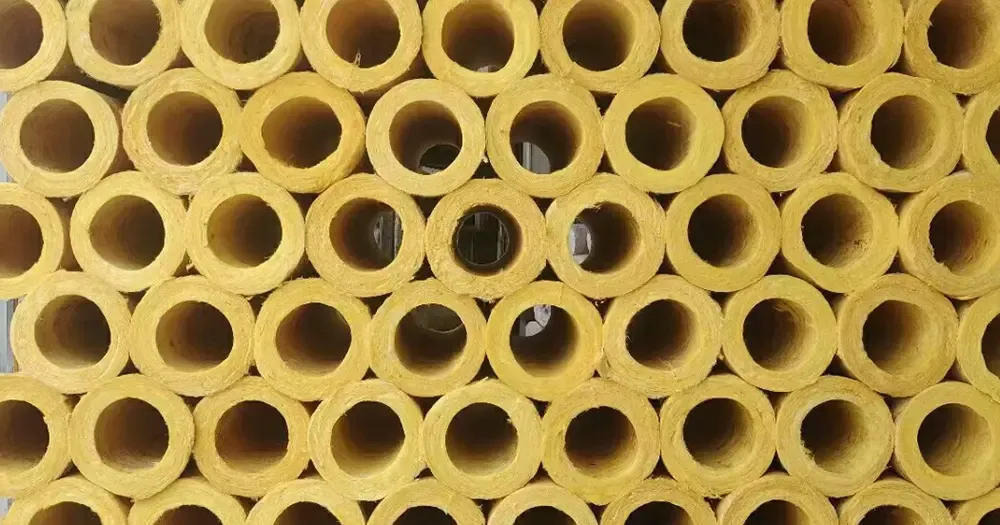
Every rock wool pipe section you order — for steam mains, petrochemical lines or HVAC risers — starts the same way: basalt, dolomite and a little recycled slag go into an electric furnace, melt into a 1500–1600 °C liquid, then leave as a thin stream that a four-roller centrifuge breaks into fibres. From there, binder, forming, curing and packaging decide whether the section you receive is a precision shell or a piece of felt in pipe shape.
This guide walks through the production flow that actually determines pipe-section quality — raw material control, melt consistency, fibre geometry, binder chemistry, three-dimensional vs pendulum vs sedimentation forming, curing profile, and the testing that proves each lot. It is written for procurement teams that need to ask informed questions when sourcing a producer, and for plant engineers who want to know why one supplier's pipe section feels stiffer, cuts cleaner or holds its shape longer than another.
For the spec-level selection side — density class, binder grade, two-temperature window, A1 non-combustible and what to install on site — see our rock wool pipe insulation specs and selection guide.
Raw Materials: Basalt, Slag, and the Acidity Coefficient
The first thing that determines a rock wool pipe section's quality is what goes into the furnace. The standard recipe mix is basalt at 60–70 %, with dolomite and a little recycled slag making up the balance; the acidity coefficient — silica + alumina divided by lime + magnesia — is held at or above 1.6 to keep the fibre chemically stable at temperature. Sub-acid blends slump above 650 °C and are easy to spot in a hot-face failure.
Raw material preparation is mostly grinding, screening and weighing: ore is crushed to a particle size below 5 mm so the furnace melts it evenly; moisture is held below 0.5 % to avoid steam explosions at the melt surface; and a V-type blender ensures the recipe mix stays consistent from batch to batch. Variations in the recipe show up weeks later, when sections begin to crack or slump on hot pipes — never blame the binder first; check the chemistry.
For the deeper raw-material story, including recycled-stream handling and trace-element control, see our rock wool raw materials and manufacturing process guide.
High-Temperature Melt: Electric Furnaces Win
A modern rock wool pipe line uses an electric furnace, not a cupola. The reason is control. An electric furnace holds melt temperature within ±1 °C using PID feedback; a cupola drifts within ±5 °C. Both work, yet the electric furnace keeps melt viscosity stable, which keeps fibre diameter stable — and stable fibre diameter is the single biggest predictor of a consistent section.
The melt zone runs at 1500–1600 °C, with melt time around 30–60 minutes and melt fluidity (a standardised flow test) targeted at 0.8–1.2 seconds. A good line has a chlorine-ion control on the feed so finished fibres stay below 10 mg/kg of chloride — important if the section will be mounted on austenitic stainless pipework, where moisture plus chloride is a stress-corrosion-cracking recipe.
When you visit a producer, the melt area is the first place to look. A clean furnace with continuous temperature logging and a fixed schedule is a different operation from a leaky cupola with manual gates — even if the fibre section that comes out looks identical.
Centrifugal Fibre Formation: Spinning the Wool
The melt flows through a stream nozzle into a four-roller centrifuge. Primary rollers spin at roughly 2500–3000 rpm; the final roller runs at 7000–8000 rpm. Combined, they pull the melt into filaments with a target diameter of 4–7 μm — fine enough to trap air for low thermal conductivity, coarse enough to be mechanically stable. A laser scanner on the production line measures fibre diameter online; a deviation beyond about ±0.5 μm is the first warning that the binder will not bond evenly through the section's depth.
Fibre uniformity is what separates a good pipe section from a great one. A laser or X-ray uniformity check on the loose mat before forming gives a single-point density tolerance inside ±5 % — that tolerance carries through to the finished section's thermal performance. If a producer cannot tell you their fibre diameter and uniformity numbers on the production line, they are not measuring them.
Resin binder is sprayed onto the fibre stream at 3–5 % of finished weight; for hydrophobic grades, a silicone water-repellent is added at 0.5–1 %. Slag ball content — the un-fibrised droplets — is held below 12 % above 0.25 mm particle size by a vibrating screen at the bottom of the fibre collector. Slag balls reduce thermal conductivity and increase weight without contributing to insulation value.
Forming: Sedimentation, Pendulum, and Three-Dimensional
Once the fibre mat lands, the next choice decides whether the section will live on a steam line or only inside a wall cavity. Three methods are used commercially:
| Method | Fibre orientation | Density tolerance | Compressive strength | Slag content | Typical use |
|---|---|---|---|---|---|
| Sedimentation | Planar (horizontal layers) | ±10 % | ≤ 40 kPa | ≥ 10 % | Low-density pipe sections, light commercial |
| Pendulum | Partly vertical (woven layers) | ±5 % | ≥ 80 kPa | ≤ 10 % | Medium-density pipe sections, general industrial |
| Three-dimensional (3D) | Multi-axis, interlocked | ±3 % | ≥ 120 kPa | ≤ 7 % | High-density, high-temperature pipe sections |
Three-dimensional forming rotates fibre layers by up to ±30° between passes, producing an interlocked structure that resists vibration and hot-face erosion. If you are buying rock wool pipe sections for high-temperature steam mains or for service lines above 250 °C, specify the three-dimensional process. If the producer cannot name the process they use, the answer is sedimentation — and the section will not perform as expected.
For an inside look at how the centrifugal fibre stream flows into a glass wool line, see our centrifugal glass wool production guide. The mineral chemistry is different, but the principle of fibre formation and binder application is shared.
Curing and Cutting: Where Tolerance Becomes Roundness
Curing is a tunnel oven, typically 125–150 m long, with three zones: a preheat at 180 °C for 1–2 minutes, a main cure at 220–250 °C for 3–5 minutes, and a forced-air cool-down to below 60 °C. The phenolic resin binder cross-links in the main cure zone; the cooling rate is held at 5–10 °C/minute to keep the section from warping. Hot-face temperature inside the oven should be uniform within ±3 °C; otherwise, soft spots appear in the cured section that you only find when the section is cut open on site.
After curing, the section is cut to size. Inner diameter is set by the mandrel; outer diameter by the cutting width. Tolerance targets: wall thickness ±2 mm, length tolerance ±3 mm, roundness error below 1.5 %. The longitudinal seam — where the mat meets itself along the length — is sealed by a high-frequency heated belt that briefly hits about 200 °C to fuse the binder, leaving a continuous, gap-free joint.
A section that meets these tolerances will install cleanly and produce consistent shell temperature in service. A section that misses roundness will gap at installation, generate hot spots, and degrade faster at the seam — a defect you cannot see from the outside.
Quality Testing: What the Lot Certificate Must Show
A good producer sends a lot certificate with every delivery. The minimum checks, beyond the obvious dimensions, are: density (each batch, target ±5 %), thermal conductivity ( 25 °C reference, 0.035–0.045 W/(m·K) ), compressive strength at 10 % deformation, water repellency for hydrophobic grades ( 98 % or better ), and acidity coefficient ( 1.6 or higher ). For stainless-steel service, the chloride number — should be at or below 0.05 % — must be on the certificate.
Traceability closes the loop. A real traceability system lets you take a serial number from a delivered section back to the raw-material batch, the furnace run, the binder lot, the forming line, and the curing oven profile. If the producer can show you that record, you have a real quality system. If they hand you only a datasheet, you have a marketing system.
Environmental Compliance: What to Look For
Modern rock wool pipe production is a regulated operation. A compliant producer carries an ISO 14001 environmental certification, holds a valid discharge permit, and reports against current emission limits. At the bag filter, particulate should be below 10 mg/m³; at the desulfurisation stack, SO₂ below 35 mg/m³; wastewater recycle rate at or above 90 %; solid waste — primarily cured-edge trim — reused at 100 %. Carbon intensity, increasingly reported in kgCO₂ per cubic metre of product, should be consistent with industry benchmarks and disclosed on request.
If your project specifies green-building certification or low-carbon material credits, ask for the producer's carbon-intensity disclosure and their renewable-electricity share before you sign the order.
How to Choose a Producer in One Page
A short checklist for the sourcing team — keep it on the next supplier-qualification trip:
- Process: three-dimensional forming for sections above 250 °C service; pendulum for general industrial; sedimentation only for low-density, low-temperature duty
- Melt: electric furnace with continuous temperature logging; chloride control on the feed
- Fibre: 4–7 μm diameter with laser scanning and a written tolerance
- Tolerance: ±5 % single-point density; ±2 mm wall; ≤ 1.5 % roundness
- Testing: ISO 9001 quality system, on-site thermal-conductivity testing, full lot certificate with every delivery
- Traceability: serial number back to raw-material batch and furnace run
- Environmental: ISO 14001, current discharge permit, reported emissions and carbon intensity
- Capacity: at least one production line capable of 30,000 tonnes/year or more, so your volume is never more than 5 % of their annual capacity
If the answer to all eight is yes, you are looking at a serious producer. If three or more are missing, the savings will not be worth the field failures.
Closing
A rock wool pipe section looks like a simple product. It is not. What you are buying is the cumulative discipline of raw material chemistry, melt control, fibre geometry, binder chemistry, forming method, curing profile and traceability — all executed lot after lot. The cheapest section is rarely the cheapest installed. Send us your pipe size, operating temperature, environment and annual volume, and our engineers will return a sampling plan and a quotation within two weeks.
For the spec-level selection side of pipe insulation — what the datasheet must show, two binder grades, supplier-qualification questions and installation notes — see our rock wool pipe insulation specs and selection guide. For the broader pipe insulation market and how rock wool compares with aerogel and calcium silicate, see our industrial pipe insulation materials hub.
The shaped pipe section is a separate production line from blanket; the rock wool pipe page shows the standard wall thicknesses, inner diameters and density grades that come off that line.
Frequently asked
What is the difference between sedimentation, pendulum and three-dimensional forming in rock wool pipe sections?
Sedimentation lays fibres in horizontal layers with a single-point density tolerance of about ±10 % and compressive strength at or below 40 kPa. Pendulum rotates layers partly vertical, tightening tolerance to ±5 % and lifting compressive strength to 80 kPa or higher. Three-dimensional forming rotates layers by up to ±30° between passes, producing an interlocked structure with ±3 % density tolerance and ≥ 120 kPa compressive strength. For high-temperature service above 250 °C, three-dimensional forming is the right specification.
What melt temperature is used in rock wool pipe production?
Modern electric furnaces run at 1500–1600 °C, with continuous PID temperature control holding the melt inside ±1 °C. A cupola can also melt rock, but it drifts within ±5 °C — enough to shift fibre diameter and create density drift in finished sections. When you visit a producer, the melt area is the first place to inspect: clean furnace, continuous logging, fixed schedule.
What binder content do rock wool pipe sections use?
Phenolic resin binder at 3–5 % of finished weight is standard. For hydrophobic grades, a silicone water-repellent is added at 0.5–1 %. Higher binder content does not mean better quality: too much binder reduces the fibre-to-fibre air space and raises thermal conductivity; too little binder produces sections that shed fibres during cutting and installation.
What fibre diameter should I expect in a high-quality rock wool pipe section?
4–7 μm is the standard range. A laser scanner on the production line measures diameter online; deviation beyond ±0.5 μm triggers an alarm and a process adjustment. Finer fibres trap more air and lower thermal conductivity; coarser fibres give better mechanical stability. The right answer for pipe sections is in the middle of this range.
How do I check slag ball content in a rock wool pipe section?
Ask the producer for the value. A vibrating screen on the fibre collector removes slag balls above 0.25 mm; good production keeps the slag ball content at 7 % or lower for three-dimensional sections, and at or below 12 % above 0.25 mm across all grades. Slag balls do not insulate — they are just weight — so a high slag ball number is a sign of an under-controlled melt.
What is the typical curing temperature for rock wool pipe sections?
The curing oven runs in three zones: 180 °C preheat, 220–250 °C main cure, and forced-air cool-down to below 60 °C. Total residence time is typically 5–7 minutes. Hot-face temperature inside the oven should be uniform within ±3 °C. Uneven cure produces soft spots in the finished section that show up only when the section is cut open.
What lot certificate should come with every rock wool pipe section delivery?
Dimensions and density (with single-point tolerance), thermal conductivity at a 25 °C reference, compressive strength at 10 % deformation, water repellency for hydrophobic grades, and acidity coefficient. For austenitic stainless service, the chloride number — at or below 0.05 % — must be on the certificate. A complete traceability record, linking the serial number back to the raw-material batch, furnace run, binder lot and oven profile, is the final item.
What is a realistic lead time for custom-density rock wool pipe sections?
A serious producer runs standard density grades on a continuous schedule, with 4–6 week lead time for stock diameters and densities. Custom density, non-standard diameter or shaped sections add 2–4 weeks for tooling and process adjustment, and carry a minimum order quantity — usually one full container or more. If your order is below that minimum, expect a longer lead time or a small-batch surcharge.
What environmental certifications should a rock wool pipe producer carry?
At minimum, ISO 14001 environmental management certification and a valid local discharge permit. For projects with green-building or low-carbon material credits, the producer should be able to disclose their carbon-intensity figure (kgCO₂ per cubic metre of product), renewable-electricity share, and emission-monitoring records. Wastewater recycle rate and 100 % solid-waste reuse are the easiest indicators to verify on a site visit.
Frequently asked
What is the difference between sedimentation, pendulum and three-dimensional forming in rock wool pipe sections? +
Sedimentation lays fibres in horizontal layers with a density tolerance around ±10 % and compressive strength at or below 40 kPa. Pendulum rotates layers partly vertical, tightening tolerance to ±5 % and lifting compressive strength to 80 kPa or higher. Three-dimensional forming rotates layers by up to ±30° between passes, producing an interlocked structure with ±3 % density tolerance and ≥ 120 kPa compressive strength. For high-temperature service above 250 °C, three-dimensional forming is the right specification.
What melt temperature is used in rock wool pipe production? +
Modern electric furnaces run at 1500–1600 °C, with continuous PID temperature control holding the melt inside ±1 °C. A cupola can also melt rock, but it drifts within ±5 °C — enough to shift fibre diameter and create density drift in finished sections. The melt area is the first place to inspect during a supplier visit.
What binder content do rock wool pipe sections use? +
Phenolic resin binder at 3–5 % of finished weight is standard. For hydrophobic grades, a silicone water-repellent is added at 0.5–1 %. Higher binder content does not mean better quality: too much binder reduces fibre-to-fibre air space and raises thermal conductivity; too little produces cutting-shed sections that lose fibres during installation.
What fibre diameter should I expect in a high-quality rock wool pipe section? +
4–7 μm is the standard range. A laser scanner on the production line measures diameter online; deviation beyond ±0.5 μm triggers an alarm and a process adjustment. Finer fibres trap more air and lower thermal conductivity; coarser fibres give better mechanical stability. Pipe sections typically land in the middle of this range.
How do I check slag ball content in a rock wool pipe section? +
Ask the producer for the value. A vibrating screen on the fibre collector removes slag balls above 0.25 mm; good production keeps slag ball content at 7 % or lower for three-dimensional sections, and at or below 12 % above 0.25 mm across all grades. Slag balls do not insulate — they are just weight.
What is the typical curing temperature for rock wool pipe sections? +
The curing oven runs in three zones: 180 °C preheat, 220–250 °C main cure, and forced-air cool-down to below 60 °C. Total residence time is typically 5–7 minutes. Hot-face temperature inside the oven should be uniform within ±3 °C. Uneven cure produces soft spots in the finished section that only show up when the section is cut open.
What lot certificate should come with every rock wool pipe section delivery? +
Dimensions and density (with single-point tolerance), thermal conductivity at a 25 °C reference, compressive strength at 10 % deformation, water repellency for hydrophobic grades, and acidity coefficient. For austenitic stainless service, the chloride number — at or below 0.05 % — must be on the certificate. A complete traceability record, linking the serial number back to the raw-material batch, furnace run, binder lot and oven profile, is the final item.
What is a realistic lead time for custom-density rock wool pipe sections? +
A serious producer runs standard density grades on a continuous schedule with 4–6 week lead time for stock diameters and densities. Custom density, non-standard diameter or shaped sections add 2–4 weeks for tooling and process adjustment, and carry a minimum order quantity — usually one full container or more. Below that minimum, expect a longer lead time or a small-batch surcharge.
What environmental certifications should a rock wool pipe producer carry? +
At minimum, ISO 14001 environmental management certification and a valid local discharge permit. For projects with green-building or low-carbon material credits, the producer should be able to disclose their carbon-intensity figure (kgCO₂ per cubic metre of product), renewable-electricity share, and emission-monitoring records. Wastewater recycle rate and 100 % solid-waste reuse are the easiest indicators to verify on a site visit.
Can rock wool pipe sections be produced to a custom inner diameter and wall thickness? +
Yes, for inner diameters from about DN 50 to DN 300 and wall thickness from roughly 20 mm to 150 mm, on a custom run. Outside that envelope — larger diameters, very thin walls, or unusual shapes — lead time and minimum order quantity rise sharply. Confirm the envelope with the producer when requesting a quotation.
Request a quote
Interested in our insulation solutions? Send us your requirements and our team responds within one business day.