
Ceramic Fiber Blanket Temperature Grades: STD, HP, HA and HZ Explained
Ceramic fiber blanket temperature grades explained: STD, HP, HA and HZ chemistry, the 100–150 °C gap between classification and continuous use, and how to select density for the duty.
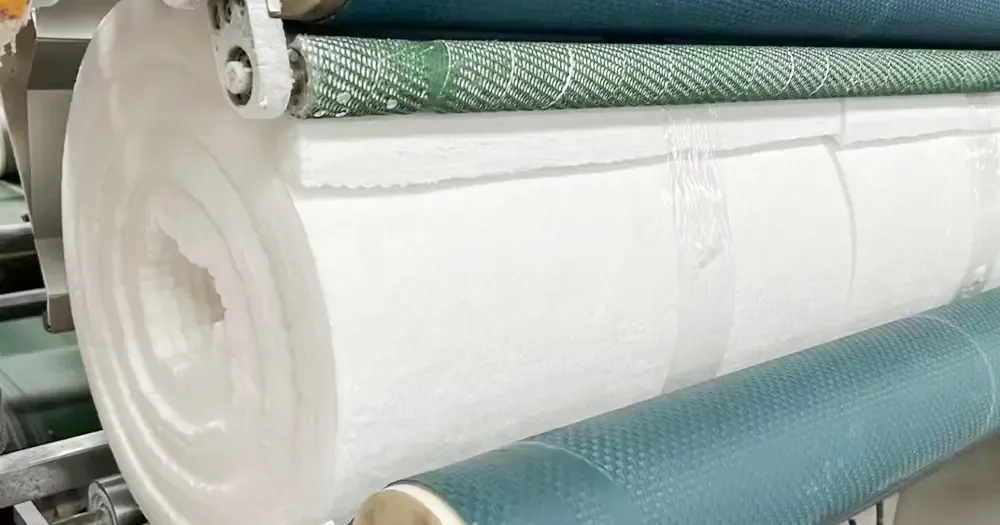
Ceramic fiber blanket does not come with one globally standardized ladder of 1260, 1400 or 1600 °C grades. The dependable way to read the market is to sort blankets by fiber chemistry first — standard (STD), high purity (HP), high alumina (HA) and zirconia-bearing (HZ) — and then verify, grade by grade, the classification temperature, the 24-hour linear shrinkage, the recommended continuous use temperature and the permitted atmosphere. EN 1094-1 requires permanent linear change after 24 hours to stay within 4% for blankets, felts, mats and papers; ASTM C356 defines how shrinkage is measured for preformed high-temperature insulation, but deliberately sets no universal acceptance limit.
In practice, STD and HP products can both carry a 1260 °C classification temperature while their recommended working temperatures are labeled around 1050 °C and 1100 °C respectively. HA grades are commonly marked 1350, 1360 or even 1400 °C depending on the supplier, and HZ grades are typically marked 1430 °C. A 1260 grade label therefore identifies a classification test step — it is not permission to run a lining continuously at 1260 °C. A conservative engineering starting point for clean, oxidizing or neutral atmospheres: amorphous alumino-silicate blankets are normally used about 100–150 °C below their classification temperature, while zirconia-bearing grades can run closer to theirs.
The purchasing sequence that follows is straightforward: lock the long-term hot-face temperature, peaks and hot spots first; choose the chemical grade second; select density third based on mechanical load, vibration, gas velocity and installation method; and close out acceptance with batch-specific test reports. Density never turns an STD blanket into an HA blanket — it changes rigidity, erosion resistance, handling and cost, and it shifts heat transfer, but it does not raise the chemical temperature capability of the fiber itself. You can browse the full product family in our ceramic fiber insulation hub.
Temperature Grades Are Chemistry First, Numbers Second
A temperature grade for ceramic fiber blanket is primarily a chemical grade, and only secondarily a number printed on a datasheet. Two blankets both labeled 1260 °C can behave differently in service because their Al₂O₃ and SiO₂ purity, Fe₂O₃ content and alkali impurities differ. Conversely, raising density from 96 to 160 kg/m³ changes how the blanket handles and resists erosion, but it does not change the fiber chemistry or the chemical grade.
The four market grades below are widely used naming, not a mandatory unified designation system:
- STD (standard): the economical general-purpose grade, with typical Al₂O₃ of about 43–46% and a continuous hot-face range of roughly 1000–1050 °C.
- HP (high purity): same 1260 °C classification family, but higher Al₂O₃+SiO₂ purity (often 98–99%) and Fe₂O₃ commonly below 0.2%, supporting about 1050–1100 °C continuous.
- HA (high alumina): raised Al₂O₃ (typically 52–55% in many datasheets), classification commonly 1350 or 1360 °C, with service around 1100–1250 °C.
- HZ (zirconia-bearing): about 13–17% ZrO₂ added to the alumino-silicate system, classified at 1430 °C, with service around 1300–1350 °C.
The table below is a selection starting point only. It cannot be used to convert between suppliers, because soak conditions, atmosphere assumptions and impurity limits are not standardized.
| Market grade | Typical classification temperature | Typical continuous/working temperature | Typical chemistry (mass fraction) | Common densities and main uses |
|---|---|---|---|---|
| STD (standard) | 1260 °C | about 1000–1050 °C | Al₂O₃ about 43–46%; Al₂O₃+SiO₂ about 96–97%; no ZrO₂ | 64–128 kg/m³; general insulation, flues, boiler and equipment backing |
| HP (high purity) | 1260 °C | about 1050–1100 °C | Al₂O₃ about 44–49%; Al₂O₃+SiO₂ about 98–99%; Fe₂O₃ often below 0.2% | 96 or 128 kg/m³; heat treatment furnaces, petrochemical heaters, low-impurity zones |
| HA (high alumina) | 1350/1360/1400 °C depending on supplier | about 1100–1250 °C | Al₂O₃ about 35–55%; balance mainly SiO₂; some grades with small ZrO₂ additions | 96/128/160 kg/m³; higher-temperature hot faces, frequent thermal cycling |
| HZ (zirconia-bearing) | 1430 °C | about 1300–1350 °C | Al₂O₃ about 35–40%; SiO₂ about 44–51%; ZrO₂ about 13–17% | mainly 128 kg/m³; ultra-high temperature and high-stability service |
The largest inter-supplier differences concentrate on HA: one manufacturer may mark it 1350 °C, another 1360 °C, and some use 1400 °C. None of these numbers is wrong by itself; they reflect different test conditions and product definitions. If a contract specifies only a grade name without classification temperature, chemistry, shrinkage conditions and recommended working temperature, the specification is not complete enough to purchase against.
STD and HP for Mid-Temperature Hot Faces; HA and HZ for Higher Demands
STD competes on cost-versus-performance in the mid-temperature range, not on using 1260 °C as a design temperature. Its natural territory is about 1000–1050 °C long-term hot face: boilers, flues, general industrial furnace backing, and lower-temperature pipe and equipment linings. Its Fe₂O₃ and alkali levels are relatively higher, and those impurities promote liquid-phase sintering, devitrification and hot-face powdering at temperature — which is why STD should not be specified far above its continuous limit just because it is cheaper. For standard-duty needs, see our ceramic fiber blanket.
HP shares the 1260 °C classification with STD but buys a more stable service ceiling through purity control. With Al₂O₃+SiO₂ around 99% and Fe₂O₃ often below 0.2%, HP is the preferred grade for clean oxidizing or reducing atmospheres, petrochemical heaters and any location sensitive to volatile impurities. Note that higher purity does not make HP universally compatible: HF, strong alkali or molten salts require a separate chemical compatibility review.
HA's value is dimensional stability above 1100 °C, not a higher Al₂O₃ figure alone. Increasing Al₂O₃ delays devitrification and shrinkage of the amorphous fiber, which is exactly what matters on higher-temperature hot faces and in cyclical duty. Where service approaches the top of the alumino-silicate range, our high-temperature ceramic fiber plus blanket covers the higher grades.
HZ is not a case of adding zirconia and becoming indestructible. Its ceiling comes from the ZrO₂ modification of the fiber chemistry, which improves high-temperature stability, resists devitrification and holds dimensions through thermal cycling. HZ still needs the same discipline as any other grade: verified atmosphere, verified hot-face profile and verified shrinkage data before commitment.
Density Is a Mechanical Grade, Not a Temperature Grade
Common blanket densities are 64, 96, 128 and 160 kg/m³ — roughly 4, 6, 8 and 10 lb/ft³ — with 192 kg/m³ as an occasional heavier option. Higher density makes a blanket stiffer, more crush- and tear-resistant, more able to resist gas erosion and vibration, and it raises heat storage and cost. Lower density blankets are softer, easier to compress around complex shapes and cheaper per square meter, but they slump and erode more readily at temperature, and joints are harder to hold closed.
| Density | Approx. lb/ft³ | Best suited to | Main limits |
|---|---|---|---|
| 64 kg/m³ | 4 | cold-face backing, flat surfaces, low mechanical load, easy to cut and fit | weaker tear, erosion and self-supporting strength |
| 96 kg/m³ | 6 | general furnace linings, ducts and pipework, moderate duty | verify under strong vibration or high gas velocity |
| 128 kg/m³ | 8 | the workhorse needle-punched duty; balance of handling, strength and cost | no substitute for a higher chemical grade |
| 160 kg/m³ | 10 | higher mechanical load, vibration, gas erosion, harder surface needed | cost, weight and heat storage increase |
| 192 kg/m³ | 12 | occasional high-load, erosion-prone or wear-critical spots | confirm supply, compressibility, cost and thermal inertia case by case |
Density also changes how heat moves through the blanket. More solid phase shifts the balance between gas conduction, solid conduction and high-temperature radiation, so conductivity values cannot be swapped between densities at one temperature: a 64 kg/m³ product measured at 1000 °C can conduct noticeably more heat than a 128 kg/m³ product at the same temperature. That is a heat-transfer fact, not proof that density raises the temperature grade.
A practical way to frame it: density decides whether the blanket stays in place through installation and years of operation; chemistry decides how long the fiber survives the temperature. If a project needs a 1280 °C continuous hot face, the answer is to upgrade to HA or HZ chemistry and then choose 128 or 160 kg/m³ for the mechanical conditions — not to buy the same 1260-grade chemistry in a heavier blanket. Where linings need anchoring and shape retention, ceramic fiber modules made from the same fiber families are the standard companion product.
Classification Temperature Is a Lab Point; Continuous Temperature Is the Design Basis
The classification temperature is a repeatable laboratory grading point, not an all-hours operating license. EN 1094-1 classifies high-temperature insulation wool by permanent linear change after 24 hours of soaking heat — within 4% for blankets, felts, mats and papers, within 2% for boards and preformed shapes, with classification temperatures reported in 50 °C steps from 850 to 1800 °C. The standard explicitly notes that a classification temperature does not imply the product can be used continuously at that temperature, and that for amorphous products the maximum continuous use temperature is typically 100–150 °C lower. Polycrystalline wools are the exception, usable close to their classification temperature.
ASTM C356 measures linear shrinkage after 24 hours of soaking heat and cooling to room temperature, and it states plainly that no fixed relation can be established between soaking-heat shrinkage and actual shrinkage in service. A 24-hour laboratory result cannot stand in for an industrial campaign lasting months or years.
This is why a shrinkage specification is only valid when three elements travel together: temperature, soak duration and permitted limit. A shrinkage figure of 3% or less means little unless the datasheet also states whether the sample was soaked at 1000, 1100 or 1350 °C for 24 hours. Typical datasheet conditions look like this:
| Typical datasheet condition | STD | HP | HA | HZ |
|---|---|---|---|---|
| Soak temperature | 1000–1050 °C | 1100 °C | 1100–1250 °C | 1200–1350 °C |
| Soak time | 24 h | 24 h | 24 h | 24 h |
| Linear shrinkage limit | 2.5–4.0% max | 2.5% max | 3.0–4.0% max | 3.0–4.0% max |
The same logic explains why maximum or limiting temperatures must never be used for everyday design. A product that already shrinks 3–4% after one day at its test temperature will keep changing over thousands of hours, and real linings add temperature gradients, local hot spots, atmosphere effects, pressure and installation constraints on top.
What Actually Happens Above the Recommended Temperature
The primary high-temperature failure of a 1260-grade blanket is not sudden melting — it is the slow devitrification and sintering of amorphous fiber. Alumino-silicate fibers leave the production line as a glass. Held at or above their comfortable service range, they progressively crystallize into mullite and cristobalite, and the fiber contact points sinter, coarsen and shorten. Crystalline phases are denser than the glass phase, so the blanket shrinks; embrittled fibers lose elasticity and tensile strength and eventually powder at the hot face.
The failure then chains: the hot face shrinks and powders, joints open, hot gas short-circuits through the gaps, heat loss and casing temperature rise, and the accelerated local environment degrades neighboring material faster. The 4% shrinkage limit at classification temperature is a grading criterion, not an installation allowance — design documents still need to specify laying direction, overlap or staggered joints, pre-compression, expansion joints, anchoring and permitted thermal movement.
Atmosphere can quietly derate a grade before temperature ever does. Fluorine and fluorides, strong and molten alkali, vanadium and heavy-metal oxides attack alumino-silicate fibers; alkali metals form low-melting phases that accelerate shrinkage and sintering, and vanadium oxides — molten at about 690 °C — can deposit on fibers and react with them. The same hot-face temperature therefore deserves a different continuous-use judgment in clean air, reducing gas, sulfur-bearing flue gas, or fluorine-, alkali- or vanadium-containing environments, backed by gas composition, dew point, concentration, exposure time and coupon testing.
A Selection Workflow That Starts at the Temperature Boundary
Step one is not picking a product — it is fixing the temperature boundary: average long-term hot face, sustained peaks, occasional peaks, hot-spot locations, heat-up and cool-down rates, hold times and cumulative operating hours. Peaks belong to short events; classification temperatures are not peak ratings.
Broad engineering ranges for clean, oxidizing or neutral service: around 900–1000 °C, STD or HP is a sensible start; around 1050–1100 °C, compare HP grades; around 1100–1200 °C, focus on HA; around 1250–1300 °C and above, compare HZ or higher systems. Final values must come from the specific product's continuous-use recommendation and test report.
Cycling, heating rate and atmosphere then amplify the differences between grades. Intermittent kilns, kiln cars, furnace doors, forging furnaces and reformer or cracker duties combine temperature cycling, vibration, flame impingement and atmosphere change. Review those cases in this order: hot spots above the recommended continuous temperature; reducing gas, alkali, sulfur, fluorine or vanadium in the atmosphere; cycling frequency and heating rates; vibration, self-weight, anchor loads and gas velocity; combined flame impingement and corrosion; and the room left for maintenance and replacement.
| Service condition | Risk | Typical engineering action |
|---|---|---|
| Hot face close to the classification temperature | insufficient continuous-use margin | upgrade the chemical grade; map average, peak and hot-spot temperatures |
| Fast heat-up and cool-down, frequent cycling | cumulative devitrification and shrinkage | move to HA/HZ or polycrystalline systems; design expansion joints and inspect after first heat-up |
| Reducing, sulfur-, fluorine-, alkali- or vanadium-bearing atmosphere | effective temperature capability derates | request a chemical compatibility statement; run atmosphere samples and coupon tests |
| Vibration, self-weight, high gas velocity | blanket sag, peel-off or erosion | raise density, use thicker or composite build-ups, add erosion guards |
| Incineration, solid fuel, heavy oil firing | ash, corrosion and condensation stack up | provide insulation gaps and casing protection; review acid dew point and anchoring |
| Cold face, flat, low load | no need for maximum density | 64/96 kg/m³ usually sufficient; check site handling |
Fuel and combustion products decide whether failure comes from heat, chemistry or both. Clean oil- or gas-fired oxidizing atmospheres sit closest to datasheet recommendations. Heavy oil brings vanadium, sodium and sulfur; solid fuels bring alkali, chlorine and ash; waste incineration adds acids, heavy metals and alkali together. Where rotary kiln linings combine all of these, see our cement plant application guide; where fired heaters and crackers set the duty, see the petrochemical application guide.
Acceptance: Same Batch, Same Conditions, Same Report
Purchasing documents cannot rely on a bare grade label as a specification. A complete inquiry should pin down at least the following:
| Acceptance item | What to specify |
|---|---|
| Product identity | grade name and supplier designation |
| Geometry | density, thickness, width, length and tolerances |
| Temperature | classification temperature, continuous/maximum use temperature and applicable atmosphere |
| Shrinkage | soak temperature, soak duration and permitted linear shrinkage |
| Chemistry | Al₂O₃, SiO₂, ZrO₂, Fe₂O₃ and other key impurities |
| Physical properties | shot content, tensile strength, thermal conductivity and test temperature |
| Test basis | standards and editions applied or declared |
| Quality documents | CoA, third-party test report, batch number and sampling date |
| Safety data | SDS and local regulatory requirements |
| Health and environment | applicability limits of RCF, AES, PCW and biosoluble fibers |
Referencing standards also needs precision: EN 1094 is a series covering terminology, classification, permanent linear change, thickness, density, resiliency, thermal conductivity, tensile strength and shot content, so a project should cite the specific part and edition rather than writing "compliant with EN 1094". ASTM C356, for its part, defines a test method only — it is not a grade system, and C356 results cannot be read as EN classification compliance or vice versa.
Thermal conductivity is only comparable at the same hot-face or mean temperature, density and thickness. A 64 kg/m³ value at 1000 °C is not a design value for a 128 kg/m³ blanket, and a 600 °C value cannot be extrapolated to 1100 °C. Thickness, meanwhile, should come from a heat-loss calculation targeting surface temperature and cold-face limits rather than from the temperature grade alone — our step-by-step insulation thickness calculation guide walks through that method.
Four Mistakes That Cost the Most
Mistake 1: treating the maximum temperature as a 24/7 rating. If an STD datasheet says classification 1260 °C and working temperature about 1000 °C, the blanket cannot run continuously at 1260 °C. And when HP and STD share a 1260 °C label, HP may still carry a higher recommended continuous temperature — grade name, classification temperature and continuous temperature must always be read together.
Mistake 2: assuming doubled density raises the temperature rating. Density changes conductivity, rigidity, erosion resistance, handling and cost — never the chemical temperature capability. If STD cannot carry the hot face, upgrade the chemistry first and raise density only for structural or gas-flow reasons.
Mistake 3: comparing 1260, 1400 and 1600 across suppliers. Suppliers use different terms — classification, maximum service, working, limit or recommended use — and HA may appear at 1350, 1360 or 1400 °C. These differences reflect test conditions, life targets and definitions, not quality rankings. Procurement documents should attach the temperature definition, test conditions and report.
Mistake 4: binding ASTM C356 results to EN 1094 classification. C356 is a test method; the 4% blanket criterion in EN 1094-1 is a classification rule. One does not automatically prove the other. Formal purchasing should state both which method was used to test and which rule was used to classify.
The final answer is never simply "is 1260 enough" — it is four consecutive judgments: fix the temperature boundary and atmosphere; select STD, HP, HA or HZ from the true continuous temperature, not the classification figure; select density for vibration, gas velocity, load and installation; and close acceptance with batch reports covering chemistry, shrinkage, conductivity and tensile strength. When the average hot face already sits near a grade's continuous limit — or corrosion and cycling arrive together — upgrade the chemical grade and keep the 100–150 °C engineering margin rather than reaching for a heavier blanket.
Frequently asked
What temperature can a ceramic fiber blanket withstand? +
It depends on the grade. STD and HP grades are classified at 1260 °C but are normally used continuously around 1000–1100 °C; HA grades classified at 1350–1400 °C serve around 1100–1250 °C; zirconia-bearing HZ grades classified at 1430 °C serve around 1300–1350 °C. Always size against the continuous use temperature, not the classification temperature.
What is the difference between 1260, 1360 and 1430 ceramic fiber blanket? +
The numbers are classification temperatures — the soak temperature at which a sample keeps permanent linear change within the limit (4% for blanket under EN 1094-1). Higher grades hold their chemistry longer: HP raises purity, HA raises Al₂O₃ to slow devitrification and shrinkage, and HZ adds roughly 13–17% ZrO₂ for stability near 1430 °C.
Does a higher density ceramic fiber blanket have a higher temperature rating? +
No. Density changes rigidity, erosion resistance, handling and thermal conductivity — not the fiber's chemical temperature capability. If the hot face exceeds a grade's continuous limit, upgrade the chemical grade (for example from STD to HA); use density for mechanical and gas-flow conditions.
Why is the continuous use temperature lower than the classification temperature? +
The classification value comes from a 24-hour laboratory shrinkage test. Industrial linings must survive months or years, and amorphous alumino-silicate fibers gradually devitrify and sinter. EN 1094-1 notes that the maximum continuous use temperature of amorphous products is typically 100–150 °C below the classification temperature.
Can ceramic fiber blanket be used in a reducing atmosphere? +
Reducing atmospheres, alkali, sulfur, fluorine and vanadium compounds can effectively derate a blanket. HP grades with low impurity levels are preferred in clean reducing service, but molten salts, HF or strong alkali call for a chemical compatibility review and coupon testing before commitment.
How do I choose the right ceramic fiber blanket grade and density? +
Fix the temperature boundary first (long-term hot face, peaks, hot spots), pick the chemical grade from the continuous use temperature, then pick density for vibration, gas velocity, load and installation — 128 kg/m³ is a common starting point — and close acceptance with batch test reports covering chemistry, shrinkage and thermal conductivity.
Request a quote
Interested in our insulation solutions? Send us your requirements and our team responds within one business day.