
Industrial Insulation Material Cost Comparison 2026: Rock Wool, Glass Wool, Calcium Silicate, Ceramic Fiber and Aerogel
Industrial insulation cost comparison 2026: indicative USD/m2 ranges for rock wool, glass wool, calcium silicate, ceramic fiber and aerogel, plus cost per R and hidden TCO items.
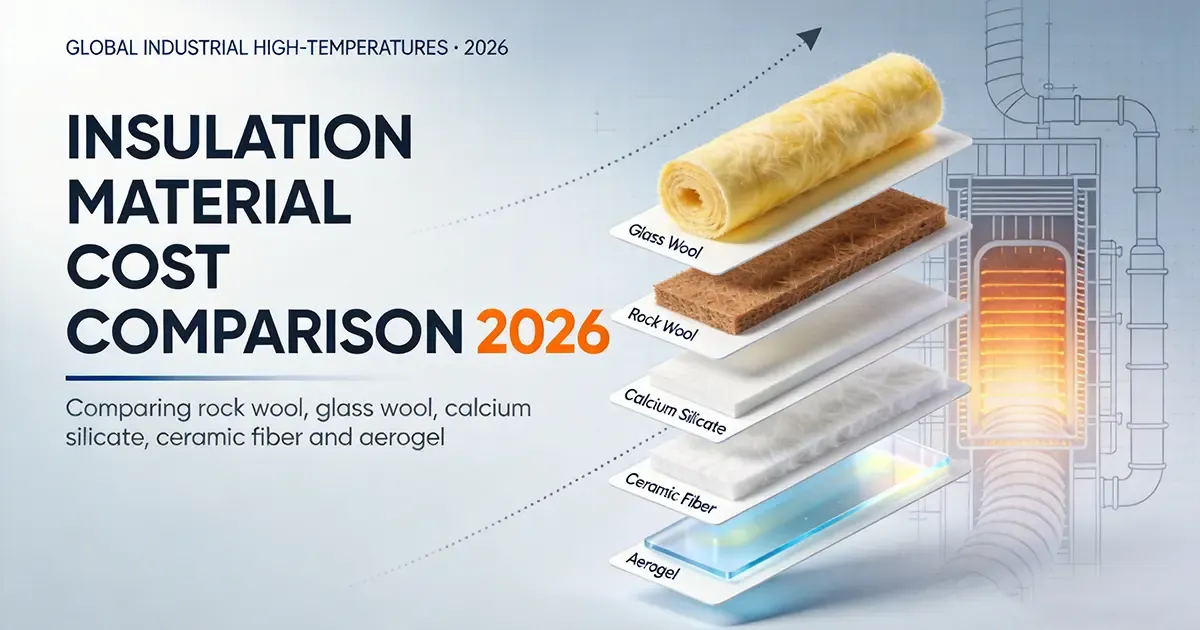
For piping, storage tanks, boilers, reactors and other high-temperature equipment, the first gate in insulation procurement is not the unit price. It is continuous operating temperature, short-term peak temperature and substrate compatibility. Aerogel blanket does have the lowest apparent thermal conductivity of the five material families compared here, but typical industrial grades are still limited to about 650 °C continuous service. Rock wool fiber softening far above 650 °C does not license continuous operation there, and the resin binder system in glass wool cannot be replaced by the softening point of the fiber itself. Ceramic fiber grades at 1100–1430 °C are classification temperatures, not working temperatures, and their conductivity at 400–600 °C already reaches 0.10–0.19 W/m·K, so a room-temperature figure of 0.08 must never be used for comparison.
This guide defines indicative 2026 material-delivered costs for each family, normalizes them into cost per unit thermal resistance, and lists the hidden costs that usually decide the real budget.
1. Direct Answer: Pass the Temperature Gate First, Then Price the R
For industrial service, screen materials in this order:
- Temperature admission. Continuous service temperature from the product data sheet, tested to recognized methods, must cover the operating condition with margin. Aerogel and most industrial rock wool stop at about 650 °C. Glass wool tops out near 350–400 °C depending on the binder system. Calcium silicate covers roughly 650–1100 °C by grade. Ceramic fiber is the only family that runs beyond about 1100 °C.
- k at the real mean temperature. Apparent thermal conductivity rises sharply with temperature for every fiber material. A value quoted at room temperature is marketing, not engineering.
- Cost per unit thermal resistance and total cost of ownership. Only after the first two gates should USD per square meter or USD per R decide between surviving candidates.
A one-line purchasing rule: filter candidates using temperature limits, k-versus-temperature curves, linear shrinkage and chemical compatibility; size the thickness with a cylinder heat-loss model such as ASTM C680; and only then compare USD per square meter of assembly R. A supplier who quotes a single conductivity and a price without stating the temperature and the finished product form should be sent back.
2. Indicative 2026 Costs by Material and Thickness
The table below consolidates the temperature envelope, representative conductivity window, typical single-layer thickness and indicative material-delivered cost (USD per square meter of covered area, material only, not installed) for the five industrial families. Figures reflect publicly anchored first-half 2026 data normalized for industrial-grade product forms; they are budgeting ranges, not quotations.
| Material family | Continuous service limit | Representative k window (W/m·K, mean temp) | Typical layer | Indicative 2026 cost, USD/m² | Best use / disqualifiers |
|---|---|---|---|---|---|
| Aerogel blanket (hydrophobic, fiber-reinforced) | ≤650 °C continuous; jacketing mandatory | 0.021 at 24 °C; 0.029 at 204 °C; 0.036 at 316 °C; 0.043–0.050 at 371–500 °C | 10–40 mm; 80–100 mm usually 2–3 layers | 25 mm: 90–220; 50 mm: 180–480; 80 mm: 290–710; 100 mm: 390–950 | Space-limited, CUI-sensitive, frequently inspected lines at 150–650 °C; above 650 °C it is disqualified; never a hot-face refractory |
| Industrial rock wool (high-density board, pipe sections) | 650 °C continuous (per ASTM C411/C447 service ratings); some regional claims of 750 °C are not continuous ratings | 0.035 at 38 °C rising to 0.068 at 260 °C and 0.088 at 400 °C | 40–120 mm | 25 mm: 8–18; 50 mm: 16–39; 80 mm: 26–58; 100 mm: 35–78 | Steam, hot oil, boilers and columns at 250–650 °C; for stainless steel specify low water-leachable chloride; above 650 °C continuous is disqualified |
| Industrial glass wool (48–64 kg/m³ mats and boards) | About −120 to 350–400 °C, binder-dependent | 0.032 at 24 °C; 0.042 at 75 °C; about 0.060 at 200 °C; 0.079 at 260 °C | 25–100 mm | 25 mm: 6–16; 50 mm: 12–29; 80 mm: 20–52; 100 mm: 27–70 | Low and medium temperature HVAC, acoustics, intermittent service; above 350 °C only grade-by-grade approval; disqualified at boiler hot faces |
| Calcium silicate (Type I per ASTM C533; special 1100 °C grades) | Type I to 649 °C; Type II to 927 °C; special grades to 1100 °C, grade-specific | Type I limit 0.059 at 38 °C rising to 0.095 at 316 °C and 0.111 at 538 °C; typical product 0.058–0.065 at 100 °C | 25–100 mm; shapes often pre-cast | 25 mm: 16–36; 50 mm: 32–80; 80 mm: 52–116; 100 mm: 70–154 | 400–1100 °C where rigidity, load capacity and thermal shock resistance are needed; not economical for thick low-temperature elbow wrap; needs jacketing because absorbed water adds weight |
| Ceramic fiber blanket (1260/1360/1430 °C grades) | Classification 1260/1360/1430 °C; working temperature about 1050/1200/1350 °C by grade | 1260 grade about 0.095 at 400 °C, 0.123 at 500 °C, 0.158 at 600 °C; higher grades similar or slightly higher | 25–100 mm; furnace linings as modules or multi-layer | 25 mm: 13–32; 50 mm: 26–64; 80 mm: 42–102; 100 mm: 56–136 | Furnaces and kilns above 650 °C, hot-face backing, expansion joints; usually over-specified and not cost-effective for mid-temperature pipework |
For context on the premium end of this table, see the detailed aerogel insulation cost and price breakdown. Building-grade fiberglass budgets are covered separately in cost of fiberglass insulation in 2026.
3. Why These Are Budget Ranges, Not Quotations
Density converts cubic-meter prices into square-meter prices. The same material name spans a multiple in density: industrial rock wool boards run near 93–130 kg/m³ depending on form, aerogel composite blankets around 150–200 kg/m³, and calcium silicate specification densities up to about 240–350 kg/m³. The table already assumes industrial finished forms, not laboratory bulk material.
Thickness is not a linear discount. Thin aerogel is a standard roll product, while 100 mm aerogel is normally supplied as multiple layers with added cutting, overlapping, stitching and packaging cost - the high side of its range carries that lamination penalty. For glass wool and rock wool, 25 mm is close to the minimum economic cutting thickness, so waste per square meter can exceed that of thicker boards.
Region and order volume are multipliers. Factory-gate pricing in manufacturing hubs, project pricing in the Gulf, taxed distribution in Europe and emergency spot supply in North America are different markets. As volume anchors, public trade listings in 2026 show ceramic fiber blanket around 100–400 USD/m³, calcium silicate board around 180–300 USD/m³ and rock wool board around 100–500 USD/m³ - order-of-magnitude references only. Always require quotations expressed as USD per square meter of developed area, with density, thickness tolerance, yield, Incoterm, minimum order quantity and validity stated.
4. Temperature Screening: 650 °C Is Not an Interchangeable Boundary
Melting point or classification temperature identifies the material; continuous service temperature predicts its engineering life. Rock wool is a silicate fiber system: the fiber itself may only soften near 1000 °C, but binders, shot content, density, shrinkage, atmosphere and hot-face testing together determine the service rating. Commercial data sheets rate industrial rock wool at 650 °C continuous with linear shrinkage within about 1.2 percent; regional claims of 750 °C maximum apply to specific test declarations, not to continuous design service.
Glass wool is misread even more often. Standard industrial glass wool mats carry an ASTM C411 working range of about −50 to 350 °C, with binder migration possible on over-temperature hot faces; only special heat-resistant binder systems extend toward 400 °C. Short-term 500 °C marketing claims do not replace a continuous rating.
Calcium silicate ratings are grade properties. ASTM C533 limits Type I to 649 °C and Type II to 927 °C at the surface; commercially available 1100 °C boards are higher grades with their own conductivity tables, and a Type I k-table must not be applied to them.
Ceramic fiber requires the sharpest distinction of all: classification temperature versus working temperature. A 1260 °C classification grade is typically rated to work at about 1050 °C; 1360 °C and 1430 °C classification grades work at about 1200 °C and 1350 °C respectively, with permanent linear change verified at defined hot-face conditions. Conversely, selecting 1260-grade blanket for a 300 °C pipeline is not automatically better: higher k, dust management during removal and higher cost all count against it.
| Admission check | Require from supplier | Common mistake |
|---|---|---|
| Continuous temperature | Service temperature per ASTM C411/C447 or equivalent, hot and cold face reported | Treating fiber melting point or classification temperature as the continuous rating |
| Short-term peak | Peak temperature, duration, cycle count, atmosphere | Accepting a bare "short-term 800 °C" with no duration |
| Hot dimensional stability | Linear shrinkage per ASTM C356 at the design hot-face temperature | Reading only room-temperature dimensional tolerance |
| Thermal values | Full k-versus-mean-temperature curve, not a single point; flat board vs pipe section method | Using a 24 °C k to calculate 500 °C heat loss |
| Chemical compatibility | Water-leachable chloride, sodium and silicates for austenitic stainless steel per ASTM C795/C692/C871 | Assuming carbon-steel approval covers 316L |
| Finished product boundary | Blanket, board, pipe section, facing, stitching, film, compressed package density | Applying unbonded-material data to faced products |
5. Thermal Conductivity: Always Quote k with Its Temperature
| Material | Sound engineering statement | Correction and pitfall |
|---|---|---|
| Aerogel blanket | 0.015–0.021 W/m·K only approximates room-temperature, best-grade values; a robust first-pass window for industrial composite blanket is 0.021–0.030 across 24–300 °C, rising to about 0.036–0.050 at 371–500 °C | Do not use 0.015 as a constant for every 650 °C-rated blanket |
| Industrial rock wool | 0.035–0.044 is representative near 38–100 °C; at 260–400 °C design with 0.068–0.088 | Density, shot content, orientation and mean temperature all shift the curve |
| Industrial glass wool | 0.032–0.044 is a fair window at 24–100 °C; use 0.06–0.08 for conservative hot-side design | Low-density flexible rolls and high-density boards do not share one curve |
| Calcium silicate | 0.05–0.07 describes typical product near 40–150 °C; specification limits rise to 0.095 at 316 °C and 0.111 at 538 °C | The limit values are specification ceilings, not vendor averages; never mix Type I tables with 1100 °C grades |
| Ceramic fiber | A 1260 grade runs about 0.095–0.16 across 400–600 °C mean temperature; higher grades follow their own curves | Quote by grade and hot-face temperature; a single "at 1000 °C" figure is too coarse |
This temperature dependence is not a defect - it is the physics of fibrous insulation, where conduction, radiation and convection coexist inside the porous structure, which is why test standards report apparent conductivity for defined thickness, density and mean temperature. For how conductivity converts into resistance in real assemblies, see insulation R-value explained for industrial applications.
6. Cost per Unit R: Two Admitted Scenarios
Raw material resistance is approximated as thickness divided by conductivity. Assembly resistance is lower: cylindrical geometry, joints, compression, support thermal bridges and jacketing contact all subtract from it, so a system discount of roughly 5–15 percent is realistic for regular surfaces, and more where supports are dense. Normalized cost per unit R below uses material cost plus an installation allowance of about 50 percent of material cost (the 40–60 percent band typical for regular, accessible work), divided by the assembly R.
Scenario A: hot face about 250 °C, large flat or large-bore surfaces
| Rank | Build-up | Representative k (mean 150–200 °C) | Raw R at 50 mm (m²·K/W) | Assembly R band | USD per m²·K/W | Interpretation |
|---|---|---|---|---|---|---|
| 1 | Aerogel blanket 50 mm | 0.024–0.029 | 1.7–2.1 | 1.45–1.85 | 175–415 | Thin, fast to cut, fewer joints; smaller jacket circumference can narrow the gap toward rock wool's upper band |
| 2 | Industrial rock wool 50 mm + mesh/banding | 0.050–0.059 | 0.85–1.0 | 0.70–0.90 | 55–135 | Usually the best total cost of ownership on open, regular surfaces |
| 3 | Glass wool 50 mm industrial mat + facing | 0.045–0.060 | 0.83–1.1 | 0.68–0.90 | 45–125 | Lowest material cost inside its temperature admission; facing damage, moisture and settlement erode the advantage |
| 4 | Calcium silicate 50 mm, mechanically fixed | 0.072–0.079 | 0.63–0.69 | 0.52–0.64 | 130–310 | Rigid and heat-resistant, but cutting, supports and shaped pieces raise labor; not its sweet spot at mid-temperature |
| — | Ceramic fiber blanket 50 mm | 0.11–0.13 | 0.38–0.45 | 0.30–0.40 | 180–420 | Survives only on admission grounds; at this temperature it is over-specification |
Scenario B: hot face 500–650 °C (post-admission comparison)
| Rank | Build-up | Representative k (mean 300–450 °C) | Raw R at 50–100 mm | Assembly R band | USD per m²·K/W | Verdict |
|---|---|---|---|---|---|---|
| 1 | Industrial rock wool 80–100 mm | 0.068–0.088 | 0.9–1.5 | 0.70–1.10 | 70–170 | Default choice for large regular surfaces within the 650 °C boundary; multi-layer with staggered joints for thick sections |
| 2 | Aerogel 50–80 mm multi-layer | 0.036–0.050 | 1.0–1.4 | 0.80–1.15 | 300–700 | Wins where space, inspection frequency or CUI value is high; outer jacketing cannot be omitted |
| 3 | Calcium silicate 50–80 mm | 0.087–0.105 | 0.5–0.9 | 0.38–0.72 | 190–480 | Preferred where rigidity, shock resistance and load capacity matter beyond pure R economics |
| 4 | Ceramic fiber 50–100 mm | 0.14–0.19 | 0.3–0.7 | 0.20–0.55 | 220–650 | Becomes necessary above about 650–800 °C, where the ranking itself stops applying |
| — | Glass wool | — | — | — | disqualified | Standard industrial glass wool is not designed for continuous 500–650 °C service |
The right way to read these tables is the slope after admission, not a single winner. Aerogel's USD-per-R stays high in Scenario A, but thickness, cutting speed and smaller jacketing can compress the gap; by Scenario B its own k has risen to 0.036–0.050 and must be modeled as such. Rock wool holds the value position across the 250–650 °C corridor. Calcium silicate sells structure and temperature admission, not raw R. Ceramic fiber exits the economic comparison entirely once furnaces exceed about 800 °C - lining life and anchoring take over.
7. The Hidden Costs: Labor, Jacketing, Downtime and CUI
Labor is a function of geometry and access, not a fixed percentage. Industry cost structures commonly land near 35–45 percent material, 40–50 percent labor and 15–20 percent jacketing and fasteners for installed industrial insulation, with complex nodes adding 25–40 percent. Aerogel cuts with a knife and needs fewer joints, compressing site hours; calcium silicate is heavy and rigid with more fixings; ceramic fiber modules demand welded anchors and controlled compression; large-area glass and rock wool work is fast but dust control, multi-layer staggering and jacketing area all grow with thickness.
Metal jacketing is a separate system cost. Aluminum, galvanized steel, stainless steel, coated fabric and GRP jacketing each carry different sheet prices, forming costs, closure bands, expansion joints and supports. Hydrophobic aerogel still requires jacketing against mechanical damage and weather; thin aerogel shrinks the jacketed circumference, while 100 mm rock wool enlarges it - this feedback belongs in the comparison, not inside the material price.
Removable insulation jackets buy downtime windows, not extra R. For valves, flanges, pumps, manways and reactors opened regularly, a removable jacket converts repeated strip-and-rebuild cycles into a capitalized asset. The honest method is to line-item: number of jackets times labor per removal times downtime cost times expected removal cycles, compared against the rework cost of permanent systems. Where a valve is never opened, permanent insulation usually wins.
CUI, moisture and vapor control look like small items until they fail big. Open porous structures admit water vapor that condenses at cold spots; calcium silicate can absorb several times its dry weight in direct water contact and must be jacketed; rock wool's repellent treatment does not replace intact cladding; aerogel composites are hydrophobic but stitching lines and cut edges remain details to manage. Over austenitic stainless steel, chloride control is a compatibility requirement per ASTM C795/C692/C871, not a nice-to-have.
8. When Paying More Is Justified: Five Conditions That Flip the Ranking
- Space-constrained geometry with hot faces up to 650 °C. For pipe racks, skids, valve groups and machinery rooms, aerogel's thin profile shrinks jacketing, clearances and removal time enough to repay the premium; on open surfaces below 650 °C, thicker rock wool normally wins.
- High CUI risk and expensive downtime. Offshore and humid petrochemical zones, cyclic service and small-bore stainless lines reward hydrophobic, few-joint, quickly restorable systems.
- Thermal shock, vibration and frequent cycling. Flexible blankets and ceramic fiber modules outperform brittle rigid boards; conversely, aged ceramic fiber demands dust-aware removal planning.
- Load-bearing, abrasive or refractory-backup duty. Here the purchase is structural function and admission, not minimum USD per R - calcium silicate, dense boards and anchored modules form systems, and squeezing rock wool onto a 1000 °C hot face is a design error.
- Acoustic or fire performance as a rated requirement. Pipe insertion-loss ratings apply to installed, jacketed systems - insulation plus mass layer plus cladding - so a low-k material without system certification cannot substitute by conductivity alone.
9. Service Life and Failure Modes
| Failure mode | Rock/glass wool | Calcium silicate | Ceramic fiber | Aerogel composite | Purchasing control |
|---|---|---|---|---|---|
| Shrinkage / dusting | Low within admission; rapid beyond it | Hot-face cracking, brittleness | Linear shrinkage and fiber aging | Typically under 2 percent within 650 °C grades | Shrinkage reports plus hot-cycle appendix |
| Settlement | Visible on low-density vertical faces | Rigid, minimal | Governed by module pre-compression | Stitched composites hold well | Density, vertical supports, spacing |
| Water uptake / CUI | Repellent treatment still needs cladding | Heavy when soaked, dries slowly | Open structure raises losses when wet | Hydrophobic but still jacketed | Leachable ions, cladding continuity, inspection |
| Thermal shock | Good flexibility; facings may crack | Fair with correct expansion details | Usually excellent; anchoring is the weak point | Good | Ramp curves, anchoring, cycle counts |
| Inspection friendliness | Mesh-faced blankets fair; bonded boards poor | Poor | Modules repairable, dusty | Excellent as removable jackets | Labor per removal, PPE, spare sets |
Removable jackets age by removal cycles - fabric wear, straps, buckles and liner recovery; permanent linings age by thermal cycles, shrinkage and anchor creep. Any "20-year maintenance-free" claim without a duty profile, cycle count and inspection plan does not belong in a budget baseline.
10. A Practical Budgeting Workflow
- Write the duty as a calculable boundary: continuous and peak temperatures with durations, cycles, geometry, orientation, wind and weather, substrate alloy, allowable surface temperature, target heat loss, design life and available shutdown windows.
- Hard-screen admission on four binary gates - continuous temperature, short peak, chemical compatibility, constructability. No USD-per-R rescue for failed candidates.
- First-pass thickness with temperature-corrected k, taking conductivity at the mean of hot and cold faces, never at room temperature.
- Assembly R with a cylinder/flat model per ASTM C680, including wind, jacket emissivity, supports and joints; optimize for energy cost, touch-safe surface, CUI risk and maximum outer diameter together.
- Three-price envelope per supplier (low/base/high) quoted as USD per square meter of developed area with density, thickness tolerance, yield, Incoterm, MOQ and validity; use the indicative ranges above only as a sanity check.
- A 20-year TCO line combining capital cost with energy, maintenance, expected downtime and disposal - including the dust-aware disposal path for aged ceramic fiber - and sensitivity runs on fuel price, operating hours, removal counts and jacket failures.
- Pilot before rollout: mock up 10–50 square meters or a critical valve group; measure installation hours, jacket temperatures, water ingress and movement; audit stainless-compatibility documents before committing framework prices.
11. Quick Selection Summary
- Up to 350 °C, budget-driven, large accessible areas: glass wool or rock wool - verify binder limits for glass wool; prefer rock wool where hot faces and fire requirements are higher.
- 350–650 °C, regular surfaces: industrial rock wool is the default baseline; run aerogel as a parallel option where clearance, CUI, inspection frequency or jacketing circumference is sensitive.
- Above 650 °C: calcium silicate, refractory backing and ceramic fiber modules compete on admission, structure and anchoring design - never on USD per R.
- All projects: put jacketing, anchors, CUI controls, support bridges and removal PPE into the bill of quantities, and size thickness with assembly heat loss rather than raw thickness-over-conductivity.
For material-level deep dives, start from the rock wool insulation, glass wool insulation, calcium silicate insulation and ceramic fiber insulation hubs, and the board-level selection guide in insulation boards: types and selection.
Costs in this guide are indicative 2026 budgeting ranges based on publicly anchored market data for industrial-grade product forms. They vary with density, thickness, order volume, region and Incoterm and do not constitute a quotation. Thermal values follow recognized test methods; final selection must be validated against product-specific data sheets and project conditions.
Frequently asked
Can I rank the five materials by R-value using room-temperature k values of 0.015, 0.035, 0.05 and 0.08? +
No. Those are entry values from different temperature zones and product forms. Aerogel's 0.015-0.021 applies near room temperature and rises to roughly 0.043-0.050 at 371-500 °C; rock wool's 0.035 is a near-ambient figure, reaching about 0.088 at a 400 °C mean; ceramic fiber must be read by grade and hot-face temperature in the 0.10-0.19 range, not from a single 0.08.
Why is aerogel blanket so expensive, and when does it actually save money? +
The premium reflects complex manufacturing, thin finished rolls and certification overhead. The savings come from thinner build-ups, faster cutting, smaller jacketing circumference, hydrophobic CUI management and faster re-inspection. It pays back only when space, downtime value, humidity or inspection frequency are high enough to convert the material premium into total-cost acceptance - never on vendor payback promises alone.
Why isn't 100 mm aerogel ten times the price of 10 mm? +
Because thick aerogel is rarely a single layer: it is built up from multiple plies with staggered joints, extra stitching, fixing and packaging, so labor and waste grow non-linearly with thickness. That lamination penalty is why the high side of the indicative range rises faster than a linear multiple.
Rock wool fibers do not melt until about 1000 °C - why is it rated only 650 °C? +
Continuous service temperature is set by binders, shot content, density, hot-face shrinkage, atmosphere and test methods, not by the melting point of the fiber alone. Recognized service ratings of 650 °C with controlled linear shrinkage define the engineering boundary; regional 750 °C claims tied to specific declarations are not continuous design ratings.
Can glass wool really handle 400 °C? +
Only certain heat-resistant binder grades approach it. Standard industrial glass wool mats are typically rated around −50 to 350 °C, beyond which hot-face binder migration becomes a risk. Specify grade, facing and binder system explicitly - a generic glass wool rating is not sufficient at the top of that range.
Why doesn't calcium silicate's typical 0.05-0.07 W/m·K contradict the ASTM C533 limit of 0.095? +
The 0.05-0.07 window describes good product near 100 °C. The C533 table lists specification maximums at each mean temperature - about 0.095 at 316 °C and 0.111 at 538 °C for Type I. Higher-temperature 1100 °C grades are separate products with their own conductivity tables and must not share Type I data.
Does a 1430 °C classification temperature mean ceramic fiber can run at 1430 °C? +
No. 1430 °C is a classification temperature measured under defined test conditions. Corresponding continuous working temperatures are lower - roughly 1350 °C for the highest zirconia grades - and service life further depends on atmosphere, gas velocity, anchoring, thermal cycling and dust-aware removal planning.
Why doesn't this comparison give one global USD-per-R number? +
Because R is a property of the assembly, not the material alone: cylinder curvature, joints, compression, supports, wind and jacketing all change it, while prices vary by region, product form, volume and Incoterm. Publishing the basis, ranges and sensitivity bands lets engineers recompute for their own project - more honest than a false-precision single figure.
Under CUI risk, is aerogel insulation maintenance-free? +
No. Hydrophobic blankets reduce liquid-water affinity, but cut edges, stitching, laps, jacket penetrations and stainless contamination remain ingress paths. Continuous jacketing, low-point drains, periodic thermography and chloride-release documentation per project specifications are still required.
How much extra is a removable insulation jacket worth for valves? +
There is no universal percentage. Model it as labor saved per removal plus scaffolding plus downtime cost times expected removal frequency, minus jacket purchase and wear-layer replacement. A valve never opened favors permanent insulation; a hot valve opened several times a year usually repays the jacket the first time it avoids a strip-and-rebuild.
Request a quote
Interested in our insulation solutions? Send us your requirements and our team responds within one business day.