
Fire Rated Duct Insulation: What Actually Carries the Rating?
Fire rated duct insulation explained: the five ratings behind one term, honest temperature limits for rock wool, glass wool, ceramic fiber and calcium silicate, and how to choose.
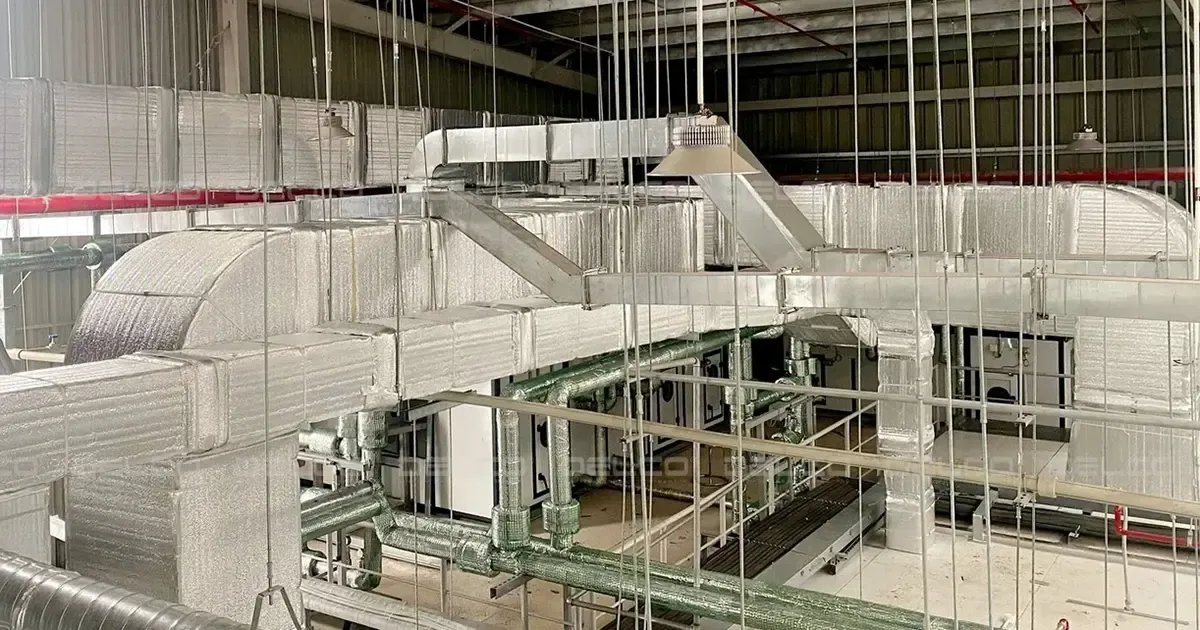
Type "fire rated duct insulation" into a search engine and you get one product category. Sit in a real project meeting and the same phrase quietly means at least five different questions: how the insulation material behaves on a surface-burning test, whether a complete duct assembly survives a furnace test, how long a smoke-exhaust duct must keep running, which damper closes at the fire barrier, and what seals the penetration. Procurement documents routinely merge them, and that merger is where fire-rated duct specifications go wrong. This guide separates the five, states what each insulation material can honestly contribute, and ends with a selection path you can defend in an audit.
One Term, Five Different Ratings
The layers are not interchangeable, and each answers a different risk question:
| Layer | What evaluates it | What it does NOT cover |
|---|---|---|
| Material surface burning | ASTM E84 / UL 723 (flame spread, smoke developed) | Duct assembly integrity or insulation value |
| Material non-combustibility | ASTM E136-type methods | Any system-level performance |
| Duct assembly fire resistance | ASTM E119 / CAN/ULC S101, ISO 6944 where the authority accepts it | Damper listings, penetrations |
| Fire, smoke and ceiling dampers | UL 555, UL 555S, UL 555C | The duct sections on either side |
| Penetrations and joints | UL 1479 / ASTM E814, UL 2079 | The duct run itself |
A material can pass the surface-burning test with flying colors and still have no rating as a duct assembly, because the assembly rating belongs to a tested construction — gauge, joints, hangers, insulation, facing, adhesive and anchors, all as tested. Model codes such as the International Mechanical Code and NFPA 90A frame air-moving systems, NFPA 91 covers exhaust systems carrying combustible contaminants, NFPA 92 governs engineered smoke control, and NFPA 96 covers commercial cooking exhaust. These are adopted jurisdiction by jurisdiction, edition by edition — "complies with NFPA 90A" without a version and an adopting authority is not a specification. For the classification vocabulary behind "non-combustible," our A1 fire rating explainer and the A1 vs A2 vs B comparison set the baseline.
What Each Material Can — and Cannot — Contribute
Rock wool is the default external fire insulation for ducts up to the 650 °C class. Continuous service tops out around 650 °C by product grade, with the binder and facing system — not the fiber — setting earlier limits. Boards at 100–220 kg/m³ hold thickness against air movement and handling, and blankets wrap bends and irregular plenums. That combination of non-combustible fiber, tolerable cost and audit-friendly product standards (ASTM C612 for boards, C592 for blankets) is why rock wool owns industrial duct wrap, kitchen exhaust enclosures and generator-room work — see forms on our rock wool board page and the wider family in the rock wool insulation hub.
Glass wool is the HVAC comfort zone, capped by its facing system. Factory duct liners and wrap typically limit to about 121 °C and a defined maximum air velocity — those are product-conditions of the coating, adhesive and facing, not the fiber's ceiling. Inside that envelope glass wool delivers thermal and acoustic performance at the lowest installed cost; outside it — hot process air, grease-laden vapor, abrasive dust — it is the wrong material regardless of price. Our glass wool board page shows the product grades.
Ceramic fiber and calcium silicate take over where ducts carry real heat. From roughly 541 °C upward, alumino-silicate fiber blankets and modules (about 1000–1200 °C by chemistry) handle hot flues, oven exhaust and thermal expansion, while high-temperature calcium silicate grades to about 1000–1100 °C provide the rigid, load-bearing backing for double-wall construction and support zones — the product frame is ASTM C533. Aerogel composites buy thickness down in the 200–650 °C band where space is money, but they buy geometry, not a fire rating: a surface-burning certificate is not an assembly listing, and no insulation should be specified into a rated duct on the strength of an E84 class alone. The rigid-grade options are on our calcium silicate insulation board page.
Liner, Wrap or Double Wall: Placement Decides the Risks
Internal lining puts insulation in the airstream, and the airstream votes first. Negative pressure pulls fibers loose; abrasive dust erodes coatings; oil mist and moisture load the surface and, in cooking exhaust, grease becomes the fuel. So treat internal lining as a conditional choice: clean media, velocity within the product's tested limit, a coating system proven against erosion, and an inspection route. When those conditions fail, the answer is external wrap or a double-wall duct with the insulation in the cavity.
External wrap is the audit-friendly default: the medium never touches the insulation, vapor barriers stay continuous, and repairs are local. Its failure modes are mechanical — support members bridging the insulation as thermal paths, jacket laps turned against drainage, pins that conduct more than they hold. Double-wall (insulation sandwiched between inner and outer skins) suits abrasive, corrosive or high-temperature service and keeps the inner surface clean, but every joint, hanger and expansion detail must be part of the tested construction, and the cavity needs drainage thought where condensation is possible.
The System Is the Rating: Build and Install Like It
The most common audit failure is not bad material — it is evidence with gaps. A listing or engineering report covers a specific assembly: thickness, density, facing, adhesive, anchors, joint treatment, hanger spacing. Substituting any one item voids it, in writing if you are lucky and in a fire if you are not. So:
- Specify the assembly, not the wool. Name thickness, density, facing, fixing pattern and jacket, and cite the report number that covers exactly that build.
- Keep dampers and firestopping in their lanes. A UL 555 fire damper rating protects a wall opening, not the duct; a UL 1479 penetration system protects the penetration. Neither upgrades the duct section.
- Install like the test was run. Compression, lap direction, adhesive coverage, pin spacing and expansion gaps all shift performance; hidden surfaces get inspected before closure, not after complaints.
- Verify what fire actually tests. Surface-burning numbers, non-combustibility and assembly ratings measure controlled-laboratory behavior; they inform, but do not reproduce, a real fire.
The Euroclass classification guide explains how the European classes map to these same material tests.
A Condition-Based Selection Path
Run the decisions in risk order, and let hard vetoes act before scoring:
- Fix the regulatory frame: jurisdiction, adopted code editions, and whether the duct is ordinary HVAC, process exhaust, smoke control, or a rated assembly crossing a fire barrier.
- Characterize the duty: media, continuous and peak temperature, pressure, velocity, dust, oil mist, moisture, cleanability, vibration, maintenance windows.
- If a rating is demanded, start from the tested assembly, not from materials — then check whether a listed system exists for that build; if not, agree an alternative evaluation path with the authority before tendering.
- Choose placement (liner / wrap / double wall) from the medium and maintenance conditions.
- Then pick the material by temperature and geometry: glass wool to about 121 °C liner duty; rock wool wrap to the 650 °C class; ceramic fiber and high-temperature calcium silicate above it; aerogel only where space or downtime value pays the premium.
| Duct duty | Sensible default | Keep away |
|---|---|---|
| Comfort HVAC, condensation control | Glass wool wrap/liner with continuous vapor barrier | Unfaced fiber in airstreams |
| Kitchen exhaust and hot service enclosures | Rock wool wrap/boards to the 650 °C class | Glass wool liners, any organic facing at the hot face |
| Hot process air 541–1000 °C | Ceramic fiber hot face + calcium silicate backing | Rock wool as long-term hot-face material |
| Space-limited mid-temperature retrofits | Aerogel composite for geometry savings | Treating an E84 class as an assembly rating |
For the marine counterpart — where fire divisions on ships follow IMO A-0 to A-60 logic instead of building codes — see our A-60 marine insulation guide; the material logic overlaps, the regulatory world does not. And whatever the duty, price the system over its life: material, fixings, jacket, downtime and inspection access, not cubic meters of wool.
Frequently asked
Does a Class A surface-burning rating make duct insulation fire rated? +
No. ASTM E84 or UL 723 measures how a material's surface burns in a tunnel test — flame spread and smoke developed. A duct's fire rating, where one is required, comes from a complete assembly tested to ASTM E119, CAN/ULC S101 or an accepted equivalent, including the duct wall, joints, insulation, facing, fixings and hangers. A Class A material is a component, not a rating.
What temperature can HVAC duct insulation handle? +
It depends on the product class: factory glass wool duct liners are typically limited to about 121 °C by their facing, coating and adhesive system; rock wool boards and blankets serve continuously up to about 650 °C by grade; ceramic fiber and high-temperature calcium silicate extend well above that for oven and flue duty. Always read the limit as hot-face temperature per product grade, never the fiber's melting behavior.
Can rock wool be used inside a duct as a liner? +
Only conditionally. The airstream must be clean, velocity within the product's tested erosion limit, the surface coated against fiber release, and negative pressure avoided or specially addressed. In dusty, oily, wet or abrasive service, use external wrap or a double-wall duct instead — the insulation belongs in the cavity, not in the flow.
If the duct has a UL 555 fire damper, is the duct fire rated? +
No. UL 555 rates the damper and its installation at the fire barrier — closing, leakage and fire endurance. UL 555S adds smoke leakage and UL 555C covers ceiling dampers. None of these assign a rating to the duct sections on either side; those need their own assembly listing or an accepted engineering evaluation, and the penetration still needs a listed firestop system under UL 1479 or ASTM E814.
How do I specify fire rated duct insulation without failing the audit? +
Specify the assembly, not the material: thickness, density, facing, adhesive, anchor pattern, jacket and hanger details, each covered by a cited report or listing number and edition. Keep damper and firestop certifications in their own lanes, run heat-loss and dew-point calculations at real mean temperatures, and inspect hidden surfaces before closure. If no tested assembly covers your build, agree an alternative evaluation with the authority before award — never after.
Request a quote
Interested in our insulation solutions? Send us your requirements and our team responds within one business day.