
Glass Wool vs Rock Wool for Soundproofing: Which Absorbs Better?
Glass wool vs rock wool soundproofing: absorption vs transmission, NRC vs STC, frequency, density, fire, installation and a scenario matrix.
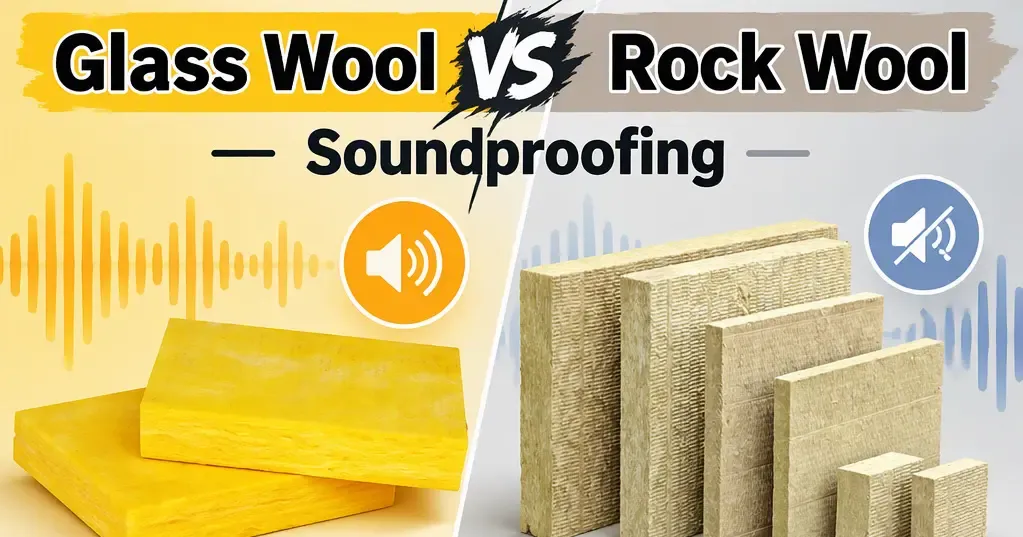
Glass wool and rock wool are both mineral-fiber insulants, both inorganic and non-combustible, and both used across building and industrial acoustics. But when a specifier asks "which one is better for soundproofing," the honest answer is that neither material, on its own, is a sound wall. Both are primarily sound absorbers inside a cavity, not sound barriers across an assembly. This guide separates the two jobs, compares glass wool and rock wool on the metrics that actually matter — absorption coefficient, NRC, density, temperature and fire — and gives a scenario-based selection matrix for walls, studios, ceilings, HVAC and plant rooms.
(See our glass wool and rock wool guides, and the broader glass wool vs rock wool: 7 differences comparison.)
1. The Core Misconception: Absorption Is Not Transmission
For an acoustic consultant, room designer or noise-control contractor, the first decision is not "does rock wool beat glass wool," but to split the problem into two different physical jobs:
- Absorption (porous): reducing standing waves, reverberation and panel radiation inside a cavity.
- Transmission (barrier): stopping energy from a source room crossing the element into a receiving room.
Glass wool and rock wool belong almost entirely to the first job. Their NRC and alpha(f) describe how much sound energy the material or assembly dissipates, not how many decibels a single layer blocks.
A real wall's sound isolation comes from a correctly sequenced system: continuous air sealing, sufficient surface mass, mass de-coupling across the two leaves, resilient or staggered studs, ceiling and floor, a deep but not over-stiff cavity, and only then filling the cavity. Published steel-stud assembly data make the point clearly: with the same glass-fiber fill, a single-board thin-stud wall reaches STC 43, while double boards, a deeper 6-inch cavity, resilient channel and asymmetric construction reach STC 51. STC belongs to the whole assembly and cannot be replaced by the NRC printed on the batt.
So the direct answer to "is rock wool better than glass wool for sound" is: there is no material-family winner. Rock wool is usually easier to make into higher-density, stiffer, temperature-resistant, non-combustible engineering board — suited to fire separation, equipment wrapping and damp or stiffness-demanding locations. Glass wool is easier to make low-density, supple, easy to cut and low-cost for full-cavity fill — suited to residential and light-steel cavities, duct lining and broadband reverberation control. Compared at the same thickness, similar flow resistance, same backing and facing, the 125 Hz to 4 kHz alpha curves can overlap almost completely.
For low frequencies, any "just add more fiber" claim must stay humble: a 25 mm glass-fiber board at ASTM C423 Type A shows alpha of only 0.04 at 125 Hz, and 0.11 even at 51 mm, despite NRC of 0.70 and 1.00 respectively. Low-frequency traps, staggered double walls, floating or resilient ceilings and membrane or Helmholtz resonators are the real tools; fiber only damps part of the cavity and does not raise the wall's STC by the same margin.
2. Glossary: Keep "Absorbs 0.9" and "Blocks 50 dB" Apart
| Term | What it really means | Common misreading | Engineering use |
|---|---|---|---|
| Absorption coefficient alpha(f) | Fraction of incident sound energy dissipated by the material at a frequency or incidence condition; 0 = full reflection, 1 = full absorption | "alpha = 0.9 means it blocks 90 percent of sound" | Ask random vs normal incidence, mounting A or E, air gap and facing |
| NRC | Usually the arithmetic average of alpha at 250, 500, 1k, 2k Hz, rounded per standard rules — a single number | "NRC 1.0 = absorbs everything at all frequencies" | Quick comparison of similar indoor absorbers only; says nothing about 125 Hz or 63 Hz |
| Reverberation-room alpha | Apparent coefficient under ASTM C423 diffuse field with finite-sample boundaries | Treat as truth for an infinite panel at any angle | Room reverberation prediction and product comparison; cite with mounting |
| Impedance-tube alpha | Normal-incidence coefficient per ASTM E1050, often small samples | Directly compare with C423 numbers | Material research, quality control, low-frequency samples; not a field NRC substitute |
| TL / STC | TL is the transmission loss of an element per 1/3-octave; STC is the single-number rating from TL per ASTM E413 | "material STC", "high NRC so high STC" | Belongs only to walls, floors, doors, windows tested per E90 (lab) or E336 (field) |
| OITC | Single number weighted for exterior-to-interior, traffic or ambient spectrum | "OITC replaces STC for neighbor speech" | Road-front facades, aircraft or traffic noise; music and low frequencies still need band TL |
| Mass law | In the mass-controlled region, doubling m or f adds about 6 dB TL | "higher density = linearly better barrier" | For barrier layers or boards; porous fiber's mass contribution is tiny and limited by stiffness, coincidence and flanking |
| Flow resistance / specific airflow resistance | Pressure drop vs face velocity through the material; a key non-acoustic parameter | "kg/m3 is flow resistance" | Density is only a rough proxy; fiber diameter, binder, compaction and pore structure also matter |
| Cavity mode / standing wave | Pressure antinodes form between two parallel hard surfaces at certain frequencies | "fill it and all resonance is gone" | Filling adds damping, but depth, position and panel stiffness still set the modes; lows need thicker or composite structures |
| Decoupling | The two masses are not rigidly connected, blocking bending waves and stud short-circuits | "same stud, one extra board each side" | Staggered studs, resilient channel, independent walls, resilient ceilings or floating slabs must avoid new bypasses |
ASTM standards must not be mixed, and even the standard names must be written correctly.
| Standard | Correct name and what it measures | What it does not measure | Role here |
|---|---|---|---|
| ASTM C423 | Sound Absorption and Sound Absorption Coefficients by the Reverberation Room Method; apparent alpha in the reverberation room | Does not measure element transmission or give STC | Primary basis for manufacturer NRC and alpha |
| ASTM E1050 | Normal Incidence Sound Absorption using the Transfer Function Method; tube normal-incidence alpha and impedance | Not field random-incidence NRC | Material research, samples, low-frequency quality control; not interchangeable with C423 |
| ASTM E90 | Laboratory Measurement of Airborne Sound Transmission Loss of Building Partitions and Elements; element TL for walls, floors, doors, windows | Does not measure a single batt, does not compute NRC | Underlying band data for STC and OITC |
| ASTM E413 | Classification for Rating Sound Insulation; compresses TL bands into STC | Does not specify how to build a wall | Explains "what STC is" |
| ASTM E119 | Fire Tests of Building Construction and Materials; load, integrity, insulation and duration under fire | Does not mean "material melting point = how long a wall holds" | For fire, only the listed assembly design and hourly rating count |
| ASTM E84 | Surface burning characteristics (flame spread, smoke) on small samples | Not E119 hourly fire resistance or non-toxic smoke | Duct lining and exposed absorptive faces often need it too |
Outside North America, the equivalent routes are EN ISO 11654 (sound absorption grading), EN ISO 10140 (laboratory sound insulation), ISO 354 (reverberation room) and ISO 717 for rating — cite the standard family applicable to the project's market.
3. Why a High-NRC Fiber Still Fails Low Bass: Frequency, Thickness, Flow Resistance and Air Gap
3.1 Mid- and high-frequency look strong because the test weights them high
NRC's four anchors start at 250 Hz, exactly where most fibrous batts are most comfortable; 63, 125 Hz and the kick drum, cabinet harmonics and traffic rumble are excluded from that average. So NRC is an excellent indoor reverberation sketch but a poor "wall transmission certificate."
Published technical data for a glass-fiber duct liner board are a good counterexample: the same glass-fiber board, ASTM C423 Mounting A (against a solid backing), at 25 mm gives 125 / 250 / 500 / 1k / 2k / 4k Hz alpha of 0.04 / 0.26 / 0.63 / 0.91 / 0.99 / 0.99, NRC 0.70; at 51 mm it gives 0.11 / 0.64 / 1.12 / 1.14 / 1.06 / 1.08, NRC 1.00. Note alpha can exceed 1.0 in the reverberation-room method: it comes from the standard's definition of apparent absorption for finite-sample edges and mounting conditions, not "114 percent of energy absorbed."
Three design rules from the curve:
- Thickness beats piling on density. For a given formulation, making the material thicker usually moves the absorption peak to lower frequencies better than compressing the same volume harder — but available cavity depth, duct cross-section and ceiling height are hard constraints.
- 125 Hz is not "70 percent of NRC." It is an order of magnitude below NRC; it needs deep cavities, membrane or panel resonance or a separate mass layer.
- Facing and mounting change the whole curve. Bare fiber, perforated metal, thin fabric, spray coating and an off-wall air gap are acoustic boundary conditions, not decoration. Copying alpha without copying mounting makes a spec non-executable.
3.2 "Denser is not necessarily more absorptive" is real, not mystic — there is an optimal flow resistance
Porous absorption is roughly three things: the sound wave squeezes into the fiber network, air in the pores does viscous work, and the structure's heat conduction dissipates part of the energy. Too loose, and air passes through with little resistance — little reflection, little dissipation. Too hard and dense, and the wave reflects at the surface before reaching depth. So for a given thickness, fiber recipe and backing, there is an optimal flow-resistance band, not a monotonic "density goes up, absorption goes up."
A parametric study on a fixed 28 mm composite panel found an optimum around 600 cgs over a 50 to 600 cgs flow-resistance scan, and porosity and structure factor shift the peak: optimal porosity differs between low and high frequency bands. This is not a recipe table saying "all glass wool should be 600 cgs"; it is a counterexample showing that treating kg/m3 as the only knob misses fiber diameter, orientation, binder, compression recovery and facing.
Practical use:
- Low-density glass wool (commonly about 10 to 48 kg/m3 flexible batt or board): easily reaches low-to-mid flow resistance, good for deep cavities and broadband reverberation control; crushing it past recovery sacrifices low frequency.
- Mid-density rock wool board (commonly about 40 to 150 kg/m3, acoustic or fire boards higher): stiffer, suited to exposed ceilings, equipment-jacket lining and core behind perforated panels; can still be surface-impedance-limited.
- High-density "soundproofing wool" (above 150 to 200 kg/m3 or more): if it is merely stiffer mineral wool, it remains primarily an absorptive, thermal and fire core and does not automatically become a mass barrier. If a product claims transmission performance, it must supply E90 band TL or assembly STC — not just density.
3.3 The backing air gap is a "free" low-frequency lever, up to a depth
Mounting thin fiber hard against a rigid wall (C423 Mounting A) versus offset from it (Mounting E or a custom air gap) usually improves low frequency, because the air gap adds equivalent acoustic thickness and changes the resonant boundary. The rule is not "deeper air gap is always better": past a point the cavity impedance mismatches and the gain saturates; and if both leaves of a cavity wall are rigidly tied to the same stud, low-frequency isolation is still short-circuited by the stud.
Two layers of thinking:
- Absorption optimization: fiber thickness plus offset distance plus perforation or facing transmission loss together; a recording studio first-reflection point cannot be decided by NRC alone.
- Transmission optimization: first make the two masses as independent as possible. The air gap itself has no surface mass; its value is providing decoupling distance for a double wall or resilient ceiling, not "leave 2 inches of empty space to replace a second board."
4. Product-Level Comparison: Same-Basis Data Only
4.1 Representative published product data (verifiable samples)
The values below are manufacturer technical data sheets or published standards, not this site's lab retests. Acoustic values must be cited with test standard, mounting, sample size and backing; products with different mountings cannot be ranked head-to-head.
| Product type | Family and form | Thickness | Nominal density | Acoustic basis and values | Temperature and fire boundary | Suitability |
|---|---|---|---|---|---|---|
| Glass-fiber duct liner board | Bonded glass-fiber board, duct or plenum lining | 25 mm (1 in) | about 48 kg/m3 per TDS | ASTM C423 Mounting A: 125 to 4k alpha = 0.04 / 0.26 / 0.63 / 0.91 / 0.99 / 0.99; NRC 0.70 | ASTM C411 service air temperature 121 °C (250 °F); flame spread 25, smoke 50 typical | First candidate for rectangular or round duct interior lining; not a wall STC product |
| Same family | Same | 51 mm (2 in) | about 69 kg/m3 per TDS | Mounting A: alpha = 0.11 / 0.64 / 1.12 / 1.14 / 1.06 / 1.08; NRC 1.00 | Same 121 °C service limit; thicker eats duct cross-section | Stronger for low-frequency duct regen noise, return plenum; check velocity, erosion, hangers, access |
| Glass-fiber duct lining, reference grade | Flexible batt (Type I) or board (Type II) | 13 to 76 mm (0.5 to 3 in) | per ASTM C167 | Type I: 13 / 25 / 51 mm NRC 0.30 / 0.45 / 0.70; Type II 25 / 51 mm 0.55 / 0.85 | Standard to 121 °C (250 °F), C411; plus UL 181 erosion, C1104 moisture, C1338 fungal | Spec language directly citable; final SKU still needs full TDS and SDS |
| Rock wool (stone wool) acoustic or fire family | Stone-wool board or felt; series differ widely | 25 to 100+ mm | Acoustic soft board, partition fill, fire board can range about 40 to 100+ kg/m3 upward; never write one "rock wool density" | North American public pages often present by system or application rather than a single ASTM C423 curve; do not transplant a European ISO 354 or EN 11654 alpha_w as a US SKU's ASTM NRC | Stone-wool fiber core melting point is often around 1000 °C magnitude, but "melting point" is not service temperature; binder, facing, compression and SDS set the limit | High fire-rating, equipment jackets, exposed acoustic ceilings, damp or structural-load locations usually evaluated first; demand North American TDS and assembly list |
4.2 Density: an engineering map, not a material law
| Material or form | Common nominal density (procurement map only) | Typical target | Do not conclude |
|---|---|---|---|
| Loose or blown glass wool, light batt | about 8 to 24 kg/m3 | Attics, irregular cavities, low-cost absorption | "lighter is worse": too light may settle, low flow resistance, but heavier is not always needed |
| Wall glass-wool batt or resilient board | about 16 to 48 kg/m3 | 2x4 or 2x6 wood or light-steel cavities with gypsum | "48 kg/m3 is always more soundproof than 24": check compression, recovery, flow resistance and assembly STC |
| Glass-fiber acoustic rigid board | about 30 to 90+ kg/m3 (product-specific) | Exposed or fabric and post-perforated-panel treatment, duct lining | "high-density board is the low-frequency magic": 125 Hz still governed by thickness and offset |
| Rock wool flexible fill or light board | about 40 to 100 kg/m3 | Partition, curtain-wall fire or acoustic zoning soft core | "rock wool is naturally denser than glass wool": low-density rock wool exists; density does not identify the family |
| Rock wool rigid acoustic or fire board | about 80 to 180 kg/m3 common, special boards higher | Exposed ceilings, equipment wrapping, fire assemblies, where dimensional stability matters | "200 kg/m3 makes it a sound barrier": it is still not a 10 to 25 kg/m2 mass layer |
| High-temperature industrial mineral wool or special board | Set by formulation and binder | Process piping, equipment, near-furnace zones | Never infer "stone-wool melting point around 1000 °C" means "product serves 1000 °C long-term" |
The "sweet spot" is an objective function, not a physical constant. For a low-cost 2x6 wall cavity needing reverberation control and thermal performance, soft, well-recovering, uncompressed glass wool is usually easier to get right; for a visible rigid board under a perforated metal ceiling, near a fire zone or in a damp mechanical room, rock wool board's dimensional stability and non-combustible core earn their place. For 80 Hz isolation, both wools step back to a supporting role.
5. Fire and Temperature: Separate Four Things
5.1 Correct the temperature framing
The common claim "glass wool −120 to 400 °C, rock wool ≤650 °C" cannot be a universal answer for North American acoustic selection, for four reasons:
- The temperature scale may be misaligned. A typical North American HVAC glass-wool lining TDS quotes a service air-temperature limit of 121 °C (250 °F) (ASTM C1071 or C411 context), not 400 °C; a −120 °C low limit must come from the specific binder, facing and frozen-moisture SDS, not assumed for all glass wool.
- "Glass softening or fiber melting point" is not "bonded-and-faced product serves continuously." Glass-fiber itself softens well above 400 °C, but the thermoset binder, coating, foil or FSK, adhesive and sealant in a duct liner fail first.
- Rock wool fiber core melts around 1000 °C magnitude, not a guaranteed 650 °C continuous service. Some high-temperature industrial mineral wools exceed or fall below 650 °C continuous; the SKU's SDS "physical or chemical properties – thermal decomposition or conditions to avoid" and the manufacturer temperature curve decide. Writing "≤650 °C" as the rock wool family ceiling simultaneously misses more temperature-resistant special products and wrongly condemns ordinary boards with organic binder or facing.
- Building fire hours are an assembly property. ASTM E119 gives a wall, floor or protection system its performance and duration under a specific fire exposure; "non-combustible" or E84 Class A does not auto-convert to 1 h or 2 h. The design number, stud spacing, board layers, screws, penetrations and batt location from a recognized testing laboratory must all agree.
5.2 Executable temperature-verification checklist
| Question | Evidence needed | Action if missing |
|---|---|---|
| Highest steady air temperature inside the duct? | SKU TDS plus SDS; confirm air side, not kiln-wall temperature | Ordinary HVAC lining above 121 °C must not continue on "glass fiber" alone; move to high-temperature ceramic fiber or special system and consult the authority having jurisdiction |
| Exposed to oil mist, moisture, negative-pressure dust extraction? | Product erosion or dusting report, facing-adhesive compatibility | Bare fiber must not face high-velocity, contaminating flow; use coating, perforated board or enclosed lining system |
| Near combustion equipment or exhaust? | Special-product continuous temperature, clearance, fire-engineer review | Do not substitute ordinary building wool for a listed fire wrap |
| Counts toward fire separation? | E119 or ULC design number, assembly detail, penetration fire-stop compatibility table | "stone wool non-combustible" alone cannot yield a fire-compliance conclusion |
| Thermal bridge, condensation, wet wool? | Dew-point calculation, vapor profile, material water-uptake or drying and mold risk | Acoustic goal cannot override hygrothermal design; wet wool settles, rots facing and changes alpha |
One-line red line: take the service-temperature limit as the worst of fiber core, binder, facing, adhesive, sealant and airflow erosion; take the fire hour from the whole listed assembly, not the marketing page.
6. Installation and Indoor Air Quality: Not "Carcinogen vs Safe"
6.1 Correct boundary: distinct from asbestos, but cutting dust still controlled
Man-made vitreous fibers (MMVF) — including glass wool, rock or stone wool and slag wool — differ from asbestos in crystalline morphology, persistence and toxicological evidence. For glass wool, IARC moved it from 2B to Group 3 in 2001: "not classifiable as to its carcinogenicity to humans"; a 2011 epidemiological review still found no consistent evidence of increased respiratory-system cancer risk from glass-wool exposure. This is not a "zero risk" or "throw it around bare-handed" pass; Group 3 means the evidence is inadequate to classify.
The real on-site issue is mechanical irritation and migratable fiber or dust: skin itch, eye, nose or throat irritation, transient cough; cutting, sawing, tearing packaging and blowing or disturbing old batts sharply raise exposure. Rock wool is not necessarily "more toxic" and glass wool not necessarily "safer"; it depends on fiber fineness distribution, binder, whether pre-faced, dust load and work method. Conversely, branding all mineral wool as carcinogenic is equally unprofessional scaremongering.
6.2 Contractor-executable exposure control
| Stage | Minimum control | Verify or record |
|---|---|---|
| Receiving and handling | Original packaging to site, minimize shaking; pre-cut area away from supply or air and food or water | Batch, TDS, SDS three-piece archive |
| Cutting | Sharp long knife or dedicated saw, local exhaust capture or wet suppression; no compressed-air blowing of fiber | Observe visible plume; exposure assessment per local regulation |
| Personal protection | Long sleeves, long pants, gloves; goggles; NIOSH-approved particulate respirator per exposure assessment, not a symbolic paper mask | Fit-test or training record; SDS and site concentration set the level |
| Installation | Push gently into place from packaging; bag cut-offs; do not sweep fiber into diffusers, light slots or equipment motors | Vacuum (not blow) before handover |
| Enclosure and facing | Per TDS use gypsum, fabric, perforated board, coating or facing to close wall, ceiling, duct airflow faces; bare fiber must not face people or return air | Keep facing, seam, seal-node photos |
| Existing buildings | First assume possible asbestos cement, old duct wrap, old bond layer; sampling or compliant removal by qualified party | Do not substitute "looks like glass wool" for testing |
On indoor air quality, once the product is reliably faced and enclosed, migratable-fiber risk is a different matter from bare construction; but spray binder, VOC sources, moldy wet wool and dust residue must also be managed in the IAQ plan. "Formaldehyde-free wool" does not mean skip facing, vacuuming and cut control.
7. Scenario Selection Matrix: Pick the Failure Mode First, Then the Family
| Scenario and primary noise | Preferred system logic | How glass wool is usually chosen | How rock wool is usually chosen | Key decision |
|---|---|---|---|---|
| Wood-stud 2x4 or 2x6 residential partition | Seal boxes and top-bottom track, then fill thick enough and uncompressed, then one or both sides add board; for high target, staggered wall or resilient channel | Soft, recovering, low-cost, easy around wiring; do not crush | Rigid board resists slump but watch wide-cavity cut or fit and compression; fire zone evaluated first | STC is the assembly report; batt NRC is not the wall STC |
| Light-steel studio or home theater | Asymmetric mass both sides plus decoupling plus deep-cavity absorption plus low-frequency traps plus door, window and duct break treatment | Deep glass wool for broadband trap core, with transmissive fabric or board; light, cheap, easy to shape | Rigid rock wool board for exposed or perforated ceiling, equipment-near zones; low frequency still needs thickness or membrane | Look at 63 to 125 Hz target first; do not fool yourself with NRC 0.9 |
| Studio interior reverberation | First-reflection broadband absorption plus rear-wall or corner low-frequency treatment plus diffusion as needed | 25 to 100 mm glass-wool board common; 125 Hz needs 75 to 150+ mm or traps | 50 to 100 mm rock wool board behind perforated panel is stable; exposed needs fire or wear face | Report alpha(f), incidence or mounting, not just NRC |
| Ceiling and shared plenum | Ceiling-panel absorption plus independent or resilient suspension plus plenum lining plus seal all hanger or duct penetrations | Glass-wool duct lining curve mature, easy to cut; watch UL 181 and velocity | High fire-rating locations favor rock wool system; verify ceiling-system listing | Plenum is an airborne highway; sealing often matters more than wool thickness |
| HVAC duct regen noise, break-in or break-out | First fix velocity, elbows, isolator, fan vibration; then line or wrap | Glass-fiber duct lining maps directly; 2 in NRC high but eats cross-section | Mechanical room, high-temperature or fire need, or rigid-jacket need favors special rock wool system | Also compute NC or RC, pressure drop, erosion, condensation; not NRC alone |
| Industrial plant equipment jacket or pipe wrapping | Near-field enclosure mass plus inner absorption plus vibration isolation plus serviceable module | Low or mid temp, complex shape, light weight favors glass wool; verify 121 °C and other service limits | High temp, oil mist or fire, rigid-shell dimensional stability favors rock wool or special mineral wool | "temperature grade" before "absorption rank" |
| Fire wall, stair wall or dense-penetration zone | Listed assembly only; wool is only one item | Only where the assembly design permits the corresponding glass-wool product | Rock wool common as fire core, but still needs design number and substitution clause | Do not substitute "non-combustible" for 1 h or 2 h proof |
| Basement, pool plant, exterior-wall dew-point zone | Hygrothermal analysis plus closed-cell or facing strategy plus drainage service | After damp, thermal and long-term position stability need review | Some hydrophobic or rigid rock wool eases open-cavity geometry, but never "never absorbs water" | Wet alpha, mold, metal corrosion all enter acceptance |
7.1 Cavity fill: correct target, wrong expectation
Correct expectation: damp the parallel gypsum, stud and air system, reduce some cavity resonance and panel-radiation coupling, cut cavity reverberation; on an already high-mass assembly there is often "perceptible but limited" STC gain, frequency-dependent. The assembly table treats wool as a fixed variable while STC moves from 43 to 51 with stud depth, board layers, resilient channel and asymmetry — exactly proving wool is not an independent variable.
Wrong expectation: treating R-13 or R-21, NRC 0.9 or "high density" as an STC increment promise; stuffing wool into a single-board wall blocks bass; one side of 2 in wool replaces a second mass board. If electrical boxes are unsealed, bottom track unsealed, receptacle boxes shared-wall, penetration holes leak, even the most expensive wool only absorbs a little reverberation in a leaking cavity.
7.2 Studio and home theater: low-frequency target must be written as bands
An executable acceptance draft:
- Write the target spectrum, not just "STC 60" or "NRC 0.8." Example: 63 / 125 / 250 Hz room impulse response or RT60, low-frequency modal decay, background-noise NC or RC, and the wall's field ASTC or FSTC.
- Use wool where there is depth: corner trap 100 to 200+ mm, rear-wall mid or high first-reflection 25 to 50 mm up, ceiling by reflection path and HVAC noise.
- With perforated board or transmissive fabric, test face plus wool as a system; perforation, cavity depth and wool thickness together set the peak — you cannot add "board NRC" and "wool NRC" separately.
- When bass is insufficient, first add equivalent depth or membrane or panel resonance, not another layer of high-density rock wool. If the room mode is 40 to 80 Hz, a few centimeters of wool contributes too little to be the main scheme.
8. From Metrics to Construction Drawing: Six-Step Design and Check
Step 1 — Define the source spectrum and receiver tolerance. Start from the source, not "need soundproofing wool": speech or TV (above 500 Hz matters), subwoofer or band practice (63 to 250 Hz), AHU broadband noise floor, pump or compressor (discrete low-frequency line plus broadband), site boundary traffic (low frequency and impulses). Write target as band sound pressure level, NC or RC, RT60 or field ASTC — not "quiet."
Step 2 — Draw the transmission paths, find the short-circuits first. Red-line every path: direct through-wall, shared ceiling plenum, door gap, cable hole, receptacle box, drain pipe, structural beam, exterior window, floor joist, duct sleeve. On site, confirm the main path with level difference, phase or headphone listening or professional transmission testing. Most failed projects did not pick the wrong wool; the air bypass and solid short-circuit were still there.
Step 3 — Use mass, decoupling and seal to set the main transmission layer. For airborne sound, first estimate the ideal mass-law ceiling: TL_mass is approximately 20 times log10 of (f times m) minus 47, where f is in kHz and m is in kg/m2. It only shows trend: raising effective surface mass from 10 to 20 kg/m2 gains about 6 dB in the mass-controlled region; from 20 to 25 kg/m2 the gain is far less than sealing one 1/8 in gap. Then add board count, staggered studs, resilient channel, independent wall, resilient ceiling or floating slab. Wool's surface mass is usually only about 0.02 to 0.2 kg/m2 magnitude — it cannot stand in for a mass layer.
Step 4 — Use thickness, flow-resistance and air-gap to design absorption. Treat wool as a controllable damper: (1) pick frequency target — mid or high reflection control 25 to 50 mm; below 125 Hz needs 75 to 150+ mm or membrane or panel composite; (2) compare C423 alpha(f) within the same product family, not NRC as the only column; (3) if perforated facing, require the "facing plus wool plus air gap" system curve; if exposed, require the exposed-state curve; (4) keep design thickness, no crushing, no top or corner voids. Acceptance may use reverberation-time before and after, but note furniture, people, doors or windows and HVAC state differences.
Step 5 — Write temperature and fire as reviewable clauses. Temperature clause: "maximum continuous air or surface temperature plus peak plus duration plus medium," not "withstands 400 °C." Fire clause: "E119 or ULC design number plus hours plus permitted substitution table plus penetration fire-stop system," not "non-combustible = 2 h." HVAC also writes velocity limit, erosion, anti-fungal or mold, moisture uptake, corrosion and serviceability.
Step 6 — Site acceptance and review. Installation completeness (sample or borescope or photo of top, behind receptacles, duct bends — no compression, no continuous seam, continuous facing); acoustics (field E336 or ASTC or room acoustics, recording source, doors or windows, HVAC — by project acoustic spec, not manufacturer NRC); transmission weak points (intensity or scan gap, smoke pen or pressure differential — no dominant leak, main path improved to budget); air and hygrothermal (velocity, static or drop, condensation, IAQ cleanup verification — by MEP or building-physics design); health and safety (SDS, PPE, local exhaust, training, post-construction vacuum — by employer, OSHA or provincial authority and site assessment).
9. Specification Verification Checklist (copy into CSI format)
Acoustic clauses
- Submit full ASTM C423 frequency table (from 125 Hz to at least 4 kHz), with mounting (A, E or actual construction), sample size, air gap, facing, reporting lab and date; NRC only as a derived column.
- If supplier gives impedance-tube data, label it explicitly ASTM E1050 normal-incidence alpha; do not mix with C423 NRC or claim "equivalent NRC."
- If claiming wall or ceiling system STC, ASTC, CAC or OITC, submit the corresponding ASTM E90, E336, E1414 or E1332 assembly report; stud size, board thickness or layers, cavity, fill, seal, doors or windows and test lab must match the construction drawing.
- For studio or low-frequency targets, separately submit 63 to 125 Hz system performance or let the designer use an acoustic model; NRC alone is not accepted for low frequency.
- State density unit and test method (kg/m3 or pcf, ASTM C167 etc.); do not present "high density" as a number.
Fire, temperature and durability clauses
- SDS and TDS temperature sections separately: continuous service, peak or short-term, thermal decomposition or shrinkage, unusable conditions; do not substitute fiber melting point for product limit.
- For exposed or duct application, submit ASTM E84 (flame spread and smoke) and applicable UL 181, ASTM C411, C1104, C1338 reports; state whether the airflow-face coating or facing was in the sample.
- Fire separation must cite the ASTM E119 corresponding assembly design number, hours, permitted material-substitution table and penetration or joint fire-stop system; ordinary wool's "non-combustible" is not a substitute basis.
- HVAC clause includes max velocity, erosion, dusting, corrosion, moisture uptake, condensation, microbial control and replaceability.
Construction and IAQ clauses
- Each batch submits SDS (WHMIS or HazCom applicable items), TDS, origin or batch, asbestos-free declaration (especially important for old materials or mixed supply chains).
- Before installation, sample-confirm cut method, facing seam, recovered thickness, contact with duct or stud; no air-blowing cleanup.
- PPE and exposure control per site exposure assessment: long sleeves or pants or gloves, eye protection, local exhaust, respiratory protection per SDS and regulation with fit management.
- Before handover, vacuum, seal holes, check diffuser or lighting or access with no exposed fiber; record whether HVAC startup shows odor, visible fiber plume or abnormal pressure drop.
10. Final Selection Advice: Decide in One Sentence, Accept in One Page
- Lowest cost to cut cavity resonance and improve thermal and acoustic fill in residential or light-steel walls: choose well-recovering, uncompressed, steadily supplied glass wool; spend the saved budget on sealing, board layers and fewer penetrations.
- Near fire separation, mechanical room, exposed acoustic ceiling, damp or stiffness-demanding board: put rock wool system on the shortlist first, but verify the North American SKU's acoustic report, temperature and assembly list.
- Recording-studio mid or high clarity and reverberation control: either works; thickness, off-wall air gap and transmissive facing matter more than the family name; require alpha(f).
- To block bass, neighbor speech or home-theater leakage: first design mass plus decoupling plus sealing, wool only fills the cavity; doors, windows, ducts, receptacle boxes and floor or ceiling bypass each need a separate budget line.
- High temperature or fire hours: stop at every "melting point" marketing page; instead check SDS service temperature, E119 or ULC design number and field substitution clause.
The most important professional discipline: next time you see "NRC 1.0, soundproofing miracle" or "high-density rock wool, STC off the charts," first ask what the ad means by the object — material, facing system, or whole wall? 1 kHz alpha or 125 Hz alpha? Laboratory E90 assembly TL, or a salesman borrowing the reverberation-room number as transmission? Answer those four questions completely, and glass wool vs rock wool selection becomes a verifiable, acceptable, accountable noise-control engineering — not a material superstition.
For material deep-dives, see our guides on glass wool, rock wool and glass wool acoustic insulation, and the broader glass wool vs rock wool: 7 differences comparison.
Frequently asked
Is rock wool better than glass wool for sound? +
Not necessarily. At the same thickness, similar flow resistance and same mounting, their reverberation-room alpha can both be excellent. Rock wool's edge is rigidity, fire rating, damp or mechanical environments; glass wool's is softness, deep-cavity fill, workability and usually broader low-cost supply. The real answer is decided by frequency target, assembly, temperature and construction, not the material name.
Glass wool vs rock wool: which is better for walls? +
For ordinary wood or light-steel cavity walls, glass wool is usually easier to fill completely without compression and at lower cost. High fire rating, rigid board that must not slump, damp mechanical zone or exposed acoustic face usually favor rock wool. But the wall's STC comes first from boards, mass, stud decoupling, sealing and penetrations, not the wool's brand.
NRC rating glass wool vs rock wool: can you compare directly? +
Only when test standard, mounting, thickness, facing and backing are identical. Even at the same NRC, 125 Hz alpha can differ by several times. A spec giving only NRC without alpha(f) is unsuitable for studios or low-frequency bands.
Rock wool sound absorption coefficient: where to find trustworthy data? +
Priority order: the North American manufacturer's TDS or test report for that SKU (stating ASTM C423 or E1050), then an independent laboratory report, then a system catalog. Do not rewrite a European ISO 354 or EN 11654 alpha_w or absorption class as an ASTM NRC; the bases differ.
Glass wool acoustic insulation density: what is best? +
There is no universal optimum across products. A 10 kg/m3 loose wool and an 80 kg/m3 rigid board solve different boundary conditions. Set thickness, target frequency, air gap, facing and compression first, then look at density and flow resistance; treating density as the only knob buys a board that is very hard but does not absorb low frequency.
Fiberglass vs mineral wool soundproofing: which is more soundproof? +
If soundproofing means stopping the neighbor from hearing, both are supporting roles. If it means reducing room reverberation and cavity resonance, both are lead players. High-density mineral wool is not a transmission barrier, and low-density glass wool is not useless. First decide whether you need TL or alpha.
Why, after adding NRC 1.0 wool, does the subwoofer still leak? +
Because NRC barely looks at 63 to 125 Hz, where the subwoofer's energy concentrates. Also the door, bottom gap, receptacle, stud, ceiling and floor may be the dominant paths. You need added effective mass, decoupling, sealing and low-frequency-specific treatment, not more stacked NRC.
Can glass wool really serve minus 120 to 400 °C and rock wool always 650 °C? +
Not as a universal rule. A typical North American HVAC glass-wool lining's service limit evidence is 121 °C (250 °F); binder and facing fail first. Rock wool fiber core melting around 1000 °C magnitude also does not mean the product serves 650 °C long-term. Every SKU must be checked against its SDS and TDS.
Is mineral wool carcinogenic, like asbestos? +
Do not conflate them. Current human evidence for glass wool or rock wool is inadequate to apply asbestos's carcinogenicity conclusion; IARC classifies glass wool as Group 3, not classifiable as to carcinogenicity. But that does not mean cutting dust is harmless. Controlling inhalable dust, skin or eye irritation and exposure remains mandatory.
Does wool need to be enclosed? +
A residential cavity is eventually closed by gypsum and is usually fine. Wool exposed in duct airflow must use a system-verified coating, facing or perforated cover. A recording-studio exposed absorptive face needs a transmissive, wear-resistant, cleanable finish with low-frequency performance already counted. Do not maximize absorption on one side and seal the fiber dead with thick plastic on the other.
Request a quote
Interested in our insulation solutions? Send us your requirements and our team responds within one business day.