
District Heating Pipe Network Insulation: How to Choose and Size It
How to choose district heating pipe network insulation by temperature tier, routing, heat loss, and economic thickness across PUR, rock wool, glass wool, and calcium silicate.
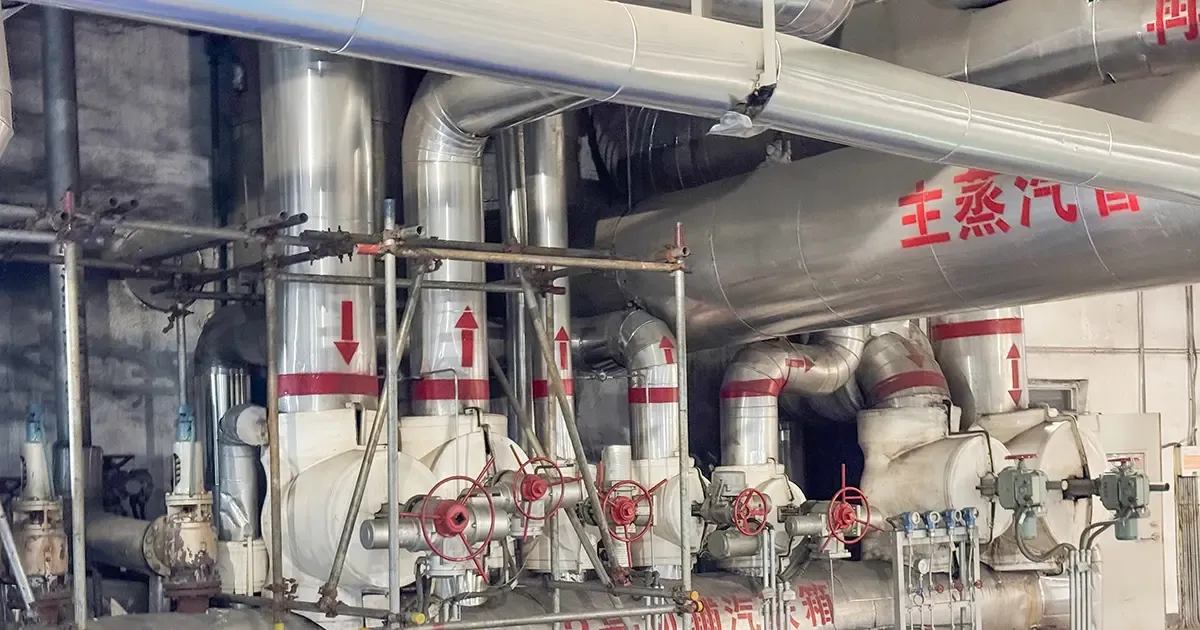
District heating networks move hot water or steam across long distances, and the insulation decision sits at the intersection of temperature, routing, fire safety, moisture control, and whole-life cost. There is no single material that covers every duty. Factory pre-insulated polyurethane (PUR) "pipe-in-pipe" systems remain the mature default for conventional buried hot-water mains and branches, because the insulation, casing, field joints, and leak monitoring form one continuous, low-risk system. Rock wool, glass wool, and calcium silicate fit better where the route is above ground, inside a gallery, at a pumping station, on valves, at high temperature, or in retrofit work that needs segmented, flexible, or irregular coverage. For material deep dives, see our rock wool insulation, calcium silicate insulation, and glass wool insulation guides.
Temperature tiers set the candidate shortlist
District heating operates across four temperature layers, and the design input should come from the actual source-grid-load, not from an industry rule of thumb written down as a fixed standard.
| Scenario | Typical temperature boundary | What it means for insulation and system |
|---|---|---|
| 4th-generation low-temperature | Supply about 50-70 °C; return target about 25-30 °C | Small temperature difference raises the share of loss per unit heat delivered; buried PUR still applies, but conductivity, casing, and joint thermal bridging matter more |
| Conventional secondary network | Supply about 80-90 °C; return about 40-60 °C | Most common case; controlling temperature layering saves more than simply adding thickness |
| Conventional primary network | Supply about 90-120 °C; return about 50-70 °C | Judge PUR service life by design peak temperature, annual load, and peak duration |
| High-temperature hot water or steam | 150-300 °C | Prefer rock wool, calcium silicate, and other high-temperature systems; conventional PUR/PE pipe-in-pipe usually does not fit |
A 2021 research study summarized 4th-generation district heating (4GDH) targets around 55 °C supply and 25 °C return, while noting that return temperatures of 30-40 °C are a realistic starting ambition for older buildings about to connect to a new network. Low-temperature networks are therefore not only about lowering the supply temperature: radiators, floor heating, domestic-hot-water exchange, hydraulic balancing, control strategy, and building retrofit must move together.
Buried mains still start with pre-insulated PUR -- but buy the system
The advantage of factory pre-insulated PUR comes from continuous factory encapsulation, not from the "PUR" name itself. The EN 253 family covers bonded pipe assemblies for directly buried hot-water networks: a steel service pipe, rigid PUR insulation, and a polyethylene casing, with a theoretical range from DN 20 to DN 600 and a continuous operating temperature up to 120 °C with occasional peaks to 140 °C. The steel pipe and PE casing are bonded by continuous foaming into one insulated and protected assembly; straight runs are made in the factory, and the site restores the steel pipe, casing, and insulation at the joints. The purchasing focus should therefore be "system capability," not a price comparison of PUR or steel per metre.
The joint is where factory performance either extends to the whole line or fails, and it is the concentration point of project risk. The design should include steel-pipe welding, non-destructive testing, casing connection or repair, on-site foaming or insulation restoration, and a closed loop of air-tightness and leak monitoring. Joint heat loss, water uptake, shrinkage, PE fusion defects, and monitoring-line continuity all belong on the acceptance checklist. Suppliers should provide type evidence and installation procedures matched to the project's soil class, burial depth, groundwater, traffic load, and maximum temperature; installer qualification, weather windows, foam batch records, and sampling all matter.
PUR's advantage should not be inflated into "fully waterproof, never ages." The closed-cell rigid foam in the EN 253 system suits direct burial, but any casing cut, scratch, joint, or monitoring-line exit becomes a water path. Once moisture enters, the insulation performance, long-term dimensional stability, and external corrosion risk on the steel pipe all rise. Direct-burial projects should define distributed temperature or leak monitoring, alarm thresholds, locating methods, and repair responsibility at the design stage -- not after commissioning.
Flexible pre-insulated systems, PE casing, or non-bonded systems suit specific short branches but should not be confused with standard steel PUR/PE systems. The EN 15632 family covers pre-insulated flexible district heating pipes with specific service-pipe, pressure, maximum-temperature, and joint-system scopes. Small courtyard networks, narrow trenches in old city areas, bends, or reduced site welding can be evaluated for flexible systems, but the decision should rest on hydraulics, operating temperature, pressure class, joint reliability, microbiology and oxygen management, and service life.
Compare materials by boundary, not by a single conductivity rank
No single table represents every rock wool, glass wool, or calcium silicate product. The table below uses representative values from public manufacturer and industrial-insulation standards for initial screening only. Procurement must replace the example values with the Declaration of Performance (DoP), technical data sheet, third-party test report, and applicable version for the exact grade purchased; "representative values" are not certification or warranty for any specific product.
| Material | Representative conductivity | Continuous service temperature | Closed-cell / moisture behavior | Compression and form | Typical Euroclass | Best location |
|---|---|---|---|---|---|---|
| Pre-insulated PUR foam | About 0.022-0.035 W/(m·K); varies with product, density, temperature, and aging | EN 253 conventional: continuous 120 °C, occasional peak 140 °C; confirm per system | Closed-cell foam; low uptake when casing intact, may take water at joints or damage | Factory-foamed, bears backfill load; excess heat or shrinkage weakens performance | Usually Class E or by product/end-construction test | Conventional buried hot-water mains and branches, and matched flexible systems |
| Rock wool pipe sections / flexible preforms | About 0.036-0.048 W/(m·K), rising with temperature, density, product | Common products to about 650 °C; confirm grade by DoP | Open fibre, not closed-cell; needs vapour barrier or metal jacket; check recovery after wetting | Semi-rigid / flexible; segmented, irregular shapes | Industrial mineral wool EN 14303 often A1; classify per EN 13501-1 | Above-ground galleries, pumping stations, valves, high-temperature hot water or steam, retrofit, A1-required layouts |
| Glass wool pipe sections / rolls | About 0.033-0.045 W/(m·K) class, by DoP and mean temperature | Common products mostly below about 400 °C; confirm by product | Fibrous, not closed-cell; needs casing, vapour barrier, continuous seams | Flexible; complex shapes and tight spaces | Industrial glass wool EN 14303 often A1; classify per EN 13501-1 | Indoor galleries, pump rooms, valves, space-limited retrofit, low-to-mid temperature runs |
| Calcium silicate pipe sections / preforms | About 0.050-0.065 W/(m·K) class, rising with temperature | Common products 650 °C; high-temperature grades may reach higher | Not closed-cell; capillary water-uptake risk; needs temperature-rated casing and sealed joints | Rigid, load-bearing, dimensionally stable; valve boxes, irregular parts, removable structures | Industrial calcium silicate EN 14306 often A1; classify per EN 13501-1 | High-temperature steam, pumping stations, valves, removable access parts, rigid-formed locations |
Rock wool and calcium silicate should be recommended for their scenario value, not marketed as "always better than PUR." At ambient temperature their apparent conductivity can exceed good PUR, but their high-temperature stability, inorganic non-combustibility, removability and repairability, irregular-fit adaptability, and on-site workability are hard for a continuous buried PUR system to replace. At pump rooms, valve pits, compensators, and gallery wall penetrations, access for maintenance often matters more than chasing the lowest single-point loss. Rock wool and glass wool pipe products are detailed on our rock wool pipe and calcium silicate pipe pages.
Fire rating is also not an absolute label detached from construction. Industrial insulation materials are classified under EN 14303, EN 14306, and EN 13501-1; a material reaching A1 does not mean the pipe casing, adhesive, coating, sealant, aluminium sheet, or valve packing all meet the same fire boundary. Markets in the Middle East and Central Asia may apply their own fire codes and test methods, so the design document should name the construction layer being evaluated, not just write "A1 material."
Assign by system: buried, above-ground, pumping station, retrofit
Buried directly buried hot-water mains and conventional branches default to pre-insulated PUR. It wraps insulation, PE/HDPE casing, steel service pipe, monitoring, and joints into one system warranty, suiting long continuous runs and fewer site variables. Reasonable boundaries are normal hot-water temperature range, stable corrosion environment, feasible factory production, and a supplier able to deliver system type approval and site quality control. Beyond the design temperature, frequent mechanical damage, frequent dismantling for inspection, high water table with uncertain casing integrity, or high-temperature steam duty should trigger re-review rather than forcing PUR.
Above-ground, elevated, and indoor galleries should prefer segmented rock wool or glass wool. Elevated pipe has no continuous PE casing; rain, condensation, ultraviolet, wind load, mechanical impact, and maintenance all enter the design. Rock wool pipe sections or flexible preforms wrap elbows, valves, compensators, and supports; glass wool suits machine rooms, irregular parts, and indoor low-to-mid temperature runs. Metal sheet, aluminium, or project-specified casing, circumferential and longitudinal seams, vapour barrier, support blocks, and cold-bridge treatment must appear on the material list -- not just "rock wool / glass wool, so many cubic metres" in the enquiry.
High-temperature steam and hot water above 150 °C prefer rock wool or calcium silicate. High-temperature hot water often uses high-density rock wool; steam, condensate, high-temperature valves, and removable access sections suit rigid calcium silicate. Both should be designed by operating temperature, pressure, displacement, condensate frequency, surface temperature, personnel protection, casing temperature rating, and inspection frequency. Where flexible rock wool products are used, confirm they will not lose unacceptable thickness under sustained compressive load at high temperature.
Retrofit should prioritize "fits the pipe, can be opened, casing can be restored." Flexible rock wool preforms, glass wool rolls, or removable valve covers suit tight spaces, complex non-stop conditions, or irregular existing runs; long straight sections that can still be excavated may still be more economical with pre-insulated PUR if temperature, life, and monitoring requirements are met. Retrofit enquiries must separate demolition, shutdown, drain/purge, anti-corrosion repair, temporary support, casing, testing, restart, and risk costs from missing as-built data.
| Scenario | First choice | Conditional alternative | Key acceptance points |
|---|---|---|---|
| Buried conventional hot water | Pre-insulated PUR/PE system | Steel casing or flexible pre-insulated system with project-specific verification | System standard, service-pipe welds, joints, monitoring, air-tightness, casing integrity |
| Elevated / indoor gallery | Segmented rock wool; glass wool in confined spaces | Calcium silicate for high-temperature rigid forming | Casing, vapour barrier, support cold-bridge, seams, surface temperature, access |
| Pumping station, valves, compensators | Rock wool; removable calcium silicate | Glass wool for low-mid temperature complex shapes | Removable construction, bolts, sealing, drainage, inspection space |
| High-temperature hot water / steam | Rock wool; calcium silicate | Only high-temperature verified dedicated systems | Operating temperature grade, expansion compensation, condensate, personnel protection, fire zoning |
| Existing gallery / non-stop retrofit | Flexible rock wool, glass wool, or removable preforms | Local buried sections per PUR system rules | Dimension re-measure, casing restoration, moisture assessment, phased shutdown plan |
Heat loss first, economic thickness second
The steady-state heat loss per unit length of a circular pipe must include the logarithmic radius. For a single, uniform, concentric insulation layer:
q = (T_i - T_o) / [ (1 / (2·π·k)) · ln(D_o / D_i) + 1 / (π·D_o·h_o) ]
where q is W/m; T_i is the medium temperature inside the steel pipe, in °C; T_o is the external environment temperature, in °C; D_i and D_o are the inner and outer diameters of the insulation layer, in m; k is the thermal conductivity at the corresponding mean temperature, in W/(m·K); and h_o is the external surface heat-transfer coefficient, in W/(m²·K). Direct burial replaces or adds the external boundary with soil thermal resistance, water table, burial depth, and pipe arrangement; ground, indoor, gallery, and outdoor elevated runs each have different h_o and radiation terms. ISO 8497 is the pipe-method standard for steady-state heat-transfer measurement of tubular insulation.
The following W/m examples are explicitly assumed engineering illustrations, not standard values or quotation bases. With medium 95 °C, ambient 5 °C, mean insulation temperature about 50 °C, apparent conductivity 0.033 W/(m·K), and external composite resistance 0.09 (m²·K)/W: DN100 steel pipe with 50 mm insulation is about 28 W/m; DN200 with 60 mm is about 42 W/m; DN300 with 70 mm is about 58 W/m. Raising the water temperature to 120 °C while holding other assumptions increases the driving temperature difference by about 26 percent, but material conductivity, joints, and soil boundary still change. A worked comparison shows a DN300 straight run under these assumptions loses about 2.1 times a DN100 run.
Economic thickness is not a fixed table; it balances incremental investment against lifetime heat-loss cost. For a candidate thickness sequence d, find the d that minimizes:
C_total(d) = C_cap(d) + Σ_{y=1}^{n} [ Q(d) · H · E_th,y / (1 + r)^y ]
where C_cap is the annualized cost of insulation material, casing, supports, installation, and joints; Q(d) is the annual heat loss after burial/above-ground boundary, in W; H is annual equivalent operating hours; E_th,y is the yearly heat price or cost; r is the discount rate; and n is the evaluation period. Expected rising energy prices push toward thicker insulation; high discount rates and short life push thinner. On site, start with a sensitivity check of "cost added per +10 mm thickness" against "W/m loss reduced × annual hours × heat price" at that thickness.
Thickness guidance must return to project inputs. Build a four-step workflow: fix medium temperature, environment, operating hours, and life; choose material grade and design conductivity; calculate W/m for the single pipe, valves, and joints; then compare economic thickness against heat price, labour, material, and capital cost. If the project requires surface-temperature control, anti-scald, condensation, fire zoning, or noise limits, those constraints may precede the economically optimal thickness. For the detailed calculation steps and formula walkthrough, see our guide on how to calculate insulation thickness.
Compliance and system verification follow the standard object
EN 253 answers the pre-insulated bonded pipe component, not the whole network design. EN 253 covers the steel pipe, rigid PUR, and PE casing for bonded straight pipe components in buried hot-water networks, classically DN 20-DN 600, continuous 120 °C, peak 140 °C. When adopting the 2022 or later version, check the national adopted version, cited-standard changes, and the manufacturer's type-test scope.
EN 13941 answers the design and installation of pre-insulated bonded systems. EN 13941-1:2019 is titled "Design and installation of preinsulated bonded pipe systems in district heating." The procurement document should require it as the framework for buried stress, expansion, anchoring, fatigue, soil-pipe interaction, joints, alarm line, and life analysis -- not merely "insulation thickness notes."
EN 15632 answers flexible pre-insulated systems and must not replace steel PUR/PE system requirements. EN 15632-1:2018 is titled "District heating pipes -- Preinsulated flexible pipe systems -- Part 1: Bonded plastic service pipes." For steel service pipe, PE casing, and PUR insulation in conventional systems, use the EN 253 / EN 13941 family; EN 15632 applies within its defined flexible service-pipe scope.
ISO 8497 and the material product standards solve different problems. ISO 8497 measures steady-state heat-transfer properties of tubular insulation; EN 13162 covers factory-made mineral-wool products for building use, EN 14303 covers factory-made mineral-wool products for building equipment and industrial installations, and EN 14306 covers factory-made calcium-silicate products for the same scenario. Products exported to the EU should further check DoP, CE marking, AVCP system, test reports, and the adopted version of the target country -- not decide compliance from a single brochure page.
| Standard / method | Covers | Use in this project |
|---|---|---|
| EN 253 | Bonded straight pipe components for buried hot-water networks | Baseline for factory straight-pipe structure, PUR, PE casing, temperature boundary |
| EN 13941-1:2019 | Design and installation of preinsulated bonded pipe systems | Framework for buried stress, expansion, fatigue, life, joint design |
| EN 15632-1:2018 | Preinsulated flexible pipe systems, bonded plastic service pipes | Boundary, products, and applicability of flexible systems |
| ISO 8497 | Steady-state heat-transfer measurement of tubular insulation | Thermal test method; material data should carry test temperature and boundary |
| EN 13162 | Factory-made mineral wool for buildings | Building-product compliance; industrial equipment should use EN 14303 |
| EN 14303 | Factory-made mineral wool for industry | Main compliance baseline for rock wool / glass wool pipe sections, rolls, preforms |
| EN 14306 | Factory-made calcium silicate for industry | Compliance baseline for calcium silicate pipe sections, preforms, high-temperature products |
Installation, fire, moisture, and monitoring together decide life
Buried projects should control thermal bridging and moisture with a complete joint procedure. After the site steel-pipe weld, restore the PE casing per the system supplier procedure, treat the foam cavity, inject or fill PUR, check venting and curing, complete the monitoring-line connection, and run air-tightness or leak checks. Wet conditions, low temperature, poor ventilation, inaccurate dosing, and unfilled cavities can cause local shrinkage, voids, and extra thermal bridging. The procurement document should state joint pass rate, sampling frequency, rework responsibility, and data archiving.
For above-ground industrial insulation the key order is: fit the pipe, seal the seams, apply vapour barrier or casing, manage drainage, and set supports. Rock wool and glass wool fibre structures are not a natural waterproof barrier; in outdoor, high-humidity gallery, condensation, or washdown environments, use a suitable casing, check end closures, longitudinal and circumferential seams, wall sleeves, and drainage direction. Calcium silicate carries moisture and capillary water-uptake risk; rigid material is not "water-resistant material."
Fire design must consider the insulation layer, casing, supports, and access path together. Combustible casing or sealant can add contribution in a fire; an inorganic A1 insulation core does not burn, but without continuous casing, flame can still travel through cavities and gaps. Cables, data lines, alarm lines, and plastic monitoring elements should be coordinated with heat source, mechanical protection, and fire zoning.
Leak monitoring earns its value in early detection, not by replacing good workmanship. Buried PUR systems can integrate an alarm line at manufacture and joints, identifying water ingress, hot spots, and damage through loop continuity, impedance change, or distributed temperature measurement. Its effectiveness depends on cable type, joint connection, termination, calibration, software alarm thresholds, and operations response. The system should define the responsibility and time limit for "alarm -- locate -- verify -- shutdown / depressurize -- excavate and repair."
Engineers and buyers should lock the specification around system boundaries
Engineers should deliver a technical package that procurement can verify. At minimum: maximum / design / normal medium temperature, peak duration, supply and return temperature, pressure class, and flow; routing, burial depth, soil, groundwater, and load; pipe diameter, alignment, supports / anchors, compensators, valves, and irregular-part list; insulation material standard and declared conductivity, temperature, density, fire class, casing, and vapour-barrier requirements; heat loss, surface temperature, anti-scald, condensation, and economic-thickness calculation; joints, monitoring, non-destructive testing, pressure test, air-tightness, and acceptance criteria.
Buyers should break "material price per metre" into system cost. The cost of pre-insulated PUR pipe includes at least steel grade and wall thickness, PUR density and thickness, PE casing grade, monitoring line, straight pipe, elbows / tees / reducers, valve parts, compensators, transport, joint material, special machinery, on-site foaming, welding, casing restoration, non-destructive testing, pressure test, monitoring commissioning, and stock margin. Public regional cost information shows a DN300 pre-insulated pipe can cost roughly 3.8 times a DN100 line of the same family, but this configuration- and region-specific sample only shows how fast published price moves with diameter and project composition; it cannot be read as European or global pricing. When no same-basis global quote exists, an honest range beats a pseudo-precise number. Public price depends on steel, wall thickness, PUR thickness and density, PE casing grade, monitoring configuration, elbows and valves, transport distance, joint count, and local construction conditions; different countries add tariffs, certification, exchange rates, and taxes. At procurement, first obtain an itemized bill of materials and at least three suppliers' equivalence comparisons; with only a straight-pipe per-metre price, you cannot judge total project cost.
Supplier review should replace marketing language with evidence. Require: intended grade and standard version; declared conductivity and test temperature; temperature-aging declaration; third-party fire or reaction class; compressive, water-uptake, or short-term water-uptake data; casing, bonding, and joint tests; monitoring-line compatibility; on-site training; type-test and project-test boundaries; warranty period and failure responsibility. If a supplier claims a rock wool or calcium silicate product "suits 300 °C," check that the DoP, installation construction, casing, supports, and compensators also apply.
Conclusion: continuous buried systems choose PUR, above-ground and high-temperature choose scenario-built preforms
For conventional-temperature buried district heating, the first choice remains the PUR pre-insulated pipe verified by the EN 253 / EN 13941 family -- not blind preference for PUR, but objective recognition of its factory-continuous insulation, casing integrity, and mature joint system. For above-ground galleries, pump rooms, valves, compensators, high-temperature hot water or steam, and existing-network retrofit, rock wool and calcium silicate have clear roles: the former excels at flexible pipe-fitting, irregular wrapping, removable maintenance, and high-temperature systems; the latter at rigid forming, valve boxes, and high-temperature load-bearing; glass wool suits space-limited, indoor low-to-mid temperature, and complex shapes. See the pipe insulation application page for related use cases.
The final decision should form a closed loop of "medium temperature -- routing -- material grade -- insulation thickness -- casing / vapour barrier -- joints / monitoring -- life cost." For the European market this requires EN / ISO and Construction Products Regulation compliance as the backbone; for export projects in the Middle East, Central Asia, and similar markets, layer local regulations, climate, and contract requirements on top. Only by first unifying the engineering boundary, then placing product DoP, installation procedure, and whole-life cost in the same table, can you avoid wrong selection driven by a single conductivity, a fire label, or a material price per metre.
Frequently asked
Best insulation for heating pipes? +
There is no single best material. Buried conventional hot-water mains default to pre-insulated PUR systems; above-ground galleries, pump rooms, and retrofit commonly use segmented rock wool products; high-temperature hot water and steam systems prefer rock wool or calcium silicate; space-limited, low-to-mid temperature, and complex irregular locations can evaluate glass wool. Selection should take operating temperature, routing environment, fire, moisture, maintenance, and whole-life cost as inputs.
How thick insulation for district heating? +
It should be calculated from cylindrical steady-state thermal resistance, environmental boundary, material conductivity at mean temperature, heat price, annual operating hours, investment, and discount rate -- not copied from a fixed millimetre table. First set the minimum thickness by allowable heat loss, surface temperature, or anti-scald constraint, then compare economic thickness; suppliers should also give W/m data for joints, valves, compensators, and gallery wall penetrations.
Is PUR always better than rock wool or calcium silicate? +
No. PUR has the advantage of continuous casing and lower conductivity in conventional buried systems; rock wool, glass wool, and calcium silicate win on high temperature, fire, irregular shapes, removable maintenance, and above-ground casing restoration. The right question is which system and construction fit the duty, not which material name beats another across scenarios.
What is the service temperature limit of pre-insulated PUR pipes? +
Judge it by the specific system, not a loose marketing value. The EN 253 historical public range includes continuous operating temperature to 120 °C with occasional peaks to 140 °C. At procurement, confirm the type boundaries and life declarations of the steel pipe, PUR, PE casing, monitoring line, and joints separately; projects beyond the normal system temperature range should move to high-temperature-verified systems.
Pre-insulated pipe cost: how much per metre? +
There is no single public price that transfers directly across Europe, the Middle East, and Central Asia. Cost includes at least steel, PUR, PE casing, monitoring line, fittings, valves, transport, welding, joints, on-site foaming, testing, commissioning, and margin. Regional public information shows diameter strongly affects price, but it cannot replace a formal quote with the same configuration, region, and delivery.
Can calcium silicate be used underground? +
Yes, but usually within a trench, gallery, steel casing, or inspectable system -- not as a simple replacement for the complete continuous PE-cased PUR direct-burial construction. Calcium silicate is a non-closed-cell rigid material with moisture and capillary water-uptake risk that must be managed; casing, seams, supports, drainage, and inspection conditions should be defined at the design stage.
Request a quote
Interested in our insulation solutions? Send us your requirements and our team responds within one business day.