
Oven & Kiln Door Insulation: Cut Heat Loss and Surface Temperature
Oven and kiln door insulation: three heat-loss paths, material selection (ceramic fiber, rock wool, calcium silicate, aerogel), installation, energy accounting and touch-temperature safety.
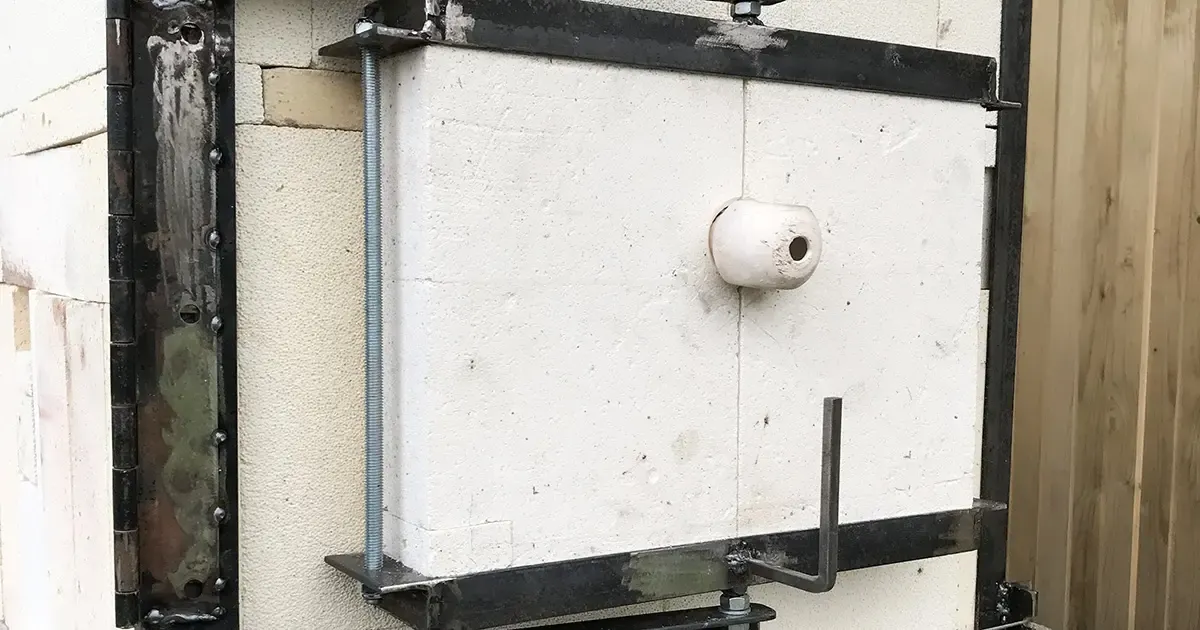
A furnace or kiln door is not simply a thinner or thicker version of the wall. It must simultaneously handle refractoriness, sealing, mechanical opening and closing, maintenance access and burn protection. Three heat-loss paths stack on top of each other: conductive thermal bridging through the multi-layer door panel, view-port and seal-gap radiation from the hot cavity, and hot-gas exchange when the door opens or leaks, and their magnitude grows non-linearly with furnace temperature. This guide explains how to select, install and verify door insulation so the result is lower energy use and a safer outer surface, not just a cooler-looking shell.
1. Why Doors Are Harder to Insulate Than Continuous Walls
A door is an active thermal boundary. A continuous furnace wall can be thick, uninterrupted, anchored on the cold face and closed by an outer jacket. A door, by contrast, must lift, slide or swing repeatedly; its edges must leave mechanical clearance, and its seals are governed by compression fatigue, slag buildup, thermal expansion and frame distortion. Hinges, latches, anchor bolts, view ports, burners, thermocouples and locks pull high-conductivity metal through the insulation. The door's own weight and the shock of opening and closing also rule out linings that are too thick or too heavy. The result: at the same furnace temperature, a door's heat loss per unit area is often higher than the adjacent wall, and the hot spot is not always at the panel center.
The three paths must be measured separately:
| Path | Physical mechanism | Door-specific amplifier | Primary control |
|---|---|---|---|
| Panel conduction | Flame or gas to working layer to back-up to steel to jacket, including solid conduction, pore-gas convection and radiation | Hinges, latches, anchor bolts, window frames, thinned lining, repeated thermal cycling | Layer-by-layer resistance design, cold-face anchoring, thermal break, staggered joints |
| Cavity radiation | Hot inner surface radiates through gaps or openings to the cooler outer side | Door bottom edge, corners, view holes and distorted seal lines are always-open vents | Labyrinth or overlap, high-temperature braided rope or shaped seals, even clamping pressure |
| Gap leakage and purge | Pressure difference draws in cold air and expels hot gas, carrying sensible heat, and chemical heat in combustible atmospheres | Frequent charging, furnace-pressure swings, door not fully closed, failed seal compression | Door knife, sand seal or labyrinth, position limit and close confirmation, fewer needless openings |
Standard furnace heat-balance methods list door and opening radiation and purge physical plus chemical heat as separate items rather than folding them into wall losses. The practical conclusion for any retrofit: measuring only the outer-surface temperature does not prove energy savings. At minimum, also record door-seam thermography, opening count and duration, furnace pressure, and fuel or electric power.
A door is also more vulnerable to local failure than a wall. A 300 mm shrunken module will not immediately destabilize a whole wall, but a 1 m bottom-edge leak with only 0.5 mm equivalent opening is a steady radiation vent at high temperature; if the door also opens every ten minutes, transient purge can dominate steady conduction within a batch cycle. Retrofit priority is therefore usually: first eliminate abnormal hot spots and through-leaks, then configure the working layer by hot-face temperature, and finally optimize the cold-face jacket and removability.
2. Temperature Zones and Design Starting Points
| Zone | Process hot-face reference | Primary function | Common logic | Do not assume |
|---|---|---|---|---|
| Low-temperature oven | up to about 250 °C | Moisture resistance, low heat storage, touch safety | Thin working felt or board plus continuous jacket; removable jacket for access doors | High-temperature fiber is automatically more efficient |
| Mid-temperature furnace | 250 to 800 °C | Thermal-shock resistance plus cold-face insulation | Fiber working layer or module plus rock wool or calcium silicate back-up, staggered joints | Use room-temperature conductivity to calculate 600 °C flux |
| High-temperature kiln | 800 to 1300 °C, locally higher | Refractoriness, low shrinkage, controlled frame heat load | Lightweight refractory or high-grade fiber working layer plus independent back-up plus thermal-break anchors | Classification temperature equals continuous allowable hot face |
| Ultra-high or corrosive local | above 1300 °C or aggressive atmosphere | Working-layer survival first | Thick fiber, special refractories, composite insulation away from the personnel side | Aerogel or rock wool can sit on the flame face |
Low-temperature ovens (roughly minus 50 to 250 °C process hot face, common control band 60 to 200 °C) should first solve surface contact, moisture resistance and mechanical durability. The heat flux through the panel is small, and mistakes usually come from placing a high-temperature, moisture-absorbing, dusty or permanently compressing material on the personnel-touchable side. The cold face can use closed-cell or elastic insulation, rock wool board or low-density felt; if the door may be exposed to water, cleaners or grease, verify material compatibility and a moisture-resistant jacket. Do not cite withstanding 1000 °C as an advantage: a high-temperature fiber lining is more expensive, dustier, and cannot by itself lower an 80 °C door's outer temperature.
Mid-temperature furnaces (about 250 to 800 °C) are the classic battlefield for composite linings. The working layer takes thermal shock, gas erosion and occasional load impact; the back-up drops the steel to a manageable temperature. Ceramic-fiber blanket or module plus a rigid back-up is a common combination; rock wool can serve the cold face but must be protected from edge compression, moisture, vibration and local hot spots. The key at mid temperature is not the single lowest conductivity but tight interlayer contact, staggered seams and metal parts that do not become through short-circuits.
High-temperature kilns (about 800 to 1300 °C, locally higher) must decouple classification temperature from long-term service temperature. Ceramic-fiber modules, high-alumina or zirconia-containing fiber products, lightweight refractory working layers and their back-ups should be selected by actual hot face, atmosphere, velocity and over-temperature events. Standard calcium silicate insulation products should not be treated as a 1000 °C working layer; and an aerogel graded at a high classification temperature does not mean its glass-fiber or silica-enhanced reinforcement, stitching, coating or jacket can serve the same hot face long term. Require the supplier to provide: permanent linear change at hot-face temperature, conductivity curve, fire and smoke-toxicity data, separate temperature rating of reinforcement and facing, and a hot-face test on a sample matching the real structure.
3. Five Material Families: Capability, Limits and Installation Coupling
3.1 Ceramic-fiber blanket, board and module
Ceramic fiber is the baseline for high-temperature door linings, but blanket and module are not the same construction object. A blanket suits facing, irregular cutting, gap filling and back-up; a board suits areas needing some rigidity, clean cut edges or compression limits; a module is a pre-compressed, bundled blanket with embedded anchors that springs back after installation to compensate shrinkage and form a thicker working layer. Public technical data give common classification grades such as 1050, 1260 and 1400 °C, and conductivity at the same grade rises noticeably with mean temperature, for example a 1260-grade, 128 kg/m3 blanket at mean 200, 400 and 600 °C has a conductivity roughly 0.045 to 0.060, 0.085 to 0.110 and 0.152 to 0.200 W/(m·K). These are vendor data-sheet values for first estimates only; the design must obtain the target density, atmosphere, compression and measured curve.
Module assembly's advantage is spring-back gap filling after thermal shock, lower weight than brick, and low heat storage; the cost is anchors passing through the insulation and seams forming at module dead points and corners. Public installation guides distinguish pinwheel and straight-row layouts: the latter usually controls seams more predictably. Either way, a door cannot use the wall's large-panel thinking: modules must avoid the hinge envelope, latch penetration zone and view-window thermal-distortion zone; corners should use shaped parts rather than torn filler.
Best for: above 250 °C up to a high-temperature flame-face back-up or working layer; frequent thermal cycling, irregular doors, weight reduction. Use with caution in strong alkali, hydrofluoric or phosphate, high-velocity dust erosion, or repeated mechanical impact unless chemical compatibility and wear structure are confirmed. Do not read fiber does not melt as fiber never shrinks or sheds.
3.2 Rock wool board and blanket
Rock wool is a mature, economical cold-face layer for low and mid temperatures, not a universal flame-face working layer. Under current product standards, industrial rock wool's room-temperature conductivity is typically about 0.038 to 0.040 W/(m·K), and stable long-term service commonly tops out near 650 °C; conductivity rises and binder or fiber durability fall as temperature climbs. It suits flat interior door-shell areas, the back of access doors, the interior of low-temperature oven jackets, and the second cold-face defense of a high-temperature door lining.
Advantages: cuttable, mature cost and supply chain, non-combustible. Disadvantages: after compression, thickness depends on the jacket; it can settle under moisture, open air or vibration; bare fiber is unfriendly to installer breathing and skin. On doors especially, avoid stuffing rock wool into the frame gap as a seal. It insulates but has no repeatable compression-spring sealing function, and after thermal cycling it powders and forms larger gaps.
3.3 Calcium silicate board
The value of calcium silicate board is rigid cold face plus dimensional stability, not the lowest conductivity at very low temperature. Published test data show samples at density about 170 to 440 kg/m3, with conductivity rising from about 0.04 to 0.10 to 0.14 W/(m·K) as mean temperature goes from 100 to 600 °C, and density is not always better. Ultra-light samples may be lower at low temperature, but pore-gas convection strengthens at high temperature and the curve rises more steeply. Treat this as experimental-trend information, not a product test report.
Best for: door-shell areas needing screw or clip fixation, where the jacket should not bulge locally and the back-up needs some compression strength; it can form a soft working layer plus rigid back board with staggered fiber blanket. Not suitable as a direct 1000 °C flame face expecting a standard 650 °C-grade product to survive long term; not suitable for small-radius sharp-corner wrapping; screw spacing, edge distance and board joints must be rechecked in the hot state to avoid thermal-expansion cracking.
3.4 Aerogel composite blanket and board
The correct selling point of aerogel is space efficiency, not a glib 0.02 at room temperature. International aerogel composite product standards classify products into types by classification temperature, roughly 200 °C, 450 °C, 650 °C, and above-650 °C grades that must state the specific temperature in the marking, and give conductivity requirements by type and grade. This means nanoporous or aerogel is not a single material grade; the blanket core, reinforcing fiber, needling or stitching, and film or fabric facing can each have different temperature limits.
Best for: where interior clearance is insufficient yet the outer surface must drop significantly; flexible cutting with moisture-resistance advantage; thin cold-face layers or combination with a high-grade fiber working layer. Use with caution and must verify: direct flame-face exposure, high-velocity dust erosion, repeated bending causing reinforcement fatigue, stitching and facing exceeding their own grade, and suppliers offering only a single 25 °C conductivity point. Engineering practice: place aerogel on the cold face where temperature has already dropped into its validated range, or use a composite door structure verified by a full-scale hot-face test; do not treat the aerogel facing as an extension of the blanket-core temperature rating.
3.5 Removable insulation jacket
A removable jacket is a maintenance-access engineering system, not a thicker piece of felt. A typical build has an inner high-temperature barrier, a middle main insulator, and an outer wear or burn-protection fabric, with lacing, buckles, hook-and-loop, spring clips, stainless tensioners and local shaped guards. It suits valves, flanges, manholes, view-window frames, access doors and frequently reworked control zones; for a whole heavy kiln door where the opening mechanism, clamping and sealing are integrated into the door, a removable jacket is usually only an outer or jacket burn-protection layer and cannot replace the inner working lining or the door-knife seal.
Advantages: maintenance without destroying insulation, re-installable, good for irregular shapes, easy thermography and inspection openings. Disadvantages: seams or overlaps are thermal bridges, buckle zones get thinned, and fabric and fastener life are affected by ultraviolet, oil, splatter and repeated removal; wrong patterning can stop the door from closing fully. If a door is serviced weekly, a permanent cast lining may have higher whole-life cost; if a door is untouched for ten years with ample space, a permanent lining is usually more controllable and has fewer human re-assembly errors.
| Material or system | General temperature zone, conservative envelope | Typical thickness thinking | Strengths | Main failure mode | Best door role |
|---|---|---|---|---|---|
| Ceramic-fiber blanket, board or module | about 850 to 1430 °C by grade; lower on cold face | Working layer 25 to 100 mm; modules often 150 to 300 mm class structure | Thermal-shock resistant, light, irregular-shape capable | Shrinkage seams, anchor thermal bridges, dust or erosion | High-temperature working layer, corner fill, modular door lining |
| Rock wool board or blanket | Cold face up to about 650 °C | 25 to 100 mm by cold-face drop | Economical, mature, easy to cut | Compression settlement, moisture, vibration | Low or mid-temperature back-up, access-door cold face |
| Calcium silicate board | Standard to about 650 °C; special high-temp grade verify separately | 20 to 50 mm as back-up | Rigid, dimensionally stable, mechanically fixable | Brittle cracking, thermal-expansion edge lift, no small-radius wrap | Flat cold face, jacket substrate |
| Aerogel composite blanket or board | By type or grade, verify; low room-temp conductivity | 3 to 30 mm thin layers | Thin, light, moisture-resistance potential | Rising high-temp conductivity, reinforcement or facing limits, bend fatigue | Space-limited cold face or composite thinning |
| Removable jacket | Set by the system grade from inner to outer layer | 10 to 80 mm system thickness | Re-installable, good access | Seam or buckle thermal bridges, uneven compression, mis-assembly | Access ports, window frames, piping, outer burn guard |
The temperature zones in the table are screening envelopes, not a guarantee for any product; thickness is an output variable of the later thermal-resistance calculation, not a procurement list.
4. Installation Methods: Adhesive, Anchoring, Module Assembly and Jackets
No single installation method optimally satisfies flame face, air tightness, removability and mechanical impact at once. The design order is: first set the hot-face or cold-face zoning and service frequency, then choose the connection, not pick a material and then find a way to glue it on.
Adhesive or facing. Suits low temperature, flat steel, mild thermal cycling and jackets not frequently removed. The high-temperature adhesive must be compatible with the steel, fiber or board expansion, curing volatiles and service atmosphere; the adhesive layer itself adds contact resistance and may embrittle at high temperature. Acceptance is not initial tack can lift the part but hot-state shear, void rate after thermal cycling, and corner warping. Door bottom edges and windward faces should not rely on adhesive alone, because charging impact and gas flow quickly enlarge a peel that starts at one edge.
Mechanical and cold-face anchoring. High-temperature fiber modules are usually locked to the door shell with pre-welded studs, sleeves or nuts, or clips. The principle: keep the metal anchor on the low-temperature side and reduce thermal short-circuit with ceramic sleeves, washers or fiber wrap. Anchor material is chosen by flue-side peak temperature, sulfur or chlorine atmosphere, and oxidizing or reducing conditions; do not assume 304 is universal. Public refractory-fiber guidance also warns that strongly reducing atmospheres often need a margin below the classification temperature, and anchors touching flue gas directly need their temperature grade upgraded separately. Anchor points must avoid the frame clamp line, view window, hinge torque zone and seal groove. Each anchor is a local thermal bridge: a thin-section stud is usually a small fraction of wall flux, but on a door with high anchor density and thin steel it cannot be ignored. Model anchors as a separate parallel thermal path, or at least confirm with thermography whether star-shaped hot spots appear.
Module assembly. Key steps: door-shell derusting and protection and layout, anchor welding with non-destructive or visual sampling, staggered back-up lay-up, module center-hole alignment and locking, fill blanket strips or compression seams by layout type, release bundling and let modules spring back in a controlled way, trim the working face, check window and seal grooves, hot-state curing and re-tightening or seam repair. Do not cut all module bands at once and then look for shape; do not use sharp metal to press module corners to fake a door-closes gap.
Jacket clasps and seams. The jacket pattern must come from a measured template or 3-D scan, with allowance for thermal expansion, handle travel, latches and hose penetrations. Seams should run with airflow or water-drip direction; overlap is verified against hot-state displacement; clip points should press on reinforced zones, not squeeze the insulation to zero thickness. For a high-temperature door, the inner layer of an outer jacket must still match the real hot-face grade; the outer fabric is only protection, not the main insulation proof. Each removal should have photos and a re-assembly checklist: misalignment, curl, exposed metal, unclosed overlap and burned fasteners all returned to zero.
5. Heat Loss, Surface Temperature and the Energy Accounting Method
5.1 Steady-state closed door: layer-by-layer resistance, not a single conductivity
For a flat, closed, crack-free door panel, heat flux per area is first estimated as one-dimensional series:
q equals (T_hot minus T_surf) divided by R_total, where R_total equals 1/h_in plus the sum of (delta_i divided by lambda_i at T_m,i) plus 1/h_out at (T_surf, v).
Here T_m,i is the mean temperature of layer i, and each lambda_i must be taken from its curve at that mean temperature; h_in includes flue convection and cavity radiation, h_out includes outer natural or forced convection and external radiation. The surface temperature is then back-calculated from q equals h_out times (T_surf minus T_amb). Teaching examples in heat-transfer texts have used h_in equals 500 and h_out equals 9.5 W/(m2·K) for a 400 °C oven exercise, but that is a specific assumption and must not be copied to a real door. A vertical door in still indoor air is often a first-estimate range of 8 to 12 W/(m2·K); with cross-wind, high-temperature external radiation or a stagnant cavity between guards, measure or use computational-fluid-dynamics correction.
Why lowering the outer-surface temperature is not the whole energy story: increasing outer-surface heat transfer, for example fins or strong wind, also drops the shell temperature without reducing in-furnace heat. Acceptance must report q or fuel or electric power together, not just an infrared photo of shell at 60 °C.
5.2 Gap radiation: the fourth-power term decides a high-temperature door's fate
Effective gap radiation can be estimated with:
Q_gap equals A_eff times phi times epsilon_sys times sigma times (tau_open divided by 3600) times ((T_cav divided by 100) to the fourth power minus (T_amb divided by 100) to the fourth power).
Here A_eff is not the door perimeter times an imagined gap, but the equivalent opening area from thermography, pressure-film or smoke test combined with a feeler gauge; phi is significantly below 1 for deep grooves, labyrinths and obstructions; epsilon_sys is the system effective emissivity of the hot inner surface and the cool receiver; normalized to a full hour, tau_open is the equivalent seconds of steady open mouth in that hour. Standard furnace heat-balance methods separate the view factor, opening temperature, environment and opening time explicitly, precisely to avoid mistaking one thermographic bright line for whole-door-area radiation.
5.3 Opening and purge: use mass balance, not feel
Q_purge equals V_leak times rho times c_p times (T_gas minus T_amb) times delta_t.
V_leak is best obtained from furnace-pressure or flow calibration, tracer or velocity matrix or heat-balance residual; each door opening, cold-air entrainment and hot-gas rise are often not the same flow. A positive-pressure furnace must prevent hot-gas escape; a negative-pressure furnace must prevent cold-air ingress that pulls furnace temperature down and raises combustion load. Keep product rhythm, charge temperature, furnace-pressure setpoint and ambient temperature consistent before and after retrofit, otherwise energy savings may just be fewer door openings, a shift change or cooler weather.
5.4 Heat storage and transients
Each heat-up or opening absorbs door-lining heat E_door equals the sum of rho_i times c_p,i at T times delta_i times A, lengthening heat-up and adding first-cycle load. The low density of fiber and aerogel helps not only steady lambda but also low heat storage; thick calcium silicate or cast layers are more shape-stable but cost more heat-up energy. If production is short-cycle with high-frequency charging, the transient term can matter more than steady conduction; use hourly or finite-difference models, at least doing the three ledgers of closed steady state, opening event and heat-up storage.
5.5 A reproducible example, keep the assumption boundaries
Assume: net door area A equals 2.0 m2, cavity T_h equals 850 °C equals 1123 K, ambient T_a equals 25 °C, annual equivalent operation 6000 h; conduction dominates when closed, and bottom-edge effective-gap radiation is given by the example parameters. For demonstration, take pre-retrofit total steady equivalent loss 7.4 kW and post-retrofit 2.8 kW, a drop of 4.6 kW.
Annual energy saved: E_save equals 4.6 kW times 6000 h equals 27,600 kWh equals 99.36 GJ.
If the door feeds a gas system, with furnace-to-flue total heat utilization of 90 percent, avoided fuel thermal equals 99.36 GJ and fuel-metered savings equals 99.36 divided by 0.90 equals 110.4 GJ/a. If the door boundary is metered directly by electric heating, at 100 percent efficiency that is 27.6 MWh/a; at an overall electrothermal efficiency of 95 percent, about 29.1 MWh/a at the grid side. The efficiency basis must be written into the baseline protocol beforehand.
Simple payback is far more sensitive to whether the gap is fixed together, energy unit price, and downtime opportunity cost than to the material brand. A representative fuel scenario with material, anchors, seal, jacket, removal, shutdown and testing capitalized, plus annual operation or inspection, can show a simple payback on the order of several years; adding gap repair that removes another about 1.5 kW of purge can shorten it substantially. These are parameter exercises, not quotes or a specific plant's actual results.
| Sensitivity variable | Direction of effect on payback | How the engineer must lock it down |
|---|---|---|
| Annual operating hours | Linear scaling of annual benefit | Measure by rhythm, shift, seasonal shutdown; do not default to 8760 h |
| Furnace temperature and opening frequency | Fourth-power on radiation, linear on purge | Record temperature curve and door events by product family |
| Furnace pressure or seal state | Can multiply purge by several times | Same pressure setpoint and differential sensor before and after |
| Energy unit price and heat recovery | Changes monetary benefit, not heat loss | State lower heating value, time-of-use price or blended unit price |
| Downtime window | Can dominate CAPEX | List production-loss cost separately, not mixed with material cost |
| Life or re-inspection | Sets repeat retrofit and O&M | Rate life by thermal cycles, permanent compression, and breakage sampling |
6. Outer-Surface Contact Safety: Use Time, Material and Condition, Not a Magic Line
General industrial safety thinking should first eliminate unintended contact, then discuss temperature. The ANSI or OSHA family's general approach treats hot surfaces as identifiable hazards, using engineering controls such as insulation, barriers, handle travel, interlocks or limits, administrative controls such as training, no-touch zones and lockout or tagout, and personal protective equipment such as heat-resistant gloves and long sleeves in layers; whether a specific clause applies must still be judged by local regulation, equipment type and site system. This article does not present any single temperature as a uniform ANSI or OSHA allowable value.
The ISO 13732-1 risk-assessment method gives a useful engineering reference: under long-contact conditions where the surface temperature is assumed maintained by the heat source during contact, uncoated metal is about 51 °C at 1 minute, 48 °C at 10 minutes and 43 °C at 8 hours or more; ceramic, glass or stone about 56 °C at 1 minute; plastic or wood about 60 °C; longer contact converges to about 43 to 48 °C. Short contact is not 52 °C absolutely safe: contact pressure, skin wetness, material thermal inertia, contact area and individual reaction time all turn the threshold into a band, and the standard draft itself states short-contact data are not yet complete.
Practical boundaries for door design:
- Handles and outer jackets that personnel may grip, lean on or accidentally contact continuously: target the long-contact zone, keep the surface preferably below about 43 to 50 °C with insulation or grille; this is not a claimed regulatory red line.
- Areas only accidentally touched, small area, where the hand reflexively withdraws: a higher-temperature risk assessment is allowed, but it must also satisfy no protruding sharp edges, no melt-drip, no reflective radiation to the face, no children or visitors entry, and be verified by thermography and contact measurement.
- Metal jackets feel hot faster than same-temperature fiber jackets: higher thermal inertia and contact conductivity; a coating or fabric can delay skin-temperature rise, but a hidden hot spot underneath can still burn.
- Any surface temperature should be measured at the worst condition: summer ambient, full-furnace soak, door half-open, failed seal, stalled cross-wind, and after several consecutive opening cycles, not cold-start 10-minute data.
Burn-protection acceptance should form four records: full-field infrared thermography and the highest point; patch or contact thermometer recheck at steady state; gloved or ungloved touch test by trained personnel under a written job safety analysis; separate judgement of high-probability contact points such as handles, latches, hinges and skirts. A low outer temperature does not equal a safe door seam: a 1 mm-high, 1000 °C radiation vent will not make the shell hot but can burn an arm, ignite a cuff or heat nearby cables.
7. Retrofit Cases: What to Learn, What Not to Extrapolate
What is learnable is the measurement structure and failure mechanism, not a promotional percentage. Public petrochemical heater retrofit reports describe: after spraying 50 mm of lightweight ceramic fiber on the radiant-chamber lining, part of the outer wall measured below 50 °C; while a bend-box area remained at 180 to 200 °C, later brought to about 80 °C only after adding high-density alumino-silicate and an outer plate with silicate fill in the box void; simultaneously, air in-leak and oxygen-content swing were solved through new packing material and a sight-hole cover. This is not a door case, but it proves three things: hot spots are often at geometric discontinuities; adding inner lining and adding outer insulation solve different temperature bands; and sealing and oxygen-content or furnace-pressure are part of the same heat-loss chain.
Public cement-kiln shell reports have listed, for a 900 °C comparison, an original shell of 71 to 50 °C and 781 to 445 W/m2, about 43 percent drop, and a 1200 °C case of 132 to 100 °C and 1600 to 1025 W/m2, about 36 percent drop. These are equipment-body, specific-structure, supplier-site data with no door opening, door seam or mechanical constraint, and must not be written as door retrofit saves 36 to 43 percent. This article uses them only to show: at high temperature the thermal resistance of multi-layer structures is non-linear, the positional value of a thin high-performance layer, and why W/m2 must be used rather than shell temperature difference.
Another verifiable benefit comes from operating discipline. Public steel-line reports describe changing a furnace door from always open to fully closed when stopped, raised only about 120 mm above the billet during production, measuring coal-gas consumption down 0.73 m3/t with a meaningful monthly saving. This again shows: a door's height and opening seconds are sometimes cheaper than switching to a more expensive felt. But it depends on billet, furnace pressure, rhythm and gas-metering boundaries, and is not a door-lining material case.
Therefore this article offers no universal numbers such as aerogel saves 40 percent, modules cut 30 percent, or jackets must pay back in two years. A qualified case report should at least contain: equipment type and door size, hot-face or cold-face temperature curve, furnace pressure, opening cycle, original structure and failure mode, which of new material, seal or operation actually changed, metering boundary, continuous running days, and raw thermography and power or fuel data.
8. Engineer Selection Workflow
The workflow is not to look up the most temperature-resistant material in a table, but to converge the thermal, mechanical, safety and inspection chains simultaneously.
- Lock the boundary. Record peak continuous temperature, 24 h anomaly and flash temperature separately; atmosphere such as oxidizing, reducing, sulfur, chlorine, alkali or water vapor; net door area; thickness envelope; open or close count; single opening seconds; furnace pressure; charge impact; service frequency.
- Build the heat-balance baseline. Record 3 to 7 typical shifts continuously: fuel or electric power or heat flux, furnace temperature, ambient, wind speed, furnace pressure, door events, shell thermography. Separate closed steady state, gap radiation and opening purge; do not pre-assign material.
- Locate the dominant item. Uniform high shell temperature means conduction or thickness insufficient; bottom-edge or corner line hot spot means seal or thermal bridge; post-opening load spike means purge and operating discipline; local anchor star hot spot means metal thermal bridge; low shell but abnormal pressure means possible air in-leak, not excellent insulation.
- Set temperature zone and failure gate. Choose a working layer that survives thermal cycling and chemical atmosphere for the flame face first; then choose rock wool, calcium silicate or aerogel for the cold face by allowable steel temperature, rigidity, moisture resistance and thickness. Any maximum temperature must be written as: hot-face temperature plus duration plus atmosphere plus sample structure plus report number.
- Thermal-resistance estimate with mechanics. Use layer-by-layer lambda at T, contact resistance, anchor parallel path and outer h to calculate q and shell temperature; simultaneously check door weight, center of mass, hinge torque, closing impact, clamping force, seal compression and jacket interference. Thickness is not the bigger the better: a door that will not close fully is negative savings.
- Design the seal system. First give the door-knife or overlap or labyrinth geometry, then choose high-temperature braided rope, shaped parts or metal or ceramic seal; state compression rate, aging replacement cycle and slag-cleaning method. The seal's equivalent opening must enter the radiation formula.
- Template and finite-element or thermography. For complex doors make a 1:1 template, measure shrinkage, warping, anchor temperature rise and seam misalignment after thermal cycling; run a transient thermal model if needed. Aerogel and composite jackets must test stitching, facing and fasteners together, not just the blanket core.
- Construction or re-assembly control. Permanent lining: layout, anchor weld, staggered back-up, module spring-back, hot-state seam repair. Removable jacket: sign off by version number, direction, overlap, clip point and penetration. Prohibit cutting away seal material to gain door closure.
- Acceptance and rolling review. Compare W/m2 or unit-product energy under the same condition before and after, not just shell temperature; re-shoot thermography at 30, 90 and 180 days, record breakage, permanent compression and removal count, and revise life and ROI accordingly.
8.1 One-page decision table
| Which door is yours most like? | Preferred structure | Do this first | Defer or avoid |
|---|---|---|---|
| 60 to 200 °C oven, cleaned or serviced daily | Thin elastic insulation plus flat removable jacket | Condensation control, touch safety, washable jacket | Thick high-temperature fiber, dense metal anchors |
| 250 to 600 °C heat-treat door, frequent open or close | Fiber working layer plus rock wool or calcium silicate cold face, door-knife seal | Bottom-edge equivalent gap, hinge load | Only stick a thin jacket outside, skip the seal |
| 600 to 900 °C kiln door, big thermal shock | High-grade fiber module or folded blanket plus independent back-up plus cold-face anchors | Module seams, corner shaping, even clamping | Treat standard rock wool as flame face |
| 900 to 1300 °C, very tight space | High-grade working layer plus hot-face-verified aerogel or nanoporous cold face | Hot-face grade, reinforcement or facing grade, anchor thermal bridge | Only watch the 1000 °C, 0.02 marketing value |
| Dense view windows, manholes, valves or piping | Shaped refractories plus removable jacket | Pattern, seam, clip-point insulation, splatter guard | Force a generic flat blanket, causing no close |
9. Installation, Operation and Acceptance Checklist
Before design freeze. Highest continuous, 24 h anomaly and flash temperature recorded separately and mapped to material classification, long-term or short-term definitions. Aerogel's blanket core, reinforcing fiber, stitching, coating or facing temperature and lambda at T data obtained; composite structure has a hot-face test. Rock wool or calcium silicate cold-face role, density, compression, moisture resistance and jacket fixation confirmed; room-temperature lambda not used above 500 °C. Ceramic-fiber grade, density, compression, permanent linear change, chemical compatibility and dust-control data complete. Door weight, center of mass, hinge or cylinder or counterweight, closing speed and clamping force recalculated under the hot lining. Anchor material, welding process, cold-face position, sleeve or washer and thermal-bridge parallel path reviewed. Seal geometry has compression allowance, wear margin and slag-cleaning path; insulation felt not used to replace a compressible seal. Jacket version, overlap direction, fastener thermal bridge, penetration and reinforced zone verified on the template; re-assembly needs no destructive re-wiring.
Construction and first heat-up. Door-shell derusting, protection, anchor weld leg or spacing per drawing; recheck looseness after thermal cycling. Staggered back-up, through-seams covered by the next layer; board edge distance, screw torque and anti-crack gap meet thermal-expansion design. Modules released in order, working face springs back evenly; no torn-fill voids at corners and frame grooves. View window, thermocouple, burner, latch and hose penetration use shaped parts with independent replaceable seals. Jacket does not block explosion-relief, observation or manual-release mechanisms or interfere with full-close and limit switches. Curing curve in stages to vent organics; personnel avoid initial organic volatiles or smoke; ventilation and respiratory protection per safety data sheet and site job safety analysis. First hot-state record: full close, clamping force, door-seam thermography, shell hot spot, anchor temperature, furnace pressure and abnormal odor.
Energy and safety acceptance. Baseline and retrofit under consistent conditions: product, rhythm, charge temperature, furnace-temperature curve, furnace pressure, ambient, wind speed. Report door heat flux or unit-product energy, shell temperature, door-seam radiation, opening duration and purge volume together, not just one item. Shell thermography notes emissivity, distance, ambient and reflected-temperature compensation; contact measurement rechecks hot spots. High-probability contact points designed for long-contact risk; if not reducible, add barrier, handle insulation and warning or training. Door seam does not jet hot gas toward personnel; nearby cable, hose, lube point and plastic parts still have margin in the hot state. Close-limit interlock or limit reliable after lining thermal expansion; door-not-closed has alarm or no-heat-up logic per equipment safety design. Establish 30, 90 and 180-day re-measurement: shell hot spot, seal compression, module shrinkage, anchors, jacket fasteners, energy deviation.
10. Risk Control and Common Misjudgments
Treating classification temperature as long-term hot face is the most expensive selection error. Classification temperature comes from standardized heat-resistance or shrinkage tests for grading; long-term continuous service, atmosphere, load, thermal cycling and local over-temperature demand larger margins. Especially for aerogel composites, product standards allow an above-650 °C grade to state its specific classification temperature, but the conductivity grade does not define all composite structures at 1000 °C as the same performance. Engineering practice: supplier-declared value at least design hot face plus explicit margin, with reported sample structure, soak time and shrinkage or conductivity curve.
Treating shell cooling as energy savings is an acceptance error. Outer-surface temperature is strongly affected by wind speed, posture, emissivity setting, guard cavity and measurement-point choice. The only trustworthy numbers are heat flux, unit-product energy or fuel or electric metering under identical boundaries; shell temperature is only a safety and thermal-bridge diagnostic.
Adding felt only, not fixing the seam, is the most common marginal failure of high-temperature doors. Above 850 °C, effective gap radiation grows with the fourth power of absolute temperature; a bottom edge whose compression spring-back has failed can swallow the benefit of a whole new back-up. Conversely, if thermography shows the panel itself is already uniformly cool but the seam still jets heat, thickening the panel further is waste.
A removable jacket is not a universal replacement for permanent lining. It solves access and outer burn protection very well, but seams, buckles, repeated removal and fabric life are human variables. A whole high-temperature kiln door relying on an outer clip jacket to hide a flame vent that will not close still carries fire, burn and local-overheat risk.
Ignoring the door's mechanical chain turns insulation into equipment failure. A thick lining adds closing torque, jams the limit, crushes the seal; if module spring-back jams the frame, actual contact pressure shifts to one corner and tears the seal. Every thickness plan must be accompanied by hinge or cylinder or counterweight or limit recheck.
Ignoring dust, volatiles and corrosion turns a savings material into an occupational-health problem. Cutting fiber and calcium silicate, first heating of composite facing or binder phase, and fluorine, chlorine or alkali atmospheres can each create different risks; construction ventilation, personal protective equipment, safety data sheet, hot-state venting and waste disposal should follow the site hazard review, not be added after acceptance.
11. Conclusion: Write the Retrofit as an Auditable Closed Loop
The highest-return order for industrial furnace and kiln door retrofit is usually: measure accurately first, then seal the gap, then configure the layer, and finally optimize the material brand. Door-panel conduction uses layer-by-layer resistance and temperature-dependent conductivity; cavity radiation uses effective opening, view factor and fourth-power temperature difference; purge uses flow, furnace pressure and opening time. Their sum is the baseline, and their individual retrofit actions are completely different.
There is no cross-temperature-zone strongest single felt. Ceramic-fiber module is the baseline high or mid-temperature working layer; rock wool is a mature, economical cold-face layer but needs protection from compression settlement and moisture; calcium silicate provides rigid back-up and a fixation base; aerogel shows its thin-layer value where high-value, space-limited and cold-face-controlled; a removable jacket is an access and outer-burn-protection tool, not a cover for inner-lining or seal failure. Every temperature ceiling must be tied to a specific model, specific structure and specific test report, especially not collapsing an aerogel composite product's classification temperature, blanket-core temperature rating and facing temperature rating into one number.
Investment recovery can only be expressed as annual-equivalent energy savings times agreed energy-efficiency basis minus O&M cost, divided by whole-life CAPEX. The example shows a door dropping from 7.4 kW equivalent loss to 2.8 kW can represent about 99 GJ thermal equivalent per year; payback varies by orders of magnitude with fuel or electric price, annual hours, downtime cost and whether seal repair is done together. Writing it as a site-specific baseline, retrofit and re-measurement closed loop is the signable, acceptable, reproducible technical retrofit, not an insulation-percentage advertisement.
For material deep-dives, see our guides on ceramic fiber, rock wool, calcium silicate and aerogel insulation.
Frequently asked
Why does a kiln door get so hot? +
A door is an active thermal boundary that must open, seal and carry metal hardware, so it loses more heat per square meter than the adjacent wall. Three paths stack: conduction through the multi-layer panel, cavity radiation through gaps and view ports, and hot-gas purge when the door opens or leaks. Above 850 °C the gap radiation grows with the fourth power of absolute temperature, so a small unsealed seam can dominate the loss.
How do I insulate an industrial oven or kiln door? +
First measure the heat balance: record shell thermography, opening count and duration, furnace pressure and fuel or electric power. Then eliminate abnormal hot spots and through-leaks, configure the working layer by hot-face temperature, and finally optimize the cold-face jacket. Do not just add thicker felt and skip the seal, and keep the door able to close fully.
What is the best insulation for a 1200 °C kiln door? +
At 1200 °C the working layer should be a high-grade ceramic-fiber module or folded blanket with an independent back-up and cold-face thermal-break anchors. Standard rock wool or calcium silicate are cold-face back-up materials, not flame-face working layers at that temperature, and aerogel belongs on the cold face after the temperature has dropped into its validated range.
Ceramic fiber vs rock wool for oven doors: which should I use? +
Ceramic fiber handles the high-temperature flame face, typically rated up to about 1430 °C by grade, with low heat storage and excellent thermal-shock resistance. Rock wool is an economical cold-face layer for up to about 650 °C. Most doors combine them: a ceramic-fiber working layer plus a rock wool or calcium silicate back-up.
Can door insulation be removable for maintenance access? +
Yes. A removable insulation jacket is a system of inner high-temperature barrier, main insulator and outer wear fabric with lacing or buckles. It is ideal for access doors, view windows, valves and flanges because it comes off and re-installs without destroying the insulation. For a whole heavy kiln door it is usually an outer burn-guard layer and does not replace the inner working lining or the door seal.
How much energy does oven or kiln door insulation save? +
It depends on furnace temperature, opening frequency, seal state, annual hours and energy price, not the material brand. A reproducible example for an 850 °C, 2 m2 door dropping from 7.4 kW to 2.8 kW equivalent loss is about 99 GJ of thermal energy per year. Because gap radiation scales with the fourth power of temperature, fixing the seal together with the lining usually shortens payback far more than a premium material alone.
What outer-surface temperature is safe to touch? +
Treat hot surfaces as identifiable hazards and use insulation, barriers and training rather than a single number. As an engineering reference, ISO 13732-1 long-contact values for uncoated metal are about 51 °C at 1 minute, 48 °C at 10 minutes and 43 °C at 8 hours or more. For handles or areas people grip continuously, target below about 43 to 50 °C; short accidental touches allow a higher assessed temperature but still need verification.
Why is fixing the door seal as important as adding insulation? +
Above 850 °C, effective gap radiation grows with the fourth power of absolute temperature. A bottom edge whose compression spring-back has failed can swallow the benefit of a whole new back-up. Conversely, if thermography shows the panel is already uniformly cool but the seam still jets heat, thickening the panel is waste. Measure the seam, not just the shell.
What thickness of insulation do I need for a furnace door? +
Thickness is an output of the thermal-resistance calculation, not a fixed number. It depends on the layer-by-layer conductivity at mean temperature, contact resistance, anchor thermal bridges and the allowed steel temperature. A thicker lining is not always better: if it adds closing torque, jams the limit or crushes the seal, a door that will not close fully becomes negative savings.
Request a quote
Interested in our insulation solutions? Send us your requirements and our team responds within one business day.